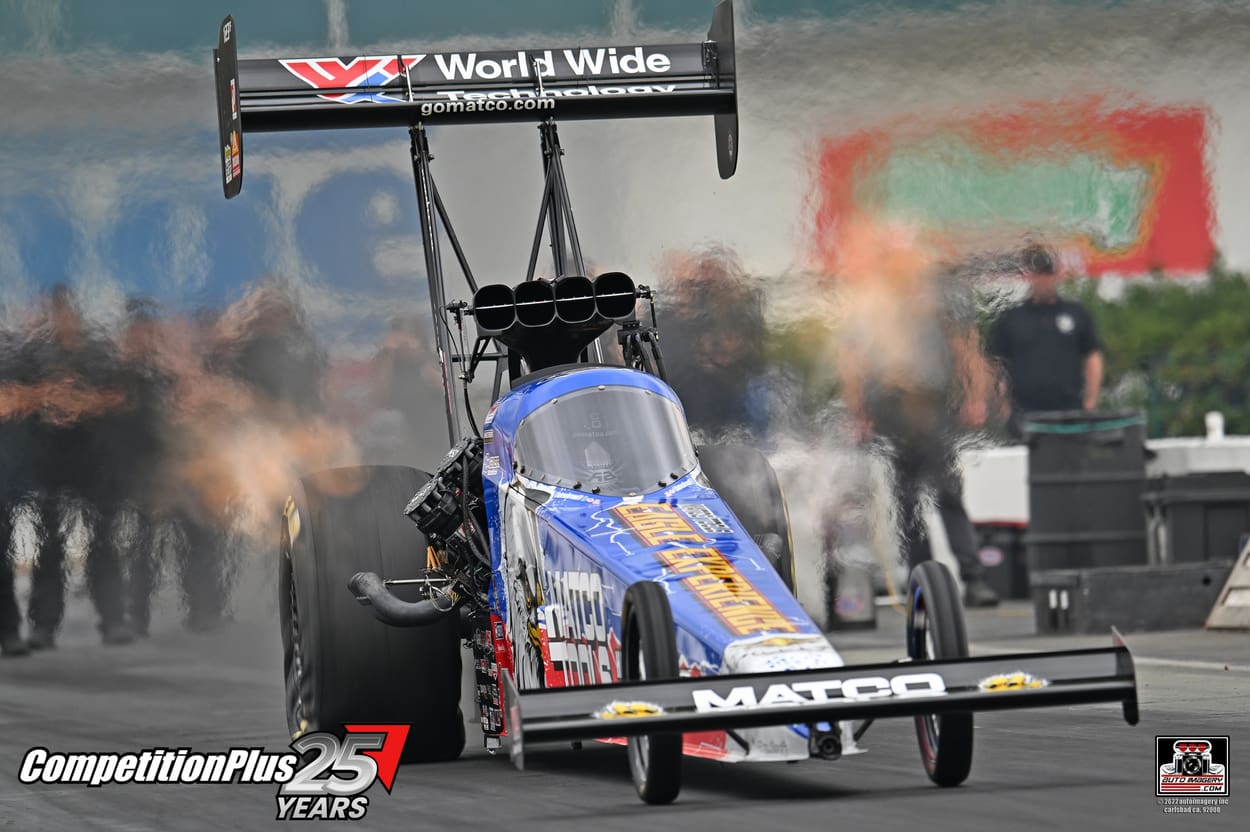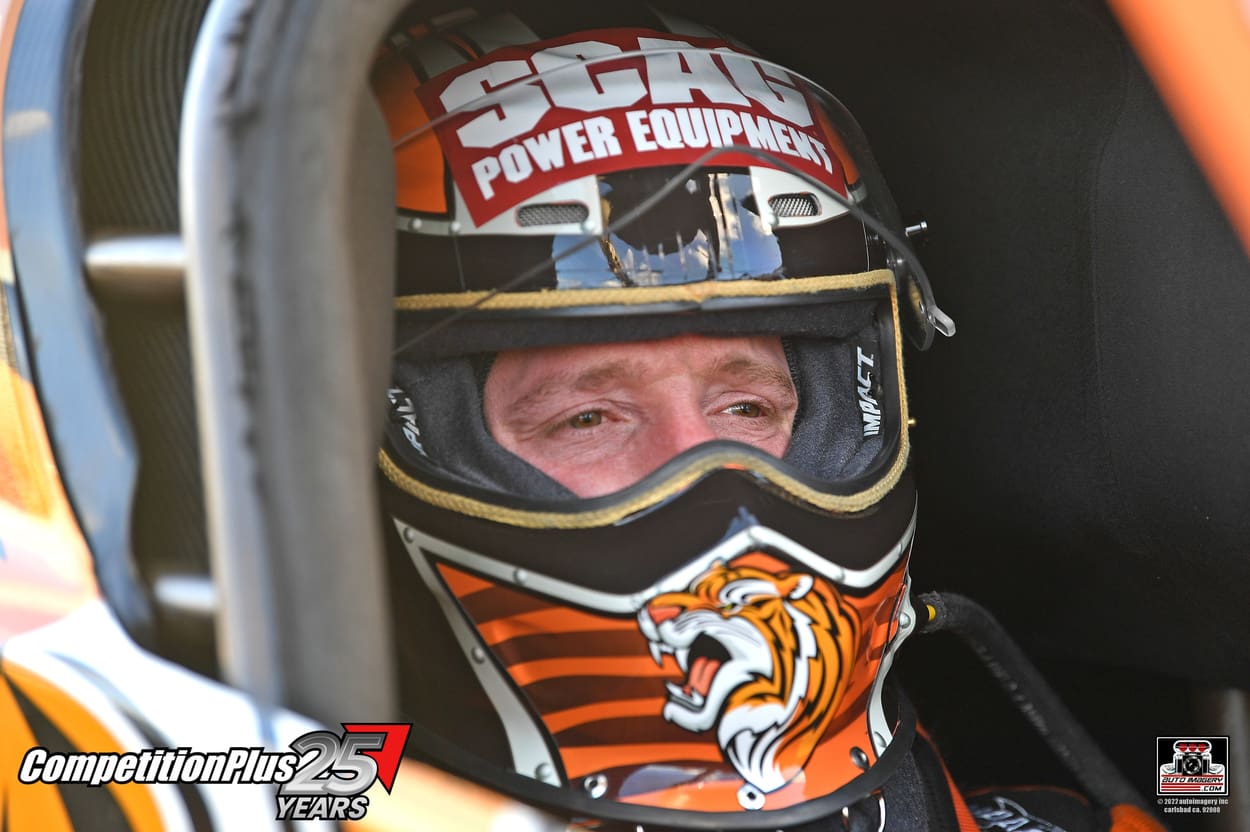

From the time Justin Ashley entered the Top Fuel ranks in 2019, the biggest lesson he learned was the reality that change is inevitable. Ashley, a 19-time national event winner in only 117 races, has seen that lesson reinforced this season through a significant turnover in personnel that has reshaped his team from the ground up.

Still, the driver who built a reputation on leaving the starting line first — quick enough to beat Nostradamus in a prediction contest — remains focused on the task at hand. For the first time in his career, Ashley finds himself outside the Top Fuel top ten in points, a reality that underscores both the volatility of the class and the magnitude of the reset his team has undertaken.

The numbers confirm what few expected — a driver synonymous with consistency is now chasing ground instead of defending it. It comes as a shock to many, and perhaps most telling, to Ashley himself.

“Wow. I didn’t even know that myself, to be honest with you,” Ashley said. “Yeah. I mean, look, we’d love to be in the top 10. Obviously that’s the expectation. The expectation is always to perform at a high level and win every race that we go to, but we also understand that this is a process.”

He didn’t deflect from the reality. He reframed it with the kind of measured perspective that has defined his rise in Top Fuel.

“This is the first time in a long time that we’ve really gone back and started building a new foundation and a new program from scratch,” Ashley added. “And when that happens, I think it’s always in the best interest to see the entirety of the process through. Because when you do and you follow a good process, generally it leads to a good outcome.”
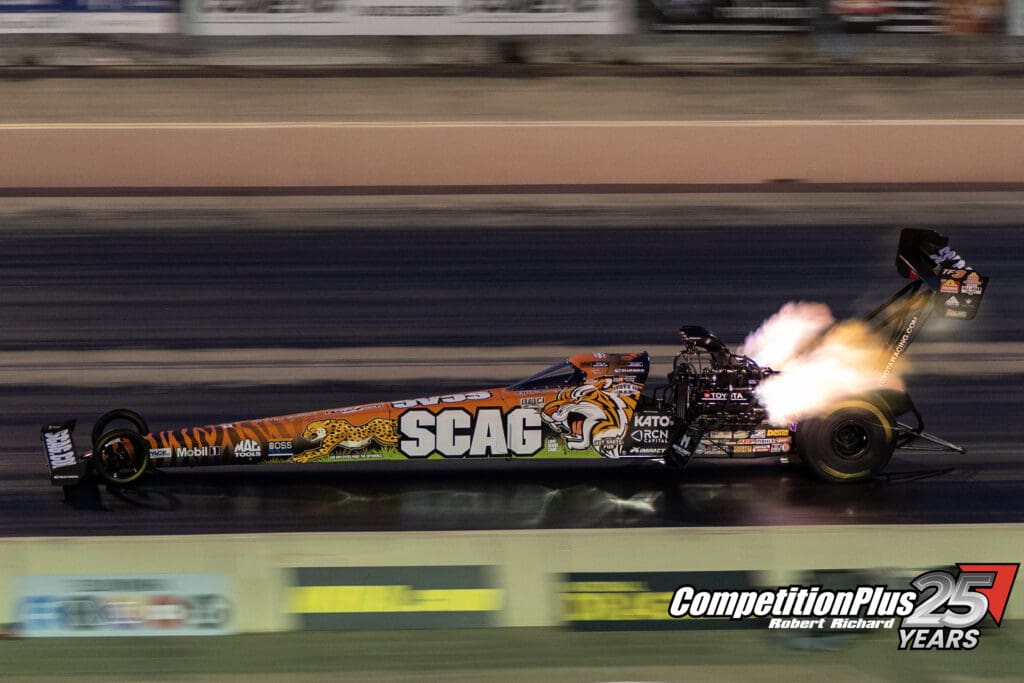

The NHRA’s Countdown to the Championship format has long provided a pathway for teams to recover from early inconsistency. Ashley has lived his entire career within that system, where momentum in the fall often outweighs the frustration of the spring.

That reality hasn’t been lost on him, and it has reshaped how his team approaches each race weekend. The approach is less about urgency and more about timing, less about panic and more about positioning.

“Yeah, I think so,” Ashley said. “It’s really about having a strategic approach because of the countdown format. Like you said, it’s about getting hot at the right time, but it’s also about looking at the big picture and balancing the big picture and your ability to perform at a high level during the countdown with your ability to win races and perform at a high level during the regular season.”

That balance is not theoretical, and it is not optional in a class where the margins are unforgiving. It is the difference between a team that peaks early and fades, and one that builds toward November.

“Everything we’re doing right now is dual focused,” Ashley explained. “It’s about winning the existing races that we’re attending, but ultimately about putting ourselves in the best position and having the best tuneup available when it’s time for the fall when we really need to run hard and compete for the championship.”

He made it clear the plan is not reactive. It is deliberate, structured, and rooted in patience.

“So we know exactly what we’re doing. We’re sticking to our plan. It’s just going to take some time to see that plan come to fruition.”

If there is one constant in Ashley’s program, it remains his ability on the starting line. Even as the faces around him changed, the man in the cockpit has continued to do what he always does.

In both of his first-round losses this season, Ashley left first. Not barely, either — he was ahead of his opponent by as much as .03 of a second, a meaningful edge in a class where races are won and lost by margins smaller than a blink.

That matters because it shifts the conversation. Ashley has given his team a chance; the timeslip says the losses started somewhere after the tree.

Some things never change, even in a season built on change. Death, taxes, and Justin Ashley leaving first off the starting line remain as reliable as anything in Top Fuel.

Ashley knows the number gets the headlines, but he doesn’t treat it like a solo act. In his view, a reaction time is only as consistent as the team that builds the car underneath it.

“It means the expectations are high,” Ashley said. “It means that I have to keep doing my job. It’s a package, right? It’s a combination of the tune up and the reaction time.”

In a category decided by thousandths of a second, the starting line is both a weapon and a responsibility. Ashley treats it as both, but he measures success by the full run, not just the first move.

“So yeah, it’s an individual statistic in some ways, but in a lot of other ways, it’s a team statistic as well,” he said. “So I certainly take pride in that. It’s certainly very humbling, but there are a lot of other really good leaders in the category.”

He knows the margin for error is effectively nonexistent, and that understanding shapes how he approaches every run. It also explains why his consistency has remained intact even as the program around him evolves.

“And quite frankly, I have no choice,” Ashley added. “If we want to compete at a high level, these races are decided by such small margins that even reaction times matter down to the thousand.”

The early losses this season have not come from hesitation. They have come despite precision, with Ashley delivering numbers that should win rounds.

“It’s right,” Ashley said. “But honestly, I always feel that pressure because no matter how good we’re running, I don’t really think about that because it’s out of my control.”

That mindset — control what you can, ignore what you cannot — has become a defining characteristic of Ashley’s approach. It is also the foundation that allows him to remain steady while everything around him shifts.

“I have a job to do, and that job, part of that job involves reaction time,” Ashley said. “And I’m a big believer in mastering your specific job. And if everybody’s able to master their specific job, generally good things happen.”

He refuses to let variables outside the cockpit dictate performance inside it. That separation is intentional, practiced, and non-negotiable.

“Part of my specific job is reaction time,” he continued. “So no matter how the car is running, I always approach it the same way, just the same way I approach it if we’re running first round or the fourth round, or we’re running a part-time car or a full-time car.”

That consistency is not accidental. It is built through repetition, reinforced through discipline, and measured in thousandths.

“None of the stuff that’s outside of my control should have an impact on the reaction time and how I approach each and every round,” Ashley said. “So regardless of how we’re running, that pressure is always there.”

The reality for Ashley is that this season is less about immediate validation and more about long-term positioning. The early standings may not reflect his career norms, but they do reflect a team committed to building something sustainable.

There is no panic in his approach, only perspective rooted in experience. He understands that in Top Fuel, progress often looks like struggle before it reveals itself as performance.

He has seen enough in 117 races to recognize that success in the category is rarely linear. It is constructed, tested, and sometimes rebuilt before it produces results that matter.

And while the standings may suggest unfamiliar territory, Ashley’s belief in the process has not wavered. He expects the payoff to come when the stakes are highest and the margins are tightest.

Because in a class defined by volatility, the drivers who endure are the ones who remain steady when everything else changes.

“Although we’re not in the top 10 now, obviously I have the utmost confidence and the expectation that we’ll be competing for championship at the end of the year.”

Share the Insights?

Click here to share the article.

ad space x ad space

ad space x ad space

Competition Plus Team

Since our inception, we have been passionately dedicated to delivering the most accurate, timely, and compelling content in the world of drag racing. Our readers depend on us for the latest news, in-depth features, expert analysis, and exclusive interviews that connect you to the sport’s pulse.

Sign up for our newsletters and email list.

This field is for validation purposes and should be left unchanged.
Name

CHANGE IS INEVITABLE: JUSTIN ASHLEY NAVIGATES RESET IN PURSUIT OF A TOP FUEL TITLE

From the time Justin Ashley entered the Top Fuel ranks in 2019, the biggest lesson he learned was the reality that change is inevitable. Ashley, a 19-time national event winner in only 117 races, has seen that lesson reinforced this season through a significant turnover in personnel that has reshaped his team from the ground up.

Still, the driver who built a reputation on leaving the starting line first — quick enough to beat Nostradamus in a prediction contest — remains focused on the task at hand. For the first time in his career, Ashley finds himself outside the Top Fuel top ten in points, a reality that underscores both the volatility of the class and the magnitude of the reset his team has undertaken.

The numbers confirm what few expected — a driver synonymous with consistency is now chasing ground instead of defending it. It comes as a shock to many, and perhaps most telling, to Ashley himself.

“Wow. I didn’t even know that myself, to be honest with you,” Ashley said. “Yeah. I mean, look, we’d love to be in the top 10. Obviously that’s the expectation. The expectation is always to perform at a high level and win every race that we go to, but we also understand that this is a process.”

He didn’t deflect from the reality. He reframed it with the kind of measured perspective that has defined his rise in Top Fuel.

“This is the first time in a long time that we’ve really gone back and started building a new foundation and a new program from scratch,” Ashley added. “And when that happens, I think it’s always in the best interest to see the entirety of the process through. Because when you do and you follow a good process, generally it leads to a good outcome.”
The NHRA’s Countdown to the Championship format has long provided a pathway for teams to recover from early inconsistency. Ashley has lived his entire career within that system, where momentum in the fall often outweighs the frustration of the spring.

That reality hasn’t been lost on him, and it has reshaped how his team approaches each race weekend. The approach is less about urgency and more about timing, less about panic and more about positioning.

“Yeah, I think so,” Ashley said. “It’s really about having a strategic approach because of the countdown format. Like you said, it’s about getting hot at the right time, but it’s also about looking at the big picture and balancing the big picture and your ability to perform at a high level during the countdown with your ability to win races and perform at a high level during the regular season.”

That balance is not theoretical, and it is not optional in a class where the margins are unforgiving. It is the difference between a team that peaks early and fades, and one that builds toward November.

“Everything we’re doing right now is dual focused,” Ashley explained. “It’s about winning the existing races that we’re attending, but ultimately about putting ourselves in the best position and having the best tuneup available when it’s time for the fall when we really need to run hard and compete for the championship.”

He made it clear the plan is not reactive. It is deliberate, structured, and rooted in patience.

“So we know exactly what we’re doing. We’re sticking to our plan. It’s just going to take some time to see that plan come to fruition.”
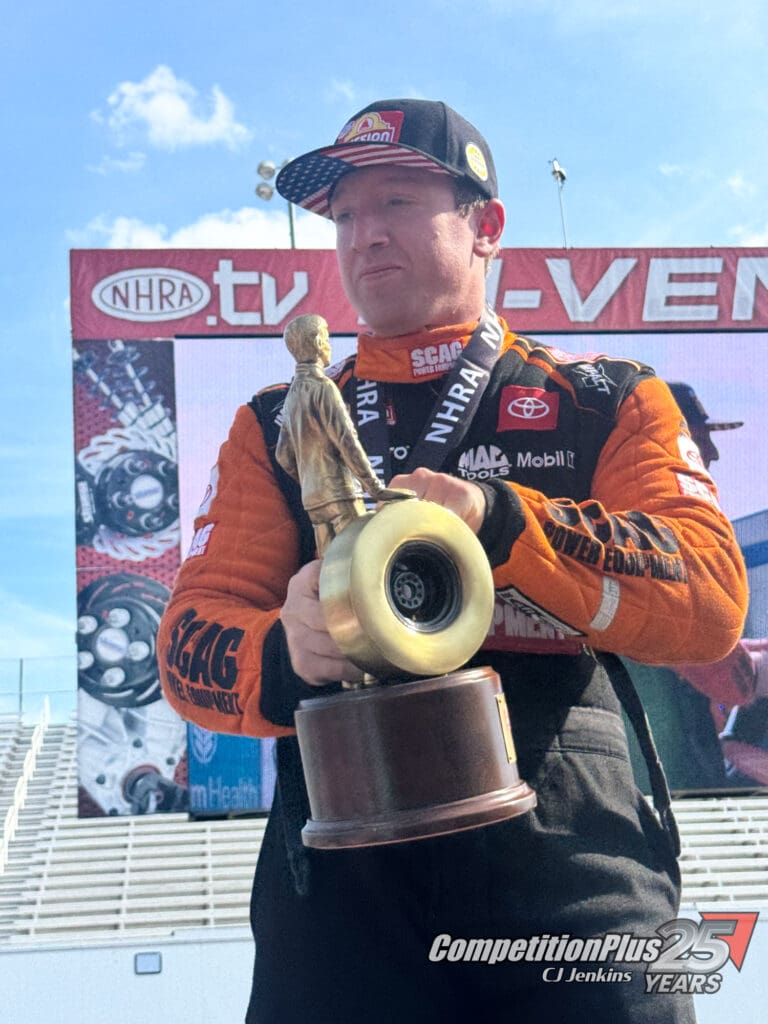
If there is one constant in Ashley’s program, it remains his ability on the starting line. Even as the faces around him changed, the man in the cockpit has continued to do what he always does.

In both of his first-round losses this season, Ashley left first. Not barely, either — he was ahead of his opponent by as much as .03 of a second, a meaningful edge in a class where races are won and lost by margins smaller than a blink.

That matters because it shifts the conversation. Ashley has given his team a chance; the timeslip says the losses started somewhere after the tree.

Some things never change, even in a season built on change. Death, taxes, and Justin Ashley leaving first off the starting line remain as reliable as anything in Top Fuel.

Ashley knows the number gets the headlines, but he doesn’t treat it like a solo act. In his view, a reaction time is only as consistent as the team that builds the car underneath it.

“It means the expectations are high,” Ashley said. “It means that I have to keep doing my job. It’s a package, right? It’s a combination of the tune up and the reaction time.”

In a category decided by thousandths of a second, the starting line is both a weapon and a responsibility. Ashley treats it as both, but he measures success by the full run, not just the first move.

“So yeah, it’s an individual statistic in some ways, but in a lot of other ways, it’s a team statistic as well,” he said. “So I certainly take pride in that. It’s certainly very humbling, but there are a lot of other really good leaders in the category.”

He knows the margin for error is effectively nonexistent, and that understanding shapes how he approaches every run. It also explains why his consistency has remained intact even as the program around him evolves.

“And quite frankly, I have no choice,” Ashley added. “If we want to compete at a high level, these races are decided by such small margins that even reaction times matter down to the thousand.”

The early losses this season have not come from hesitation. They have come despite precision, with Ashley delivering numbers that should win rounds.

“It’s right,” Ashley said. “But honestly, I always feel that pressure because no matter how good we’re running, I don’t really think about that because it’s out of my control.”
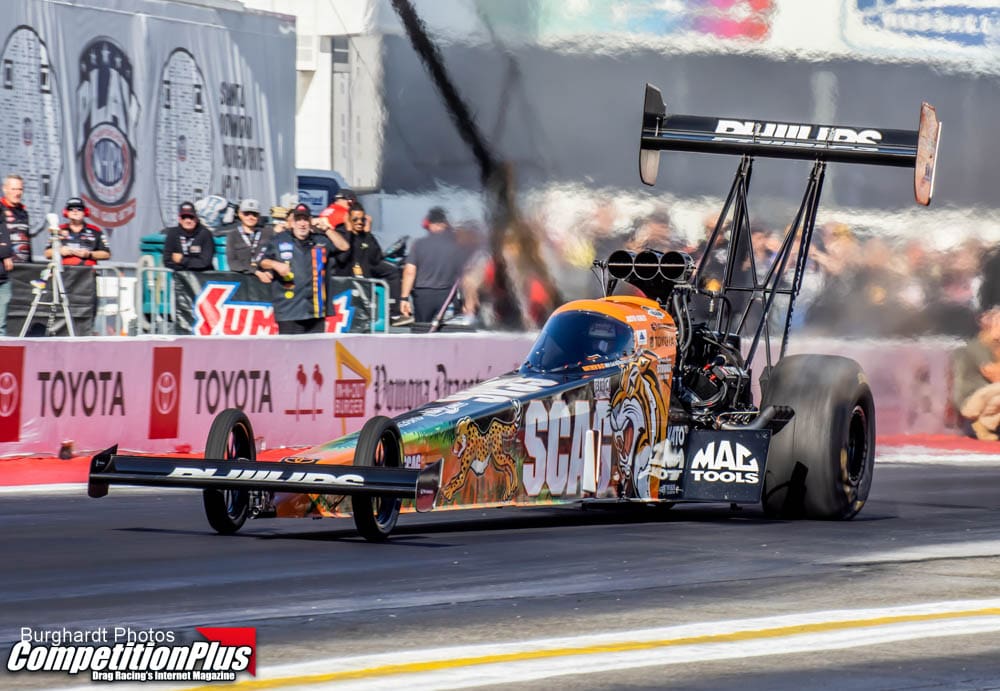
That mindset — control what you can, ignore what you cannot — has become a defining characteristic of Ashley’s approach. It is also the foundation that allows him to remain steady while everything around him shifts.

“I have a job to do, and that job, part of that job involves reaction time,” Ashley said. “And I’m a big believer in mastering your specific job. And if everybody’s able to master their specific job, generally good things happen.”

He refuses to let variables outside the cockpit dictate performance inside it. That separation is intentional, practiced, and non-negotiable.

“Part of my specific job is reaction time,” he continued. “So no matter how the car is running, I always approach it the same way, just the same way I approach it if we’re running first round or the fourth round, or we’re running a part-time car or a full-time car.”

That consistency is not accidental. It is built through repetition, reinforced through discipline, and measured in thousandths.

“None of the stuff that’s outside of my control should have an impact on the reaction time and how I approach each and every round,” Ashley said. “So regardless of how we’re running, that pressure is always there.”

The reality for Ashley is that this season is less about immediate validation and more about long-term positioning. The early standings may not reflect his career norms, but they do reflect a team committed to building something sustainable.

There is no panic in his approach, only perspective rooted in experience. He understands that in Top Fuel, progress often looks like struggle before it reveals itself as performance.

He has seen enough in 117 races to recognize that success in the category is rarely linear. It is constructed, tested, and sometimes rebuilt before it produces results that matter.

And while the standings may suggest unfamiliar territory, Ashley’s belief in the process has not wavered. He expects the payoff to come when the stakes are highest and the margins are tightest.

Because in a class defined by volatility, the drivers who endure are the ones who remain steady when everything else changes.

“Although we’re not in the top 10 now, obviously I have the utmost confidence and the expectation that we’ll be competing for championship at the end of the year.”


Picture of John Doe

John Doe

Lorem ipsum dolor sit amet consectetur adipiscing elit dolor

More Posts

Send Us A Message

Picture of Bobby Bennett
Bobby Bennett
Thank you for joining us on this journey. Your support and trust inspire us every day to deliver the best in drag racing journalism. We are excited about the future and look forward to continuing to serve you with the same dedication and passion that has defined CompetitionPlus.com from the very beginning.

Don’t miss these other exciting stories!

Explore more action packed posts on Competition Plus, where we dive into the latest in Drag Racing News. Discover a range of topics, from race coverage to in-depth interviews, to keep you informed and entertained.