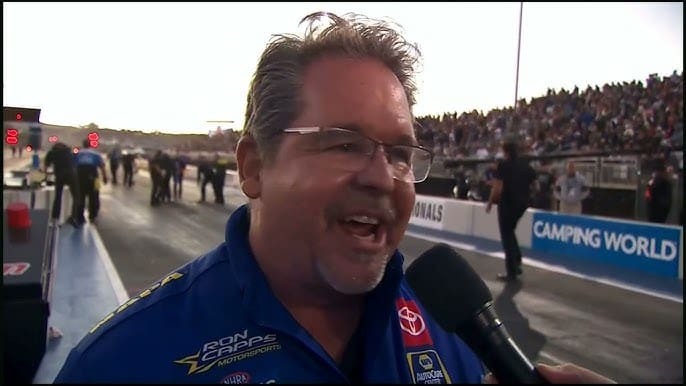
Ron Capps’ race day at the NHRA 4-Wide Carolina Nationals ended in a violent second-round engine explosion that destroyed the body of his Toyota GR Supra. For Dean “Guido” Antonelli, crew chief for Capps’ NAPA Auto Parts Toyota, the incident underscored the ongoing debate over NHRA’s controversial Funny Car tether system.


Antonelli explained that the blast was so extreme that the body itself disintegrated, even though the tethers held.


“So the explosion was so violent that it disintegrated the body, so the brackets all pulled through the body,” Antonelli said. “The lanyards were strong enough, but it just pulled right out of the body.”


Unlike other explosions where intact bodies have remained tethered and blocked driver visibility, Capps’ Supra separated into fragments that scattered behind the car. Antonelli said the biggest piece of debris was roughly six feet long and landed about 10 feet past the retaining wall, well clear of the grandstands.


The outcome was a reminder of why the tethering system was implemented in 2013 after Robert Hight’s body detached and flew beyond the racing surface at Charlotte. That incident led to NHRA mandating ballistic tethers and dual front latches to keep carbon-fiber shells attached to their chassis during catastrophic failures.


But the very strength of that design has become a point of contention. Critics argue the reinforced mounts and tethering often prevent energy from escaping during explosions, leaving the body to collapse or buckle over the driver. Antonelli acknowledged the dilemma.


“Most of these issues have all come with the dual front latch system,” he said. “It is so robust that it doesn’t let any of the explosion out. The body doesn’t lift an inch, and so it doesn’t let any energy out.”

Capps’ explosion in Charlotte provided an unusual outcome, as the body disintegrated rather than remaining whole and obscuring the cockpit. While the car was destroyed, the separation meant Capps was not blinded by fiberglass and carbon fiber.


Antonelli said his focus is now on finding solutions that relieve pressure without removing tethers entirely. He is studying systems that would allow a body to rise slightly during an explosion, venting energy before returning to place.


“It’ll have like a 24-inch lanyard,” Antonelli said. “So if it blows up, it’ll either come up, but it won’t let it get too high and it’ll let some of the energy out and then come back down.”


He noted that earlier single-pin latch systems allowed some flexibility, with most explosions causing bodies to lift just inches before settling back down. The current setup, while more secure, eliminates that release point, forcing teams to consider alternatives that balance safety for both fans and drivers.


Capps escaped unharmed from the Charlotte explosion, though his Supra was left in ruins. Antonelli summed up the challenge facing the sport: “There’s going to be bad ones, but mostly this will eliminate the body coming up and going back, and the drivers can’t drive, but it should let it not buckle the body.”

Share the Insights?

Click here to share the article.

ad space x ad space

ad space x ad space

Competition Plus Team

Since our inception, we have been passionately dedicated to delivering the most accurate, timely, and compelling content in the world of drag racing. Our readers depend on us for the latest news, in-depth features, expert analysis, and exclusive interviews that connect you to the sport’s pulse.


Sign up for our newsletters and email list.

This field is for validation purposes and should be left unchanged.
Name

CAPPS’ EXPLOSION AMPLIFIED FUNNY CAR TETHER DEBATE AT NHRA CAROLINA NATIONALS

Ron Capps’ race day at the NHRA 4-Wide Carolina Nationals ended in a violent second-round engine explosion that destroyed the body of his Toyota GR Supra. For Dean “Guido” Antonelli, crew chief for Capps’ NAPA Auto Parts Toyota, the incident underscored the ongoing debate over NHRA’s controversial Funny Car tether system.


Antonelli explained that the blast was so extreme that the body itself disintegrated, even though the tethers held.


“So the explosion was so violent that it disintegrated the body, so the brackets all pulled through the body,” Antonelli said. “The lanyards were strong enough, but it just pulled right out of the body.”


Unlike other explosions where intact bodies have remained tethered and blocked driver visibility, Capps’ Supra separated into fragments that scattered behind the car. Antonelli said the biggest piece of debris was roughly six feet long and landed about 10 feet past the retaining wall, well clear of the grandstands.


The outcome was a reminder of why the tethering system was implemented in 2013 after Robert Hight’s body detached and flew beyond the racing surface at Charlotte. That incident led to NHRA mandating ballistic tethers and dual front latches to keep carbon-fiber shells attached to their chassis during catastrophic failures.
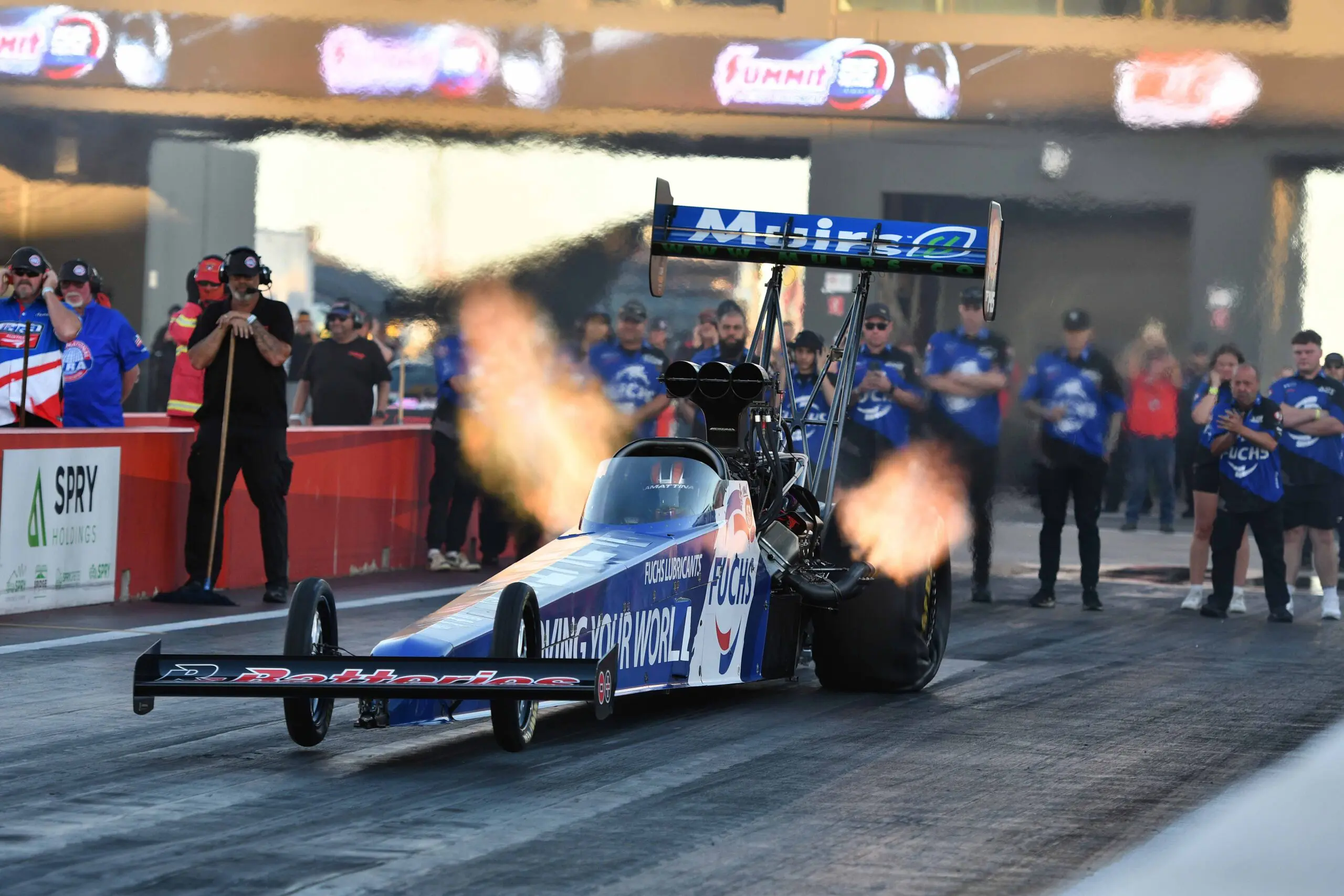

But the very strength of that design has become a point of contention. Critics argue the reinforced mounts and tethering often prevent energy from escaping during explosions, leaving the body to collapse or buckle over the driver. Antonelli acknowledged the dilemma.


“Most of these issues have all come with the dual front latch system,” he said. “It is so robust that it doesn’t let any of the explosion out. The body doesn’t lift an inch, and so it doesn’t let any energy out.”

Capps’ explosion in Charlotte provided an unusual outcome, as the body disintegrated rather than remaining whole and obscuring the cockpit. While the car was destroyed, the separation meant Capps was not blinded by fiberglass and carbon fiber.


Antonelli said his focus is now on finding solutions that relieve pressure without removing tethers entirely. He is studying systems that would allow a body to rise slightly during an explosion, venting energy before returning to place.


“It’ll have like a 24-inch lanyard,” Antonelli said. “So if it blows up, it’ll either come up, but it won’t let it get too high and it’ll let some of the energy out and then come back down.”


He noted that earlier single-pin latch systems allowed some flexibility, with most explosions causing bodies to lift just inches before settling back down. The current setup, while more secure, eliminates that release point, forcing teams to consider alternatives that balance safety for both fans and drivers.


Capps escaped unharmed from the Charlotte explosion, though his Supra was left in ruins. Antonelli summed up the challenge facing the sport: “There’s going to be bad ones, but mostly this will eliminate the body coming up and going back, and the drivers can’t drive, but it should let it not buckle the body.”

Picture of John Doe

John Doe

Lorem ipsum dolor sit amet consectetur adipiscing elit dolor

More Posts

Send Us A Message

Picture of Bobby Bennett
Bobby Bennett
Thank you for joining us on this journey. Your support and trust inspire us every day to deliver the best in drag racing journalism. We are excited about the future and look forward to continuing to serve you with the same dedication and passion that has defined CompetitionPlus.com from the very beginning.

Don’t miss these other exciting stories!

Explore more action packed posts on Competition Plus, where we dive into the latest in Drag Racing News. Discover a range of topics, from race coverage to in-depth interviews, to keep you informed and entertained.