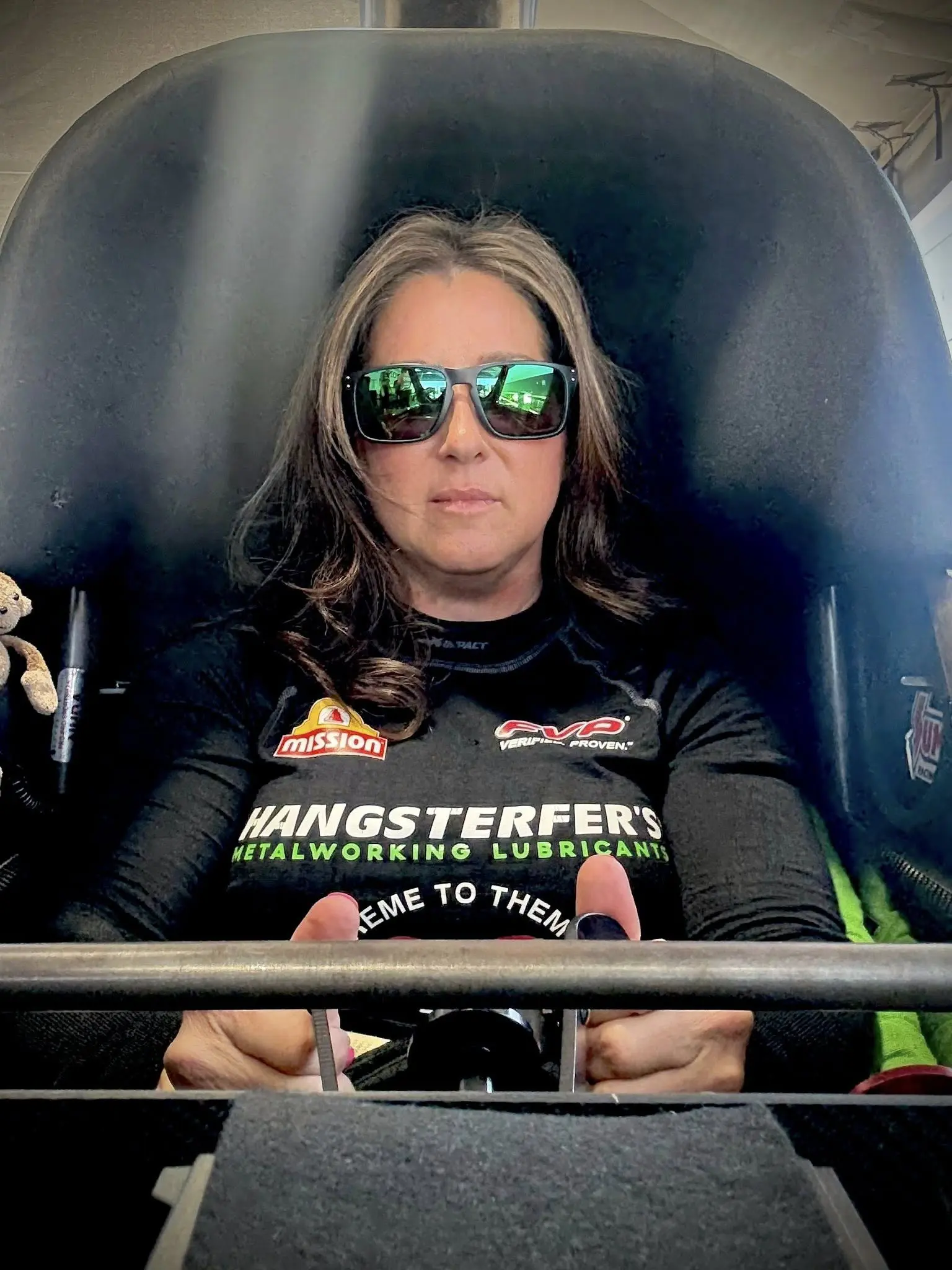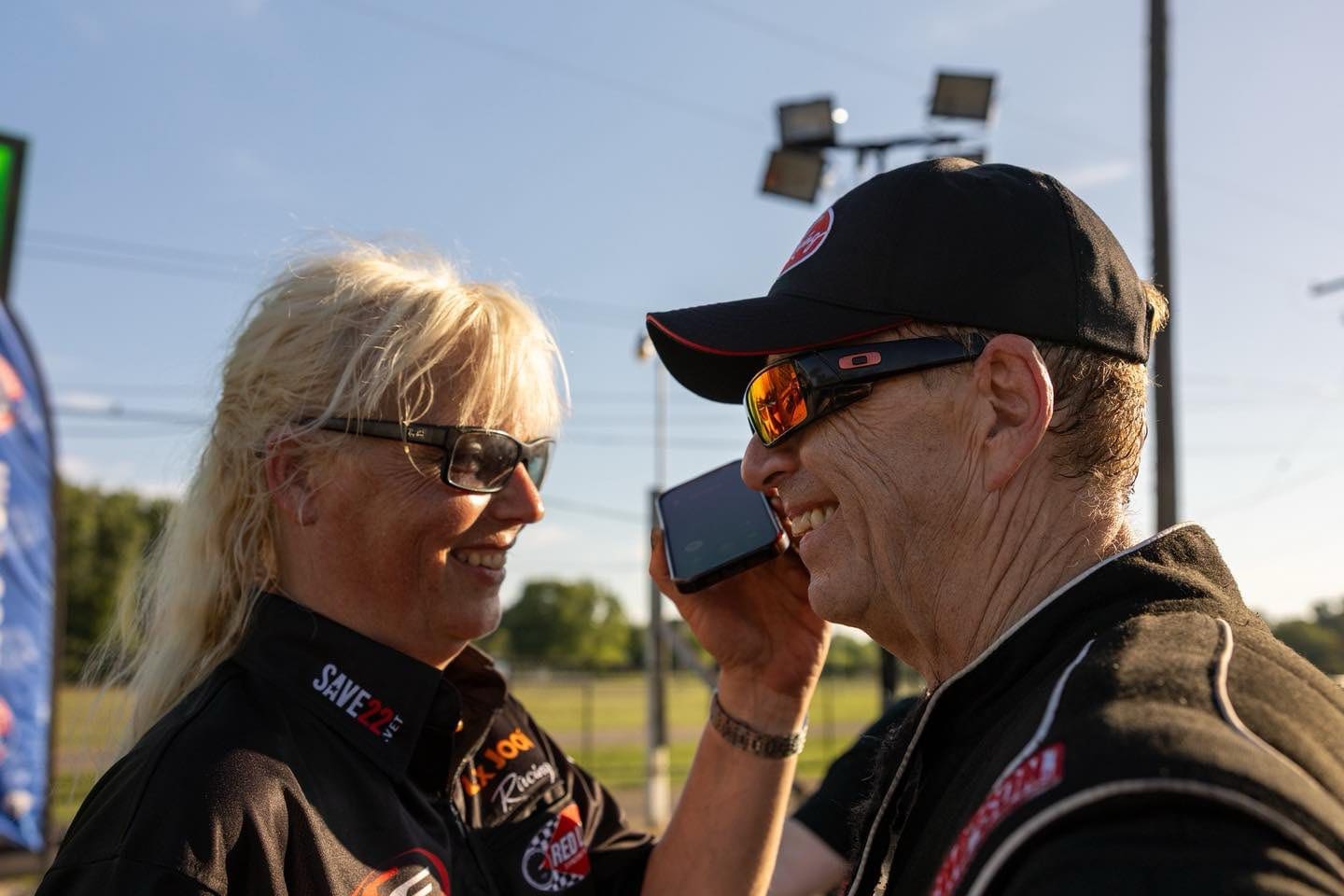

Gerda Joon has never asked to be front and center, and she has never needed to be. In a sport that celebrates the driver in the seat, she has built her value in the space behind it, where races are shaped long before the car ever fires.
Standing in her husband’s shadow has never been a problem for her. Instead, it has allowed Gerda to become a vital part of Lex Joon Racing’s Never Quit approach, a philosophy built on preparation, realism, and refusing to let circumstances dictate identity.
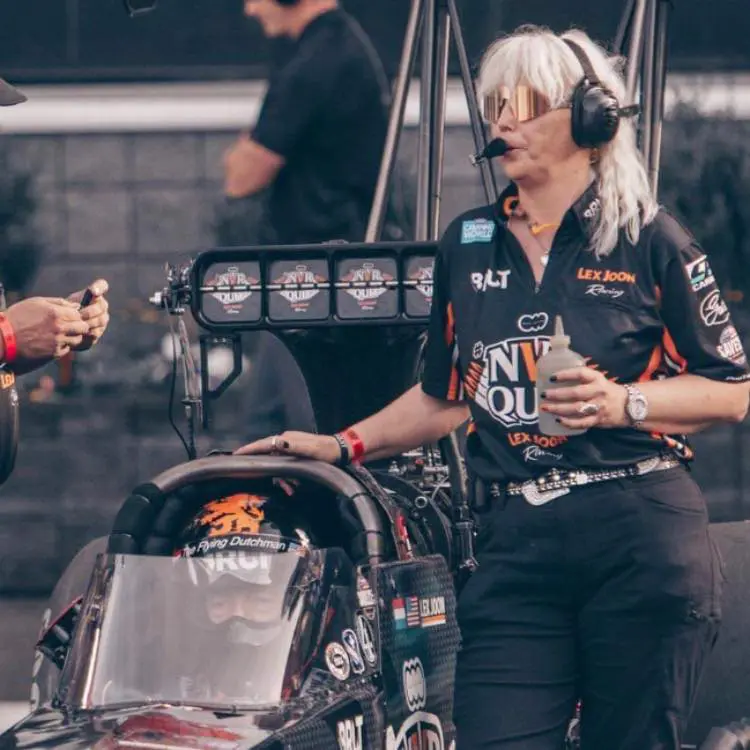
She is Lex Joon’s wife, but that is the simplest description possible. Inside the family-run Top Fuel operation, Gerda is the crew chief, the numbers mind, and the one who keeps emotion from outrunning reason.
Her quick wit makes her popular in the pits. Her discipline keeps the team pointed forward when things get heavy.
“I’m a horse girl,” Gerda said. “I had issues with one horsepower. I do not need that many horsepower under my right foot.”
That line draws laughter because it also draws a line. Gerda has never wanted the driver’s seat; she has wanted responsibility.
When Lex wins, Gerda wins. When Lex struggles, she owns that, too.
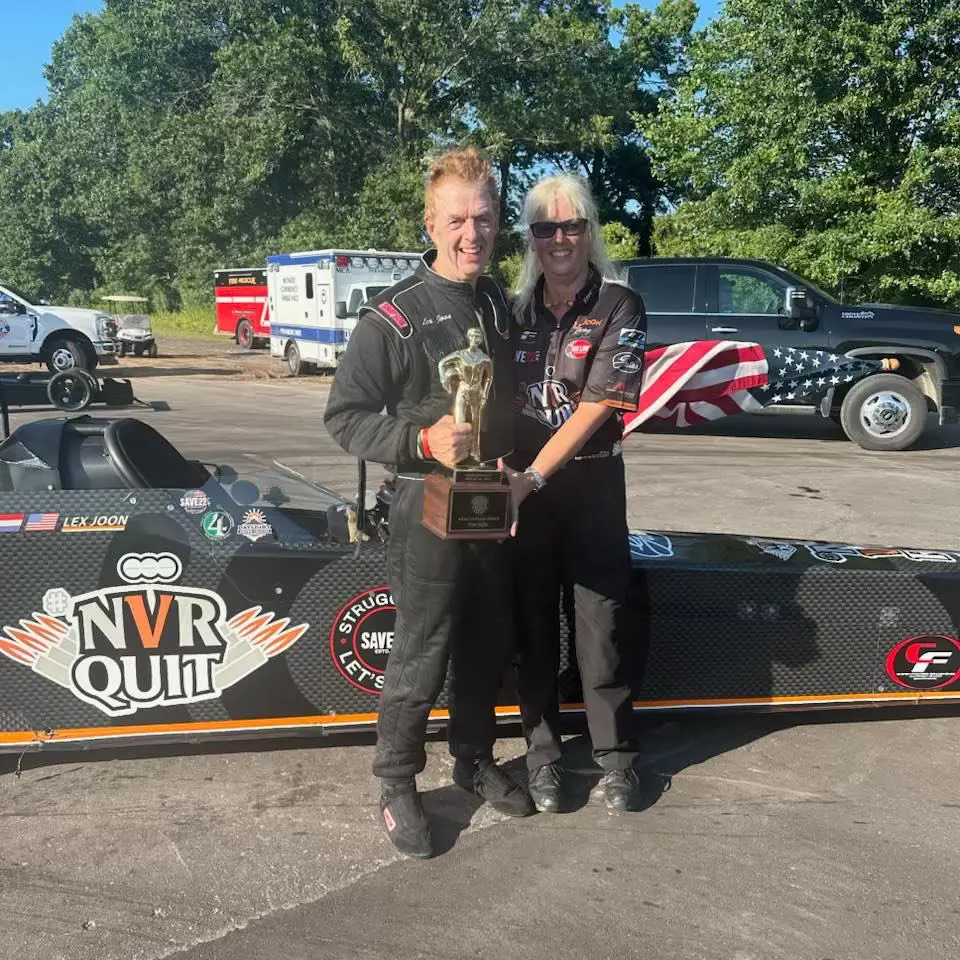
This season delivered something rare in drag racing: alignment. Lex Joon Racing captured its first IHRA national event victory, and within months, Gerda and Lex officially became United States citizens.
“To be honest, the world Gerda and I had in mind when we moved to the US basically came together this year by winning our first race and becoming US citizens,” Lex Joon said. “That’s really what it’s all about for us.”


Gerda’s perspective on the milestone is less about celebration and more about meaning. It reflects someone who understands how much work lives behind moments that look simple from the outside.
“When I was little, I loved the Olympics,” Gerda said. “The United States of America is always a country that performs really good at the Olympics because they are so resilient and they’ve got a goal.”
That resilience is what pulled the Joons across the Atlantic. After years of European success, America represented the next test.
“This is where you want to be,” Gerda said. “We’ve been racing in Europe so long, won everything there is to win.”
Her path into racing did not begin with speed. It began with responsibility.
“Selling tickets at the gate at a local racetrack,” she said.
The racetrack was not even permanent. Gerda said it was a private airfield in Drachten, Netherlands, rented a few times a year for drag races.
“It used to be a private airfield,” she said. “And the town is called Drachten.”
Drag racing was not part of her upbringing. She said the noise she heard in the summer never hinted at a future in nitro.
“I’d never heard of drag racing at all,” Gerda said. “I had no idea what was going on over there.”

Her entry into the sport came through organization, not speed. The sanctioning body at the time noticed her aptitude for paperwork and money and asked her to take on the role of racing secretary.
“They thought that I was pretty good with paperwork and money,” Gerda said. “So they asked if I wanted to do the racing secretary.”
That meant invitations, credentials, entry fees, and accountability. It was the kind of job that teaches how racing actually functions.
“Make sure everybody pays their entry fee and all that stuff,” she said.
That role led to an invitation to the Hockenheim race, where she met Lex Joon. What followed was not a fairy tale but a partnership built on work.
She never wanted to drive, and she has never pretended otherwise. The humor in her answer is also a boundary she has always respected.
“No, still don’t,” Gerda said. “I do not need that many horsepower under my right foot.”
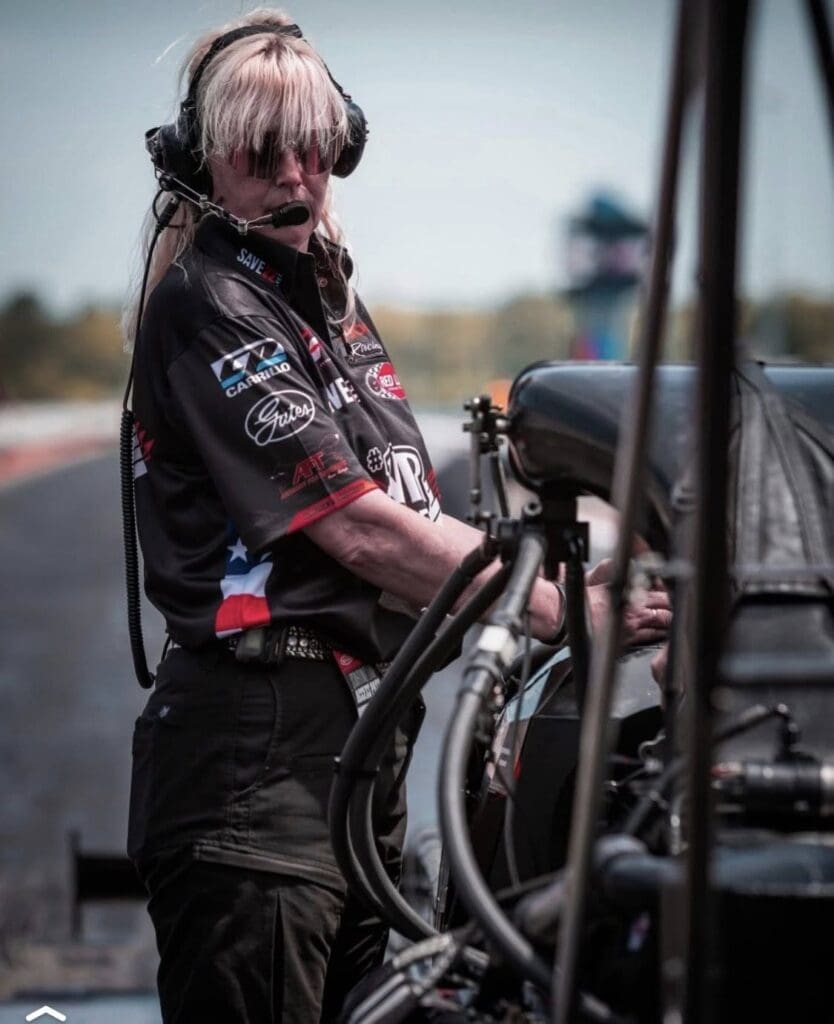
Her title as crew chief is not honorary. Gerda’s responsibilities extend from engine service to the starting line and into the data-driven decisions that define a Top Fuel run.
“I would help with the rods and pistons during the service,” she said. “I would back them up on the starting line and put them in the lights.”
Her evolution into the team’s decision-maker came naturally. Lance Larson encouraged her to take on the role because she was always present and because Lex needed someone he could trust.
“He thought it was a good idea that I would start doing what I’m doing now,” Gerda said. “I was always there.”

Gerda defines herself by numbers. She said she makes the calls that shape the car’s identity before it ever leaves the line.
“I make the head gasket calls, the blower overdrive calls, what kind of compression we’re running,” she said. “I look at the weather and figure out what it’s going to be for the next run.”
That is what “numbers cruncher” means in Top Fuel. Every run is a calculated risk, and Gerda is the one tasked with narrowing the unknowns.
“I do all the number things,” she said. “Lex does the mechanical part.”
Asked when the data screens began to feel familiar, Gerda laughed. The answer was not confidence, but curiosity.
“I don’t even know if it looks normal now,” she said. “I keep digging into stuff.”
She credits mentorship for accelerating her learning curve. Rob Flynn, she said, sharpened her discipline by demanding answers, not impressions.
“I always felt like it was a test,” Gerda said. “What were your numbers?”
Her comfort zone is spreadsheets, not guesswork. At the track, she said she operates with multiple Excel files open at once.
“I love numbers. I love Excel sheets,” she said. “I have about six Excel sheets open.”
Her guiding principle comes from a Dutch saying. Measurement, she believes, is the only path to understanding.
“Measuring is knowing,” Gerda said.

Despite her preparation, intimidation never fully disappears. Gerda said standing alongside crew chiefs she once watched online still feels surreal.
“I’m still intimidated by them,” she said. “It’s weird to be in that movie now.”
Sometimes the moment catches her off guard. She said it still feels dreamlike to share space with people she once idolized.
“Can you pinch me?” she said. “Because it feels like I’m dreaming.”
When asked whether she ever imagines fans pointing her out in the pits, her answer was immediate.
“I don’t think that will ever happen,” she said.
She explained it with a line that has become part of her identity. It was said plainly, without apology.
“As Lance Larson says, ‘My plumbing is different,’” she said.
That realism defines her approach. Gerda understands how she is perceived, and she understands that perception does not determine competence.
Her adaptability began long before tuning software. Gerda said she speaks four languages and learned racing English at the track.
“I did not learn in high school what a piston was in English,” she said. “I learned that at the racetrack.”
She now balances racing with a full-time job at O’Reilly Auto Parts. Gerda describes it simply as having two full-time lives.
“One is at O’Reilly,” she said. “The other one is racing.”
America, for Gerda, represents opportunity rather than image. She said parents often ask how their daughters can do what she does.
“You cannot let anybody tell you, you cannot do it,” she said.
She does not sugarcoat the reality. Gerda said women still have to work harder to earn the same respect.
“You’ve got to work twice as hard,” she said. “But my goal is always to prove everybody wrong.”
She hears the critics. She hears the questions about why she shows up when qualifying is uncertain.
“People literally have asked me, ‘Why do you even show up?’” she said.
Her answer is simple. Showing up is the only way progress happens.
That philosophy is the spine of Never Quit. It is not optimism; it is discipline.
Lex Joon said Gerda’s resolve shaped every major decision they made. He said her words framed the risk of regret better than any calculation.
“She told me, ‘If you don’t do it, you’ll always wonder what could have been,’” he said.
That sentence built a life, a team, and a citizenship. It also built a win that arrived when persistence finally met opportunity.
Gerda Joon remains comfortable in the background. She does not chase recognition, only results.
And in a sport that eats the unprepared, that may be the most powerful position of all.