






Paul Lee has never drawn a sharp line between racing and business, largely because he does not believe one exists. Whether the setting is a boardroom, a manufacturing facility, or the starting line of a nitro Funny Car, Lee views success through the same lens: preparation, people, and performance.
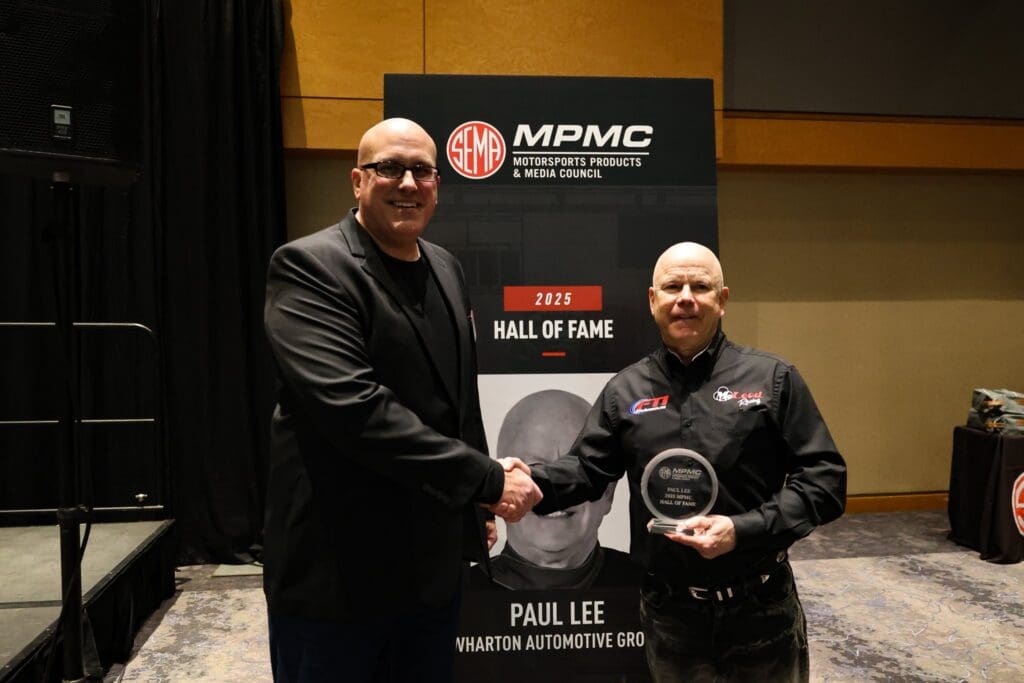
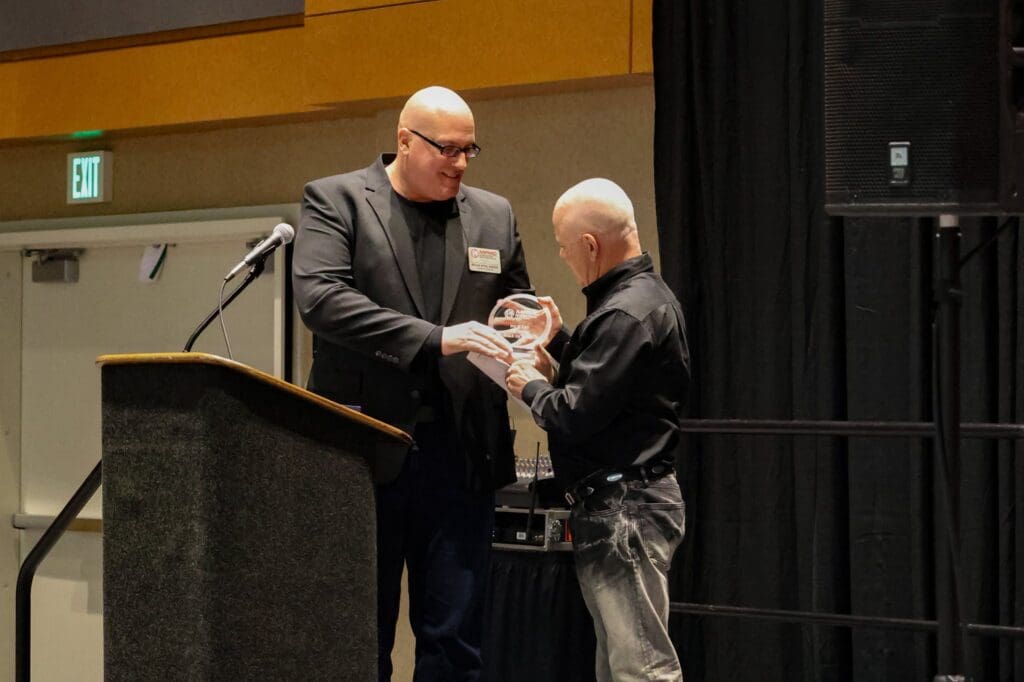
That philosophy, refined over decades and applied quietly across multiple companies, was formally recognized during the 2025 PRI Show when Lee was inducted into the SEMA Motorsport’s Products & Media Council Hall of Fame. The honor reflected not a single moment, but a sustained approach to leadership inside the automotive aftermarket.
Lee is the president of Wharton Automotive Group, a performance-driven organization that owns McLeod Racing, Silver Sport Transmissions, FTI Performance, Competition Clutch, and Independence Driveline. Together, those brands represent one of the most influential drivetrain portfolios in the industry.
The Hall of Fame recognition acknowledged Lee’s ability to preserve the heritage of established performance brands while modernizing operations and expanding their reach. Industry peers have credited him with balancing innovation and restraint in a segment where both are often difficult to reconcile.
The SEMA Motorsports Products & Media Council honors individuals whose careers have materially advanced the automotive aftermarket. Lee’s induction placed him among leaders whose impact extends beyond their own balance sheets.
For Lee, the honor carried a different weight than race wins or trophies. Championships are measured in elapsed time, while Hall of Fame recognition reflects years of decisions made without applause.
“Being an entrepreneur in the automotive aftermarket has been really the thrill of my life, just as much as racing or any other sports that I’ve participated in,” Lee said. “It’s competition. I look at it—our business is competition as well.”
Lee’s path through the aftermarket has been shaped by an insistence that racing and business operate under the same rules. At the professional level, he said, neither can survive on instinct alone.
“Racing at the professional level in the nitro categories, especially if you’re a full-time team, you must run it as a business,” Lee said.
Lee currently competes as a team owner and driver in NHRA Nitro Funny Car. That role, he said, reinforces the discipline required to manage companies that serve both street and racing customers.
“And that’s what it is,” Lee said of professional racing. “It’s another business.”
He said the same principles guide every operation under the Wharton Automotive Group umbrella. Success begins with people, followed by trust.
“It’s just like any other business; you get the best people that you can get and afford, and you let them do their jobs,” Lee said.
Lee said he avoids micromanagement across all his ventures. He believes clear expectations and accountability produce better outcomes than constant oversight.
“I’m not a micromanager either on the race team or in my businesses,” he said. “So my philosophy has always been hire the right people, let them do their jobs.”
That philosophy, he added, carries a clear boundary. “And if they’re not doing their jobs, then they’re not the right person,” Lee said.
The approach has produced consistency across organizations with different histories and markets.


Lee traces that mindset back to fundamentals learned long before his involvement in motorsports ownership. He said early business education shaped how he evaluates teams, processes, and results.
“I think it is,” Lee said when asked if that approach represents a broader key to success. “That’s always been my philosophy.”
He compares business organizations to athletic teams, where defined roles determine outcomes. “It’s no different than a football team or any other organization, your business and your race team,” Lee said.
Lee said the comparison is more than metaphorical. He believes preparation and execution determine results regardless of industry.
“I mean, it’s a business, and it’s always worked,” he said. “That’s worked for me.”
Rather than chasing trends, Lee said he applies the same principles repeatedly. “So I learned business skills a long time ago in business school, and I just apply them to everything I’m doing, and it seems to work,” he said.
That repetition has allowed Wharton Automotive Group to grow methodically. Each acquisition has been integrated with an emphasis on stability rather than disruption.
The Hall of Fame induction, Lee said, arrived without expectation. Recognition, in his view, is a byproduct rather than an objective.
“You just strive for success,” Lee said. “You keep your head down, you work hard.”

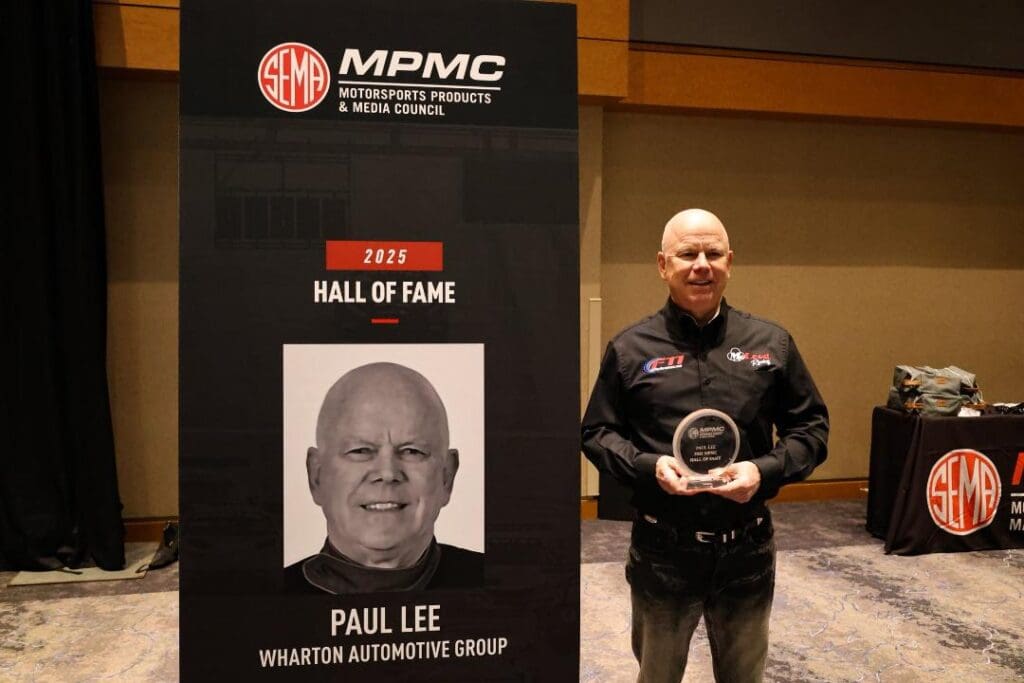
Lee said industry honors differ from race trophies because they reflect collective effort over time. While drivers stand alone in victory lanes, business success is distributed across teams.
“And if things like being honored like that, that’s just icing on the cake,” Lee said. “I never expected anything like those honors.”
He emphasized that the induction recognized far more than his own decisions. “It’s not just me,” Lee said.
“But it’s a great team that we have at the Wharton Automotive Group,” he added. “And that’s at every business that we have.”
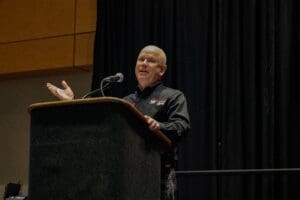
The induction ceremony took place during the PRI Show, one of the industry’s primary annual gatherings of racing professionals, manufacturers, and suppliers. The setting placed the recognition in front of peers who understand the demands of the aftermarket.
SEMA Motorsports Products & Media Council Chair Brian Bohlander cited Lee’s breadth of involvement when announcing the honor. He said Lee’s influence reaches beyond individual brands.
“Paul Lee’s influence extends far beyond individual brands,” Bohlander said. “His vision, leadership, and hands-on involvement in both manufacturing and motorsports have helped elevate the entire aftermarket industry.”
Lee’s relationship with the Motorsports Products & Media Council extends beyond the Hall of Fame. He has been a longtime participant in its Media Trade Conference, a focused business-to-business event designed to connect manufacturers with media professionals.
The conference, often described as a series of scheduled one-on-one meetings, operates far differently than large public trade shows. For Lee, its value became apparent early.

“When I first bought McLeod many years ago and moved to California, I didn’t even know what MPMC was,” Lee said. “I knew of the theme of the show, but I wasn’t familiar with MPMC.”
Lee said his introduction to the conference came through drag racing legend Tom McEwen, widely known as “the Mongoose.” McEwen explained why attendance mattered.
“But Mongoose quickly explained to me that as a company, we needed to be there,” Lee said. “And he told me what it was all about.”
The logic resonated immediately. “And I said, ‘Wow, that’s like a no-brainer,’” Lee said.
At the time, McLeod Racing had not been a regular participant. Lee said that changed quickly after his first experience.
“Our company before I owned it didn’t attend the MPMC,” Lee said. “So I contribute being a member of that and attending that show every year.”
Lee credited McEwen’s guidance with influencing the growth trajectory of his companies. “Thanks to the Mongoose’s advice, that’s helped in our growth of our companies for sure,” he said.
Over time, the conference became a fixture on Lee’s calendar. He said it evolved from a business obligation into a tradition rooted in relationships including traditional bonding meals.
Lee said those meals continue to carry symbolic meaning. “It is our picture of Tom ‘the Mongoose’ McEwen that a good friend of mine made years ago,” he said.
Lee explained that McEwen was a central figure in those gatherings. “We had lunches every day with the Mongoose,” he said.
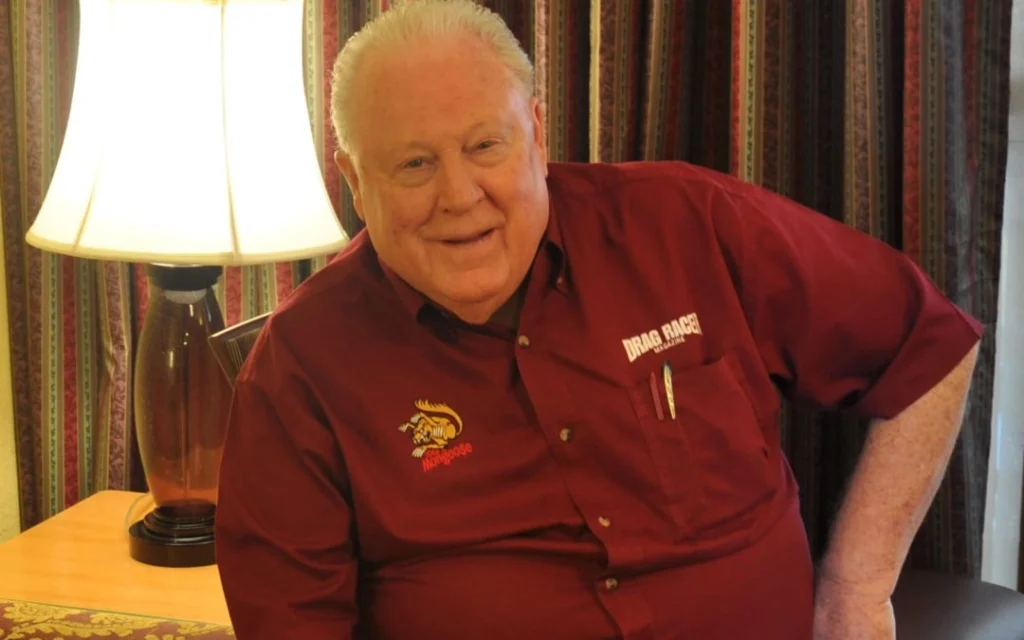
After McEwen’s death, Lee said the ritual remained unchanged. “So now that Mongoose is gone, we still feel his presence there,” he said.
Lee said the photo is placed at the head of the table during each meal. “We put his picture at the end of the table, and we still have our lunches,” he said.
He credited McEwen with persuading him to attend the conference initially. “He was really the one behind me of even attending the show in the first place,” Lee said.
Lee said the value of the event became clear after the first year. “After I attended the first one, it was like, this is a must show,” he said.
He ranked its importance alongside the industry’s largest events. “Just as important, if not more so, than the SEMA show itself,” Lee said.
The Hall of Fame induction brought those memories into sharper focus. When asked how McEwen might have reacted, Lee did not hesitate.
“Boy, I wish he was here,” Lee said.
He said McEwen would have shared the pride. “Oh yeah, he would be for sure,” Lee said.
“He’d be proud of us, all of us,” Lee added.
Lee said the recognition ultimately reflects a lifetime of competition, measured not only in elapsed time but in decisions that shaped people and companies.
“I am truly honored to be inducted into the MPMC Hall of Fame,” Lee said. “This recognition reflects the hard work of the teams behind each of our brands, our partners throughout the industry, and a lifelong passion for performance and racing.”












BOBBY BENNETT: SOCIAL MEDIA SAVED DRAG RACING — AND NOW IT’S SLOWLY STRANGLING IT