




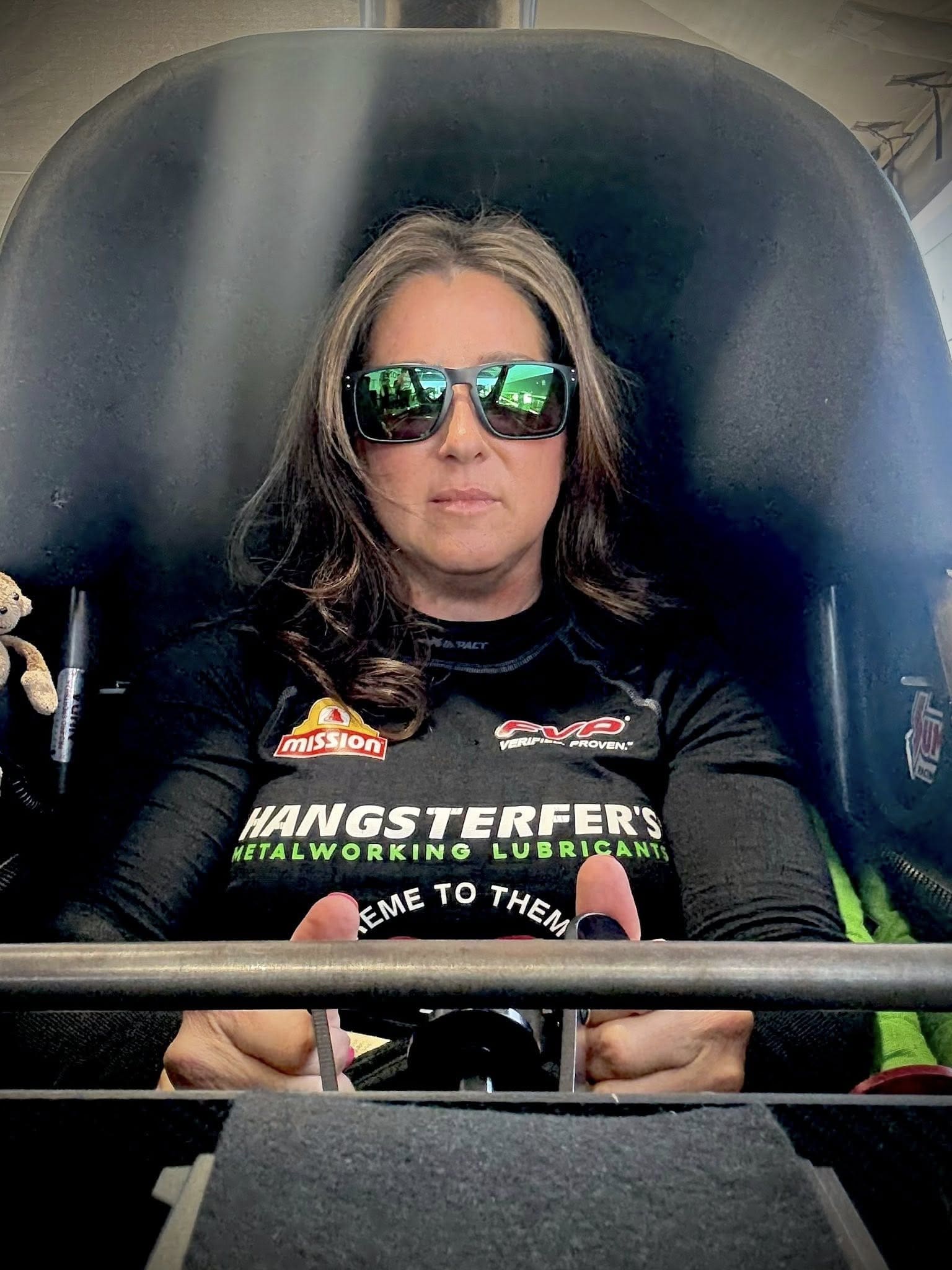

Photos courtesy of Logan Sampey
Angelle Sampey had waited long enough to know the moment would never feel routine, not even with three world championships on her résumé. When she finally made her first pass in a Top Fuel dragster after the Las Vegas race, she carried a wish she couldn’t fulfill: her father had asked to see her drive one before he died, and he missed it by a week.
“It was supposed to happen a few months ago,” Sampey said. “We had actually had a test session planned for Monday after Ohio. I think it was Ohio, I think. And that got rained out all day long.”
For a month, she said, she cycled through “every emotion you could imagine with just straight up fear to being nervous and anxious to, okay, I think I can do this.” Then the weather ended it early. “I think it was either Saturday night, I think it might have even Saturday night they had already called it because of the weather forecast being so bad.”
Sampey is a three-time NHRA Pro Stock Motorcycle champion, winning titles in 2000, 2001 and 2002, and she remains one of the category’s defining drivers with 46 national-event victories. But she said that résumé didn’t quiet the voice that shows up when something new carries real consequences.
By the time the Vegas plan surfaced, she tried not to chase it. “I think only like a week before Vegas, Brian [Corradi] and Antron [Brown] had mentioned possibly staying after Vegas and testing, but I didn’t know for sure,” she said. “So I just wasn’t going to get my hopes up high.”
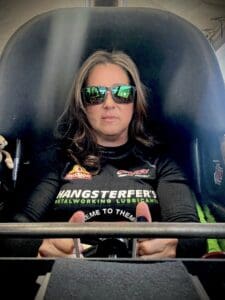
The Monday test began like a handoff between two careers: her present and her possible future. “I got to drive my car twice. Monday morning, Antron drove the Top Fuel car twice,” she said, explaining the sequence before her seat was moved into Antron Brown’s dragster.
Then she saw the moment that reminded her what Top Fuel can take. “In the meantime, I saw that car, the guy, I don’t know his name, but I saw the crash happen,” Sampey said, referring to the incident involving Dave Davies, who was like her, making a licensing run. “And that kind of set me back a little bit mentally.”
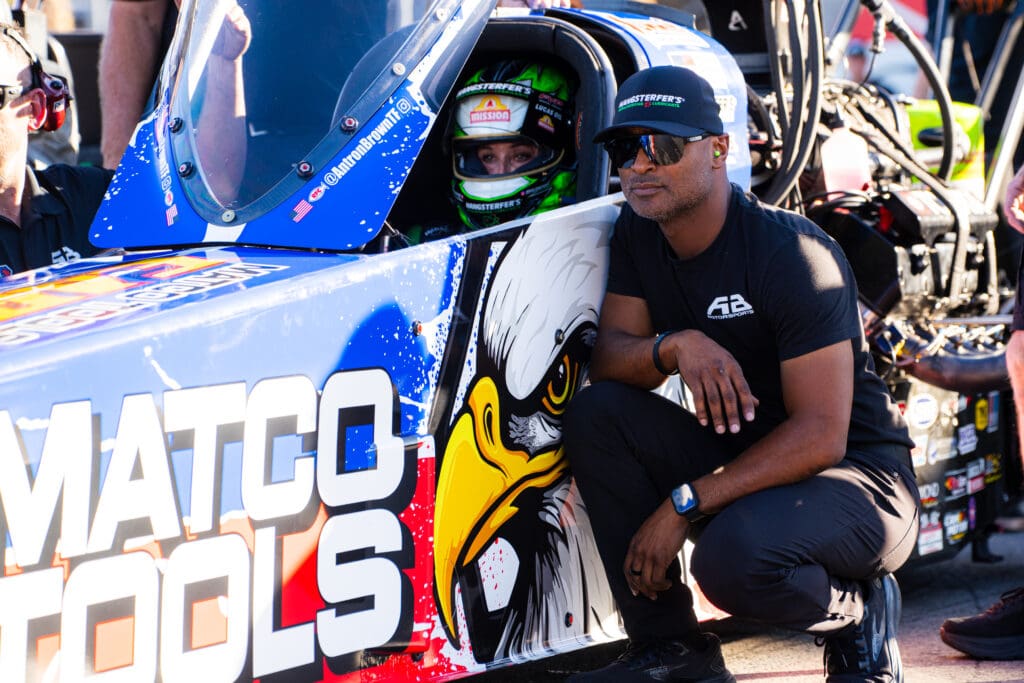

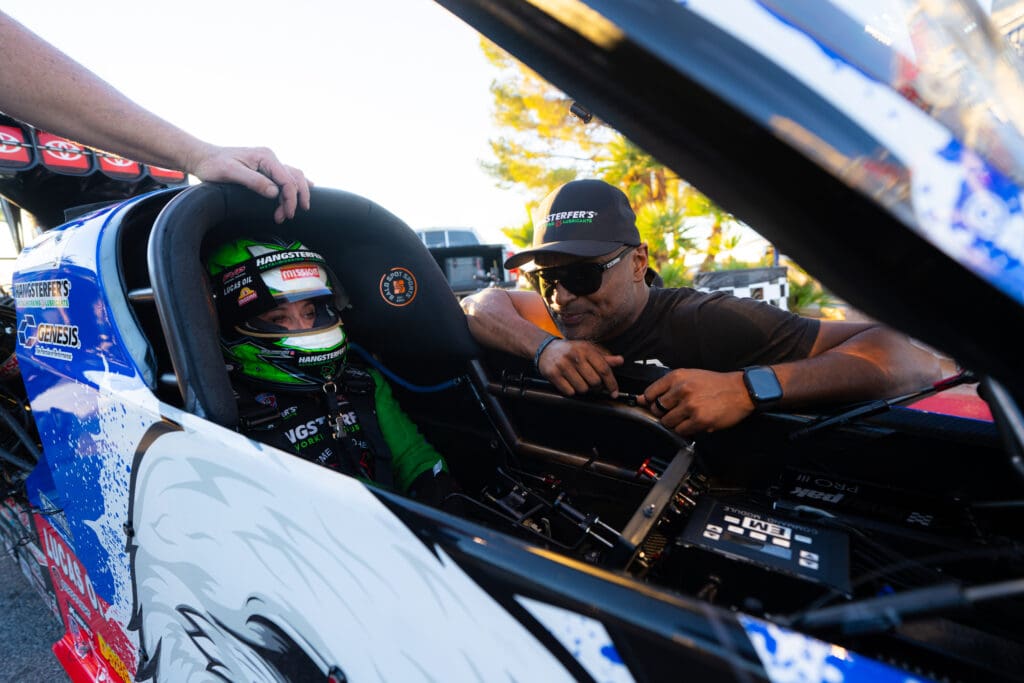
That flash of danger didn’t end the plan, but it changed the weight of it. She said Brown stayed in her ear, “nonstop telling me how prepared I am and that he has 100% faith in me and that he knows that I’m going to drive it just like I drive my car.”
Sampey described the anxiety as physical, but different from her first A/Fuel experiences. “I had some tension in my chest. I wasn’t trembling or shaking like I did the first time I drove the A/Fuel car,” she said, adding her fear was tied to the responsibility of protecting Brown’s equipment.
She tried to shrink the moment down to something familiar. “I told myself, this is my car. I’m just going to drive it like my car,” Sampey said. “Because when I was sitting in it, everything’s exactly the same.”
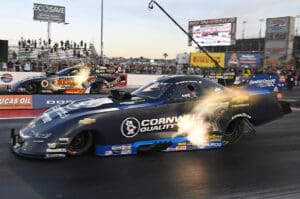
That was the point of Brown’s plan: build a bridge, then walk it. Sampey licensed in Top Alcohol Dragster in late 2023, ran the full tour in 2024, and won her first national event at Reading, Pennsylvania’s Maple Grove Raceway, a result that reinforced Brown’s belief she could transition upward without being overwhelmed by the car.
The first jolt came when the engine lit and the cockpit turned into its own world. “When we started it, of course I could hear and feel the differences in the engine, which didn’t feel what I thought it was going to feel initially,” she said. “Just the initial starting of the car, it kind of felt a little cleaner and just the sound of it was awesome.”
She said the violence fans hear trackside doesn’t translate the same way inside the helmet. “Inside of the cockpit and you helmet on, it’s muffled some, so it’s not as violent as what you hear outside,” Sampey said. The surprise, she said, was how quickly the noise turned into calm.
The calmer she got, the more intensely she focused on the details that keep a run clean. “On my mind I kept thinking I got to make sure this car is straight,” she said. “I was focused so hard on that.”
That focus created the kind of tiny mistake only a perfectionist notices, and she noticed it immediately. “I missed Brandon telling me to stop before the pre-stage beam. So I rolled through the pre-stage beam,” Sampey said, calling it “a rookie move” even as the crew simply backed her up a few inches.
She staged the way she always has, because changing the rhythm felt riskier than trusting it. “We had even talked about take your time staging, but when you’re a racer that you’ve done this for so long, you just do the same thing,” she said. “It’s like changing the time of how I stage or anything like that would’ve messed me up.”
Her reaction time wasn’t what she feared it would be. “I was thinking I was going to have a 200 light, but I did exactly what I normally do,” Sampey said. “I had an I think a 075 light or maybe… it was a 70 light.”

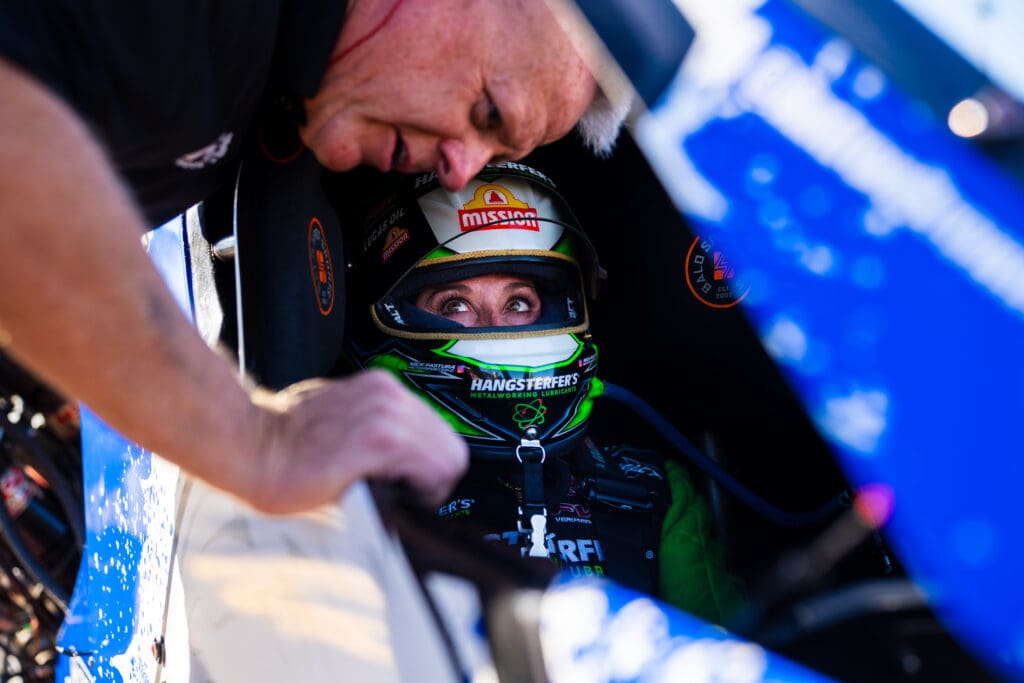
The run itself was controlled by design, but it still delivered the confirmation she needed. “Took off, the car went perfectly straight. It felt so smooth and so good,” she said, noting the car “buried me into the seat a little bit more” than A/Fuel.
The shutdown point was set, layered, and non-negotiable. “It was a pre-planned shutoff at 330 feet,” Sampey said. “Me, I’m going to shut it off at 330. Brian has the button in his hand. He’ll shut me off at 330 if I don’t. And then the car was time to shut off at 330.”
When it happened exactly as planned, the emotion hit all at once. “As soon as I let off the gas and shut the fuel and everything off, I just started to scream and scream with excitement,” she said. “I was just so happy that the fear of the unknown is now gone.”
The team wanted more on the second run, and she wanted it, too. “They told me I did such an awesome job that this time they wanted me to take the half track,” Sampey said. The car never got the chance, shutting off on safety systems when an internal problem appeared.
“Right at about … Well, they said it was already hurt in the burnout, but of course we didn’t know it,” she said. “The rings and the piston had seized up… and it caused the pan pressure valve to turn the car off.”
The mechanical ending left her with one licensing pass and a longer wait than she wanted. “So that’s all I got that day,” Sampey said. “Now I got to wait two or three months to be able to try it again.”
In her mind, the Top Fuel test wasn’t just about performance or curiosity; it was tied to a conversation she had at the edge of time. “Before my dad died, I asked him, had he done everything he wanted to do… and he said… ‘I want to see you drive that Top Fuel car,’” Sampey said.
She told Brown, and the goal sharpened into something urgent, even if no one thought the clock was that short. “We did not think my dad was going to die the day he died,” she said. “I really did think he was going to see it.”
Sampey said the week of her father’s death included a quiet, deeply personal moment of faith that she prefers to keep understated in public. She said that before he died, he prayed the sinner’s prayer, and that it brought her peace even as the timing broke her heart.

The strange part, she said, was how close it all came to lining up. “Then Tuesday he took his last breath and then the following Monday is when I drove the Top Fuel car,” Sampey said. “So he missed by that close.”
She carried his picture with her, and the symbol became heavier once she climbed into Brown’s dragster. “My dad’s picture was on Anton’s car… so getting in the car and seeing my dad’s face and getting out of the car and seeing my dad’s face,” Sampey said, “knowing that that was the one thing he wanted to see while he was alive and he didn’t get to do it.”
Even with that grief sitting on her shoulders, she questioned whether she should climb in at all. “It was almost like… should I drive the car now? Because I wanted to make sure that mentally I was safe,” Sampey said. “But after that, I was fine.”
She described the larger arc as a door closing that she didn’t understand until she was on the other side of it. “I was miserable my last two years on a Pro Stock bike,” Sampey said, and she said the discomfort ultimately pushed her toward the dragster life she never expected to love.
Now, she talks like someone who recognizes where she fits. “I would have never guessed that this is where I needed to be,” Sampey said. “And here I am and I couldn’t be happier.”





















IHRA TAPS VETERAN VOICES FOR 2026 NATIONAL EVENT ANNOUNCING TEAM