Introduction
In drag racing, “Top Fuel” refers to the fastest class of dragsters, featuring the quickest accelerating racing cars in the world. Top Fuel is the quickest, fastest class in professional drag racing, where fuel cars—specifically Top Fuel dragsters powered by nitromethane-burning engines—produce over 11,000 hp and cover 1,000 feet in approximately 3.65 seconds. These purpose-built machines represent the absolute pinnacle of straight-line acceleration, reaching speeds exceeding 330 mph from a standing start—faster than any other piston-powered vehicle on Earth. The immense energy produced by Top Fuel engines is harnessed to deliver extreme acceleration, with the energy content of the specialized fuel playing a crucial role in their record-breaking performance.
What separates Top Fuel from other drag racing classes like Funny Cars, Pro Stock, or Pro Mod isn’t just raw speed. It’s the extreme engineering required to harness nitromethane’s explosive potential, the physical punishment drivers endure under 5+ g acceleration, and the spectacle of open exhaust flames, ground-shaking noise, and visible shockwaves that make every pass an event unto itself. Numerous records and milestones have been achieved in Top Fuel, including the fastest elapsed times and top speeds in drag racing history.
Top Fuel dragsters are often referred to as the ‘kings of the sport‘ due to their extreme performance.
What This Guide Covers
This guide provides a comprehensive introduction to Top Fuel racing as sanctioned by the National Hot Rod Association (NHRA). You’ll learn the history behind the class, the basic rules and specifications that define a top fuel dragster, how the cars are built to survive seconds of maximum violence, how a complete run works from burnout to shutdown, key records and iconic drivers, and what it actually feels like to witness these machines in person.
This is not a detailed engine-building blueprint or a guide to street drag racing. We focus specifically on professional Top Fuel competition and the technology that makes it possible.
Who This Is For
This guide is designed for new NHRA fans, casual motorsports followers, and automotive enthusiasts who want to understand Top Fuel without needing an engineering degree. Whether you’re attending your first national event at a drag strip and want to know what’s happening when two vehicles stage at the line, or you’ve seen Top Fuel on television and wondered how a car can accelerate faster than a fighter jet, you’ll find clear explanations here.
Why This Matters
Understanding Top Fuel transforms the experience of watching these races from impressive spectacle to genuine appreciation of human and mechanical achievement. The safety innovations born from this class—developed after major crashes and engine failures—have saved lives across motorsport. Multimillion-dollar teams spend enormous resources to gain thousandths of a second, making Top Fuel a fascinating study in the engineering arms race at the absolute limits of internal combustion technology.
What You’ll Learn
Here’s what this guide covers:
- Basic definition and rules that define a top fuel car: fuel composition, engine displacement, chassis requirements, and race distance
- How a Top Fuel run works from burnout to finish line to shutdown, including the g-forces drivers experience and the workload required to control these machines
- Key technical elements of the engine, fuel system, ignition, clutch, and tires that enable 11,000 hp and 330+ mph performance
- Major records, iconic drivers, and how Top Fuel fits into the wider landscape of nitro cars and NHRA competition
Understanding Top Fuel Drag Racing
Top Fuel represents NHRA’s premier nitromethane dragster category—the class where the sport’s most extreme machines compete in heads-up elimination racing. Since 2008, all nitro cars run a standard distance of 1,000 feet (rather than the traditional quarter mile of 1,320 feet), with typical elapsed times between 3.6 and 3.8 seconds and terminal speeds regularly exceeding 330 mph. Top Fuel
The class is considered the pinnacle of straight-line acceleration because no other form of motorsport produces comparable performance from a standing start. The combination of massive horsepower, specialized fuel, and purpose-built chassis creates acceleration that subjects drivers to forces normally experienced only by astronauts and fighter pilots.
What Makes a Top Fuel Car “Top Fuel”
A top fuel dragster must meet specific regulatory requirements that define the class. The engine is limited to 500 cubic inches (8.19 liters) of displacement, running on a nitromethane-based fuel mixture. Minimum vehicle weight is approximately 2,330 pounds, and maximum length approaches 25 feet for the long-wheelbase rear-engine chassis design used by all competitive teams.
These rules connect directly to the Top Fuel concept: by standardizing the platform, competition becomes about tuning precision and driving skill rather than unlimited design freedom. The NHRA codifies these specifications, with the FIA and IHRA adopting similar standards for international competition. Every team works within the same fundamental constraints, making incremental gains extraordinarily difficult and valuable.
From Quarter-Mile to 1,000 Feet
The shift from the traditional quarter mile to 1,000 feet came in 2008 following high-speed accidents and comprehensive safety reviews. At terminal speeds approaching and exceeding 330 mph, the shutdown area after the finish line became dangerously short at many tracks built for slower cars in the early days of the sport.
The shorter distance allows similar spectacle—cars still reach over 330 mph—while reducing shutdown speeds and the distance required to bring fuel dragsters safely to rest. This change reflects how Top Fuel has pushed against the physical limits of existing facilities, requiring rule modifications to balance performance with driver safety. With this context established, let’s examine what a Top Fuel pass actually looks and feels like.
Inside a Top Fuel Run: Speed, G‑Forces, and Race Format
Building on the definition of Top Fuel and its 1,000-foot distance, the real-world experience of a pass is unlike anything else in motorsport. NHRA Top Fuel competition follows a standard format: qualifying sessions determine field position, then heads-up elimination rounds narrow the field until a winner emerges. Each run is measured by elapsed time (ET) from launch to finish line and terminal speed at the 1,000-foot mark.
Performance Numbers: How Fast Is Top Fuel?
Typical elapsed times for competitive top fuel dragsters range from 3.6 to 3.8 seconds over 1,000 feet, with terminal speeds exceeding 330 mph. The highest recorded speed in a National Hot Rod Association Top Fuel event is 343.16 mph, set by Brittany Force on July 25, 2025. This achievement marked her third time breaking the Top Fuel national record in 2025, with her record-setting run completed in a remarkable 3.645 seconds at the NHRA Sonoma Nationals. The first-ever 300-mph pass in Top Fuel racing was achieved by Kenny Bernstein at the 1992 Gatornationals. Don Garlits achieved the NHRA’s first official 200-mph run at the 1964 NHRA World Championship Series event. These milestones demonstrate how teams continue pushing the limits of what these machines can achieve. Other legendary drivers such as John Force have set additional extraordinary benchmarks in the sport.
The acceleration is almost incomprehensible: 0-100 mph occurs in less than one second. Mid-track incremental times show the car gaining speed at a rate that subjects drivers to 4-5+ g of sustained acceleration—more than astronauts experience during space shuttle launch. For comparison, the fastest production supercars need 2+ seconds to reach 60 mph; a top fuel car covers over 300 feet in that same time.
What Happens During a Pass
Every Top Fuel run follows a precise sequence. The driver performs a burnout to heat the rear tires and lay down fresh rubber for traction, then backs up and stages at the starting line. The Christmas Tree lights sequence through pre-stage and stage bulbs before the amber countdown and green launch signal.
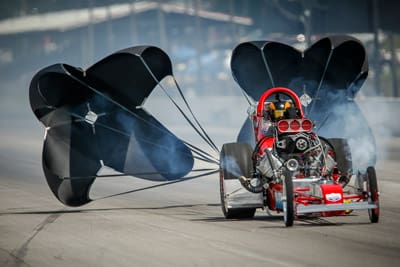
At launch, the clutch management system progressively engages as the car accelerates, transferring power to the massive rear slicks. The driver’s job is to steer a straight line while experiencing tunnel vision and physical compression from the g-forces. After crossing the finish line, twin parachutes deploy to slow the car from 330+ mph, with brakes applied only at lower speeds. The entire pass—from full throttle at launch to shutdown—takes roughly 10-12 seconds total.
Why Top Fuel Gains Get “Harder” at the Limit
At these extreme speeds, the physics of going faster work against you. A mid-tier drag racing car might gain significant ET improvement from a modest power increase, but Top Fuel teams spend millions to shave thousandths of a second because the returns diminish dramatically near the limit.
Aerodynamic drag increases with the square of velocity, meaning the air resistance at 330 mph is enormously greater than at 200 mph. Tire traction becomes the critical limiting factor—more power simply spins the tires rather than accelerating the car. And safety rules cap how far engineers can push, with fuel mixture percentages, engine displacement, and blower specifications all regulated.
Key Points:
- Massive power (~11,000+ hp) is required just to maintain current competitive performance
- Aerodynamic drag and tire traction become the dominant limiting factors at extreme speeds
- Safety regulations and rules limit how much further engineers can push the technology
Understanding these constraints helps explain why Top Fuel engineering is so specialized. Let’s examine how the cars are built to survive the violence of a full-throttle pass.
Technical Anatomy of a Top Fuel Dragster
The extreme performance of Top Fuel comes from specific engineering choices in the engine, fuel system, chassis, and safety equipment. There are different models of Top Fuel dragsters, each featuring unique design variations and technical specifications, such as V-Twin and inline four-cylinder engine configurations. Top Fuel dragsters typically have a compression ratio of about 6.5:1. Every component is designed for maximum output over a run lasting less than four seconds—reliability is measured in runs, not hours, and parts that would last years in a passenger car may be replaced after a single pass.
Engine and Supercharger
The heart of every fuel engine is a 500 cubic inch, 90-degree V8 based on the Chrysler Hemi architecture, though modern versions use billet aluminum blocks and cylinder heads rather than production castings. The intake manifold sits beneath a massive 14-71 Roots-type supercharger that produces up to 70+ psi of boost, driven directly from the crankshaft at speeds that consume nearly 1,000 hp just to spin the blower.
Internal components include forged aluminum pistons, a steel crankshaft capable of handling 11,000 hp worth of torsional loads, and steel rocker arms that actuate the valves at engine speeds approaching 8,500 rpm. There is no radiator or coolant system—the engine is built to survive seconds of maximum output, not extended operation. This architecture is why top fuel engines can produce 8,500-11,000+ hp but only for very short bursts before requiring complete teardown.
Fuel and Oil Systems
Nitromethane serves as the primary fuel, typically blended at up to 90% nitro with methanol making up the balance. The key property of nitromethane’s molecular structure is that it carries oxygen within the fuel molecule, allowing the engine to burn far more fuel per cycle than gasoline engines can. Where gasoline requires about 14.7 pounds of air per pound of fuel, nitromethane needs only about 1.7 pounds of air—allowing roughly eight times more fuel throughput for the same volume of atmospheric oxygen.
A mechanical fuel pump delivers this enormous volume through approximately 42 fuel nozzles, with the engine burning 10-15 gallons during a complete run including burnout and pass. The wet-sump oiling system holds around 16 quarts of SAE 70 racing oil in titanium and aluminum pans designed for containment during the violent g-forces. Crew chiefs adjust fuel flow throughout the run to balance power output against tire grip—too much fuel early can spin the tires; too little leaves horsepower on the table.
Ignition, Exhaust, and Noise
Dual magnetos provide redundant ignition, with two spark plugs per cylinder ensuring reliable combustion at cylinder pressures that would destroy conventional ignition systems. Timing is highly advanced at launch—often 58-65 degrees before top dead center—then retarded during the run as cylinder pressures build to prevent detonation.
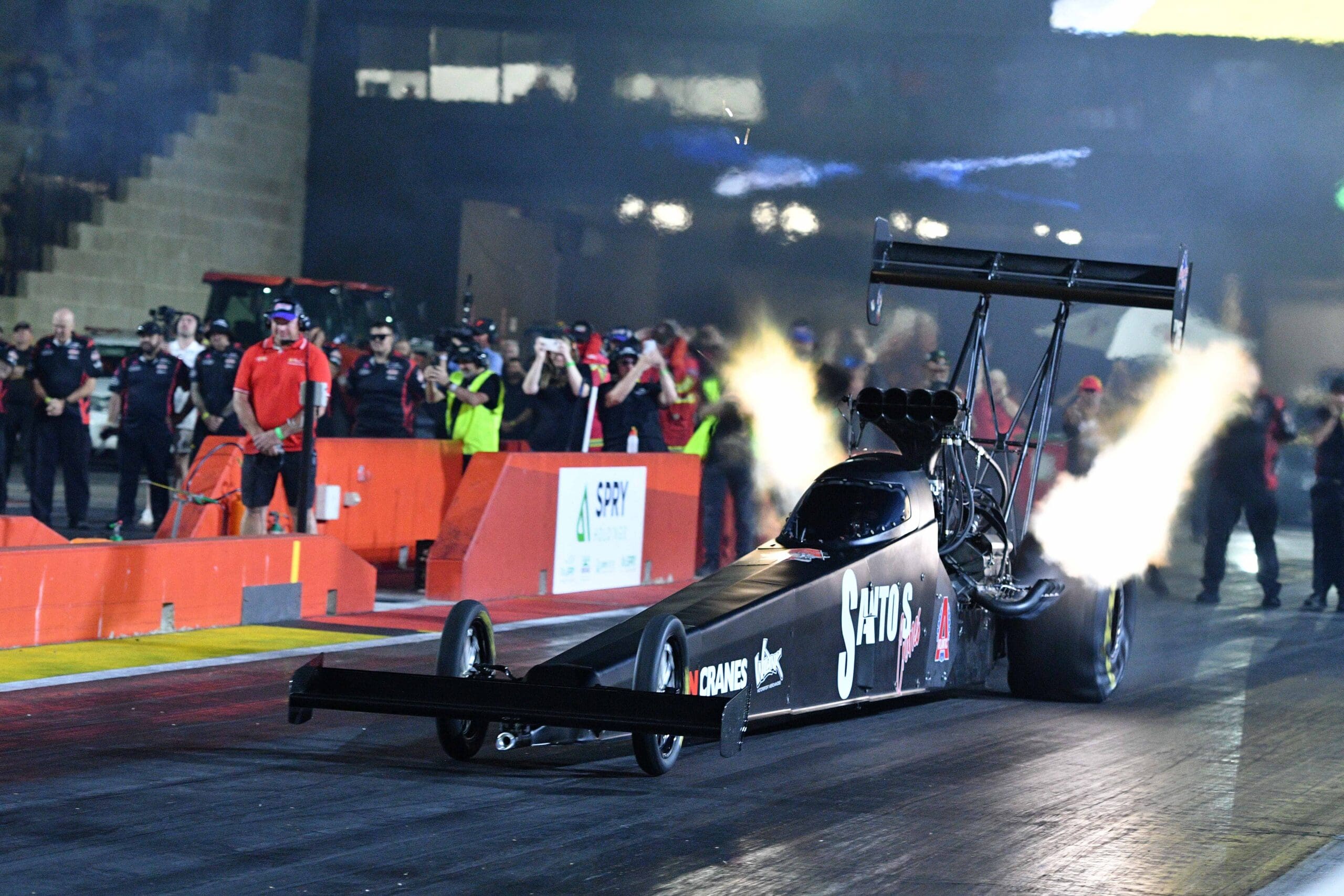
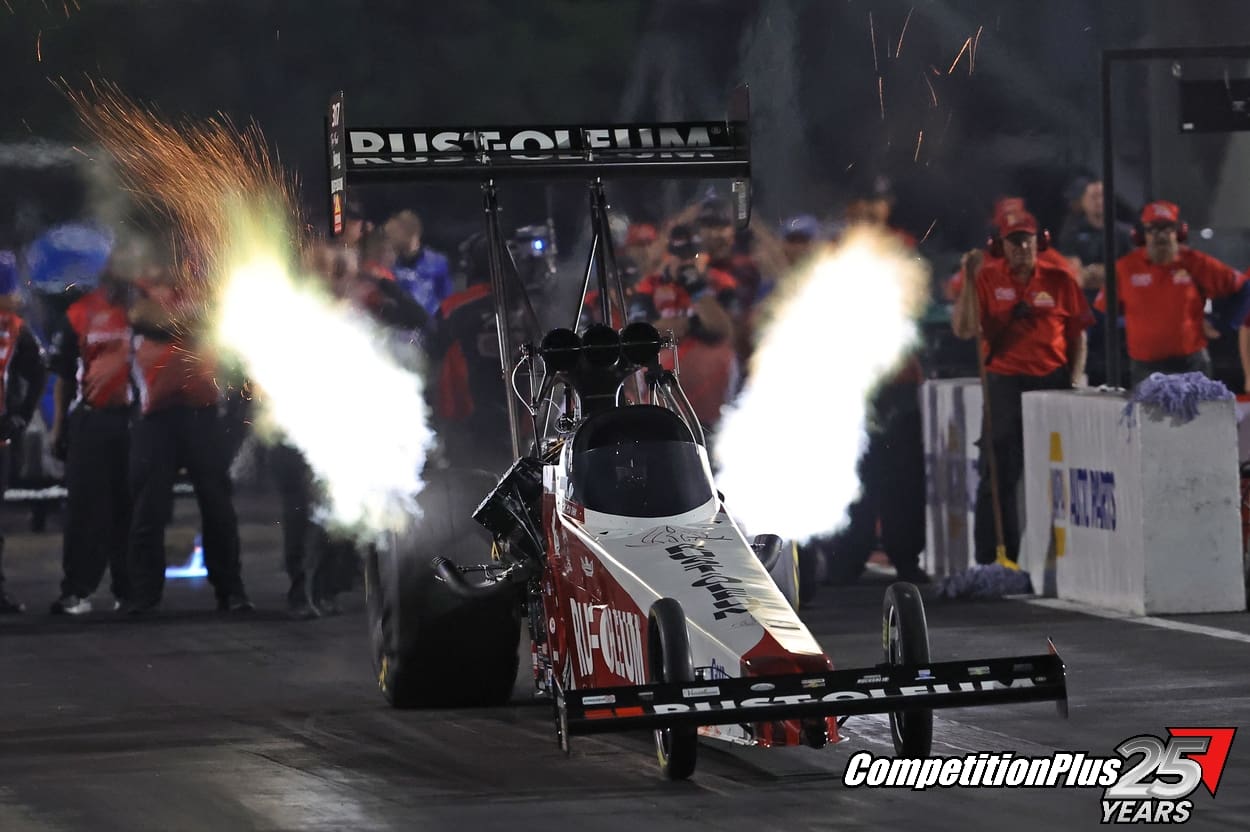
The eight open “zoomie” exhaust pipes create Top Fuel’s signature visual and auditory experience. Flames reach several feet from the headers as unburned nitro ignites in the open air, with exhaust temperatures around 1,800°F. The combustion temperature of nitromethane approaches 2,400°C (4,350°F), and the sound pressure at the starting line reaches levels that require hearing protection—the blast physically impacts spectators’ chests.
Key Points:
- Redundancy (dual magnetos, twin plugs) ensures reliability under extreme cylinder pressures
- Angled exhaust headers create measurable downforce from exhaust thrust, improving rear tire grip
- Top Fuel launches are physically punishing for drivers experiencing 5+ g and spectators feeling pressure waves
With the car’s technical systems explained, let’s examine how teams actually operate these machines at the track.
Running a Top Fuel Team in Practice
Beyond the hardware, Top Fuel success depends on crew operations, tuning decisions, and strategic choices across a race weekend. Most competitive NHRA Top Fuel teams are full-time professional operations with budgets in the millions, supported by major sponsors and staffed by specialized technicians. The cost of competing at this level is enormous, but so are the rewards in terms of NHRA history and championship recognition.
Step-by-Step: What Happens on Race Day
When to use this: This walkthrough helps fans attending an NHRA event follow what’s happening in the pits and on track.
- Warm-up and prep: The crew fires the engine in the pits for system checks, selects the clutch pack configuration, and sets the fuel and ignition maps based on weather conditions and track temperature.
- Tow to staging lanes: The car is pushed or towed to the staging lanes where final tire pressure, wing angle, and weight distribution checks occur. Teams monitor conditions constantly as temperature and humidity affect performance.
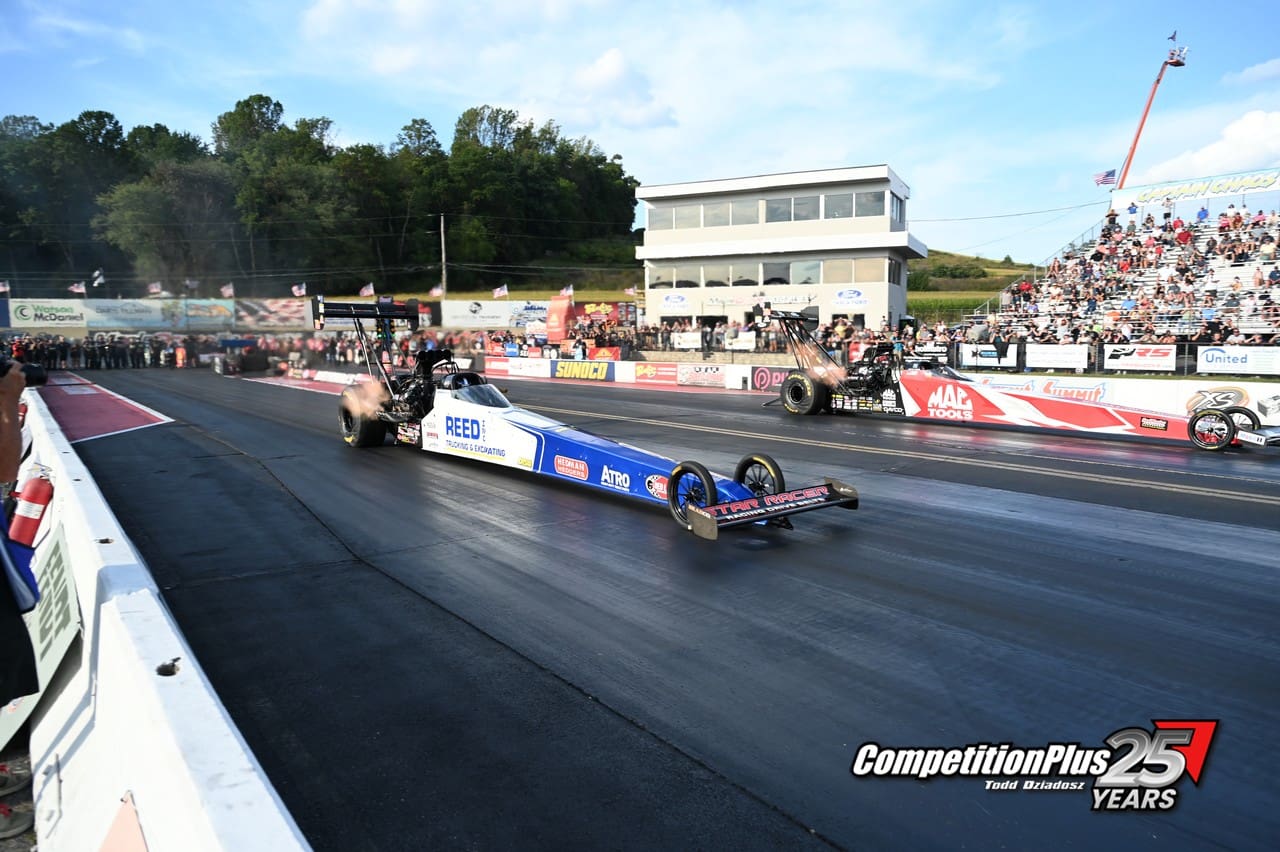
- Burnout and staging: The driver performs the burnout to heat the rear slicks and clean them of any debris, then backs up into the pre-stage and stage beams. Both drivers must stage before the Christmas Tree sequence begins.
- The run: At green, the driver goes to full throttle while the multi-stage clutch progressively engages. There is no gearbox—power flows directly through the clutch to the rear axle. The driver’s job is keeping the car straight through steering corrections while managing the physical assault of acceleration.
- Turnaround: After shutdown, the car returns to the pits for engine teardown. Between rounds, crews typically replace clutch discs, pistons, bearings, and other components—the engine is essentially rebuilt for each pass.
Comparison: Top Fuel vs Funny Car
Understanding the difference between these two nitro classes helps fans follow a complete NHRA event.
| Feature | Top Fuel Dragster | Nitro Funny Car |
| Chassis layout | Long rail, rear-engine, open cockpit | Short wheelbase, front-engine, enclosed body |
| Typical ET | 3.65-3.80 seconds | 3.80-4.00 seconds |
| Typical speed | 330-343 mph | 320-340 mph |
| Body style | Open-wheel, minimal bodywork | Full carbon-fiber body resembling production cars |
| Driver experience | Better visibility, extreme g-forces | Limited visibility, body lifts for entry/exit |
| Both classes produce similar horsepower and burn nitromethane, but the driving dynamics differ significantly. Funny Cars are more challenging to see out of, while Top Fuel dragsters subject drivers to more direct aerodynamic forces. Some racers like John Force have built legendary careers in Funny Car, while others prefer the raw exposure of Top Fuel. Understanding both classes lets fans appreciate the full scope of nitro racing at any NHRA national event. |
Common Challenges and How Teams Solve Them
At Top Fuel speeds, small issues become catastrophic problems in fractions of a second. Teams fight recurring challenges in traction, reliability, and safety that have shaped the evolution of the class.
Challenge 1: Putting Power to the Track
Problem: Delivering 11,000 hp to rear tires from a standing start creates immediate wheelspin or violent tire shake that scrubs speed and can damage the car.
Solution: Teams manage power delivery through sophisticated clutch tuning, fuel curve shaping that ramps power progressively, track preparation that optimizes grip, and rear wing angle adjustments that balance downforce against drag. Crew chiefs read data including driveshaft speed and tire temperature to refine setups between rounds, making incremental changes that can mean the difference between hooking up and smoking the tires.
Challenge 2: Engine Durability and Explosions
Problem: The extreme cylinder pressures and heat loads cause frequent parts failures—dropped cylinders, connecting rod breakage, and complete engine destruction are regular occurrences in Top Fuel.
Solution: Teams follow strict rebuild schedules, often replacing major components after every single run. In hot conditions, crews dial back the tuneup to reduce stress on parts. NHRA mandates containment devices including Kevlar blankets around superchargers and valve-cover restraints to contain shrapnel when failures occur. These rules evolved after high-profile engine and clutch explosions demonstrated the violent forces involved.
Challenge 3: Safety at Extreme Speeds
Problem: Racing at 330-343 mph in under four seconds leaves almost no margin for error. Any mechanical failure, tire blowout, or loss of control can be immediately life-threatening.
Solution: Modern Top Fuel safety features include full fire suits, HANS devices to prevent basilar skull fractures, carbon-fiber monocoque driver compartments, twin parachutes for redundant braking, automatic fuel shutoffs, and onboard fire suppression systems. Track safety has improved with upgraded catch-nets, concrete barriers, and expanded shutdown areas. The switch to 1,000 feet acknowledged that existing facilities couldn’t safely accommodate quarter-mile speeds approaching 340 mph.
These challenges continue shaping Top Fuel’s evolution, driving innovation in materials, procedures, and regulations that keep the sport on the edge of possibility while protecting the racers who push these machines to the limit.
Conclusion and Next Steps
Top Fuel represents the absolute extreme of piston-powered acceleration—a class where 11,000 hp engines burning nitromethane propel purpose-built dragsters to over 330 mph in less than four seconds. Understanding the technology behind these machines, from the supercharged fuel engines to the sophisticated clutch management and safety systems, transforms the experience of watching races from impressive spectacle to genuine appreciation of what humans and hardware can achieve at the limit.
The combination of regulated competition, extreme engineering, and calculated risk has produced a unique motorsport category. Every pass represents millions of dollars in development, decades of accumulated knowledge, and split-second decisions by drivers experiencing forces that push human physiology to its limits.
To Get Started
- Watch a full NHRA Top Fuel event (live or streaming) and follow one driver through qualifying and eliminations to understand the rhythm of competition
- Visit the pits at a race and observe a Top Fuel team’s between-round routine—watching a crew rebuild an engine in under an hour is an education in organized precision
- Explore technical content from crew chiefs and team engineers to deepen understanding of the tuning decisions that separate winning runs from also-rans
Additional Resources
For those wanting to go deeper:
- NHRA Rulebook section on Top Fuel Dragsters in Page 1 of Section 19 (PDF Pg 378) provides official specifications for engines, chassis, safety equipment, and competition procedures
- Follow Top Fuel records and standings with Competition Plus and visit the official NHRA website for maintained updated statistics for each season, including elapsed time and speed records at individual tracks.