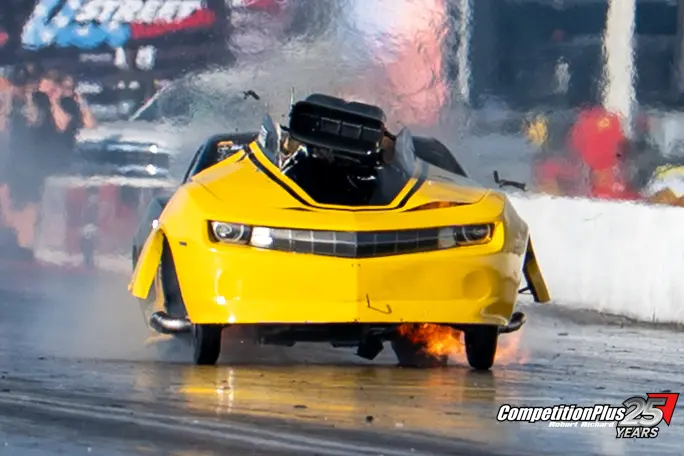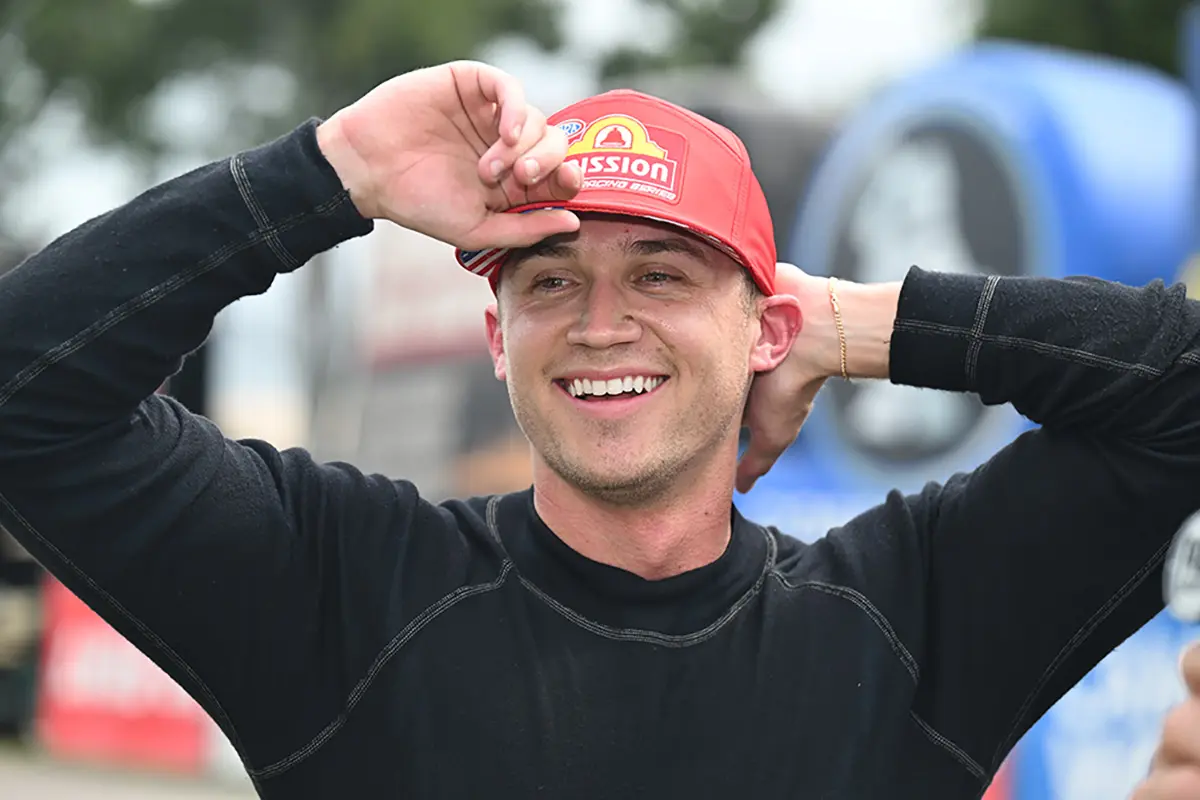

Replacing a two-time Funny Car champion is supposed to come with nerves, doubt and public skepticism. Jordan Vandergriff arrives instead with conviction, stepping into one of the sport’s most demanding seats with a belief shaped by patience rather than pressure.
One might expect anxiety to overwhelm a driver stepping into one of drag racing’s most scrutinized roles, but Vandergriff insists that is not the case. The experienced Top Fuel driver says confidence, not nerves, defines his mindset as he prepares for his first full season in Funny Car.
Vandergriff was introduced at the PRI Show in December as the replacement for back-to-back Funny Car champion Austin Prock. The move placed a driver with limited Funny Car seat time into one of the sport’s most successful operations at John Force Racing.
The transition carries weight because Vandergriff’s Funny Car experience is limited to licensing runs completed early in 2024. Those runs, he said, now feel both distant and immediate as the season approaches.
“The anxiety level, I think it’s pretty low, to be honest,” Vandergriff said. “I think through the process in the beginning, I think there was a lot of anxiety, not knowing who was going to get the ride and me hoping it was me.”
Once the decision became official, Vandergriff said uncertainty gave way to preparation. With a plan now in place and the season drawing closer, he said confidence has replaced apprehension.
“But now that it’s been decided it’s me and it’s been announced and we’re getting closer and closer to the time to a season starting and the plan that we have in place is all starting soon, so the anxiety is a lot lower,” Vandergriff said. “I think I have a lot of confidence in myself and in this race car and in this team.”
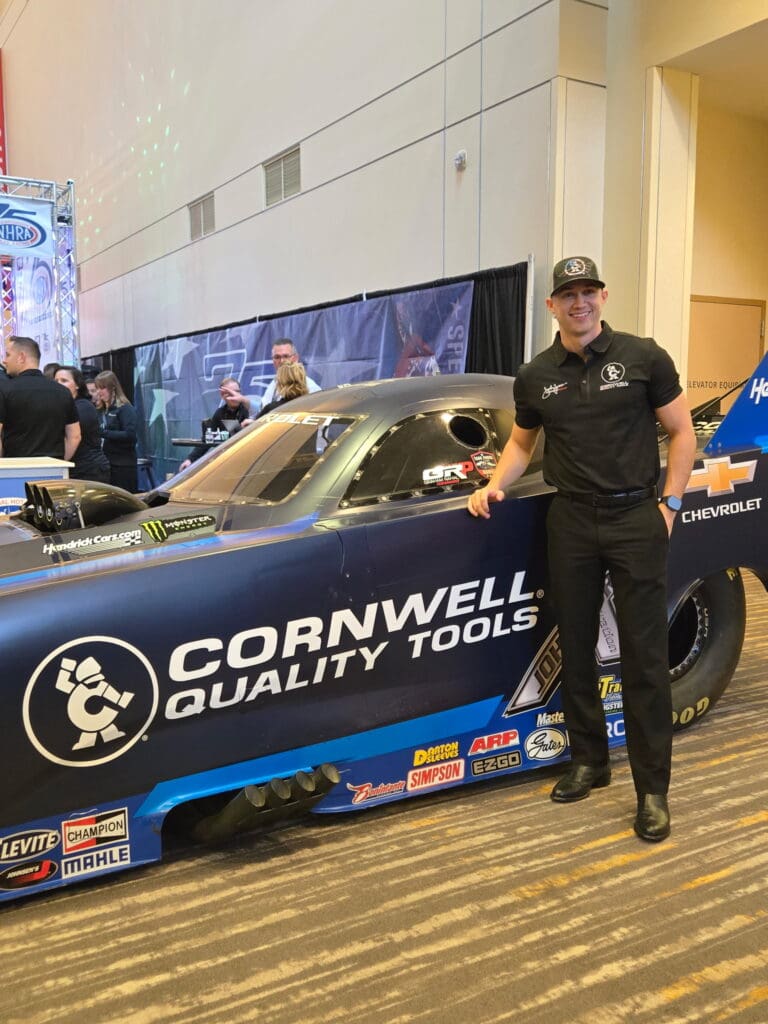

That confidence, he said, is reinforced by the environment surrounding him. Vandergriff acknowledged that joining John Force Racing comes with resources few teams can match.
“So it really helps out,” he said. “You know you have all the best equipment and the best crew members and the best crew chiefs and stuff like that. So it really helps out.”
The challenge, however, is unavoidable. Vandergriff is stepping into a Funny Car that has been the standard of the class for two seasons.
“You’re right, this car has been badass the last couple of years and I expect it to continue to be,” Vandergriff said. “I’m expecting to come into a race car that has been fast, has been quick, and it’s going to stay fast and stay quick.”
That reality places immediate responsibility on the driver. Vandergriff said he understands that maintaining the car’s performance requires him to be ready from the start.
“So I have to be ready,” he said. “I am a dragster driver. I’ve driven the drags to the top field drivers in competition and I’m moving into the funny car class, but I’m excited for the challenge.”
Vandergriff framed the opportunity as one he has pursued for years. When it finally arrived, he said hesitation was not part of the equation.
“I think this opportunity for me, I’ve been wanting it for so long and waiting for it,” he said. “Now it’s finally here. So I have to give it all I’ve got and I will.”
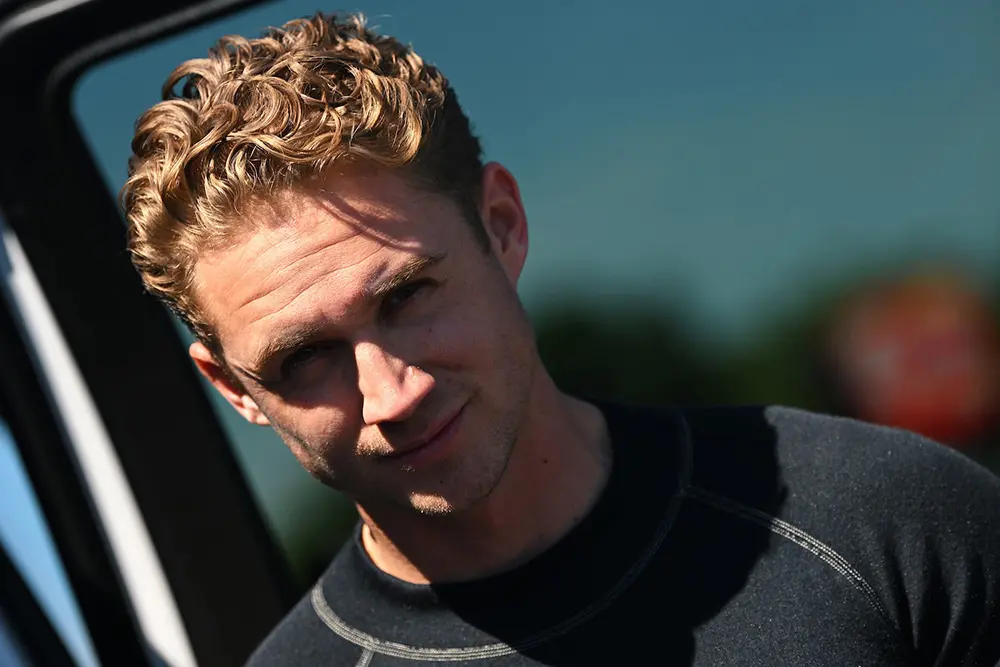
Driving a Funny Car for John Force Racing, he said, carries symbolic meaning beyond the statistics. The class itself, and the legacy behind it, add context to the transition.
“I think coming into this class where the Funny Car has been a staple of drag racing for forever and driving for John Force, the greatest funny car driver of all time, being on this team driving a funny car, I think that’s what you do over here,” Vandergriff said. “So it’s awesome. It’s awesome and I can’t wait.”
Although his licensing runs took place nearly a year ago, Vandergriff said the experiences remain vivid. He has revisited those moments repeatedly as preparation intensifies.
“Yeah, I mean, the last hits I’ve had were, it was early 2024, but it does seem like it was just yesterday, honestly,” he said. “The memories are burned in your brain and you can replay them anytime you want.”
Those memories, he said, have become reference points rather than distant recollections. Vandergriff believes they will ease his return to the Funny Car cockpit.
“I have been replaying them over and over again and trying to remember little things about them and things I can take into this year,” he said. “So yeah, I’ve had those runs back then, but I think they’re going to help me get ready for these runs coming up soon.”
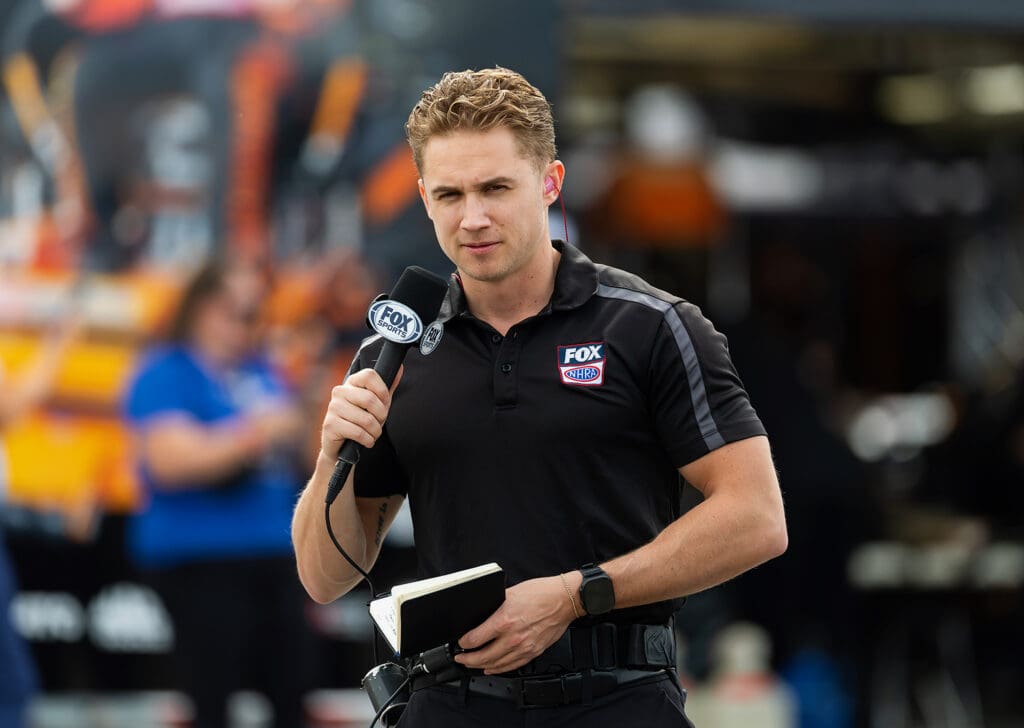
The technical differences between Top Fuel and Funny Car, he said, revealed themselves immediately during testing. Vandergriff described the contrast as both mechanical and sensory.
“I mean, it’s just completely different,” he said. “They launched different the first 100 to 200 feet are different.”
Once past the initial phase of the run, Vandergriff said the sensations begin to converge. The early moments, however, demand adjustment.
“Once you get past that kind of area, the speed and the acceleration kind of catch up with the same,” he said. “They kind of feel the same, I guess.”
What surprised him most was how the Funny Car delivered power off the starting line. The engine placement alone, he said, changes the entire experience.
“I think with a dragster that kind of shoots off the line a little quicker, your 60 foots are quick, so it feels like you’re just taking off and gliding and zipping through the air,” Vandergriff said. “And the funny car, with the engine in front of you, it feels like I’ve described it to other people.”
His description was characteristically vivid.
“It feels like an angry lawnmower that doesn’t want to cut the grass,” he said. “It’s angry and you could feel it and you could see it.”

Navigating those differences, Vandergriff said, requires patience and adaptability. He compared his current mindset to following a flexible plan rather than a rigid script.
“I think it’s just take it one run at a time, honestly,” he said. “Each run is going to surprise me.”
Veteran Funny Car drivers, he said, have warned him about the class’s ability to humble even the most prepared competitors. Vandergriff has taken that advice seriously.
“A lot of Funny Car drivers talk about how these things will humble you very quickly,” he said. “And I think it’s just taking each run one at a time.”
That approach, he added, is unlikely to change.
“I think that’s going to be my motto really all year,” Vandergriff said. “Because you never know what each run’s going to bring you.”
Preparation, he acknowledged, can only go so far. Once the car leaves the starting line, instinct takes over.
“You can plan all you want, but you just got to be reactive,” he said. “That’s what’s special about driving these kind of cars, Top Fuel and Funny Cars.”
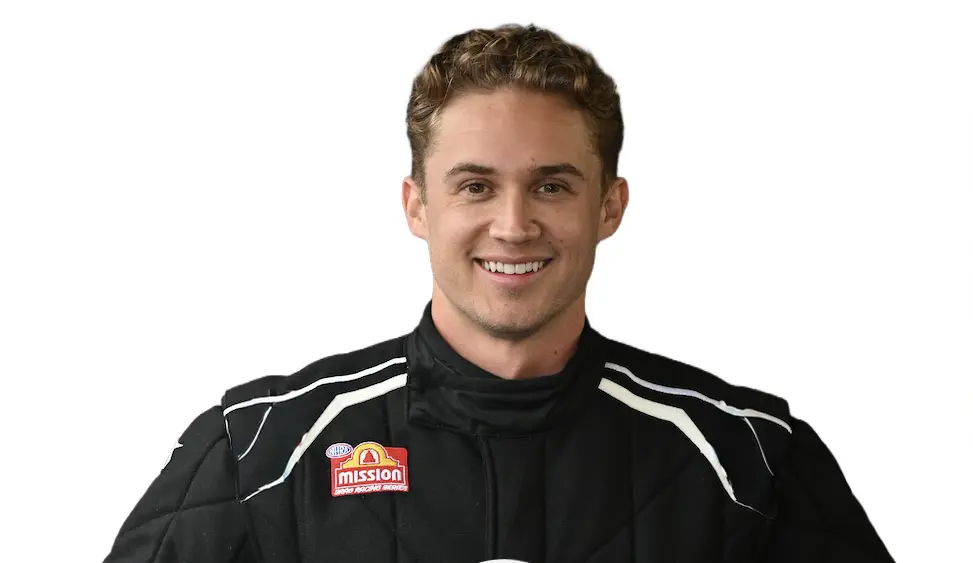

Reaction, he said, must be precise. Overcorrection can be as costly as hesitation.
“You have to react correctly and on time and just enough,” Vandergriff said. “You can’t overdo it, you can’t underdo it, but you have to give it exactly what it wants.”
That uncertainty, he said, is part of the appeal. Every run brings new information and new challenges.
“Each run is going to be so unique that it’s just about learning what to do and using those reactions to your benefit,” he said. “I don’t know what I don’t know yet, but I’m going to learn along the way.”
The waiting, however, has tested his patience more than the prospect of driving the car. Vandergriff admitted anticipation can be harder to manage than the act itself.
“Yes,” he said when asked if the wait is worse. “I just want to get in there and do it.”
The extra time, he said, invites overthinking. Getting on track is the only cure.
“The wait, the anticipation, it’s giving me more time to think,” Vandergriff said. “Let’s get the car out there. Let’s get the team out there and let’s just go make some runs.”
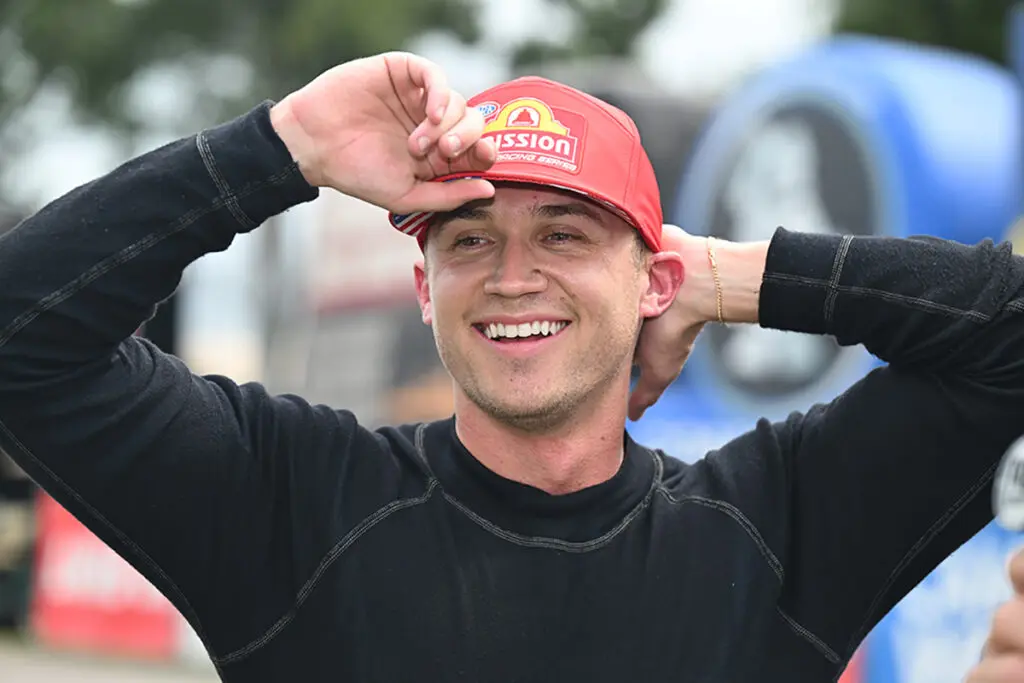

Expectation remains the unspoken pressure attached to the seat. Vandergriff acknowledged that replacing a two-time champion brings scrutiny that cannot be ignored.
“I think people expect perfect in every professional sport, right?” he said. “That’s what the fans expect.”
He views that expectation as universal rather than personal. Mistakes, he said, are inevitable and necessary.
“I don’t feel that pressure of I can’t make a mistake here and there,” Vandergriff said. “I’m going to. And that’s part of the process.”
The highest expectations, he said, come from within. Vandergriff measures success against his own standards rather than external judgment.
“The expectations on myself are higher than even those,” he said. “I want to be the best driver that I could possibly be.”
The context is unavoidable. The car he now drives has won the last two championships.
“This car’s won the last two championships and it had somebody else in the seat and now it has me in the seat,” Vandergriff said. “And we have a chance to win another championship.”
He understands the comparison that follows any successor. Still, he sees the opportunity clearly.
“For me to slide right in, it’s what I want,” Vandergriff said. “It’s exactly where I want to be.”
Doubt, he said, is fuel rather than distraction.
“Doubt me, do whatever you want,” Vandergriff said. “I’m going to go out there and prove you wrong and I’m going to drive this race car.”