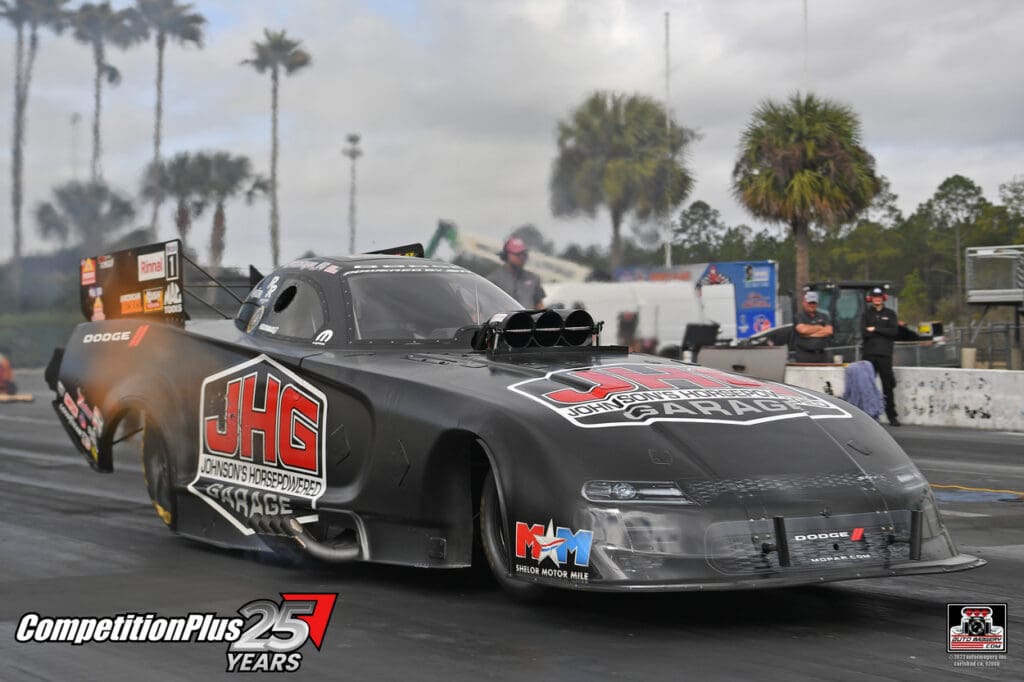
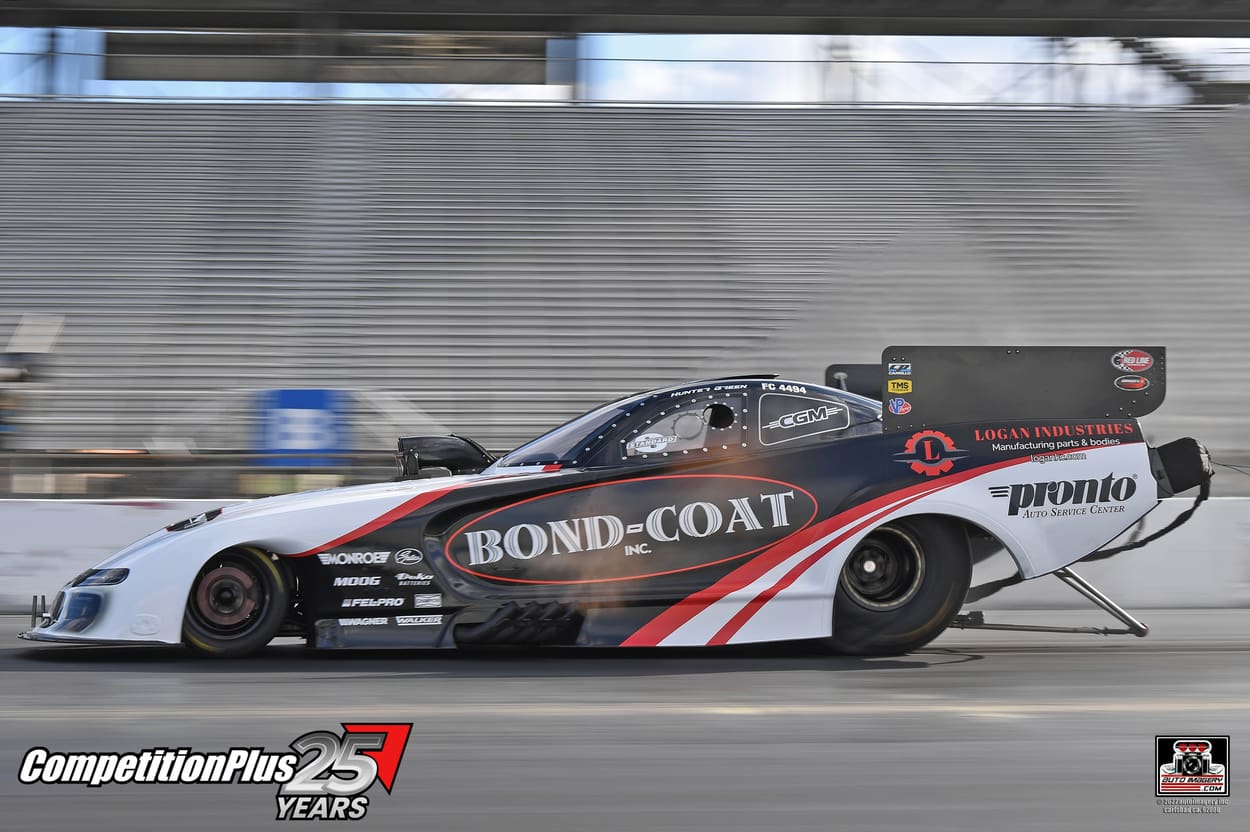
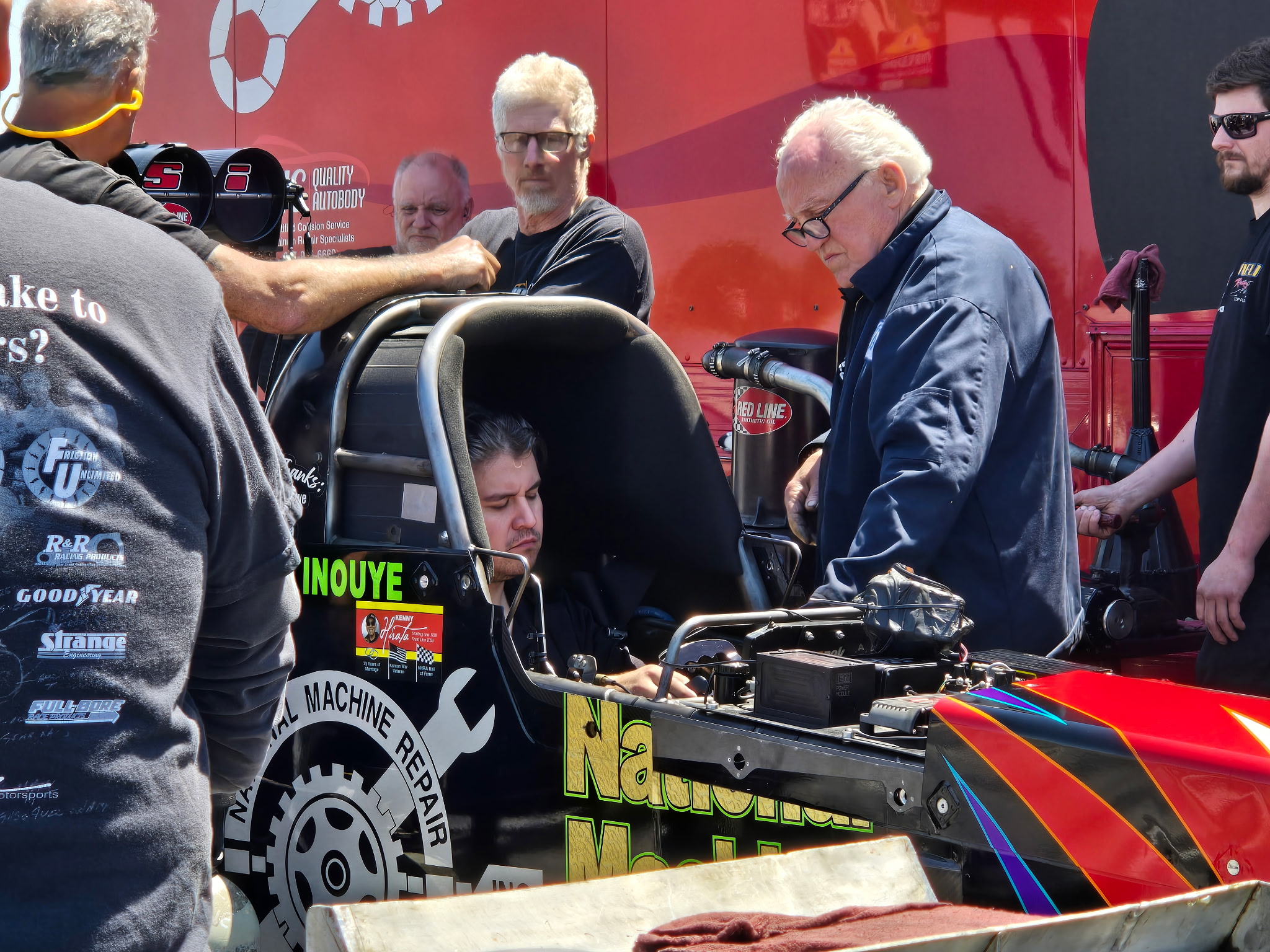
The most valuable nitro test sessions do not always produce the loudest numbers.
While preseason leaderboards can generate buzz, crew chiefs and drivers in Top Fuel and Funny Car insist the real work at a session like the P.R.O. Preseason Test is measured in data points, part durability and incremental gains that may not show up in a headline.
For veteran crew chief Tommy DeLago, testing begins with an agenda, not an elapsed time target.
Each team arrives with a defined objective, whether that means closing a performance gap, validating new components or building a foundation for a second car in the stable.
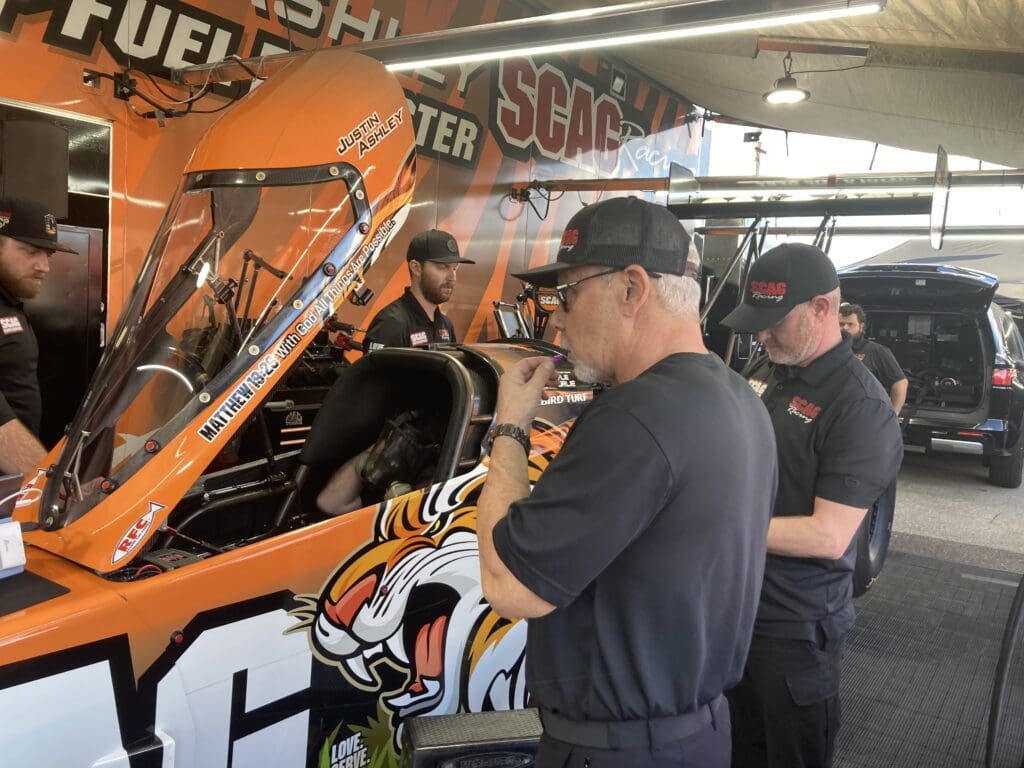
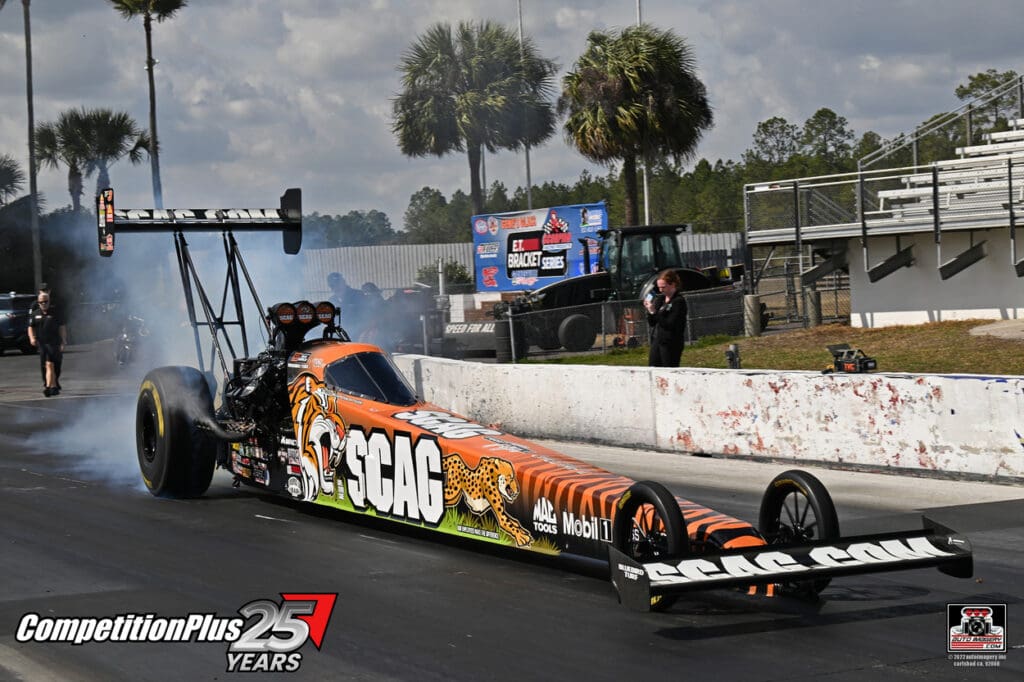
In his first preseason test overseeing Justin Ashley’s Top Fuel operation, DeLago balanced both refinement and expansion.
Ashley’s primary dragster required performance gains without sacrificing the consistency that kept it competitive, while a second entry demanded methodical attention simply to establish reliability.
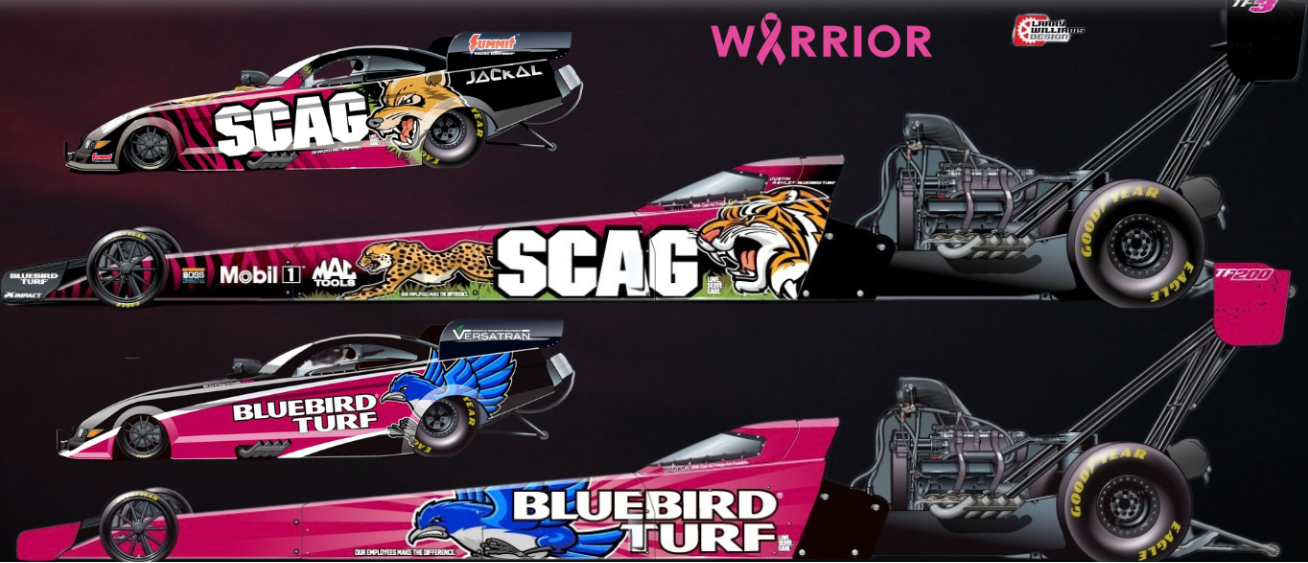
“Each day’s a little different and each team has their own agenda,” DeLago said. “Obviously for the SCAG, Ashley dragster, it’s a pretty good running car, but we feel it’s a little bit behind compared to the top three, four cars out here. And so, we’re trying to work on improving our performance and hopefully not losing a bunch of consistency as we try to gain some performance.”
That balance dictated how aggressively the team pushed.
Some organizations arrive at preseason testing focused on personnel, giving new crew members repetitions under controlled conditions.
Others seek only to shake off rust, make a handful of clean runs and leave confident in their baseline.
DeLago’s approach in Gainesville began with establishing that baseline.
“I would say how we structured our week was we came in the first day and baseline the track with our stuff from last year, and then once we knew where that was at, trusted the track, then we went into testing some clutch stuff for New Year,” he said.
Before experimenting with clutch settings or new parts, the team needed to understand how the car reacted to familiar inputs on the current surface.
Only after confirming that foundation did DeLago feel comfortable introducing change.
Run distance, he emphasized, is determined by purpose rather than ego.
With a new or unproven combination, short launches are the norm.
“Well, obviously with, let’s say the Bluebird car, it’s never made a pass. I don’t know how everything’s working, if everything goes good in the warm-up, I’m still, I would only have them take it 150 feet, 120 feet, if it goes that far,” DeLago said. “Come back, make sure everything works.”
Fuel volume, ignition timing, clutch application and mechanical movement are reviewed before stretching a run to 330 feet or beyond.
Spark plugs, bearings and data traces provide more meaningful answers than a full 1,000-foot blast on a fragile combination.
Even with Ashley’s established car, DeLago said there was little reason to chase full-track numbers if the target zone was earlier on the strip.
“It’s like even when we came here, my plan was to run mostly eighth mile runs just to, I already know it runs good speed and the motor runs good down there,” he said. “I know where I’m trying to attack the track is all before 660.”
The focus for his team was between 60 feet and roughly 400 feet.
Back-half performance, often celebrated in mph figures, was already competitive.
Occasionally, a longer run is allowed to keep the driver comfortable and sharp.
But even then, the shutoff point may come early if the data objective has been met.
Testing, DeLago made clear, is about solving specific problems rather than proving capability already established.
From the cockpit, however, that discipline can test a driver’s resolve.
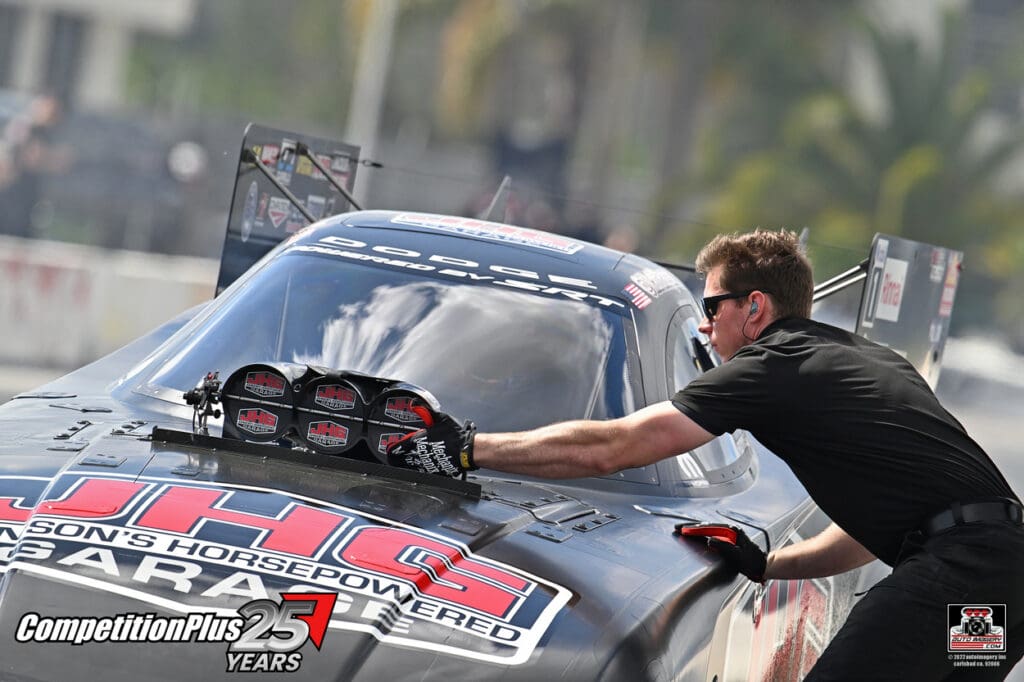
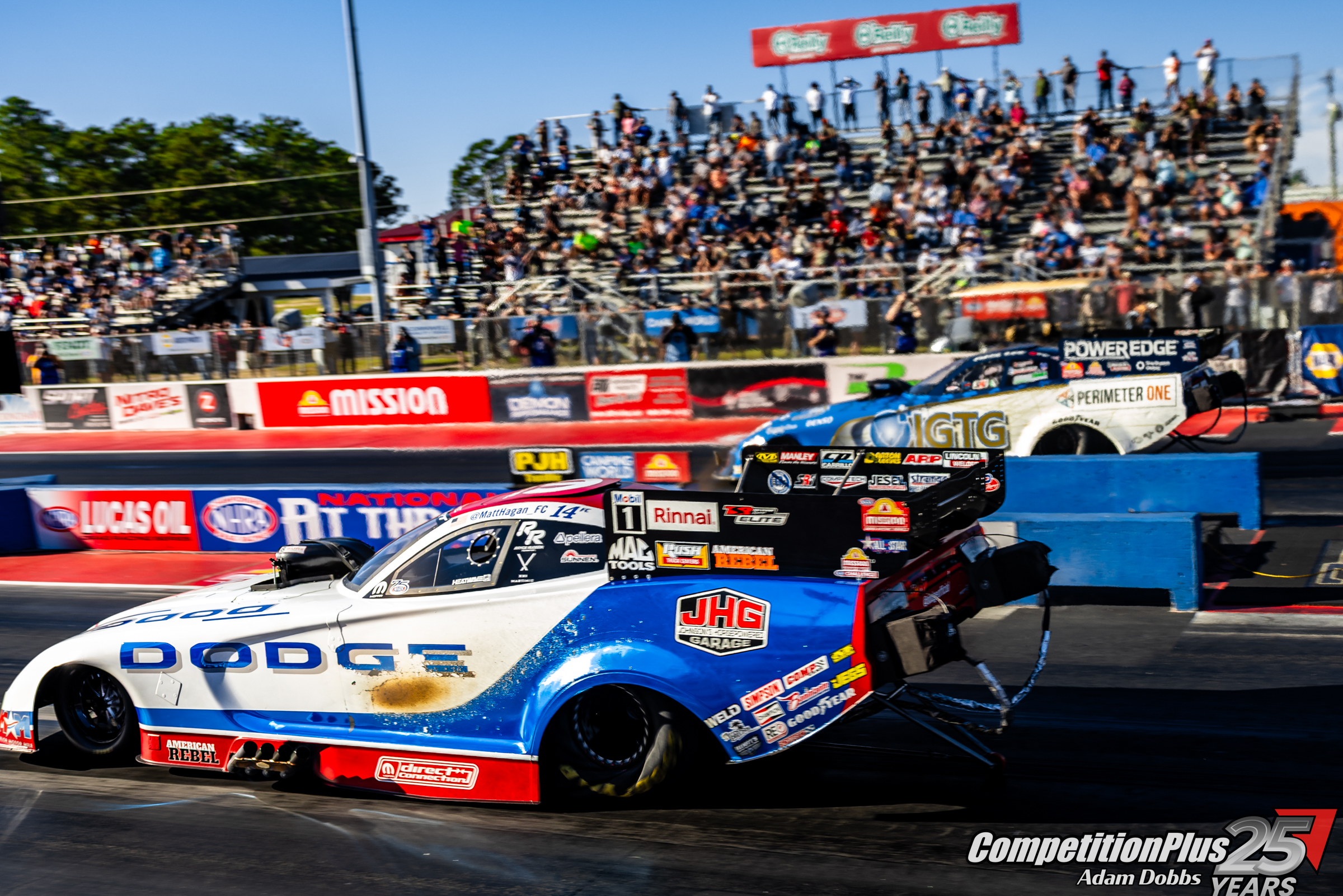
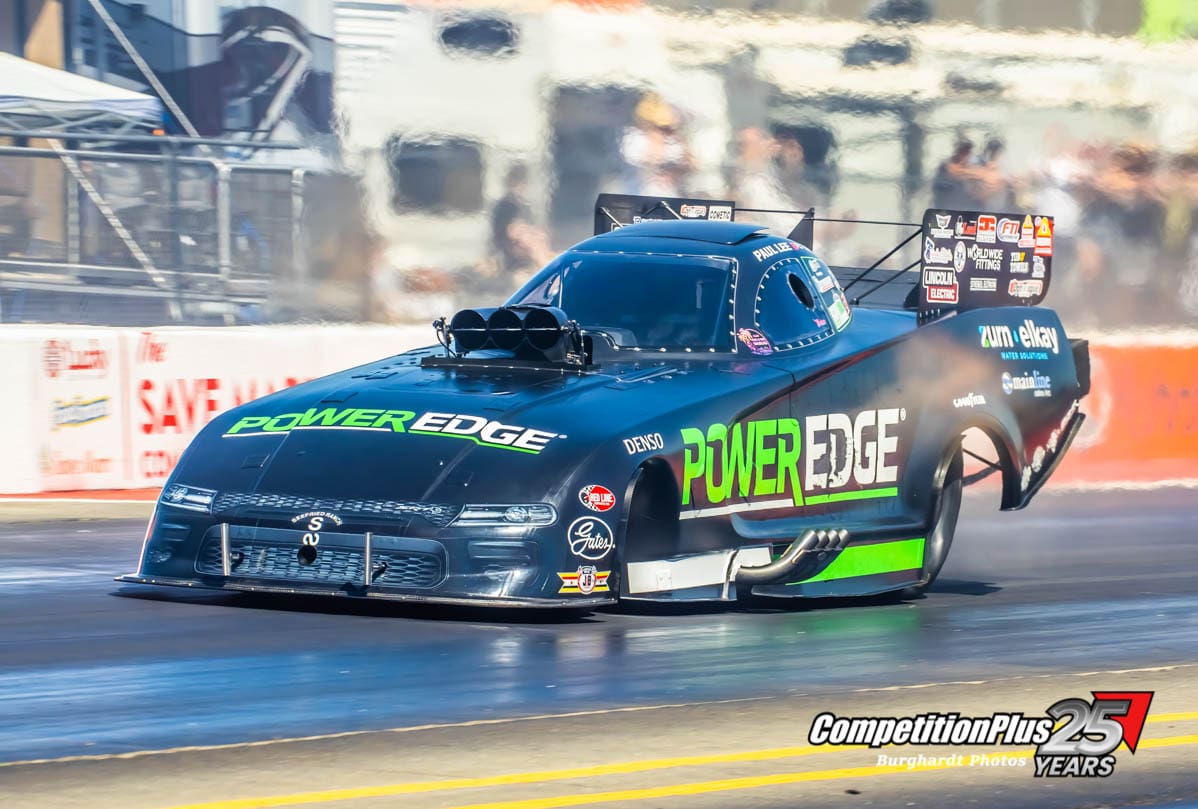
Matt Hagan, a veteran Funny Car champion, entered Gainesville with a clear directive from his crew chief to prioritize evaluation over exhibition.
Despite a car capable of carrying strong performance numbers to the finish line, Hagan and his team resisted the temptation to leg it out the back door during the weeklong session.
“It’s extremely difficult because you want to go out there and make some full pulls and lay down some great numbers,” Hagan said. “And you can always ask your crew chief, you go say, ‘Hey man, what was that going to run?’”
At Gainesville, Hagan said the team focused on validating new parts and confirming procedures rather than posting eye-catching elapsed times.
The Funny Car responded well in early increments, giving the driver every reason to keep his foot planted.
“It’s so hard to get to half-track and the car’s running great, and you go, ‘All right, I got to pull my foot out of it now,’” Hagan said. “Because you just want to run it out the back door.”
Instead, the approach emphasized part preservation and predictable application.
After a previous season marked by multiple explosions and parts attrition, the team placed a premium on finishing the test session with intact inventory.
“But also being said, coming into that test session, we had a lot of new parts and pieces and there was no reason to really run them to the end,” Hagan said. “We needed to make sure that they were going to work right and everything was going to go smooth.”
The philosophy represented a shift in mindset.
“I think that mentality of always having to run it to the end and flex your muscles and see, I think it is more of an old-school mentality,” Hagan said. “I think my new crew chief, Mike, has got that mentality of like, ‘Hey, here’s the budget, here’s what we’re doing, here’s how we’re going to do this.’”
That measured approach in Gainesville did not mean the car lacked capability.
It meant the team chose to leave something in reserve.
Testing also brings scrutiny when other teams light up the scoreboard.
Recent preseason sessions have produced 340-plus mph speeds in Top Fuel, prompting debate among fans who question the legitimacy of such numbers outside official eliminations.
Hagan rejected the suggestion that test-session accomplishments should be discounted.
“I think it definitely, it’s a knock to those guys because they probably were legal and they were probably doing what they needed to do to run that number,” he said.
He added that in nearly two decades of competition, his teams have never brought illegal combinations to testing.
“We never have in the 19 years that I’ve been doing it,” Hagan said.
To him, performance in testing still reflects real advancement.
“340 anything is getting it done,” Hagan said. “The incrementals and the times to do that, it’s so hard to do.”
For DeLago, preseason success is measured in confirmation, not celebration.
For Hagan, it is measured in discipline — even when the car begs for more throttle.
The time slips in February may not count toward a championship, but the information gathered often does.
“We say, ‘Okay, well there’s the new bar,’ and that’s what we’re all shooting for,” Hagan said.
In Top Fuel and Funny Car, that bar is rarely set by noise alone — it is built in the quiet, calculated work of testing.
Share the Insights?
Click here to share the article.
CLICK HERE
Facebook
Twitter
LinkedIn
ad space x ad space
ad space x ad space
Competition Plus Team
Since our inception, we have been passionately dedicated to delivering the most accurate, timely, and compelling content in the world of drag racing. Our readers depend on us for the latest news, in-depth features, expert analysis, and exclusive interviews that connect you to the sport’s pulse.
The most valuable nitro test sessions do not always produce the loudest numbers.
While preseason leaderboards can generate buzz, crew chiefs and drivers in Top Fuel and Funny Car insist the real work at a session like the P.R.O. Preseason Test is measured in data points, part durability and incremental gains that may not show up in a headline.
For veteran crew chief Tommy DeLago, testing begins with an agenda, not an elapsed time target.
Each team arrives with a defined objective, whether that means closing a performance gap, validating new components or building a foundation for a second car in the stable.
In his first preseason test overseeing Justin Ashley’s Top Fuel operation, DeLago balanced both refinement and expansion.
Ashley’s primary dragster required performance gains without sacrificing the consistency that kept it competitive, while a second entry demanded methodical attention simply to establish reliability.
“Each day’s a little different and each team has their own agenda,” DeLago said. “Obviously for the SCAG, Ashley dragster, it’s a pretty good running car, but we feel it’s a little bit behind compared to the top three, four cars out here. And so, we’re trying to work on improving our performance and hopefully not losing a bunch of consistency as we try to gain some performance.”
That balance dictated how aggressively the team pushed.
Some organizations arrive at preseason testing focused on personnel, giving new crew members repetitions under controlled conditions.
Others seek only to shake off rust, make a handful of clean runs and leave confident in their baseline.
DeLago’s approach in Gainesville began with establishing that baseline.
“I would say how we structured our week was we came in the first day and baseline the track with our stuff from last year, and then once we knew where that was at, trusted the track, then we went into testing some clutch stuff for New Year,” he said.
Before experimenting with clutch settings or new parts, the team needed to understand how the car reacted to familiar inputs on the current surface.
Only after confirming that foundation did DeLago feel comfortable introducing change.
Run distance, he emphasized, is determined by purpose rather than ego.
With a new or unproven combination, short launches are the norm.
“Well, obviously with, let’s say the Bluebird car, it’s never made a pass. I don’t know how everything’s working, if everything goes good in the warm-up, I’m still, I would only have them take it 150 feet, 120 feet, if it goes that far,” DeLago said. “Come back, make sure everything works.”
Fuel volume, ignition timing, clutch application and mechanical movement are reviewed before stretching a run to 330 feet or beyond.
Spark plugs, bearings and data traces provide more meaningful answers than a full 1,000-foot blast on a fragile combination.
Even with Ashley’s established car, DeLago said there was little reason to chase full-track numbers if the target zone was earlier on the strip.
“It’s like even when we came here, my plan was to run mostly eighth mile runs just to, I already know it runs good speed and the motor runs good down there,” he said. “I know where I’m trying to attack the track is all before 660.”
The focus for his team was between 60 feet and roughly 400 feet.
Back-half performance, often celebrated in mph figures, was already competitive.
Occasionally, a longer run is allowed to keep the driver comfortable and sharp.
But even then, the shutoff point may come early if the data objective has been met.
Testing, DeLago made clear, is about solving specific problems rather than proving capability already established.
From the cockpit, however, that discipline can test a driver’s resolve.
Matt Hagan, a veteran Funny Car champion, entered Gainesville with a clear directive from his crew chief to prioritize evaluation over exhibition.
Despite a car capable of carrying strong performance numbers to the finish line, Hagan and his team resisted the temptation to leg it out the back door during the weeklong session.
“It’s extremely difficult because you want to go out there and make some full pulls and lay down some great numbers,” Hagan said. “And you can always ask your crew chief, you go say, ‘Hey man, what was that going to run?’”
At Gainesville, Hagan said the team focused on validating new parts and confirming procedures rather than posting eye-catching elapsed times.
The Funny Car responded well in early increments, giving the driver every reason to keep his foot planted.
“It’s so hard to get to half-track and the car’s running great, and you go, ‘All right, I got to pull my foot out of it now,’” Hagan said. “Because you just want to run it out the back door.”
Instead, the approach emphasized part preservation and predictable application.
After a previous season marked by multiple explosions and parts attrition, the team placed a premium on finishing the test session with intact inventory.
“But also being said, coming into that test session, we had a lot of new parts and pieces and there was no reason to really run them to the end,” Hagan said. “We needed to make sure that they were going to work right and everything was going to go smooth.”
The philosophy represented a shift in mindset.
“I think that mentality of always having to run it to the end and flex your muscles and see, I think it is more of an old-school mentality,” Hagan said. “I think my new crew chief, Mike, has got that mentality of like, ‘Hey, here’s the budget, here’s what we’re doing, here’s how we’re going to do this.’”
That measured approach in Gainesville did not mean the car lacked capability.
It meant the team chose to leave something in reserve.
Testing also brings scrutiny when other teams light up the scoreboard.
Recent preseason sessions have produced 340-plus mph speeds in Top Fuel, prompting debate among fans who question the legitimacy of such numbers outside official eliminations.
Hagan rejected the suggestion that test-session accomplishments should be discounted.
“I think it definitely, it’s a knock to those guys because they probably were legal and they were probably doing what they needed to do to run that number,” he said.
He added that in nearly two decades of competition, his teams have never brought illegal combinations to testing.
“We never have in the 19 years that I’ve been doing it,” Hagan said.
To him, performance in testing still reflects real advancement.
“340 anything is getting it done,” Hagan said. “The incrementals and the times to do that, it’s so hard to do.”
For DeLago, preseason success is measured in confirmation, not celebration.
For Hagan, it is measured in discipline — even when the car begs for more throttle.
The time slips in February may not count toward a championship, but the information gathered often does.
“We say, ‘Okay, well there’s the new bar,’ and that’s what we’re all shooting for,” Hagan said.
In Top Fuel and Funny Car, that bar is rarely set by noise alone — it is built in the quiet, calculated work of testing.
John Doe
Lorem ipsum dolor sit amet consectetur adipiscing elit dolor
Thank you for joining us on this journey. Your support and trust inspire us every day to deliver the best in drag racing journalism. We are excited about the future and look forward to continuing to serve you with the same dedication and passion that has defined CompetitionPlus.com from the very beginning.
Don’t miss these other exciting stories!
Explore more action packed posts on Competition Plus, where we dive into the latest in Drag Racing News. Discover a range of topics, from race coverage to in-depth interviews, to keep you informed and entertained.
The most valuable nitro test sessions do not always produce the loudest numbers. While preseason leaderboards can generate buzz, crew chiefs and drivers in Top