
As NHRA celebrates the 25th season of its Pro Mod Drag Racing Series in 2026, the milestone invites a closer look at how the doorslammer category was introduced at the national level. The anniversary, spotlighted in a recent NHRA announcement, traces directly to a rain-delayed exhibition in 2001 — but the class’ foundation was shaped by two sanctioning bodies and two very different debuts.

While NHRA and IHRA operated under separate rulebooks and philosophies, both launched Pro Modified through exhibition events that became defining moments in drag racing history. Those introductions, 12 years apart, unfolded under dramatically different circumstances yet helped establish one of the sport’s most resilient doorslammer divisions.

NHRA’s first Pro Modified exhibition took place in March 2001, marking its formal step toward integrating the class into national competition. Sixteen cars entered, competing for eight qualifying spots.

The bump spot belonged to Troy Critchley at 6.372 seconds. The field split evenly between four supercharged and four nitrous-injected entries.

Only two qualifying sessions were completed before rain washed out the weekend. The exhibition was rescheduled for the following weekend, placing it directly on top of the IHRA season opener in Darlington.

The scheduling conflict thinned the field, as most teams honored their Darlington commitments. Only four of the original entries returned for the rescheduled NHRA exhibition.

When eliminations were finally contested, Rickie Smith, driving a nitrous-injected Dodge Viper, defeated Kirk Kuhns to claim the inaugural NHRA Pro Modified exhibition title. The victory provided early validation for a class still carving out its place within the NHRA structure.

One of the most memorable moments of that debut came during qualifying.

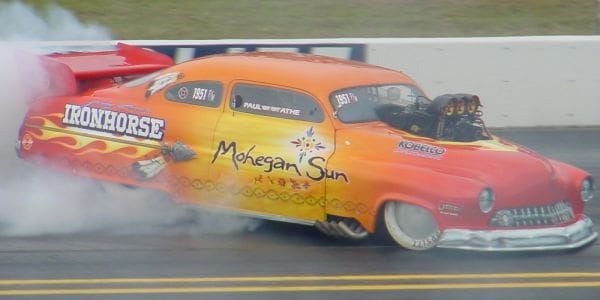
Paul Athey, driving Johnny Rocca’s 1949 Mercury, lost control during his burnout, crossed the centerline and sideswiped Ronnie Hood’s 1963 Corvette. Both drivers backed up and staged despite the contact.

Athey aborted his run early, while Hood posted a 6.322-second pass at 224.25 mph to take the provisional pole.

There were a score of onlookers watching the exhibition, including 16-time NHRA Funny Car champion John Force. The moment became part of Pro Mod lore not because of the contact, but because of who was paying attention.

Alcohol Funny Car standout Jay Payne stood alongside his father-in-law, Top Alcohol icon Brad Anderson. After seeing Rocca — dressed in full Indian garb — back the car up and then witnessing the contact and continuation of the run, legend has it Payne turned to Anderson and said, “They have Indians, they crash into each other and still race, ‘we gotta have one of those.”

Shortly thereafter, they fielded a supercharged Camaro Pro Modified, adding to the growing momentum behind the category.

Paul Fink Photo

That 2001 exhibition laid the groundwork for expansion. The class evolved into a regional presence before becoming an official NHRA national championship category in 2010.

Now, as NHRA celebrates its 25th Pro Mod season as part of the NHRA Mission Foods Drag Racing Series, the class competes at 11 national events across the country. To commemorate the milestone, NHRA is streaming one round of qualifying each day and the opening round of eliminations live and free on its YouTube page at every Pro Mod event in 2026.

“NHRA Pro Mod being streamed live on YouTube isn’t just exposure — it’s proof of our evolution,” NHRA Pro Mod driver and Team Shelton Motorsports owner Stan Shelton said. “We’re a self-managed class with a clear identity, and this growth reflects the power of that model within the NHRA. We’re excited to celebrate the 25th year of Pro Mod in NHRA and we’re looking forward to a great season.”

NHRA Senior Vice President Evan Jonat said the anniversary reflects the category’s competitive depth and staying power.

“The 2026 season is a milestone moment for NHRA Pro Mod Drag Racing Series, which continues to be one of the most exciting and unpredictable categories in drag racing,” Jonat said. “We’re proud to celebrate this anniversary across all 11 events this year and offer fans free coverage on the NHRA YouTube page. With a bigger spotlight, it’s a great opportunity for these talented drivers to showcase their skills and what makes this class so enjoyable to watch.”

Auto Imagery Photo

More than a decade before NHRA staged its exhibition, IHRA introduced Pro Modified in October 1989 at Atco Dragway. The 16-car exhibition carried no points and offered a $4,000 winner’s purse along with the right to display the No. 1 designation for the inaugural season.

The class had been formally named only days earlier in Drag Review, and event flyers listed it simply as “Pro 16.” National coverage was minimal, and the IHRA media guide made little mention of the debut.

Much of the recollection of that weekend comes from interviews conducted in 2005 with those who were present.

“Ever since I came on the scene in 1987 and watched Kuhlmann run the 200, I fell into this whole excitement and as a west coast guy, we always had a lot of racing excitement out there,” Don Gillespie said in a 2005 interview. “But, seeing this whole thing unfold and the excitement on the faces of those people in an area that didn’t experience a lot of that was priceless. It was really big on a race-to-race basis. This was the center of the drag racing universe for this period of time.”

“When the race started, there was a very positive feeling throughout the place,” Ted Jones said in 2005. “Everybody was up and excited about the event. We felt like we were on the cusp of something really big.”

Don Gillespie Photo

That optimism changed during eliminations.

Walter Henry lost control of his Corvette when a tire entered the grass recovery area between the racing surface and the retaining wall. The car crossed lanes, went airborne and struck a scoreboard beam, killing him instantly from massive internal injuries.

Lane Green, in the opposite lane, had lifted early after tire shake. Had he remained alongside Henry, the accident might have involved both cars.

Henry had planned to retire after the event and turn driving duties over to his son Gary, who was preparing to begin licensing.

In a 2005 interview, Bill Kuhlmann reflected on leaving the track after winning the event.

“I had mixed emotions about leaving that place when I pulled out and saw Walter’s rig sitting over there like a ghost,” Kuhlmann said. “It was really emotional. You get to win the first race and a friend gets killed. All of my circuits were overloaded that day.”

“There was an eerie feeling about that whole weekend and the experience,” Gillespie said in 2005. “It was just before Halloween and all of the houses and everywhere were decorated with skeletons and various things associated with death. That whole thing made it eerie. Knowing that a good friend has just died violently and seeing all of those images just made me sick to my stomach.”

Share the Insights?

Click here to share the article.

ad space x ad space

ad space x ad space

Competition Plus Team

Since our inception, we have been passionately dedicated to delivering the most accurate, timely, and compelling content in the world of drag racing. Our readers depend on us for the latest news, in-depth features, expert analysis, and exclusive interviews that connect you to the sport’s pulse.

Sign up for our newsletters and email list.

This field is for validation purposes and should be left unchanged.
Name

AS NHRA CELEBRATES 25 YEARS OF PRO MOD, CLASS EXHIBITION ROOTS TRACE BACK TO TWO MEMORABLE DEBUTS

As NHRA celebrates the 25th season of its Pro Mod Drag Racing Series in 2026, the milestone invites a closer look at how the doorslammer category was introduced at the national level. The anniversary, spotlighted in a recent NHRA announcement, traces directly to a rain-delayed exhibition in 2001 — but the class’ foundation was shaped by two sanctioning bodies and two very different debuts.

While NHRA and IHRA operated under separate rulebooks and philosophies, both launched Pro Modified through exhibition events that became defining moments in drag racing history. Those introductions, 12 years apart, unfolded under dramatically different circumstances yet helped establish one of the sport’s most resilient doorslammer divisions.

NHRA’s first Pro Modified exhibition took place in March 2001, marking its formal step toward integrating the class into national competition. Sixteen cars entered, competing for eight qualifying spots.
The bump spot belonged to Troy Critchley at 6.372 seconds. The field split evenly between four supercharged and four nitrous-injected entries.

Only two qualifying sessions were completed before rain washed out the weekend. The exhibition was rescheduled for the following weekend, placing it directly on top of the IHRA season opener in Darlington.

The scheduling conflict thinned the field, as most teams honored their Darlington commitments. Only four of the original entries returned for the rescheduled NHRA exhibition.

When eliminations were finally contested, Rickie Smith, driving a nitrous-injected Dodge Viper, defeated Kirk Kuhns to claim the inaugural NHRA Pro Modified exhibition title. The victory provided early validation for a class still carving out its place within the NHRA structure.

One of the most memorable moments of that debut came during qualifying.

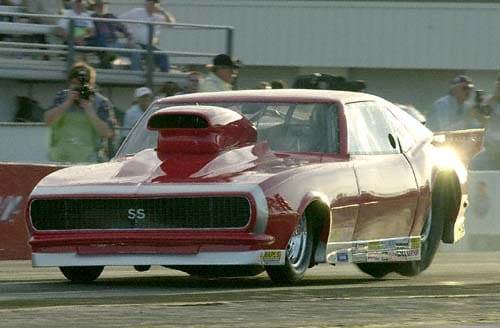
Paul Athey, driving Johnny Rocca’s 1949 Mercury, lost control during his burnout, crossed the centerline and sideswiped Ronnie Hood’s 1963 Corvette. Both drivers backed up and staged despite the contact.

Athey aborted his run early, while Hood posted a 6.322-second pass at 224.25 mph to take the provisional pole.

There were a score of onlookers watching the exhibition, including 16-time NHRA Funny Car champion John Force. The moment became part of Pro Mod lore not because of the contact, but because of who was paying attention.

Alcohol Funny Car standout Jay Payne stood alongside his father-in-law, Top Alcohol icon Brad Anderson. After seeing Rocca — dressed in full Indian garb — back the car up and then witnessing the contact and continuation of the run, legend has it Payne turned to Anderson and said, “They have Indians, they crash into each other and still race, ‘we gotta have one of those.”

Shortly thereafter, they fielded a supercharged Camaro Pro Modified, adding to the growing momentum behind the category.
Paul Fink Photo

That 2001 exhibition laid the groundwork for expansion. The class evolved into a regional presence before becoming an official NHRA national championship category in 2010.

Now, as NHRA celebrates its 25th Pro Mod season as part of the NHRA Mission Foods Drag Racing Series, the class competes at 11 national events across the country. To commemorate the milestone, NHRA is streaming one round of qualifying each day and the opening round of eliminations live and free on its YouTube page at every Pro Mod event in 2026.

“NHRA Pro Mod being streamed live on YouTube isn’t just exposure — it’s proof of our evolution,” NHRA Pro Mod driver and Team Shelton Motorsports owner Stan Shelton said. “We’re a self-managed class with a clear identity, and this growth reflects the power of that model within the NHRA. We’re excited to celebrate the 25th year of Pro Mod in NHRA and we’re looking forward to a great season.”

NHRA Senior Vice President Evan Jonat said the anniversary reflects the category’s competitive depth and staying power.

“The 2026 season is a milestone moment for NHRA Pro Mod Drag Racing Series, which continues to be one of the most exciting and unpredictable categories in drag racing,” Jonat said. “We’re proud to celebrate this anniversary across all 11 events this year and offer fans free coverage on the NHRA YouTube page. With a bigger spotlight, it’s a great opportunity for these talented drivers to showcase their skills and what makes this class so enjoyable to watch.”

Auto Imagery Photo

More than a decade before NHRA staged its exhibition, IHRA introduced Pro Modified in October 1989 at Atco Dragway. The 16-car exhibition carried no points and offered a $4,000 winner’s purse along with the right to display the No. 1 designation for the inaugural season.

The class had been formally named only days earlier in Drag Review, and event flyers listed it simply as “Pro 16.” National coverage was minimal, and the IHRA media guide made little mention of the debut.

Much of the recollection of that weekend comes from interviews conducted in 2005 with those who were present.

“Ever since I came on the scene in 1987 and watched Kuhlmann run the 200, I fell into this whole excitement and as a west coast guy, we always had a lot of racing excitement out there,” Don Gillespie said in a 2005 interview. “But, seeing this whole thing unfold and the excitement on the faces of those people in an area that didn’t experience a lot of that was priceless. It was really big on a race-to-race basis. This was the center of the drag racing universe for this period of time.”

“When the race started, there was a very positive feeling throughout the place,” Ted Jones said in 2005. “Everybody was up and excited about the event. We felt like we were on the cusp of something really big.”
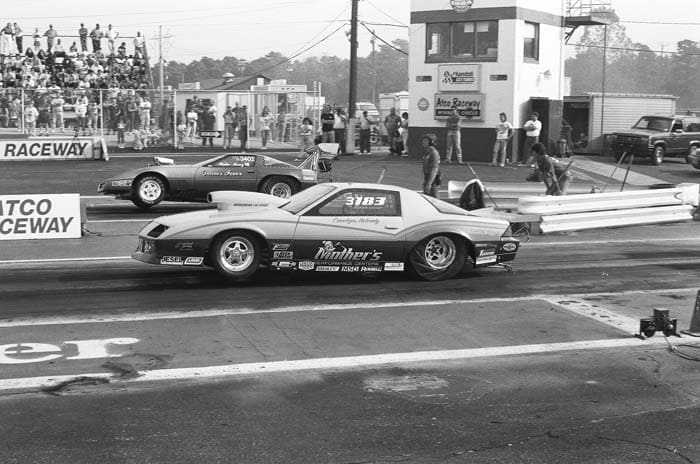
Don Gillespie Photo

That optimism changed during eliminations.

Walter Henry lost control of his Corvette when a tire entered the grass recovery area between the racing surface and the retaining wall. The car crossed lanes, went airborne and struck a scoreboard beam, killing him instantly from massive internal injuries.

Lane Green, in the opposite lane, had lifted early after tire shake. Had he remained alongside Henry, the accident might have involved both cars.

Henry had planned to retire after the event and turn driving duties over to his son Gary, who was preparing to begin licensing.

In a 2005 interview, Bill Kuhlmann reflected on leaving the track after winning the event.

“I had mixed emotions about leaving that place when I pulled out and saw Walter’s rig sitting over there like a ghost,” Kuhlmann said. “It was really emotional. You get to win the first race and a friend gets killed. All of my circuits were overloaded that day.”

“There was an eerie feeling about that whole weekend and the experience,” Gillespie said in 2005. “It was just before Halloween and all of the houses and everywhere were decorated with skeletons and various things associated with death. That whole thing made it eerie. Knowing that a good friend has just died violently and seeing all of those images just made me sick to my stomach.”

Picture of John Doe

John Doe

Lorem ipsum dolor sit amet consectetur adipiscing elit dolor

More Posts

Send Us A Message

Picture of Bobby Bennett
Bobby Bennett
Thank you for joining us on this journey. Your support and trust inspire us every day to deliver the best in drag racing journalism. We are excited about the future and look forward to continuing to serve you with the same dedication and passion that has defined CompetitionPlus.com from the very beginning.

Don’t miss these other exciting stories!

Explore more action packed posts on Competition Plus, where we dive into the latest in Drag Racing News. Discover a range of topics, from race coverage to in-depth interviews, to keep you informed and entertained.