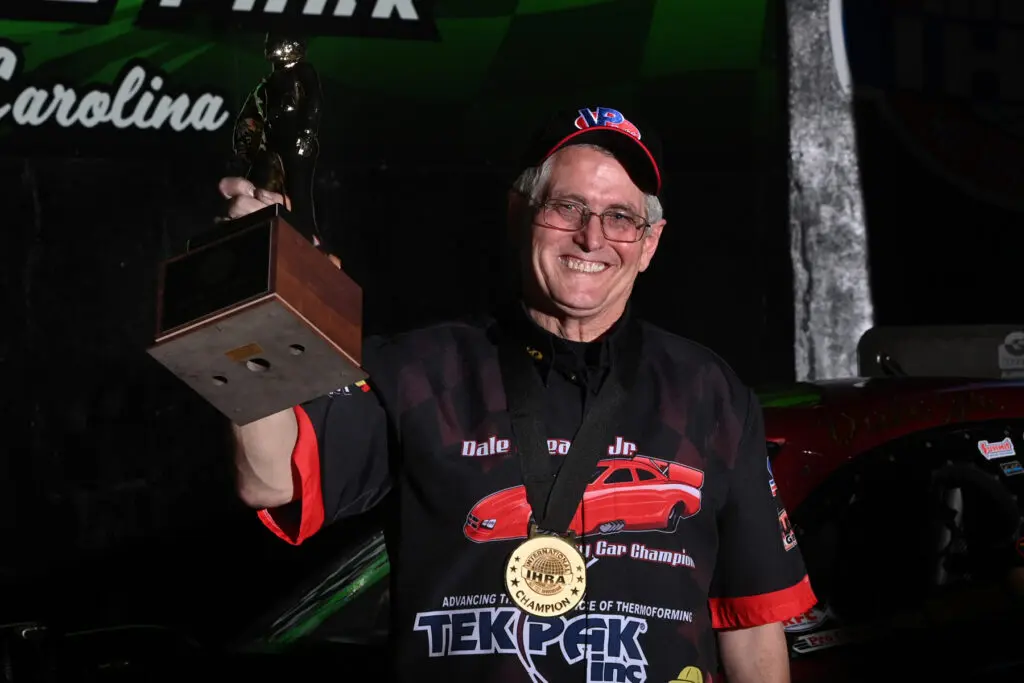

Dale Creasy Jr. sees the comments. He doesn’t have to go looking for them because they find him, usually after a win and usually from someone who has never turned a wrench on a Funny Car. They question the legitimacy of his wins, the series he runs, and the track length, and after a while it all blends together.
He lets them talk. Always has. That approach didn’t come from ignoring it, but from learning what matters and what doesn’t over a long time in a sport that has already tested him in ways most of them never will.
“It’s one of them things that most of the people that are making those comments are sitting on their mom’s couch in their basement making fun of people that are doing what we’re doing, and they have no clue. I mean, no clue. Unless you’ve actually worked on one of these cars or been around a team every day, you don’t understand the hours or the pressure that comes with it.”
He doesn’t say it angry. It comes out level, like something that has already been settled and filed away.
There’s a line in this sport between people who watch it and people who have had it take something from them.
Creasy crossed it years before the comments ever showed up.
What happened in 2008 made sure there was no going back.

“Up to that race, we had won three or four of the first five or six, and we were doing well there,” Creasy said. “And I think it was second round, hit the gas and a coupler broke on the drive shaft. There wasn’t anything leading up to it, nothing that made you think something was about to happen, and once it did, you were already in it.”
It didn’t build. It arrived all at once, and once it started, there wasn’t anything he could do to stop it.
“And at that time, we didn’t have the tunnels blocking it, and it spun around and broke both of my legs in multiple places,” he said. “It was just a fluke because the parts were newer, but something happened and then it kept spinning around, and it was pretty bad. It didn’t hit once and stop, it just kept going.”
From the outside, the car stayed straight. It didn’t cross lanes, didn’t give anyone a reason to think something inside had gone completely wrong.
That disconnect delayed the reaction, because what people saw didn’t match what he was dealing with.
“I couldn’t see it with my helmet on, but once I took my helmet off, I looked down and I’m like, ‘Oh my God,’” Creasy said. “At that point, you know it’s not something small and you know it’s going to take time to get through it.”
That was the moment everything shifted.
“I compared it to Misery, the movie where she hits him with a hammer on the ankles, but this kept going,” Creasy said. “It didn’t stop after the first one, and you don’t have a way to get away from it. You’re just there for it, and you’ve got to deal with it until it’s over.”
The impacts didn’t come clean. They stacked, one after another, and there was no way to interrupt what was happening.
“And after five or six hits, whatever it was, I got on the radio and I said, ‘When I stop, somebody needs to be here to help me,’ but by that time it tore all the wires out,” he said. “After that, you’re on your own, and you just have to stay with it and keep doing your job until it stops.”
His focus stayed on the car. That’s what he could still control.
“During this whole thing, I kept telling myself, ‘Pay attention. Don’t go in the other lane. Don’t crash your car,’ because there’s nothing you can do,” Creasy said. “You just have to wait for it to stop.”
That mindset kept it from getting worse.
VIDEO – FOOTAGE FROM THE ACCIDENT
“When it stopped, the guy pulled up and hooked the rope up to pull me off the track and I stopped him,” Creasy said. “He came and looked and I thought he was going to pass out, and I still had no idea how bad it looked.”
What the car showed didn’t match what had happened. That changed once someone saw it up close.
“My right leg was the better of the two and it was underneath the driveshaft on the left side, and it was pretty bad,” he said. “The way things were twisted up, you knew something wasn’t right.”
The injuries were severe.
“The left leg was the worst,” Creasy said. “It took an inch and a half out of the tibia, crushed my ankle, and crushed my big toe, and the right leg was in the teens of fractures but that was the good leg.”
That’s when the focus changed.

“The last thing I remember when I was going into surgery, the doctor said, ‘We might have to take that leg off,’” Creasy said. “I’m looking at him like, ‘Please don’t do that.’”
That moment removed everything else. Racing didn’t matter.
“When I came out of surgery, the foot was still there, and that was the first thing I checked,” he said. “Once I saw that, I knew we had something to work with.”
That was the win that day.
Everything else came later.
“It took 13 surgeries and six or eight months before I could even get into heavy rehab,” Creasy said. “A year later I was back in the car, still with a cane, but I was back in the car.”
The timeline doesn’t show the setbacks.
“It was setback after setback because of infection from skin grafts,” he said. “It was six to eight months before I could even start rehab.”
Once he could start, he didn’t ease into it.
“I went full bore because I wanted to be back in the car that year,” Creasy said. “That was the goal from the start.”
That approach carried him through it.

“There were times where I’m laying there thinking, ‘What am I doing?’ with two broken legs and I’m thinking about fixing my race car,” Creasy said. “It doesn’t make a lot of sense, but that’s what kept me going.”
That focus gave him something ahead of him.
“If I didn’t have that to focus on, it would’ve been a lot harder to get through it,” he said.
When he came back, the first runs weren’t about results.
“We went to Salt Lake for a match race and then back to Edmonton,” Creasy said. “I had to go there to get it out of my head.”
That’s how he got past it.
There had already been discussion about a driveshaft containment tunnel, but teams had resisted the cost.
“They called me and asked for pictures of my leg, and I told them they didn’t want to see them,” Creasy said. “But I sent them anyway because they needed to understand what happened.”
That changed the conversation.
“They saw it and it didn’t take long, and the rule was in,” he said. “Once they saw what it did, there wasn’t much discussion after that.”
After that, it wasn’t optional anymore.
Creasy had fires and engine explosions after Edmonton, and none of them changed his plan to keep racing. That part never wavered.
Then came October 13, 2023. First round of Funny Car qualifying at the Texas NHRA FallNationals at Texas Motorplex. His car crossed the centerline and collided with Dave Richards, destroying both machines.
“There was a point where I was done, and I knew it,” Creasy said. “That was Dallas, and I could’ve told you right then it was over.”
That moment landed differently than Edmonton. This time, it wasn’t about surviving it. It was about whether it was time to walk away.
A friend told him to take a step back and figure out what he really wanted, not what the moment was telling him.
“I’m driving home thinking, ‘I’m not done yet,’” Creasy said. “Once that hit me, everything started moving again.”


That decision meant starting over again. New car. More money than expected. Same commitment.
“This move was more expensive than I thought it would be, and I know what parts cost,” Creasy said. “But everything is new, everything is up to date, and this car drives better than anything I’ve had before.”
That’s not someone easing back in.
That’s someone deciding to keep going.
“I don’t think people realize how hard we work,” he said. “It’s 12 to 14 hours a day, every day, and it doesn’t stop.”
That part never shows up.
“If it’s still in your heart, don’t let anything beat you.”