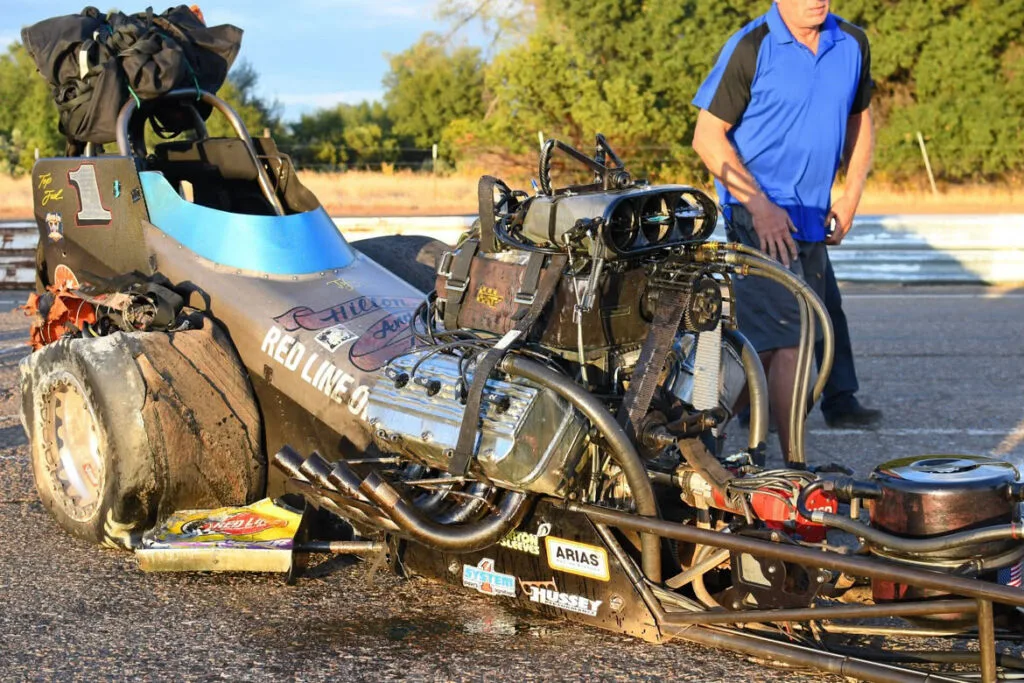


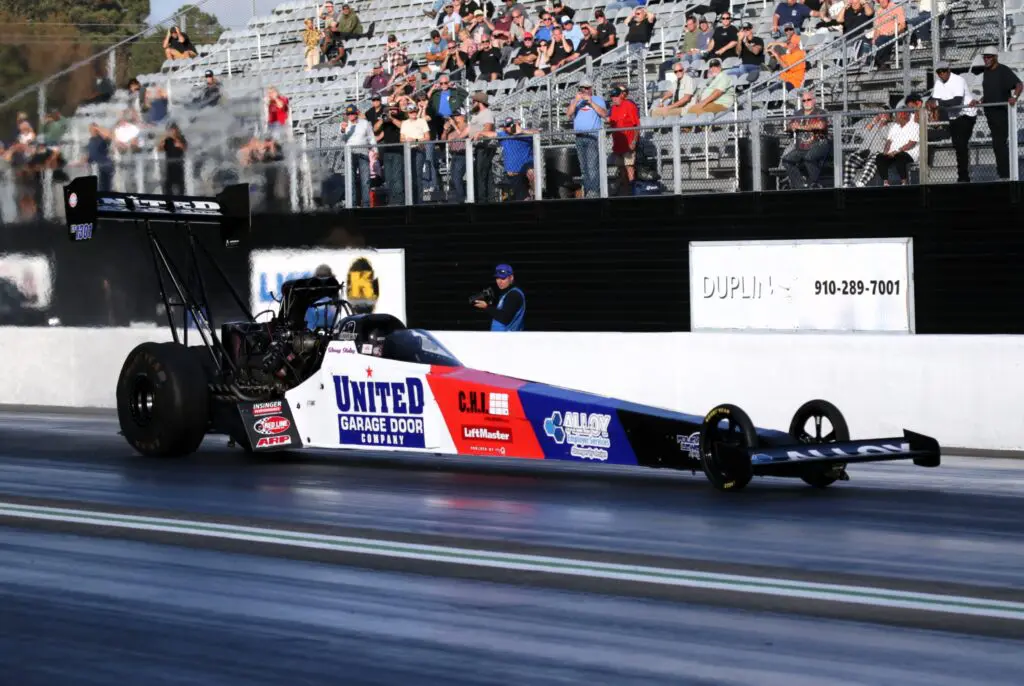
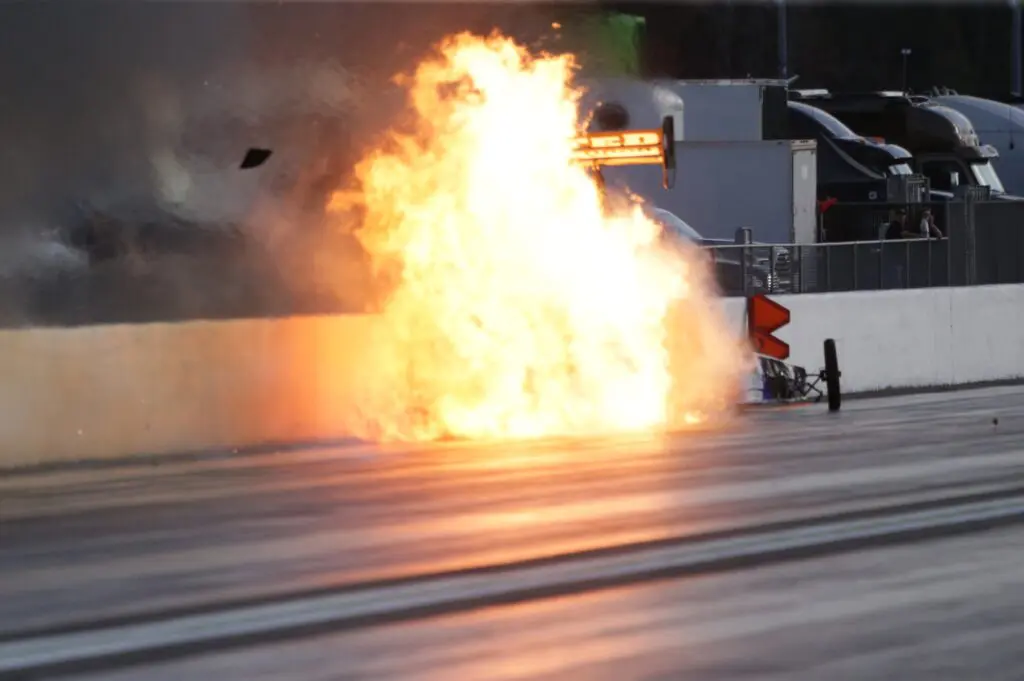
Veteran Top Fuel driver Doug Foley knows how quickly a good run can turn bad. During Friday night’s opening round of IHRA Outlaw Nitro Series qualifying at Darana Motorsports Park in Dunn, North Carolina, his dragster lost traction, turned sharply left, and slammed hard into the wall before grinding to a stop downtrack.
Within seconds, IHRA safety crews were on the scene. Foley climbed from the wreckage under his own power — alert, responsive, and visibly frustrated. The car was destroyed, but the man walked away. For a driver who’s seen both sides of danger, that mattered most.
“No, they don’t play around,” Foley said afterward, referring to the violent temperament of a Top Fuel dragster. “We analyze footage 12 days till Sunday, from yesterday to today, just looking at it and seeing, did I overdrive the car? What did I do wrong? Was there fluid on the track? Was there this? Was there that? And to be honest with you, I think it’s one of those things where it’s a Top Fuel car. If you don’t want us to have a problem, don’t start it.”
Foley quickly ruled out the idea that track conditions caused the crash. The issue, he believes, came from the car itself — or perhaps something unseen in that split-second chaos. “The track was great,” he said. “The biggest part I can’t figure out is why did it turn left so quickly? That’s the thing that baffles me.”
When the run went wrong, it went wrong fast. Foley said the car’s onboard computer provides a second-by-second record of what happened, but even that didn’t reveal a clear cause. “There was no doubt it started spinning the tire,” he said. “You can look at when it started spinning the tire. You can look when I lifted off the gas. There’s two-tenths of a second difference. The computer will tell you everything you want to know.”
Still, some questions remain unanswered. “There is a possibility that, because you can still see some slight header flames coming out — which, even at that point, it should still keep it straight — so why the left turn? I have no idea,” he said. “It is what it is. We just learn as much as we can and go back and do it again.”
That mindset — learning, rebuilding, and moving forward — is what separates survivors from statistics in drag racing. Foley said that when a Top Fuel car loses traction, the driver must act purely on instinct. “Reaction time is so important on the starting line,” he said. “But reaction time when it comes to smoking the tires in one of these things, even when you can’t even see the tires… you just have to react immediately.”
He spent hours reviewing video, slowing it down frame by frame to see if throttle movement played any role. “We can see that the butterflies close,” Foley said. “Whether it looks like, because it shook a little bit, did it keep the throttle blades open just a hair, enough to still power it and let it turn? I don’t know all of that.”
Some on social media suggested Foley might have overdriven the car. He doesn’t buy it. “There were some comments that I overdrove it, which I take personally because I’ve been out here for a while, and I don’t take crashing a car lightly,” he said. “I looked at it. I think it’s time to put it to rest and say, ‘Hey, listen, I don’t see anywhere where I did much wrong.’ Obviously, something went wrong, and I’m the one in the seat, so the responsibility is on me.”
That responsibility includes accepting what can’t be saved. “Yeah, it’s done,” Foley said bluntly when asked about the chassis. “You can keep the cockpit in almost any car, but other than that, yeah, there’s nothing left of that thing.”
The dragster may have been beyond repair, but Foley was not. When asked if he suffered a concussion, he shook his head. “I don’t believe so,” he said. “I never really went out. I was definitely aware the entire time. It did hit hard.”
For that, Foley credits Trevor Ashline of ESS — one of drag racing’s leading safety minds — who worked closely with him over the offseason. “If this was 10 years ago, I’d be in bad shape,” Foley said. “He takes the time to look at it. Over the winter, we need to do different belts, different head and neck restraint, different things. The fact that he took the time to help me out probably saved my ass in that car.”
🔥 48-HOUR SALE! 🔥 Odd-lots, short-lots, closeouts & display shirts — all priced to move! 🏁 Get authentic https://t.co/jcAfIG1TiW gear for as low as $10 👕💥
— Competition Plus (@competitionplus) November 6, 2025
When they’re gone, they’re gone!
👉 https://t.co/ZWQRwUgEQb #DragRacing #NHRA #CompetitionPlus #PEAKSquad #Sale… pic.twitter.com/UOWDUKCRSP
This isn’t the first time Foley has stared down the consequences of a Top Fuel crash. In 2006, he wrecked during a run and spent days recovering from a serious concussion and shoulder injury. That experience, he said, is why he invests heavily in safety — and why he respects how far the sport has come. “I crashed in ’06 when we didn’t have much safety stuff, to be honest with you, and I was in bad shape after that one,” Foley recalled. “Different crash, every crash is different, but the head impact was very similar.”
This time, he refused a hospital visit despite pressure from medical staff. “They were pushing me very hard to go to the hospital, and I said, ‘No, I’m fine. I’m not going,’” he said. “I was in pain, but just not anything that needed a doctor or a surgeon. Just need a little time, a little bit of aspirin, and just spend a little time with my wife, and my son, and my guys, and killed our pride.”
Beyond the physical pain, Foley admitted the crash stung emotionally. It derailed sponsor commitments and hospitality plans that were set for the weekend. “We had commitments, as far as hospitality goes today, and things like that — disappointing because we’re always working on growing our program,” he said. “Fortunately, everybody is understanding, but we work very hard to try and make this a quality program from start to finish.”
He also credited NHRA’s influence for helping improve safety standards across all professional sanctioning bodies. “Some of the kudos has to go to NHRA on the fact that they don’t give you much leeway on that safety stuff,” Foley said. “If you’re going to race over there, they require it. Not that IHRA is not implementing the same rules, but we were trying to keep our car just to the proper standards. And by doing that, it helped on the safety side.”
Despite the intensity of the impact, Foley said the physical toll was relatively light compared to earlier accidents in his career. “Yeah, I mean, I had a slight headache,” he said. “Unfortunately, hitting the left side — I seem to always hit the left wall. Last time in ’06, I separated that shoulder and got my bell rung. That one was definitely a concussion. This one I don’t believe is a concussion, but same shoulder socket taking that abuse.”
By the next morning, Foley was back in work mode. “I’m not getting any younger, you know,” he said, half-jokingly. “We got some stuff done at the track, got everybody situated, get everybody flights home, figure all that stuff out. We’ll start tomorrow tearing the car apart in the shop and get it ready to go somewhere.”

Foley’s next step is already in motion. A brand-new PBRC-built dragster is waiting in his shop — a project he had planned before the crash but will now fast-track. “I have a brand new PBRC car in the shop that we were going to start building anyway,” he said. “We were going to have two cars next year, which we still will.”
He knows rebuilding won’t come cheap, but it’s part of the commitment. “I got great sponsors with United, and Alloy, and Coble — these are just people that support our program,” Foley said. “So, we’ll rebuild. We’ll have two cars in the trailer when we head to testing, and we’ll figure it out. It’s definitely going to hurt the pocketbook, but we’ll figure it out.”
Foley’s willingness to face the danger again — to climb back into a car that just tried to destroy itself — speaks to the mindset that drives nitro racers. For them, control and chaos live inches apart, and when one wins, the other learns.
Even after a violent crash, Foley’s words summed up the paradox that defines drag racing’s bravest. “If you don’t want us to have a problem,” he said, “don’t start it.”