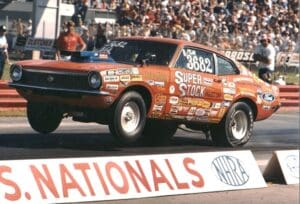
Back in the 1970s, long before any of today’s Super-class racing existed, sportsman drag racers were searching for an affordable way to compete heads-up. They wanted no breakout racing and no dial-ins, preferring competition based on a pounds-per-cubic-inch formula similar to the class racing they already knew. Those desires ultimately led to the creation of Super Modified, the original 10.5-tire form of racing.
Not far removed from the 1974 U.S. energy crisis, class racers — then the only option for national-event sportsman racing — began feeling the sting of extreme operating costs. Fuel, parts, and travel expenses were rising quickly. Many racers opted for the new craze of the time, bracket racing, while a good number remained true to their craft, seeking creative ways to preserve the only kind of racing they knew.
As was the case with many good ideas of the era, the concept began on a scratch sheet of paper and, through the support of a major magazine, became reality.
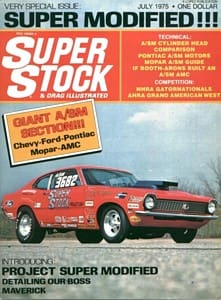
Car Craft Magazine presented the Super Modified concept in its July 1974 issue.
“We had just completed the Econo Dragster crusade and we wanted to do a doorslammer-oriented version,” recalled former Car Craft magazine staffer Rick Voeglin in a 2004 interview. “Our initial version was to be called Pro Modified. It was intended to be a heads-up eliminator for sportsman racing on an affordable level.”
The objective was to attract body styles such as 1967-and-later muscle cars and some compacts. The vision included Camaros, Chevy IIs, Dusters, Barracudas, Mavericks, Firebirds and AMC Hornets, just to name a few. The pounds-per-cubic-inch ratio was established at 10 pounds. If a racer preferred a small-block engine, the rules stipulated it had to match a combination that originally came with the car.
The initial Car Craft “rulebook” called for a fiberglass hood with an all-steel body. Engines were limited to a single four-barrel carburetor, flat-tappet camshaft and stock cylinder-head ports. The suspension had to be acceptable in Super Stock, and tires could be as large as 12 inches. The goal was to tap into the large contingent of C through G Modified Production cars already attending national events. As the magazine noted at the time, “A small block in a 3,000-pound car is a natural combination.”
Car Craft magazine drafted the initial concept for Super Modified. Staffer Rick Voeglin built this competitive entry for less than a $5,000 investment.
NHRA took notice only after a growing number of racers began planning and building cars to meet the proposed rules. That groundswell also inspired the up-and-coming IHRA to offer these cars a place to race — and eventually their own stand-alone eliminator.
Final NHRA rules mandated a 10.5-inch tire, a 10-point roll cage and production cylinder heads, which could be ported one inch down. Cars had to be production models from 1967 or later, with at least 500 units produced. Wheelbase was limited to 103 inches. Engines were restricted to a single four-barrel carburetor, transmissions had to match the manufacturer, spoilers had to be production, suspension had to remain stock and chassis lightening was prohibited. Weight distribution was set at 50/50, and bodies could not feature external modifications.
In 1975, NHRA competition featured just one class at a 9.5-pound-per-cubic-inch rule. One year later, the category expanded to three classes — 8.5, 9.5 and 10.5 — labeled A through C.
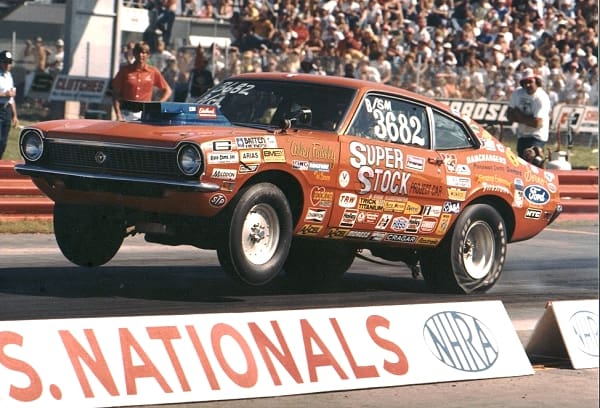
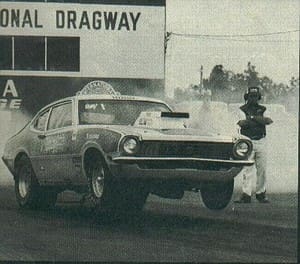
One of the icons of the Super Modified movement was Arlen Fadely, who ironically built a Maverick for the class as a project car for Super Stock and Drag Illustrated magazine.
The Maverick developed by Fadely, Leroy Hinzman and Ed Bennett was nothing short of a full-fledged effort.
“I watched as most of the Trans-Am Series cars started out as body-in-white versions,” Fadely recalled in a 2004 interview with CompetitionPlus.com. “Ford was pretty screwed up at that time and you could actually buy a body in white through the dealerships. I ordered one from Walt Hickey Ford in Southgate, Michigan, and paid $450 for it.”
The package included the doors and deck lid — and little else. Fadely immediately had the car shipped to Don Hardy, who prepared it according to the rulebook. The car was trick in every aspect.
Interest in this type of drag racing continued to build, inspiring NHRA rivals — the American Hot Rod Association and International Hot Rod Association — to consider the trend and the possibility of making Super Modified a stand-alone eliminator.
Fadely, however, was one of the few racers who never wanted Super Modified to become a stand-alone class, believing it would ultimately be detrimental to its long-term survival.
“There was a lot of wishful thinking during that time that it would become a junior Pro Stock class,” Fadely said. “Those kinds of deals are never destined to work. It didn’t work in the IHRA and it certainly didn’t work in the AHRA with the GT classes. When you have that style of racing, it’s always exciting to watch. But as the season wears on and guys become less competitive, participation begins to fall off. There’s always a big difference between the successful teams and those less fortunate.”
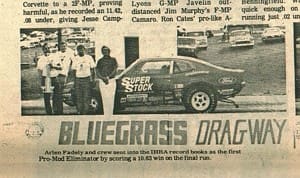
Super Modified was actually originally referred to as Pro Modified, as evidenced by this old Drag Review clipping circa 1974.
Rickie Smith, the most successful Super Modified racer in IHRA competition, was often cited as the reason the Bristol, Tenn.-based sanctioning body eventually dropped the class.
Simply put, many believed IHRA Super Modified died because Smith won too many races and the competition stopped showing up.
“The IHRA just canceled the class,” Smith said in 2004. “That certainly wasn’t my fault. I raced by the rules, and the rulebook allowed us to run a bigger tire and that was about it. We just had the right combination, and I think in about a year or so everyone would have caught up with us. But we worked hard — real hard.
“There were many nights that I laid on my back in the parking lot of my motel working on that car.”
Pro Stock legend Rickie Smith took three-quarters of the event wins in the IHRA’s stand-alone version of Super Modified. The class was eventually cancelled, but Smith points out that he was more determined than anyone else and that was why he won so much.
Smith continued, “Too many guys wanted to go out after the races instead of working on their cars, and then when it came time to race they wanted to whine because we had an advantage. I was fresh out of high school, an ex-athlete, very determined and full of willpower. I didn’t have the money, but I had Keith Fowler. That car was hard on bearings, and I had to pull the pan at the end of the night every night.”
Smith credited the influx of knowledge he gained from Jack Roush as one of his key advantages, particularly when it came to engine preparation.
The hard work, however, did little to change the views of Smith’s detractors, many of whom felt IHRA should have stepped in and regulated the class more aggressively.
“The IHRA had some staunch supporters, and when Rickie started dominating so much, they called it quits,” Fadely said. “When sanctioning bodies allow one racer to win that much, it prices everyone else out of the class. I’d say Keith Fowler spent his money wisely.”
In NHRA competition, where Super Modified ran within the Modified eliminator ranks, the class developed strong regional rivalries, particularly between the East and West coasts.
“When they came out from California, we would kick their a****,” Fadely said.
“They’d run out there and be two-tenths quicker, then fall off the pace when they came out here.”
The Super Modified cars of the 1970s were no slugs, running as quick as 10.18 seconds. The record shows the first official NHRA Super Modified class eliminations winner — before the A, B and C designations — was Ray Allen.
Fadely eventually exited Super Modified racing in 1978 for another Car Craft project class, Econo Dragster, selling his popular Maverick to an up-and-coming Modified racer named Mike Edwards.
Share the Insights?
Click here to share the article.
CLICK HERE
Facebook
Twitter
LinkedIn
ad space x ad space
ad space x ad space
Competition Plus Team
Since our inception, we have been passionately dedicated to delivering the most accurate, timely, and compelling content in the world of drag racing. Our readers depend on us for the latest news, in-depth features, expert analysis, and exclusive interviews that connect you to the sport’s pulse.
Back in the 1970s, long before any of today’s Super-class racing existed, sportsman drag racers were searching for an affordable way to compete heads-up. They wanted no breakout racing and no dial-ins, preferring competition based on a pounds-per-cubic-inch formula similar to the class racing they already knew. Those desires ultimately led to the creation of Super Modified, the original 10.5-tire form of racing.
Not far removed from the 1974 U.S. energy crisis, class racers — then the only option for national-event sportsman racing — began feeling the sting of extreme operating costs. Fuel, parts, and travel expenses were rising quickly. Many racers opted for the new craze of the time, bracket racing, while a good number remained true to their craft, seeking creative ways to preserve the only kind of racing they knew.
As was the case with many good ideas of the era, the concept began on a scratch sheet of paper and, through the support of a major magazine, became reality.
Car Craft Magazine presented the Super Modified concept in its July 1974 issue.
“We had just completed the Econo Dragster crusade and we wanted to do a doorslammer-oriented version,” recalled former Car Craft magazine staffer Rick Voeglin in a 2004 interview. “Our initial version was to be called Pro Modified. It was intended to be a heads-up eliminator for sportsman racing on an affordable level.”
The objective was to attract body styles such as 1967-and-later muscle cars and some compacts. The vision included Camaros, Chevy IIs, Dusters, Barracudas, Mavericks, Firebirds and AMC Hornets, just to name a few. The pounds-per-cubic-inch ratio was established at 10 pounds. If a racer preferred a small-block engine, the rules stipulated it had to match a combination that originally came with the car.
The initial Car Craft “rulebook” called for a fiberglass hood with an all-steel body. Engines were limited to a single four-barrel carburetor, flat-tappet camshaft and stock cylinder-head ports. The suspension had to be acceptable in Super Stock, and tires could be as large as 12 inches. The goal was to tap into the large contingent of C through G Modified Production cars already attending national events. As the magazine noted at the time, “A small block in a 3,000-pound car is a natural combination.”
Car Craft magazine drafted the initial concept for Super Modified. Staffer Rick Voeglin built this competitive entry for less than a $5,000 investment.
NHRA took notice only after a growing number of racers began planning and building cars to meet the proposed rules. That groundswell also inspired the up-and-coming IHRA to offer these cars a place to race — and eventually their own stand-alone eliminator.
Final NHRA rules mandated a 10.5-inch tire, a 10-point roll cage and production cylinder heads, which could be ported one inch down. Cars had to be production models from 1967 or later, with at least 500 units produced. Wheelbase was limited to 103 inches. Engines were restricted to a single four-barrel carburetor, transmissions had to match the manufacturer, spoilers had to be production, suspension had to remain stock and chassis lightening was prohibited. Weight distribution was set at 50/50, and bodies could not feature external modifications.
In 1975, NHRA competition featured just one class at a 9.5-pound-per-cubic-inch rule. One year later, the category expanded to three classes — 8.5, 9.5 and 10.5 — labeled A through C.
One of the icons of the Super Modified movement was Arlen Fadely, who ironically built a Maverick for the class as a project car for Super Stock and Drag Illustrated magazine.
The Maverick developed by Fadely, Leroy Hinzman and Ed Bennett was nothing short of a full-fledged effort.
“I watched as most of the Trans-Am Series cars started out as body-in-white versions,” Fadely recalled in a 2004 interview with CompetitionPlus.com. “Ford was pretty screwed up at that time and you could actually buy a body in white through the dealerships. I ordered one from Walt Hickey Ford in Southgate, Michigan, and paid $450 for it.”
The package included the doors and deck lid — and little else. Fadely immediately had the car shipped to Don Hardy, who prepared it according to the rulebook. The car was trick in every aspect.
Interest in this type of drag racing continued to build, inspiring NHRA rivals — the American Hot Rod Association and International Hot Rod Association — to consider the trend and the possibility of making Super Modified a stand-alone eliminator.
Fadely, however, was one of the few racers who never wanted Super Modified to become a stand-alone class, believing it would ultimately be detrimental to its long-term survival.
“There was a lot of wishful thinking during that time that it would become a junior Pro Stock class,” Fadely said. “Those kinds of deals are never destined to work. It didn’t work in the IHRA and it certainly didn’t work in the AHRA with the GT classes. When you have that style of racing, it’s always exciting to watch. But as the season wears on and guys become less competitive, participation begins to fall off. There’s always a big difference between the successful teams and those less fortunate.”
Super Modified was actually originally referred to as Pro Modified, as evidenced by this old Drag Review clipping circa 1974.
Rickie Smith, the most successful Super Modified racer in IHRA competition, was often cited as the reason the Bristol, Tenn.-based sanctioning body eventually dropped the class.
Simply put, many believed IHRA Super Modified died because Smith won too many races and the competition stopped showing up.
“The IHRA just canceled the class,” Smith said in 2004. “That certainly wasn’t my fault. I raced by the rules, and the rulebook allowed us to run a bigger tire and that was about it. We just had the right combination, and I think in about a year or so everyone would have caught up with us. But we worked hard — real hard.
“There were many nights that I laid on my back in the parking lot of my motel working on that car.”
Pro Stock legend Rickie Smith took three-quarters of the event wins in the IHRA’s stand-alone version of Super Modified. The class was eventually cancelled, but Smith points out that he was more determined than anyone else and that was why he won so much.
Smith continued, “Too many guys wanted to go out after the races instead of working on their cars, and then when it came time to race they wanted to whine because we had an advantage. I was fresh out of high school, an ex-athlete, very determined and full of willpower. I didn’t have the money, but I had Keith Fowler. That car was hard on bearings, and I had to pull the pan at the end of the night every night.”
Smith credited the influx of knowledge he gained from Jack Roush as one of his key advantages, particularly when it came to engine preparation.
The hard work, however, did little to change the views of Smith’s detractors, many of whom felt IHRA should have stepped in and regulated the class more aggressively.
“The IHRA had some staunch supporters, and when Rickie started dominating so much, they called it quits,” Fadely said. “When sanctioning bodies allow one racer to win that much, it prices everyone else out of the class. I’d say Keith Fowler spent his money wisely.”
In NHRA competition, where Super Modified ran within the Modified eliminator ranks, the class developed strong regional rivalries, particularly between the East and West coasts.
“When they came out from California, we would kick their a****,” Fadely said.
“They’d run out there and be two-tenths quicker, then fall off the pace when they came out here.”
The Super Modified cars of the 1970s were no slugs, running as quick as 10.18 seconds. The record shows the first official NHRA Super Modified class eliminations winner — before the A, B and C designations — was Ray Allen.
Fadely eventually exited Super Modified racing in 1978 for another Car Craft project class, Econo Dragster, selling his popular Maverick to an up-and-coming Modified racer named Mike Edwards.
John Doe
Lorem ipsum dolor sit amet consectetur adipiscing elit dolor
Thank you for joining us on this journey. Your support and trust inspire us every day to deliver the best in drag racing journalism. We are excited about the future and look forward to continuing to serve you with the same dedication and passion that has defined CompetitionPlus.com from the very beginning.
Don’t miss these other exciting stories!
Explore more action packed posts on Competition Plus, where we dive into the latest in Drag Racing News. Discover a range of topics, from race coverage to in-depth interviews, to keep you informed and entertained.
Originally published November 2012 Back in the 1970s, long before any of today’s Super-class racing existed, sportsman drag racers were searching for an affordable way