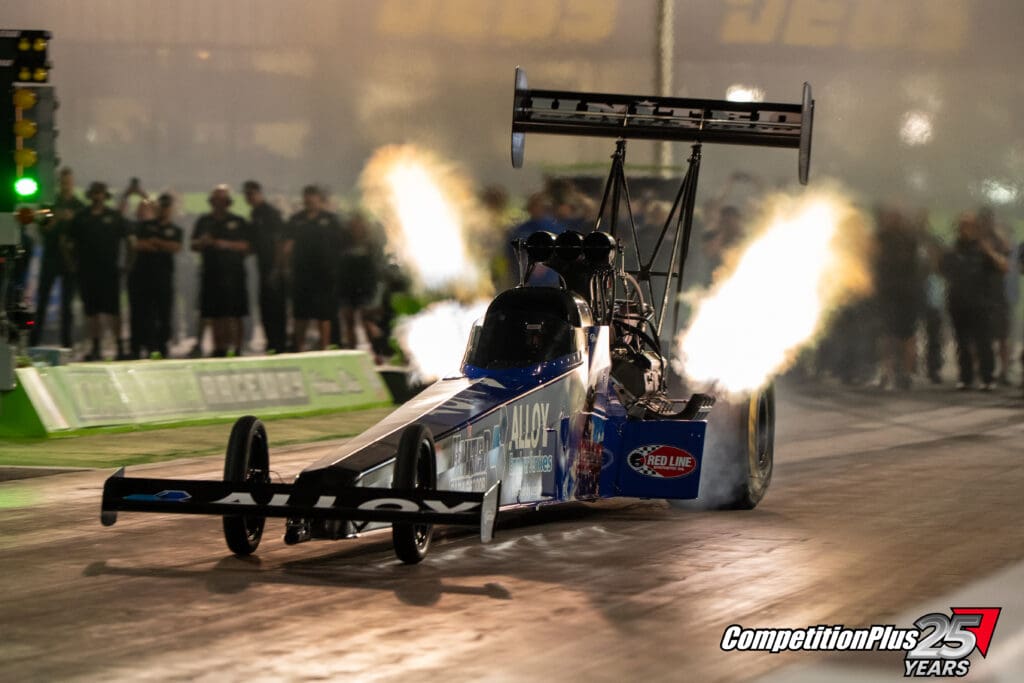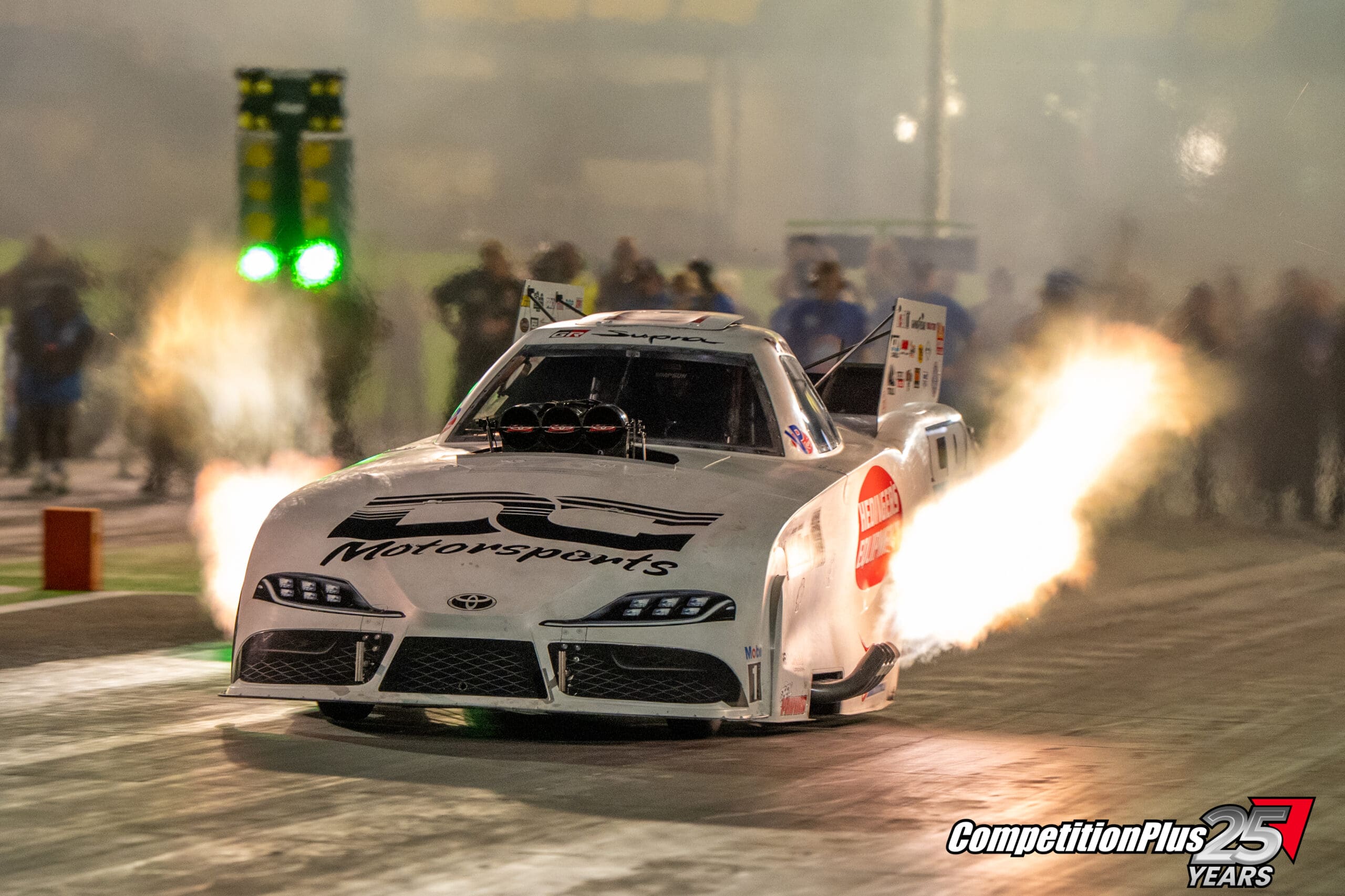

The International Hot Rod Association closes its 2025 season this weekend at Darana Dragstrip – Galot in Dunn, North Carolina, with a full lineup of independent racers who say the once-fading organization has given them renewed purpose.
It marks the IHRA’s sixth national event under new ownership, and the fourth eighth-mile race in its history — only the second intentionally designed that way. For many teams, the reborn series represents an opportunity in a sport where access to nitro racing has narrowed.
Businessman Darrell Cuttell purchased the IHRA at the beginning of the 2025 season and quickly assembled a six-race schedule. What started as a rebuilding effort has evolved into what competitors describe as a vital alternative for professional-level racers.
The IHRA recently announced an expanded 10-race schedule for 2026, along with several key staff additions to continue its momentum. For those who have competed this year, the revival has already made an impact.
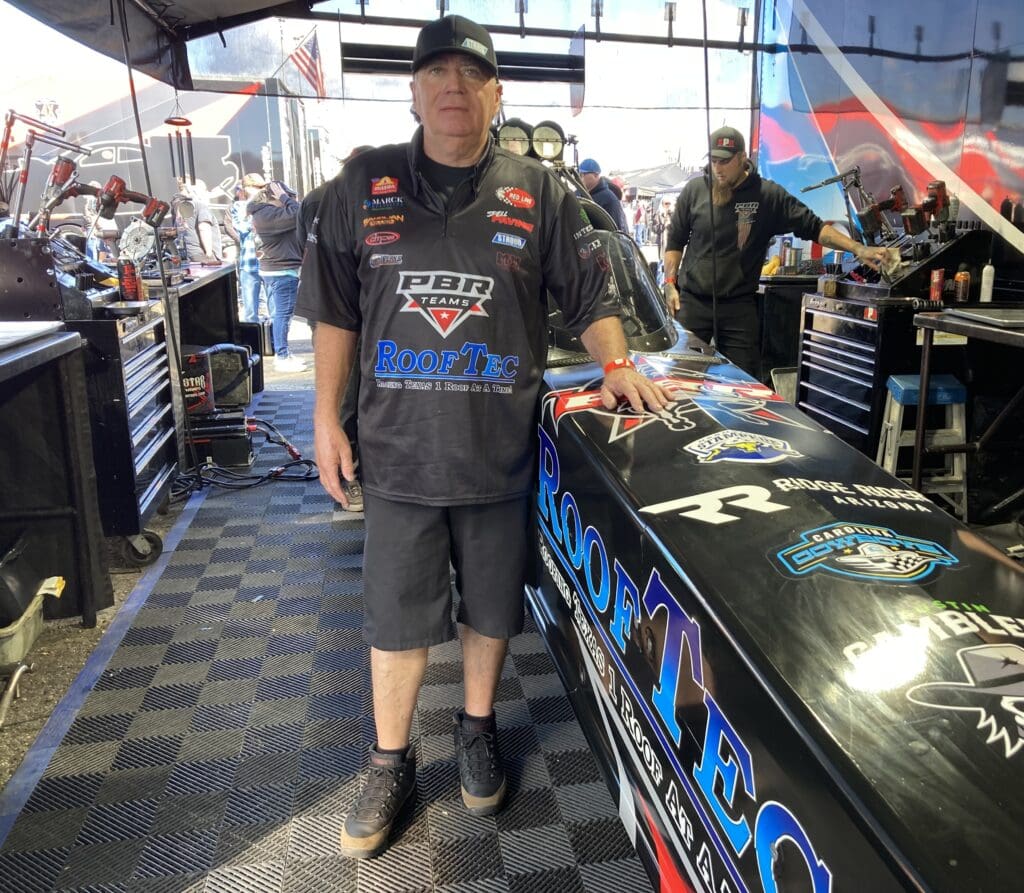
Top Fuel driver Scott Palmer has been among the most vocal supporters of the IHRA’s return, saying it provides an essential platform for independent nitro racers. “I worked my whole life to run a Top Fuel car,” Palmer said. “If you run a Pro Mod or any other thing, you’ve got at least a couple of options of places to go. And without IHRA, if you have a Top Fuel car or a nitro Funny Car and you want to run with the big show setup, you only have one option — or go match race.”
Palmer said the IHRA offers fair pay and opportunities for smaller-budget teams. “It pays more to qualify, pays the same amount to win,” he said. “Somebody like Lex Joon, Scott Palmer, Mitch King, Doug Foley, or Krista Baldwin is going to win these races. And every race we go to, no matter how big or small the team, with the extra money, every race team is going to get better.”
🔥 48-HOUR SALE! 🔥 Odd-lots, short-lots, closeouts & display shirts — all priced to move! 🏁 Get authentic https://t.co/jcAfIG1TiW gear for as low as $10 👕💥
— Competition Plus (@competitionplus) November 6, 2025
When they’re gone, they’re gone!
👉 https://t.co/ZWQRwUgEQb #DragRacing #NHRA #CompetitionPlus #PEAKSquad #Sale… pic.twitter.com/UOWDUKCRSP
The additional income, Palmer said, can be transformative. “It’s not enough to go home and buy a new car, but it is enough to get another crew guy or a couple of sets of rods,” he added. “Your program will get better the more you go and the more you race.”
Palmer noted the IHRA has become a viable option compared to expensive cross-country travel. “A lot of people couldn’t afford to run the Western Swing,” he said. “My options were go to Seattle and Sonoma, or go do the IHRA race in Milan. Honestly, this is a better option for a lot of racers.”
Veteran Top Fuel driver Doug Foley said he has been impressed by the organization’s ability to rebound under difficult circumstances. “I think it’s gone pretty good,” Foley said. “They had very little time to prepare and ran six events, and to me it looked like they went off pretty good.”
He added that the IHRA’s presentation has improved dramatically through the year. “Their streaming package was maybe a little rough in the first couple ones, but I watched the last one at Dragway 42 from home and they’re definitely making strides. It seems very professional.”
Foley said the IHRA gives him another way to promote his sponsors. “At the end of the day, somebody like myself has to be able to represent their brands,” he said. “They have a complete package — a TV package and more — and I have to make sure I can represent those brands and get those impressions. They’re definitely making every stride to go that direction.”
He believes racers should be able to participate in both the IHRA and NHRA without pressure. “I’m in that struggle now,” Foley said. “I want to run both. I just want to keep racing. That’s my only passion — to represent my sponsors and do something I love.”
Foley said NHRA officials have been receptive to racers who juggle multiple commitments. “I’ve talked to NHRA President Glen Cromwell multiple times, and he was very open-minded,” he said. “Everybody knows my goal is to run NHRA full time eventually, but that takes growth and showing partners value. You need a platform to show that.”
He called the new IHRA a “godsend” for smaller teams. “We’re already hearing of people buying cars,” Foley said. “In a time where car counts are dropping, now people are bringing old cars out. Those are racers we would’ve never gotten into the market if this option didn’t exist.”
Funny Car veteran Del Worsham echoed that optimism, crediting the IHRA for rebuilding from near collapse. “Coming into this season, I didn’t know there was even going to be an IHRA event,” Worsham said. “To pull off four events and now go into their fifth, and every race getting better and more competitive — that’s impressive.”
Worsham said the 2025 season has met or exceeded expectations. “They’ve done everything they wanted to do,” he said. “They’ve got competitiveness, cars running, people watching, and they’ve put on good, safe events.”
Looking ahead, Worsham said the IHRA’s next season could draw even more attention. “I saw a preliminary 10-race schedule,” he said. “Everything looked pretty good to me. If you come to an IHRA event, you’re going to see some good drag racing.”
With its season-ending event underway and a larger schedule already announced, the IHRA’s turnaround story has captured the attention of racers who once had few options outside the NHRA. For Palmer, Foley, and Worsham, it’s proof that a once-forgotten sanctioning body has found new life — and brought opportunity back to independent nitro racing.