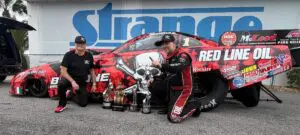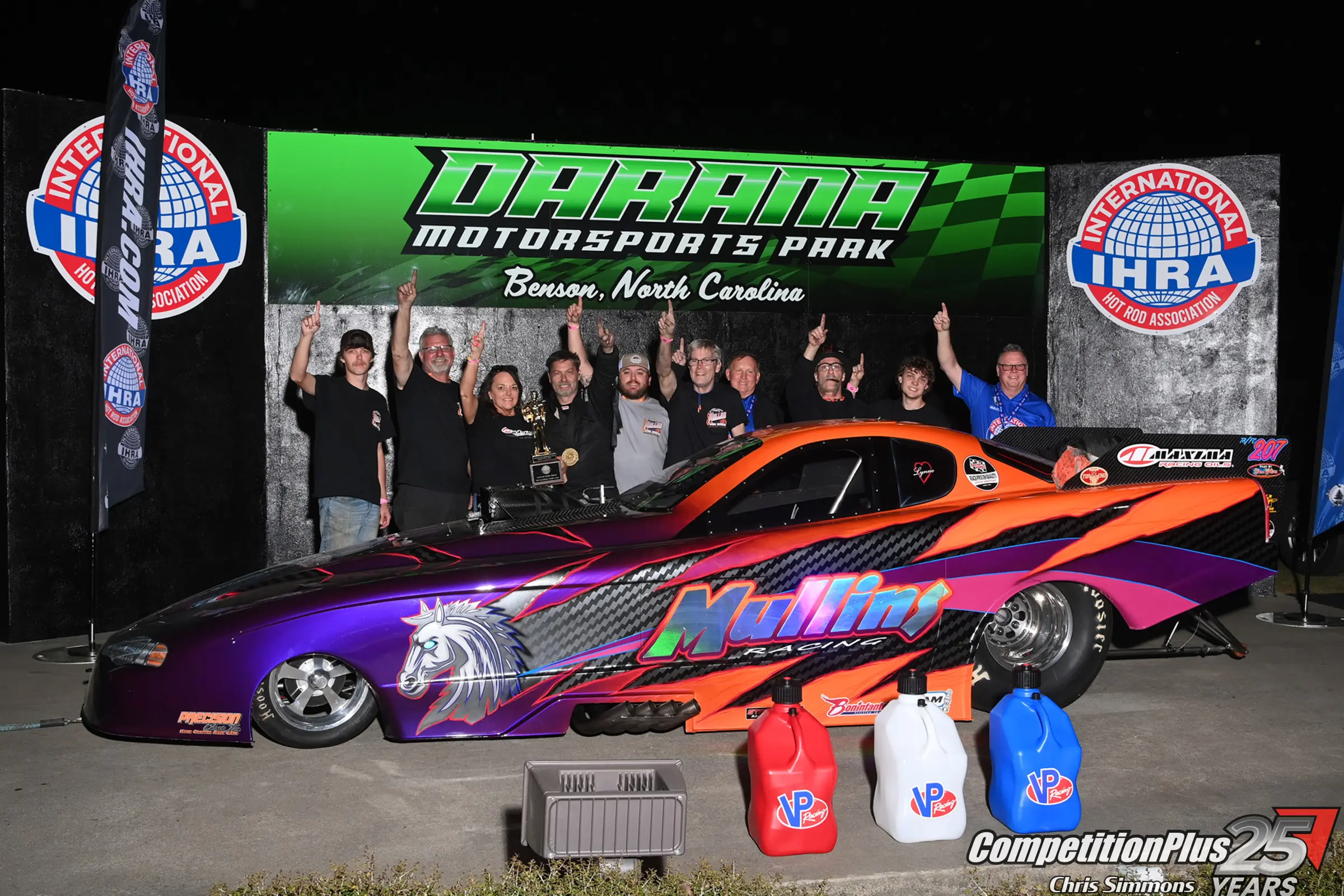

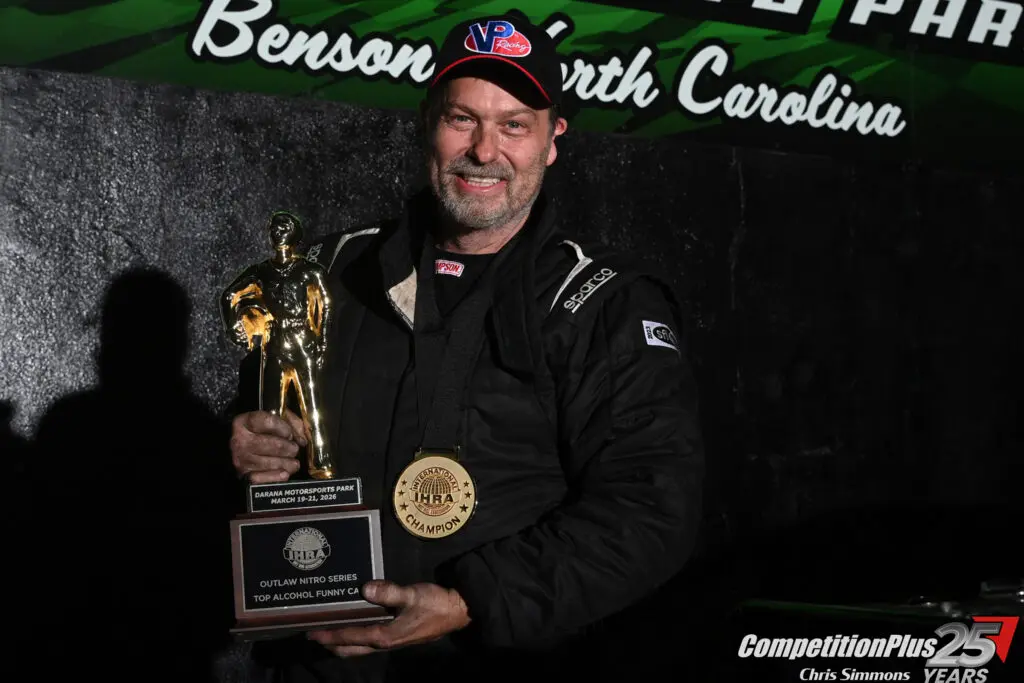
Bruce Mullins knows exactly where his motivation to return to Top Alcohol Funny Car originated. Moments after securing victory at the IHRA Outlaw Nitro Series season opener at Darana Motorsports Park in Dunn, N.C., he made sure the answer was unmistakable.
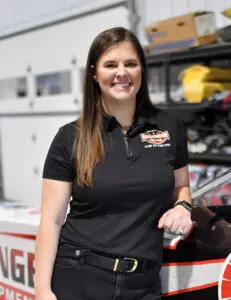
“This is going to be hard to put into words. That woman right there is the reason I’m back in a Funny Car,” Mullins said of his wife, Lynne. “I met her six years ago, and a couple years back she told me I needed to get back in a Funny Car. I hadn’t been in one in 17 years.”
The emotional declaration framed a weekend that blended persistence, mechanical adversity and technical conviction. Mullins’ victory came in a division increasingly defined by screw-supercharger combinations, yet his program continues to rely on a roots-blown configuration.
“I had no plans to do it until she mentioned it,” Mullins said. “I missed it and I loved it, but she gave me the push. She put my life back on track. I never thought I’d win again. I never thought I could do this.”
The win reinforced Mullins’ belief that IHRA competition has provided a renewed sense of belonging. After years away from regular Funny Car competition, the environment has rekindled both his enthusiasm and competitive focus.
“[IHRA] has felt like home for the past year,” Mullins said. “Words really can’t describe what this means.”
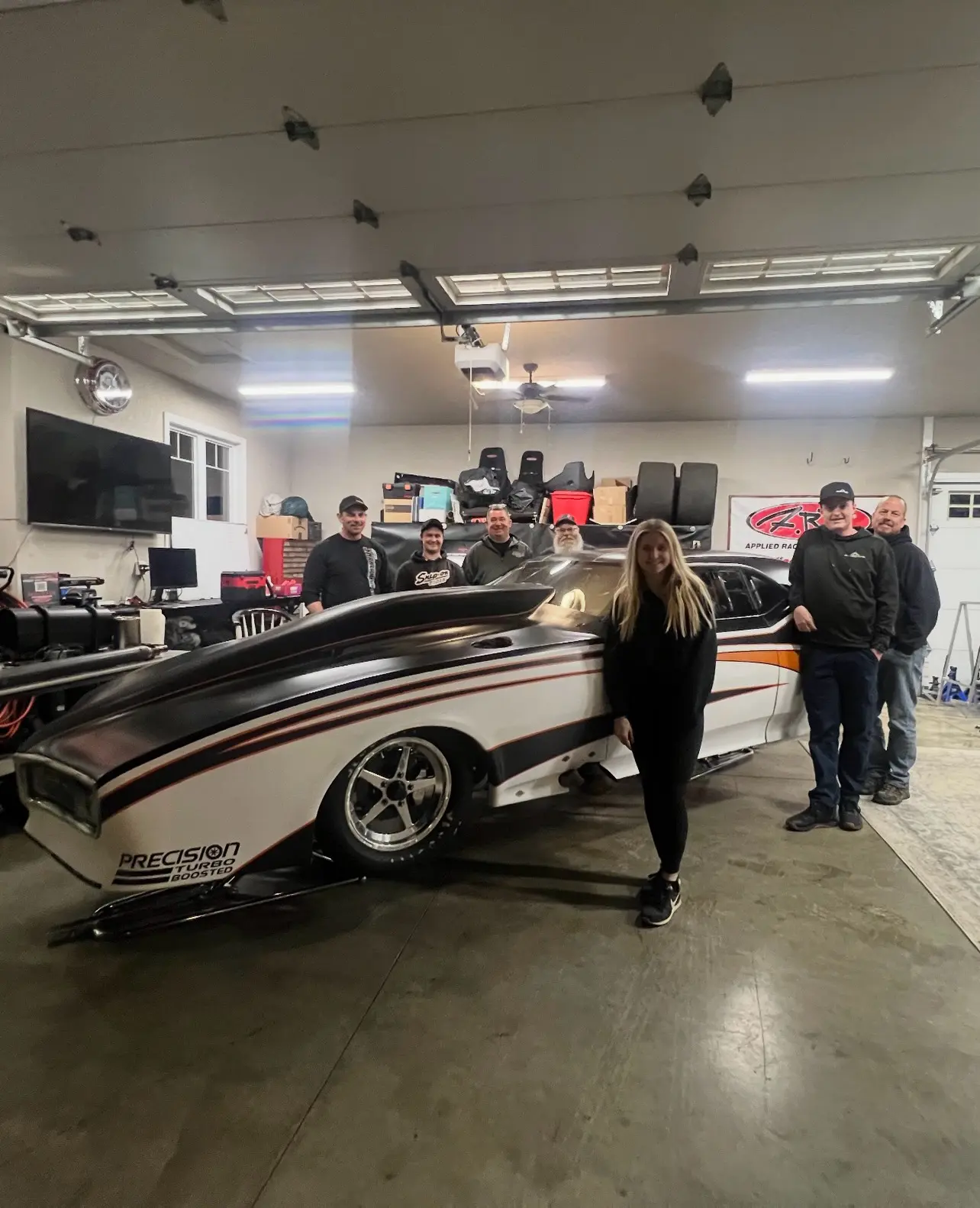
Mullins credited longtime chassis builder Jim Carl as instrumental in the program’s development. Their partnership extends beyond technical collaboration to a friendship built over decades in drag racing.
“I’ve got to thank Jim Carl at Precision Chassis,” Mullins said. “He’s been a best friend a long time and he built this car.”
Carl’s involvement also connects Mullins’ current success to earlier chapters of his career. The continuity has provided stability as the team navigates the evolving demands of modern Alcohol Funny Car competition.
“He built my previous car too, and without him this wouldn’t have happened,” Mullins said.
The victory path was far from smooth.
A mechanical issue during the opening qualifying attempt created internal engine damage that required a complete teardown. The team responded by installing a spare engine and thrashing to remain competitive, ultimately qualifying on the strength of an early 3.85-second pass at only 169 mph.
The late-night effort reinforced Mullins’ appreciation for the collective commitment surrounding the program. He emphasized the role of mentor Leroy Dudeney, whose technical guidance has shaped his approach to both driving and tuning.
“I also have to thank Leroy Dewdney,” Mullins said. “He taught me how to spell the word Funny Car when I didn’t even know how.”
Mullins maintained constant communication with Dewdney throughout the event. The collaboration highlighted the value of experience and trust in a class where incremental gains often determine race outcomes.
“I was on the phone with him this morning talking tune-ups,” Mullins said. “I’m always on the phone with him.”
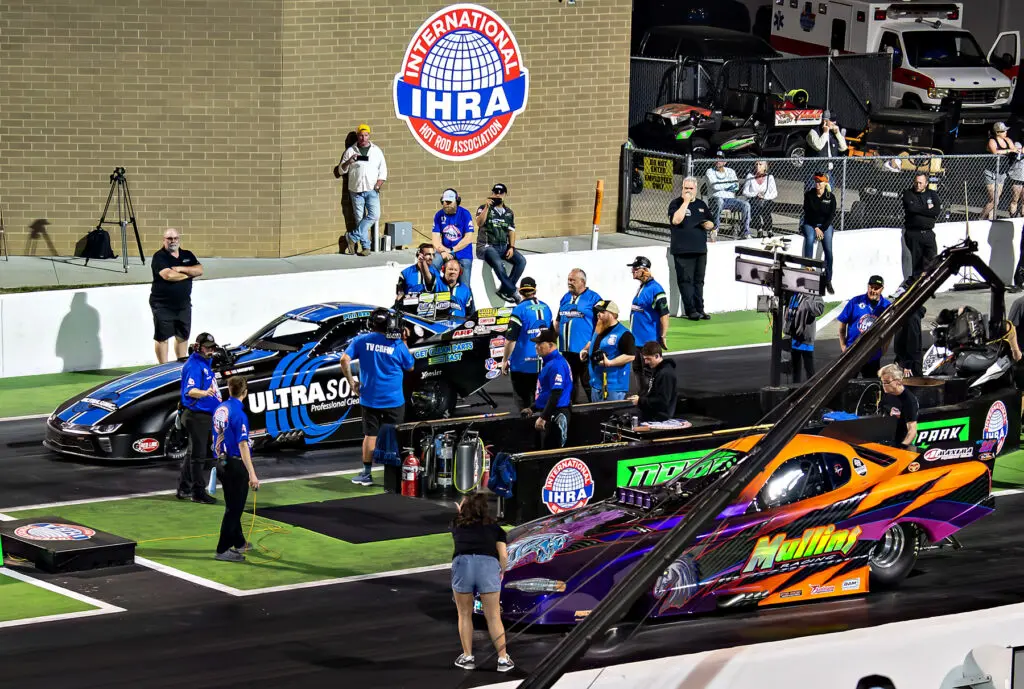
Mullins’ commitment to a roots-supercharger combination distinguishes his program within a screw-dominated division. The choice reflects both technical philosophy and a desire to preserve an approach rooted in earlier eras of Funny Car competition.
“Everybody went to screw blowers a long time ago,” Mullins said. “They dominate.”
His objective remains clear despite the competitive disadvantage often associated with the configuration. Mullins has focused on refining performance to prove that roots-blown combinations can still contend at the highest level.
“When I bought this car, I said I wanted to be the fastest roots-blown Funny Car in the world,” Mullins said.
The pursuit has produced both challenges and defining moments. Mullins described the team’s early struggles as analogous to entering a mismatched contest, a perception that evolved as performance improved.
“We used to joke we were bringing a knife to a gunfight,” Mullins said. “Then we started running really good.”
That transformation inspired a symbolic addition to the car’s livery during the offseason. The phrase reflects both humor and determination within a program built on persistence rather than conformity.
“So over the winter I put ‘the fastest knife in the damn drawer’ on the back of the car,” Mullins said.
Mullins’ victory over Phil Esz in the final underscored the potential of his unconventional approach. It also reaffirmed the importance of adaptability as IHRA’s revitalized platform continues to attract diverse technical strategies.
The result provided validation not only for Mullins’ driving but also for the collective belief sustaining the program. The combination of personal motivation, mechanical resilience and competitive execution created a defining moment early in the season.
“We love what IHRA is doing,” Mullins said. “I don’t even know what to say right now.”
For a driver who once doubted whether he would return to the winner’s circle, the weekend represented both closure and renewal. Mullins’ adherence to roots-blown tradition now carries new relevance within a division shaped by innovation.
In a sport where evolution often eclipses heritage, his victory offered a reminder that conviction can still shape outcomes. Mullins ensured that persistence, not conformity, defined the narrative of IHRA’s opening event.
“This thing is wicked,” Mullins said.