Imagine 11,000 horsepower trapped under a carbon-fiber shell, lighting off nitromethane and clawing its way to more than 330 mph in under four seconds.
That’s funny car drag racing; violent, theatrical, and unapologetically excessive.
These cars make more power per pound than many elite circuit racers, yet still carry the showmanship that helped cement drag racing as one of America’s defining speed spectacles.
As one of the NHRA’s headline professional categories, Funny Car sits between the long, spidery Top Fuel dragsters and the more production-rooted Pro Stock machines.
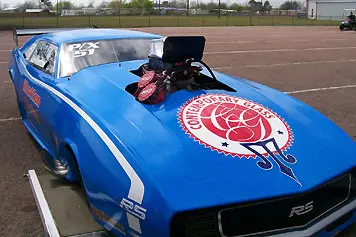
They run bodies shaped like Camaros, Mustangs, and Camrys. But those shells are closer to costumes than sheet metal, familiar silhouettes hiding pure race car underneath.
The result is a class that hooks hardcore gearheads and casual fans alike, especially anyone who wants to feel their ribcage rattle when a pair of nitro cars hit the throttle.
Let us take you through how these machines are built and raced, along with the people, rivalries, and technology that define them. Whether you’re new to the sport or remember parking-lot match races, you’ll get a clear look at why these short-wheelbase missiles remain the crown jewel of professional drag racing.
The Foundations of What Makes a Car “Funny”
The “funny” name came from the odd look: stretched, altered, and exaggerated versions of factory bodies that didn’t sit quite right. Modern funny cars keep that spirit. They blend Top Fuel-grade performance with body shells that only loosely resemble showroom models. Emphasis on loosely.
On paper, the layout sounds almost reasonable: an enclosed cockpit, a carbon-fiber body, and a shape that nods at a street car. Strip it back and reality shows up fast—there’s no trunk, no rear seat, no convenience features. Just a single driver’s seat, a nitro engine, fuel system, driveline, and the safety gear required to cope with forces that would tear apart a normal car.
The numbers do the talking. Supercharged engines running on nitromethane produce roughly 11,000 horsepower. A full quarter-mile pass takes about 3.8 seconds and can top 330 mph. Drivers see launch forces well over 5 g, and the components survive cylinder pressures that would reduce production parts to shrapnel in milliseconds.
Those odd proportions are for pure function.
- Longer wheelbases help plant the rear tires.
- Shortened front sections trim weight and keep the car responsive.
The end result looks like a caricature of a road car. Recognizable enough to carry a badge, extreme enough that nobody confuses it with something that belongs in rush hour.
How Funny Cars Evolved From Parking Lots to Pro Showpiece
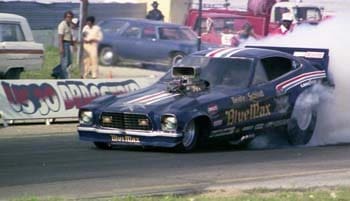
Funny car racing took shape in the mid-1960s, when creative hot rodders slid rear axles forward, played with wheelbases, and chased traction with radical “factory” bodies. Working out of small garages, they found that strange-looking cars left harder, went quicker, and drew crowds.
The 70’s Wild New Direction
By the late ’60s and early ’70s, the NHRA recognized that this wild new direction had real star power. Rulesets and safety standards turned loose match-race experiments into a formal category. With structure in place, sponsors came on board, teams invested, and funny cars shifted from sideshow to centerpiece.
The 1970s cemented their popularity. Drivers like Don Prudhomme, Tom McEwen, and Kenny Bernstein understood that winning rounds was only part of the job. Paint schemes, rivalries, and personalities turned races into traveling theater. Creating storylines fans could latch onto, not just reaction times and elapsed numbers.
Speed pushed safety. Early chassis and protection were minimal by modern standards. Hard lessons and painful incidents forced rapid progress: stronger cages, better fire control, stricter inspections.
Over time, the class evolved from “leather jacket and luck” to a discipline defined by serious engineering around driver survival.
80’s and 90’s Boom
Television coverage in the ’80s and ’90s amplified it all. National broadcasts turned regional heroes into household names. Manufacturers saw brand-shaped, 300+ mph cars as rolling billboards and invested engineering support that helped push performance into new territory.
Today’s funny cars still channel that original attitude, but they do it with big-league resources and expectations.
Under the Body: Funny Car Tech, Simplified
Engine and Power Systems
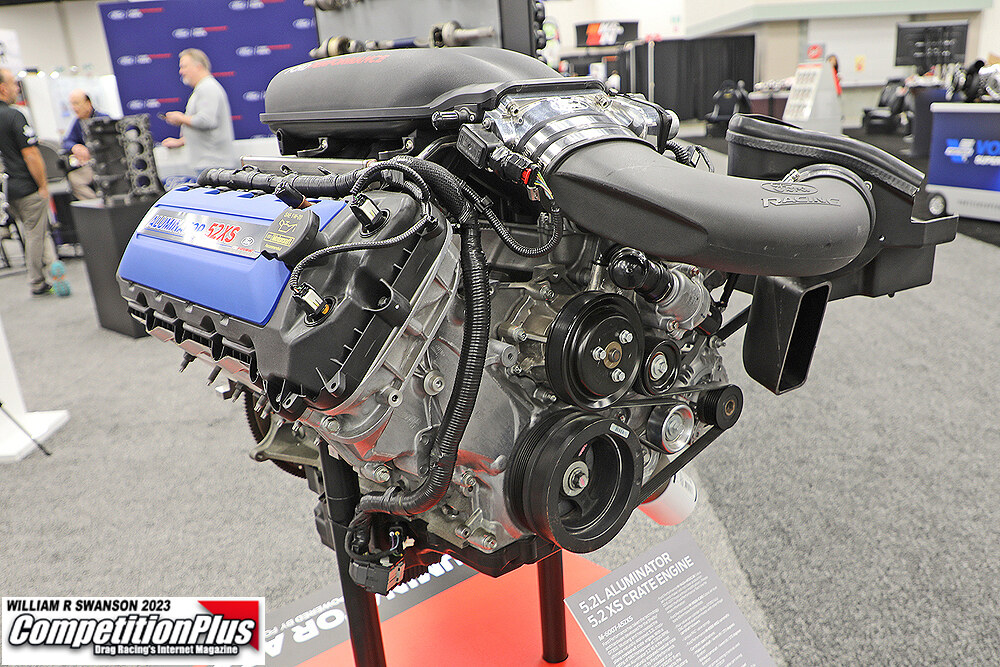
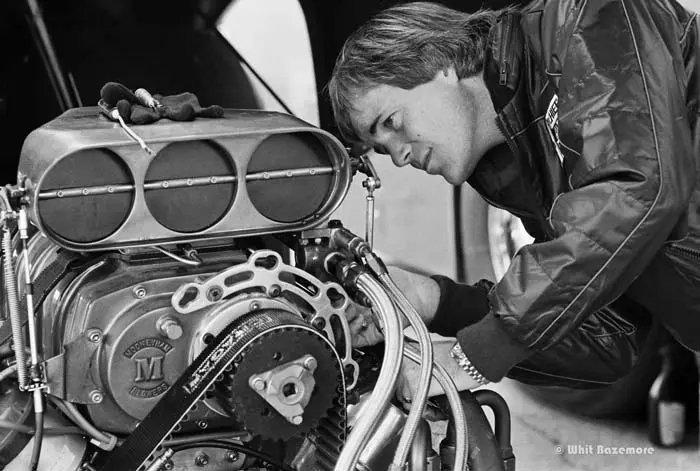
At the center of every funny car is a 500-cubic-inch aluminum V8 topped with a massive Roots-style supercharger. The blower forces a dense fuel–air charge into the cylinders, and nitromethane is the enabler.
It carries oxygen in its chemistry, allowing enormous fuel volume and explosive combustion. Over a single run (including burnout, backup, and pass), a car can burn roughly 15 gallons of nitro.
Putting that power down takes finesse. If all 11,000 horsepower hit at once, the slicks would just spin. Multi-disc carbon clutches engage in stages, feeding power progressively as the car accelerates.
Crew chiefs spend hours reading data and plugs, adjusting clutch weight, fuel curves, and timing. A small change can be the difference between a crisp lap and a tire-smoking throwaway.
Building the Beast
The body is typically carbon fiber: light, strong, and designed to manage both downforce and disaster. It has to endure extreme airloads at over 300 mph and remain controllable if an engine detonates.
Beneath that shell, a chrome-moly tube chassis forms a rigid safety cell. It supports the engine, fuel system, cockpit, and wings while locking in critical dimensions mandated by NHRA rules. Weight distribution is tuned so the car can launch hard without being lazy or trying to lift the front end into the air.
Aerodynamics are more than aesthetics. Front elements manage airflow for stability, while the large rear wing drives the rear tires into the surface at speed.
Teams adjust configurations for track temperature, grip, and altitude. When aero and power balance properly, the car runs straight and planted; get them wrong, and it’s a fight to keep it off the wall.
Putting Power to the Track
Funny car suspension exists for one purpose: efficient weight transfer. Comfort is irrelevant. Teams dial in shock settings and ride height so the chassis plants the huge rear slicks without unloading them or driving the car out of the groove.
Those slicks are specific to the job. Massive, soft, and designed to wrinkle on launch, bite into a prepped surface, and then grow in diameter as speed and centrifugal force increase.
The slim front tires focus on stability and minimal drag, doing their job as the driver threads the car down a narrow strip at closing speeds that leave zero room for sloppy inputs.
How Funny Car Racing Works
The NHRA governs funny car racing with detailed rules: engine displacement, blower drive limits, fuel type, safety equipment, chassis specs, and body dimensions are all tightly controlled. Before any pass, officials inspect the car. If it doesn’t meet the rulebook, it doesn’t run.
16-Car Elimination
Events use a 16-car elimination ladder. During qualifying sessions, teams make repeated attempts to post their quickest times. The fastest 16 earn spots; their positions on the ladder are based on those times. Reliability, not a single “hero run,” gets you into a strong race-day position.
Race day moves quickly. Teams warm the car in the pits, confirm systems, then stage for competition. Each pairing is simple: two cars, one green, one winner. Advance and you reset for the next round. Win four rounds and you take home the trophy.
Strategy is baked in. Chase low qualifying at all costs and you risk damaging parts. Play it too safe and you’re staring down a top contender in round one. Champions know when to lean on an aggressive setup and when to leave just enough margin to turn on win lights all day.
The People Who Built the Legend
John Force is the defining figure in funny car history. He is a 16-time champion whose mix of driving skill, raw personality, and business sense pulled massive attention toward the class. He didn’t just win; he built organizations and storylines that helped shape modern nitro racing.
Before and alongside him, drivers like Don “The Snake” Prudhomme and Tom “The Mongoose” McEwen elevated rivalries into cultural hooks. Their battles, branding, and sponsor relationships showed how funny cars could move beyond niche coverage and into mainstream awareness.
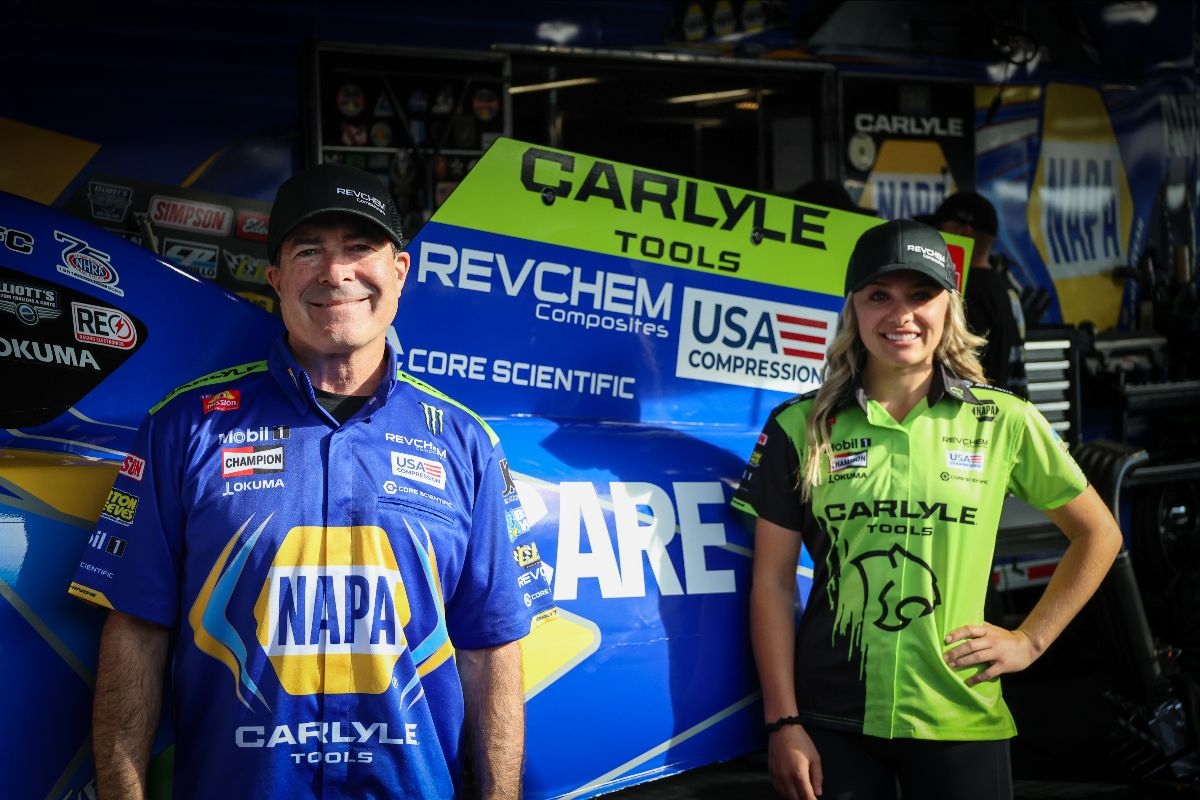
Today’s stars like Ron Capps, Robert Hight, Matt Hagan, and others race in an environment where the job description is broader. They’re expected to understand setups, represent sponsors, communicate with fans, and handle media while delivering on race day. The role blends racer, communicator, and technician.
Long-running team battles and manufacturer storylines. Big multi-car operations versus independents, Chevy vs. Ford vs. Toyota, historic powerhouses clashing across seasons.
These keep the fans engaged in more than just timeslips.
Major sponsors and technical partners underpin it all; without those relationships, the modern scale of funny car racing simply doesn’t exist.
Pathways Into Funny Car Racing
Nobody jumps straight into an 11,000-horsepower funny car. Most drivers build experience in sportsman and index classes, learning how to stage, react, tune, and race under pressure where mistakes don’t carry six-figure repair bills.
Get a License to Drive All that Power
The NHRA licensing ladder formalizes that journey. As speeds climb, drivers must pass written exams on procedures and complete observed runs to prove control and consistency.
By the time someone earns a funny car license, they’ve shown they can handle high-power machinery within tight safety protocols.
Need Good Financial Backing
Running a front-running nitro program requires serious backing. Fielding a competitive funny car team typically means a budget north of $2 million annually once you count engines, clutches, blowers, nitro, haulers, crew salaries, and constant parts turnover.
That’s why sponsor relationships and manufacturer support are non-negotiable.
Training Can Get You There
Formal training programs, such as established drag racing schools, give aspiring drivers structured seat time and exposure to teams.
Many pros credit this mix of education, discipline, and networking as a key step toward landing opportunities.
And not every path runs through the driver’s seat. Many current racers and high-level crew chiefs started on the wrenches, learning basics like clutch service, engine maintenance, and data work before ever climbing into a cockpit.
Safety at 330 MPH
Modern funny cars are engineered around the assumption that failures can be sudden and extreme. Drivers suit up in multi-layer fire gear, gloves, boots, and advanced helmets, backed by head-and-neck restraints and tightly mounted harness systems.
Onboard fire suppression systems stand ready to flood the cockpit and engine bay if something goes wrong, helping to knock down flames and protect the driver. Impact-absorbing structures and carefully designed cockpits help manage crash forces and maintain space around the driver even when the car takes a hard hit.
Safety standards evolve constantly. Each major incident is studied, and findings turn into updated rules:
- Stronger components
- Refined fuel and ignition shutoffs
- More robust body retention
- Enhanced inspection routines.
Solutions that were state-of-the-art a few years ago can be outdated as new ideas prove better.
Trackside safety has kept pace. Professional events deploy trained rescue, medical, and fire crews specifically familiar with nitro cars, along with modern barriers and shutdown areas that reduce the severity of impacts.
Combined with the chassis and equipment advances, this has significantly improved outcomes when things go bad.
The risk never disappears; every driver knows what sits inches away on the other side of the firewall. But the entire system from car, track, rulebook, and crew is built to give them the best possible odds.
The Future of Funny Car Racing
Data has become a central weapon. Sensors measure driveshaft speed, clutch slip, cylinder behavior, G-forces, and tire shake across every run. Crew chiefs dissect that information between rounds, looking for microscopic improvements in power curves and application that translate into a few thousandths on the time slip.
At the top level, parity is tight. Well-funded teams trade runs separated by inches. A single cylinder dropping, a brief haze of the tires, or a late reaction time can swing a race or a championship. Precision has never mattered more.
Ahead, the class has to manage cost, technology, and environmental pressure without losing its identity. Nitro remains the heartbeat, but conversations about how to keep programs sustainable and competitive are always in play. Rule adjustments aim to protect both the show and the ability of smaller teams to participate.
The long-term health of funny car racing depends on holding that balance: keep the noise, the flames, the recognizable bodies, the close racing—while continuing to evolve safety, presentation, and access in ways that connect with new generations of fans.
Why Funny Cars Still Rule
Funny car drag racing condenses the sport to its sharpest edge. Instant, overwhelming power. Blistering speeds over a brutally short distance. Side-by-side runs so close that a blink, a pedal, or a stripe call can decide everything.
The formula works because it evolves without losing its core. Technology improves durability and safety. New drivers bring fresh personalities. Teams refine how they tell their stories. But on the starting line, it’s still simple: two lanes, two cars, one green, one winner.
To really understand it, you have to feel it for yourself. Standing trackside when a pair of nitro funny cars launch is a full-body experience.
The shockwave in your chest, the exhaust snapping in the air, the sting of nitro in your eyes. Screens can’t duplicate it.
For those who get hooked, following the class means keeping up with rivalries, setups, and rising talents all season long. Once you’ve watched a funny car charge through the lights at full song, it’s obvious why this class remains one of drag racing’s most intense, addictive rides.
Additional Resources
For deeper exploration of funny cars, the following resources provide additional information:
- Official NHRA Funny Car Driver Listings feature driver positions, date of birth, residence, sponsors, and social profiles for funny car drivers.