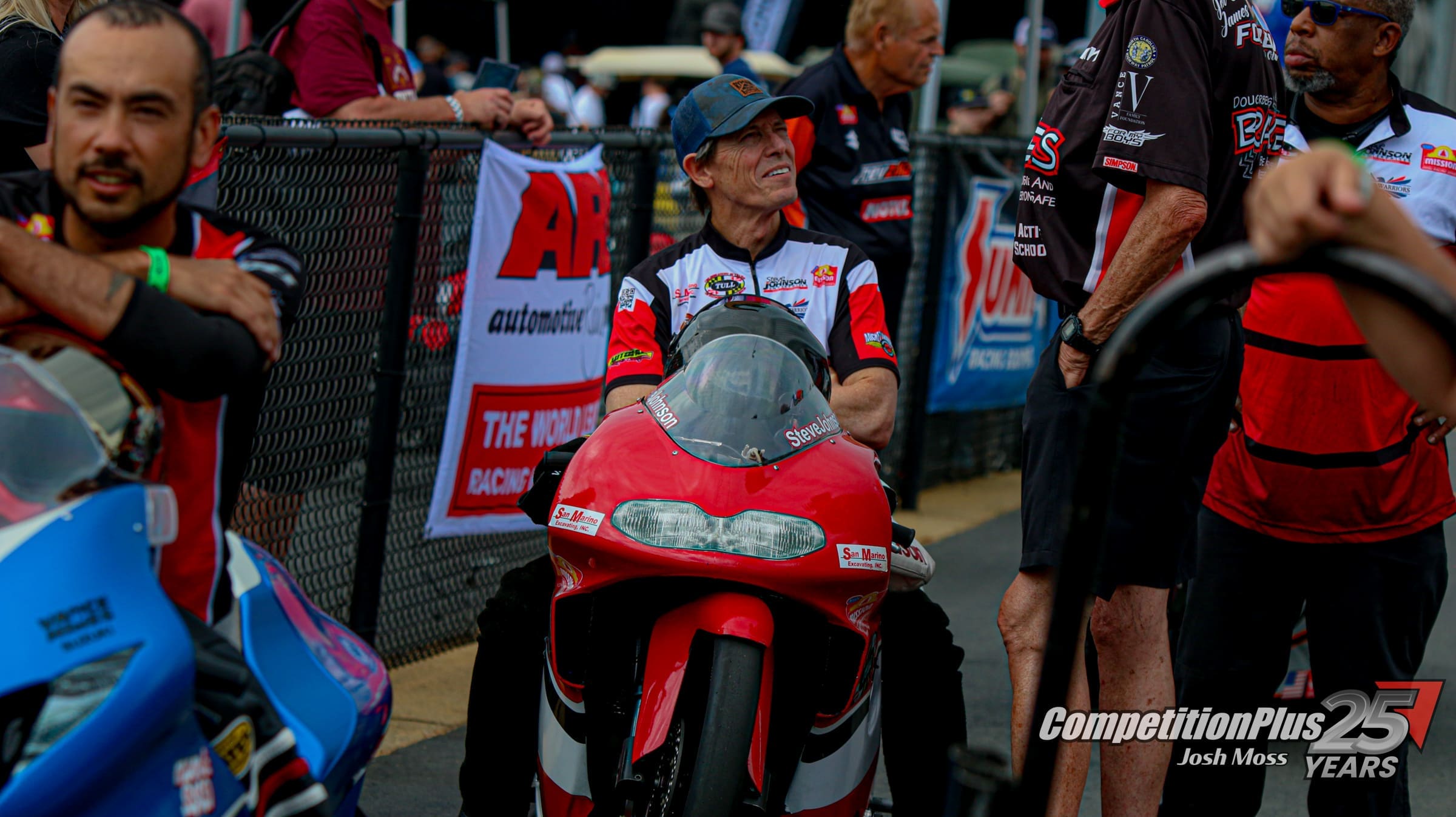

After 40 years competing in the Pro Stock Motorcycle ranks, there is no slowing down Steve Johnson. The wily veteran went from humble beginnings to 12 career wins — two at the prestigious U.S. Nationals — along with influence on furthering the category as head of the PRO2 board. Often diving headfirst into the business and marketing side of the sport to keep his aspirations afloat, his career has come full circle with a hands-on approach to tuning and engine building. Along the way, he affords opportunities to others by way of his BAT-man (Be a Technician) scholarship.
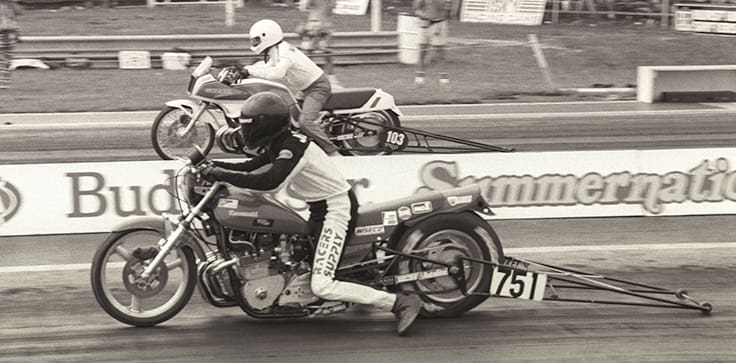
Johnson’s journey began with a trip from his native Southern California to race in Englishtown, N.J., with a makeshift plan to get to the event and no plan at all to get home.
“I saw drag racing on TV as a kid back in Ontario,” said Johnson. “Before I was 16, I hung out with some older guys and they knew all about the street races. That was fascinating to me, and I wanted to go. And then I’d sneak out of the house at midnight and jump in their Camaro or a Roadrunner and drive down to Van Nuys Boulevard in the San Fernando Valley. And behind the bank, all these hot rods, race cars were there, and I was just tore up with it.”
“I got a street bike for under a thousand dollars and could race. It was a pretty fast, 11-second Kawasaki. And then I wanted to go full-time racing. But then when we got to go to that first NHRA race and the guy backed out on me and we had to put our bike in a wooden crate that we all built and shipped it there. We raced and won the first round, qualified, won the first round, and would’ve won the second round but my bike didn’t shift.”
“We literally pitted out of that crate. I went to ‘Torch’ [Paul LeSage] for everything, and I said, ‘Hey, I’ve done all this. I planned all this except getting my bike home back to California.’ He negotiated a deal with Alan Johnson back then with Blaine and Everett. Everett drove it back in the trailer they ran their Alcohol Dragster out of, and the bike was in between the stairs, between the lounge and the floor. They pillowed and put a bunch of stuff in there and it got there.”
“From that point on, I was pretty much hooked, line, and sinker. All I wanted to be is just part of the fraternity. Just watching all these people race for all these years and then being able to do it.”
Johnson learned quickly that to have any kind of longevity in the sport, he would need to hustle for sponsorship.
“I learned from Jon Asher that you needed either a rich family or you needed a sponsor,” said Johnson. “He told me how to get a sponsor. And I fiddled, faddled around for a little bit, but then I landed the Slick 50 deal with him and got a small pile of money that I just couldn’t believe.”
“I was more interested in the business side and the marketing side, because it didn’t seem like my bike was fast. I didn’t understand why. I bought Vance & Hines engines. I bought Star Racing engines. Every once in a while, we had some success.”
Johnson’s efforts off the track often benefited the class as a whole.
“I learned from PRO,” said Johnson. “I learned from Kenny Bernstein and his wife, Sheryl — she was so intuitive about the business side of the sport. I just realized that if we wanted something, we needed to negotiate for it. And when you negotiate, you need to give something before you get it. I got everybody together and we created PRO2 in 1997, and I led that forever. We got stuff. We didn’t have to park across the street and get our bikes teched in. We got free entry fees. We got TV time. We were a professional category.”
“I feel like I got a little bit of respect, but I was good at that. I wasn’t good at racing. I wanted to be better at racing. I wanted to learn all of it.”
These days, Johnson has a more personal investment in his performance. Along the way, he utilizes his vast network within and outside of the Pro Stock Motorcycle world, which includes several legends of the sport.
“It’s almost made a full circle because George Bryce, Chris McGaha, Bill Maropulos, Austin Coil — they’re on my advisory committee,” said Johnson. “I’m learning how to build real engines, and it just sucks up all the time. The full circle part is now I need to get a sponsor and start all over again.”
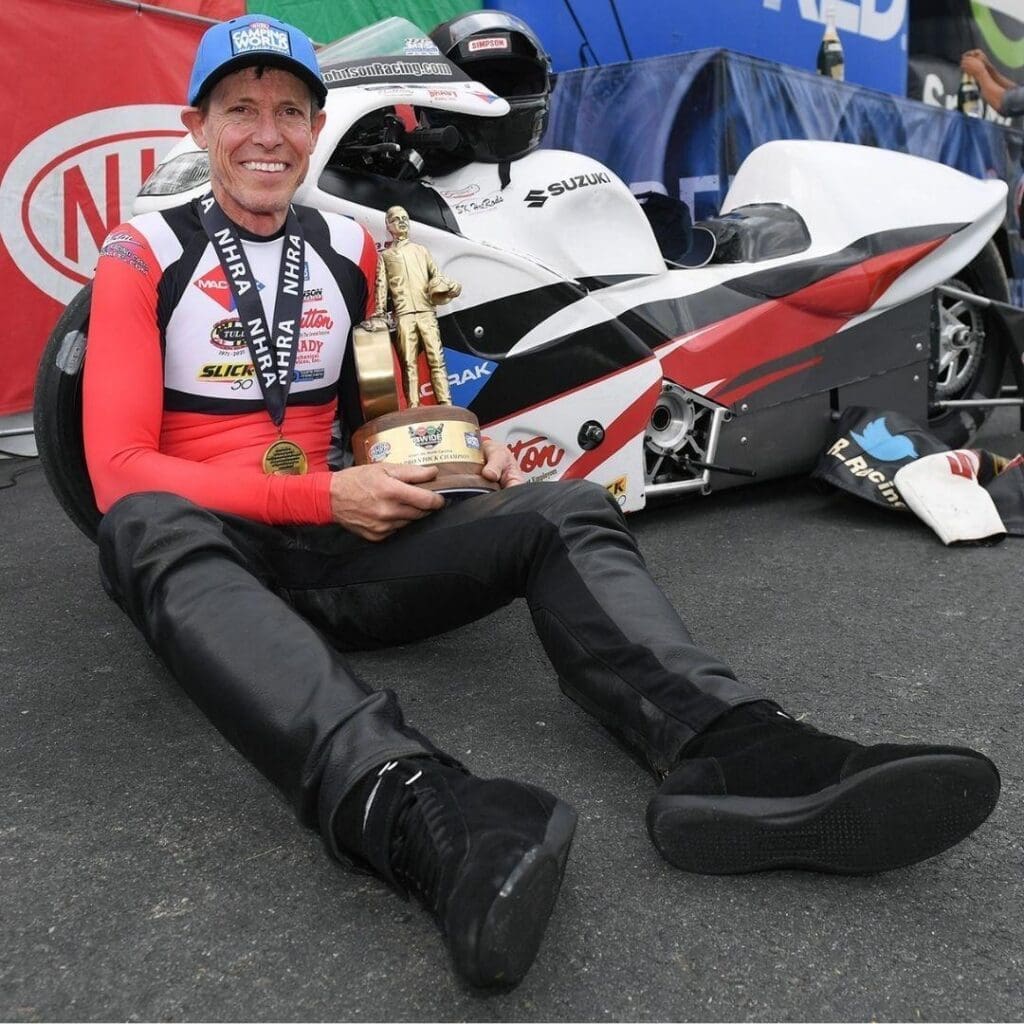
“It is very, very special to know all the fuel guys and to look up to them as big brothers, even the ones that have come and gone and returned. Getting calls from Austin Coil every week is royalty. But to be able to call George Bryce, who’s won six championships, be able to call Bill Maropulos and call Coil. I get to go to Chris McGaha’s shop and work on a Pro Stock engine dyno. Back in the day, I think you rented Pro Stock motors for $50,000 a race. It’s kind of surreal to think about.”
The interest in engine development brings Johnson a renewed fascination with the sport he has been a part of for four decades.
“Some people like computers,” Johnson explained. “Some people lean toward medical and legal. I like the engines. I say my next 40 years and next 500 races are going to be better than my first 40 years and 500 races.”
In qualifying the competition in the Pro Stock Motorcycle category, Johnson realizes the contradiction of prompting participation while describing how difficult it is to be successful against the top riders in the class.
“I’m starting to say this more because eventually I’ll be gone, but it’s in my estimation that the Pro Stock Motorcycle, for the amount of time that you’re on it, is the most difficult vehicle to be perfect on for the entire 6.7 seconds,” said Johnson. “Gaige Herrera and Richard Gadson, and Matt Smith, and John Hall, and this new kid Brayden Davis. And Chase Van Sant. These guys all ride pretty darn close to perfect, and I don’t. I want to before I split.”
“As much as I want to get sponsors and money, I want to ride perfect, too. They all make it look way, way too easy. It’s the double-edged sword, because I’m trying to promote the sport and tell them how easy it is to come in here, but at the same time, I’m telling you how difficult it is to ride them perfect. And if you don’t ride them perfect, they’re not going to be fast.”
Johnson continues to use his experience and connections to pay it forward by way of his BAT-man scholarship.

“The scholarship is about providing an opportunity with tools that we get,” said Johnson. “I think that when we, as humans, don’t take advantage of opportunities, whatever they are, it’s almost a sin to ourselves. So, George Bryce has got a school on engine building. He’s not going to be here forever and he’s learned some stuff the hard, hard, hard way. So I go to his schools. And then I pass that information on to high school and college instructors that are teaching auto classes. And then I go to college and talk to people about opportunities.”
“And I just think that excluding all the social media bumbo jumbo, I think you get right down to the core issue, which is to put your feet in the water and get wet and learn. There’s an opportunity that you can cash in on that when you learn it. So when you have knowledge and you prepare, those two will sometimes add to luck. You definitely need luck out here.”