“We’re trying to get rid of the energy.”

That’s how Tim Wilkerson explains the new body-tethering system he and chassis builder Murf McKinney designed for his SCAG Racing Ford Mustang Funny Car, unveiled during preseason testing at Gainesville Raceway.

Wilkerson arrived at the Professional Racers Organization test session planning to evaluate performance combinations. Instead, the most significant development may be a safety innovation he hopes never has to prove itself at 330 mph.

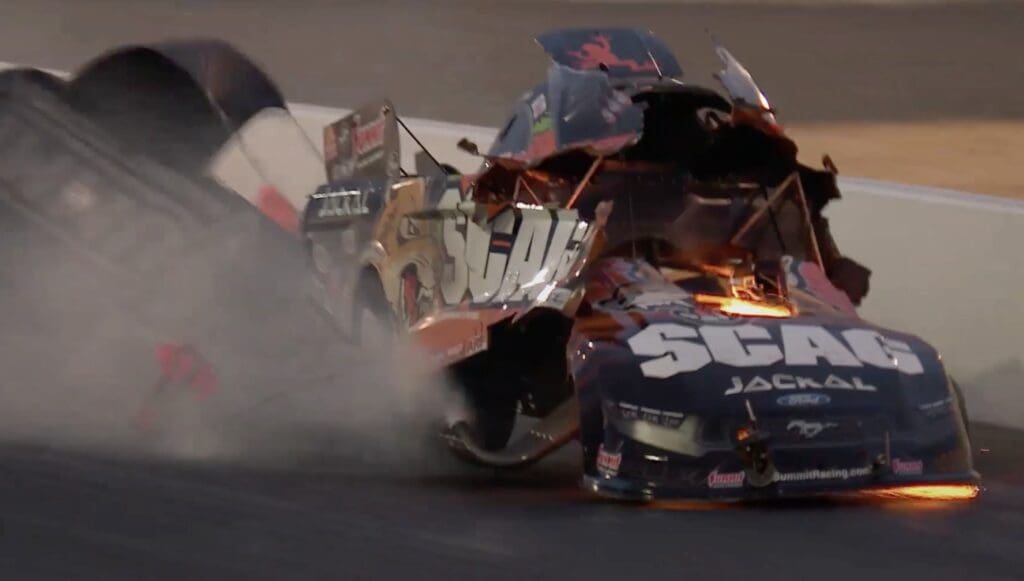
The redesign follows a season in which several high-profile NHRA Funny Car explosions reignited debate about body containment, latch integrity and tether placement. In multiple incidents, front latches were destroyed while explosive force appeared to travel unpredictably through the body structure.

Rather than attempt to reinforce the body to resist that force, Wilkerson chose a different philosophy.

“So we decided we were going to try to get rid of the energy by allowing the body to blow up about three foot,” he said.

Wilkerson and McKinney explored two concepts over roughly 30 days. One configuration tethered the body near the dash, while the other anchored it at the nose.

“Well, Murf and I worked on it, two different versions,” Wilkerson said. “One version grabbed it at the center of the car by the dash and the other version grabbed it right at the nose.”

They selected the nose-mounted design because it limits vertical travel while still permitting controlled lift.

“And after messing with it for… We probably messed with it for 30 days back and forth, decided we’d try the one at the nose because it doesn’t let the body go up as high,” he said. “It lets it go up about three foot in the very front, like old style blow ups.”

Wilkerson referenced earlier eras of Funny Car, when bodies would lift and settle rather than fragment.

“If you ever remember seeing an old style blow up, it’d blow up in the body, come up in the air a little bit, mm, back down, it would go, right?” he said. “Sometimes they blew all the way off the back.”

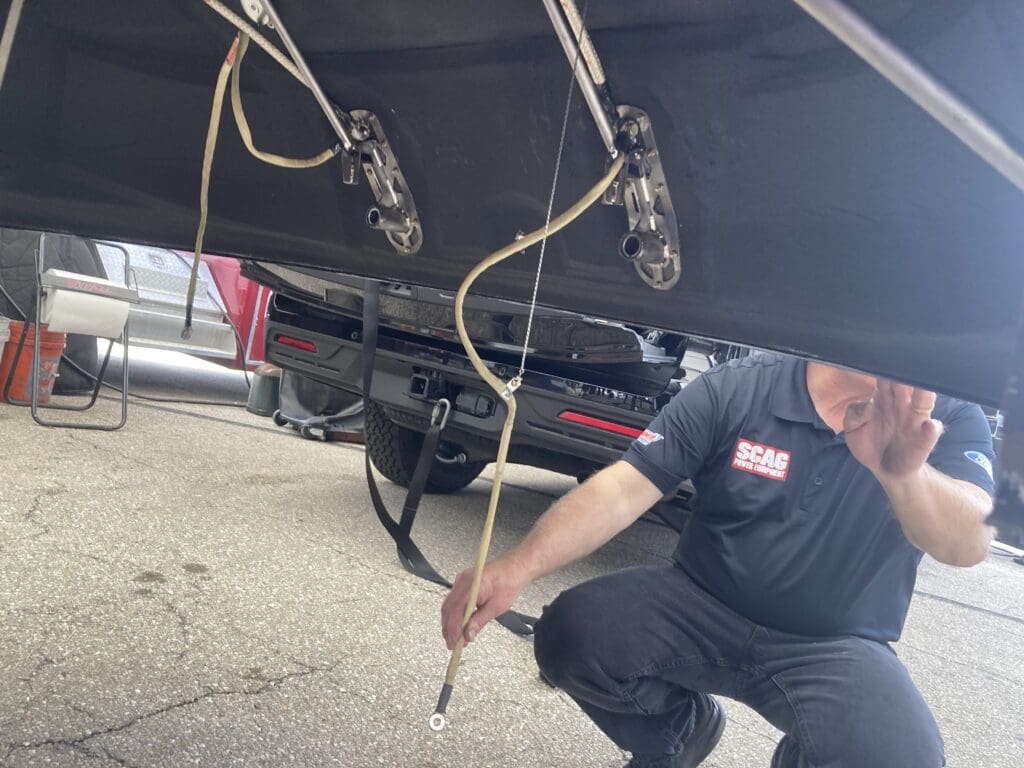
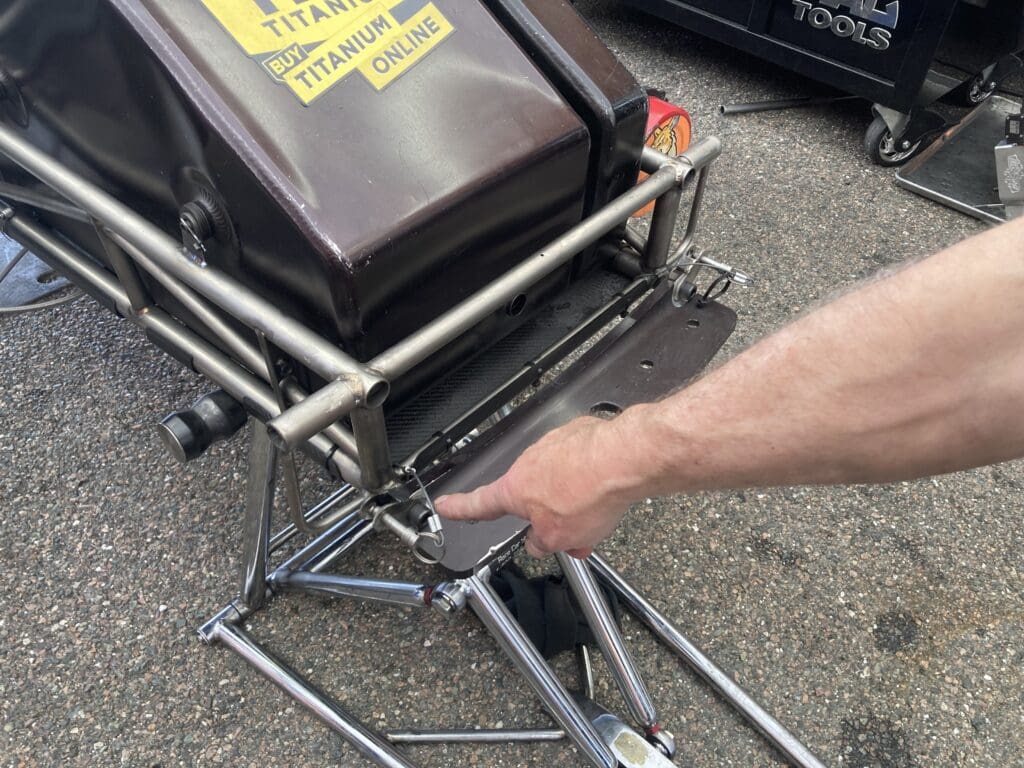
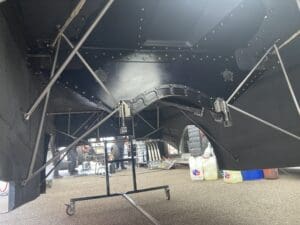
The new system retains the traditional rear hinge structure but adds two forward-mounted tethers connecting the chassis and body. The intent is to allow upward movement before restraining it.

“It’s got two tethers that are on the front of the chassis and on the front of the body and it grabs the body to try to pull it back down,” Wilkerson said.

He acknowledged the uncertainty of introducing a safety concept that cannot be fully simulated.

“Now it may pull it down crooked, it may pull it down straight. We don’t have no clue what it’s going to do,” he said. “We’re under the assumption that it may blow straight up in the air and blow straight back down. That’s what our hope is.”

The approach centers on dissipating force instead of containing it.

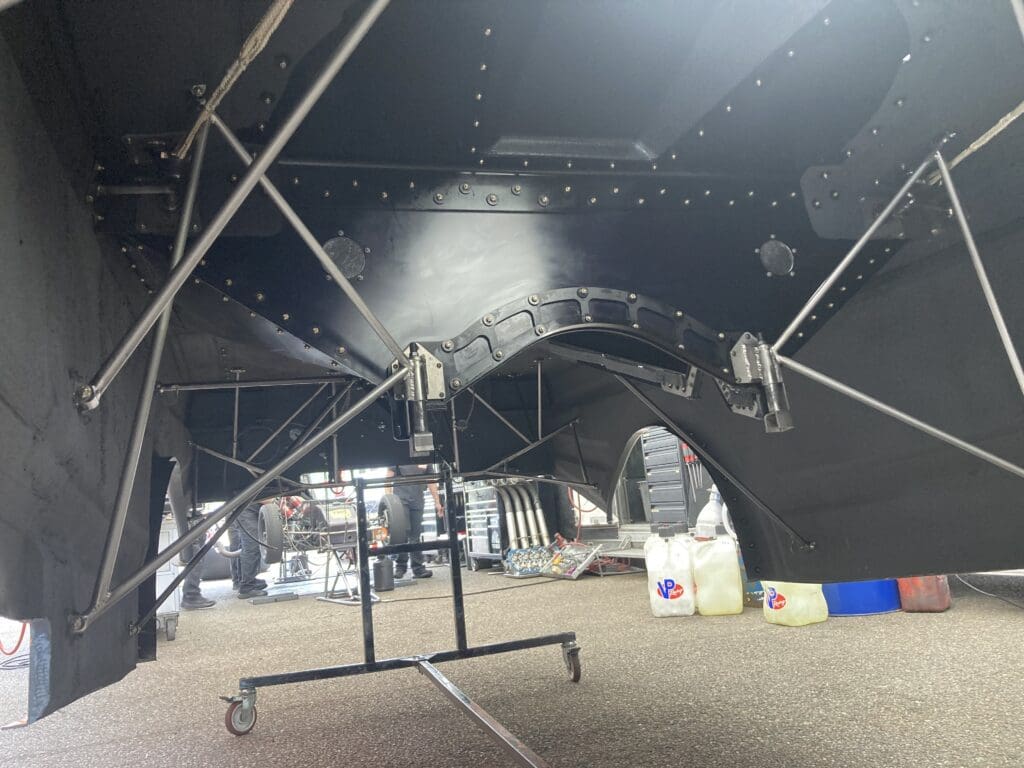
Wilkerson also modified airflow management inside the body. A tunnel now directs explosive force toward the burst panel to encourage a predictable release point.

“And we’ve also made the burst panel… Made a tunnel run into the burst panel, trying to make sure if it does have a small blow up that it funnels that energy to the burst panel to blow the burst panel out of the car,” he said.

The objective is to prevent the body from splitting under pressure.

“So hopefully with all these little things we’ve done, the thing will come loose or just blow the burst panel in the smithereens and won’t blow the body in half,” Wilkerson said. “That’s what we’re trying to get done. Not trap the driver, not blow the body in half, not junk the whole thing.”

Wilkerson has little confidence that front latches alone can withstand severe explosions.

“I told them, I said, how many times have you seen one of these things blow up bad when the front latches were still worth a crap?” he said. “They’re always violated so bad, sometimes you can’t even get them out.”

The latches remain in place but are no longer expected to carry the full burden.

“They’re still on there. They still do their job, but they’re not going to be hanging onto the front of the car like they used to,” Wilkerson said. “If it blows up, that thing’s coming up in the air and we’re going to catch it on the way up, we hope.”

The tether material itself has not changed.

“Kevlar,” Wilkerson said. “They’re just a Kevlar rope.”

He retained the dash-mounted tethers as redundancy.

“Same material,” he said. “They’re exact same… I even left the other tethers on, the one that hold the body to the dash. They’re still on there, so it shouldn’t… Even if it does something wrong, it shouldn’t blow into pieces.”

For now, the system exists as engineering theory. Wilkerson would prefer it never face a full-speed validation.

He came to Gainesville to chase horsepower gains. Instead, he may have introduced a new approach to managing Funny Car explosions — not by fighting the force, but by giving it somewhere to go.

Share the Insights?

Click here to share the article.

ad space x ad space

ad space x ad space

Competition Plus Team

Since our inception, we have been passionately dedicated to delivering the most accurate, timely, and compelling content in the world of drag racing. Our readers depend on us for the latest news, in-depth features, expert analysis, and exclusive interviews that connect you to the sport’s pulse.


Sign up for our newsletters and email list.

This field is for validation purposes and should be left unchanged.
Name

WILKERSON DEBUTS NEW FUNNY CAR TETHER SYSTEM AIMED AT CONTROLLING EXPLOSION FORCE

“We’re trying to get rid of the energy.”

That’s how Tim Wilkerson explains the new body-tethering system he and chassis builder Murf McKinney designed for his SCAG Racing Ford Mustang Funny Car, unveiled during preseason testing at Gainesville Raceway.

Wilkerson arrived at the Professional Racers Organization test session planning to evaluate performance combinations. Instead, the most significant development may be a safety innovation he hopes never has to prove itself at 330 mph.

The redesign follows a season in which several high-profile NHRA Funny Car explosions reignited debate about body containment, latch integrity and tether placement. In multiple incidents, front latches were destroyed while explosive force appeared to travel unpredictably through the body structure.

Rather than attempt to reinforce the body to resist that force, Wilkerson chose a different philosophy.

“So we decided we were going to try to get rid of the energy by allowing the body to blow up about three foot,” he said.

Wilkerson and McKinney explored two concepts over roughly 30 days. One configuration tethered the body near the dash, while the other anchored it at the nose.

“Well, Murf and I worked on it, two different versions,” Wilkerson said. “One version grabbed it at the center of the car by the dash and the other version grabbed it right at the nose.”

They selected the nose-mounted design because it limits vertical travel while still permitting controlled lift.

“And after messing with it for… We probably messed with it for 30 days back and forth, decided we’d try the one at the nose because it doesn’t let the body go up as high,” he said. “It lets it go up about three foot in the very front, like old style blow ups.”

Wilkerson referenced earlier eras of Funny Car, when bodies would lift and settle rather than fragment.

“If you ever remember seeing an old style blow up, it’d blow up in the body, come up in the air a little bit, mm, back down, it would go, right?” he said. “Sometimes they blew all the way off the back.”

The new system retains the traditional rear hinge structure but adds two forward-mounted tethers connecting the chassis and body. The intent is to allow upward movement before restraining it.

“It’s got two tethers that are on the front of the chassis and on the front of the body and it grabs the body to try to pull it back down,” Wilkerson said.

He acknowledged the uncertainty of introducing a safety concept that cannot be fully simulated.

“Now it may pull it down crooked, it may pull it down straight. We don’t have no clue what it’s going to do,” he said. “We’re under the assumption that it may blow straight up in the air and blow straight back down. That’s what our hope is.”

The approach centers on dissipating force instead of containing it.

Wilkerson also modified airflow management inside the body. A tunnel now directs explosive force toward the burst panel to encourage a predictable release point.

“And we’ve also made the burst panel… Made a tunnel run into the burst panel, trying to make sure if it does have a small blow up that it funnels that energy to the burst panel to blow the burst panel out of the car,” he said.

The objective is to prevent the body from splitting under pressure.

“So hopefully with all these little things we’ve done, the thing will come loose or just blow the burst panel in the smithereens and won’t blow the body in half,” Wilkerson said. “That’s what we’re trying to get done. Not trap the driver, not blow the body in half, not junk the whole thing.”

Wilkerson has little confidence that front latches alone can withstand severe explosions.

“I told them, I said, how many times have you seen one of these things blow up bad when the front latches were still worth a crap?” he said. “They’re always violated so bad, sometimes you can’t even get them out.”

The latches remain in place but are no longer expected to carry the full burden.

“They’re still on there. They still do their job, but they’re not going to be hanging onto the front of the car like they used to,” Wilkerson said. “If it blows up, that thing’s coming up in the air and we’re going to catch it on the way up, we hope.”

The tether material itself has not changed.

“Kevlar,” Wilkerson said. “They’re just a Kevlar rope.”

He retained the dash-mounted tethers as redundancy.

“Same material,” he said. “They’re exact same… I even left the other tethers on, the one that hold the body to the dash. They’re still on there, so it shouldn’t… Even if it does something wrong, it shouldn’t blow into pieces.”

For now, the system exists as engineering theory. Wilkerson would prefer it never face a full-speed validation.

He came to Gainesville to chase horsepower gains. Instead, he may have introduced a new approach to managing Funny Car explosions — not by fighting the force, but by giving it somewhere to go.

Picture of John Doe

John Doe

Lorem ipsum dolor sit amet consectetur adipiscing elit dolor

More Posts

Send Us A Message

Picture of Bobby Bennett
Bobby Bennett
Thank you for joining us on this journey. Your support and trust inspire us every day to deliver the best in drag racing journalism. We are excited about the future and look forward to continuing to serve you with the same dedication and passion that has defined CompetitionPlus.com from the very beginning.

Don’t miss these other exciting stories!

Explore more action packed posts on Competition Plus, where we dive into the latest in Drag Racing News. Discover a range of topics, from race coverage to in-depth interviews, to keep you informed and entertained.