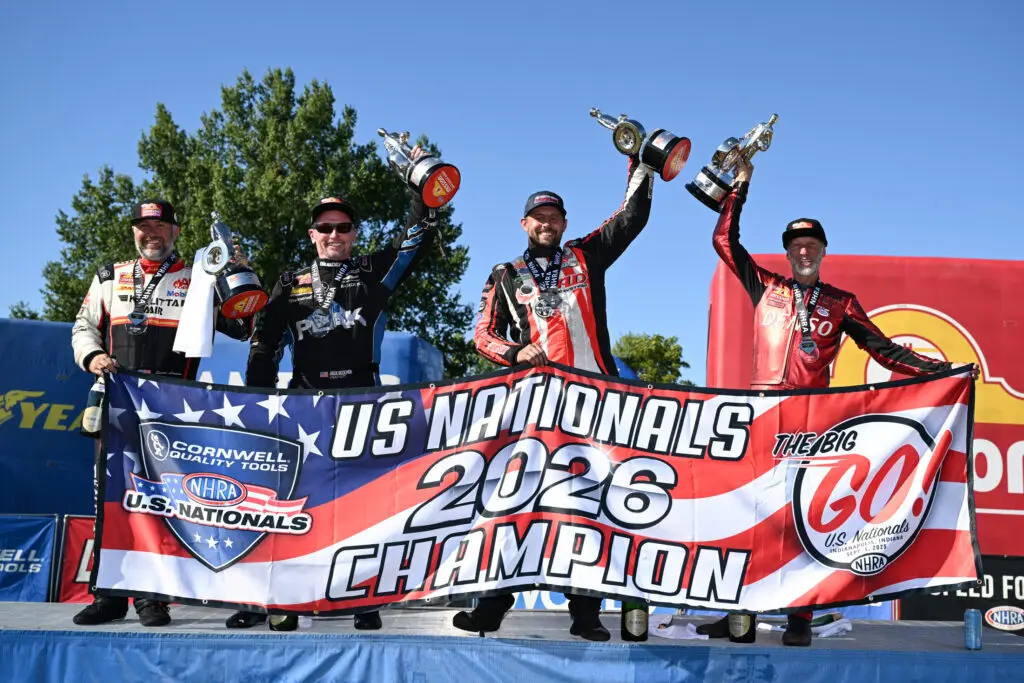
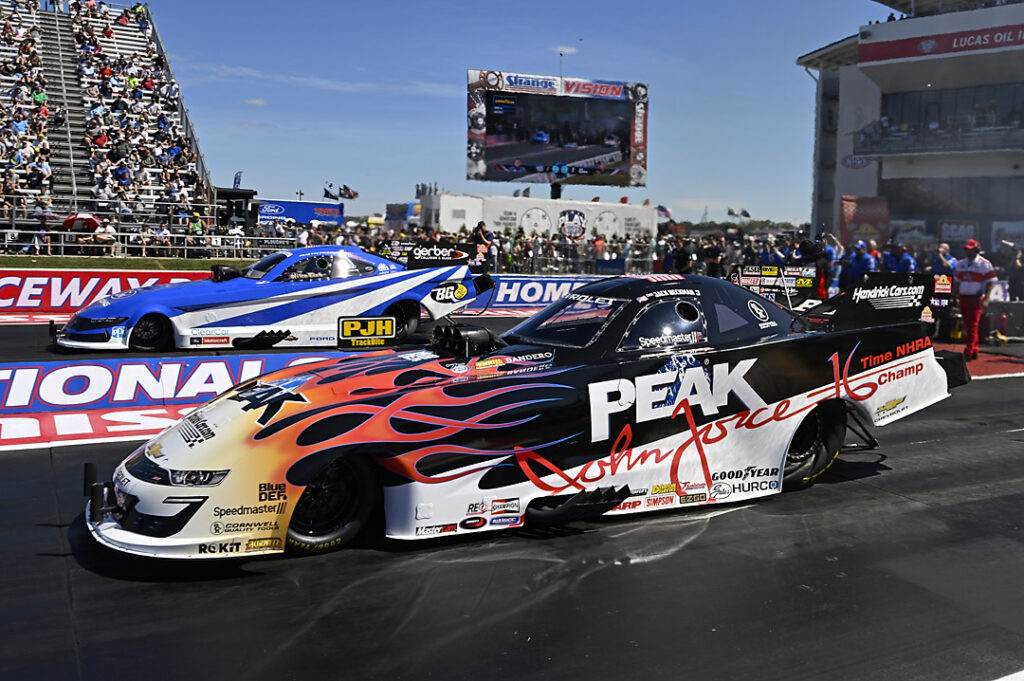
The NHRA US Nationals — known as “The Big Go” — is the most prestigious drag racing event in the world. Held every Labor Day weekend at Lucas Oil Indianapolis Raceway Park in Brownsburg, Indiana, it is the final race of the NHRA regular season and the gateway to the Countdown to the Championship playoffs. Winning the US Nationals carries a weight that no other event on the tour can match — drivers have called it the one win that completes a career. The 2026 event is the 72nd annual Cornwell Quality Tools NHRA US Nationals, running September 2–7, 2026, as part of the NHRA’s 75th anniversary season. CompetitionPlus.com has covered the US Nationals from the starting line since 1999.
The NHRA US Nationals at a Glance
| Official name | Cornwell Quality Tools NHRA US Nationals |
| Nickname | The Big Go |
| Venue | Lucas Oil Indianapolis Raceway Park |
| Address | 10267 East US Highway 136, Brownsburg, Indiana 46112 |
| Location | ~15 miles west of downtown Indianapolis |
| 2026 dates | September 2–7, 2026 (Wednesday–Monday) |
| When (annually) | Labor Day weekend |
| First held | 1955 (Great Bend, Kansas) |
| At Indianapolis | 1961–present |
| NHRA ownership of track | Since 1979 |
| Season position | Final regular-season event |
| Significance | Last event to qualify for the Countdown to the Championship |
| Qualifying sessions | Five (vs. four at most events) |
| Track surface | Concrete and asphalt, 4,400-foot drag strip |
| Track elevation | ~700 feet |
| Field size | ~950+ cars across all classes |
| Broadcast | FOX (eliminations live on Labor Day), FS1 (qualifying) |
| 2025 winners | Justin Ashley (TF), Austin Prock (FC), Erica Enders (PS), Gaige Herrera (PSM) |
Why the US Nationals Is Different From Every Other Race
Every NHRA national event offers a Wally. The US Nationals offers something more.
There is no direct analogy in other sports — the closest is the Masters in golf or the Daytona 500 in NASCAR, events where winning means something beyond the championship points, where the name on the trophy carries permanent historical weight. In drag racing, winning the US Nationals completes a career. Drivers who have won championships without an Indianapolis Wally speak openly about the gap. Drivers who have won at Indy without a championship speak with similar gravity about what that trophy means.
The reasons are layered and reinforcing. The US Nationals is the largest field of the season — typically over 950 cars across all professional and sportsman classes. It carries elevated qualifying points (worth more than any other regular-season event). It is the last race before the Countdown resets everything, meaning it can simultaneously determine playoff positioning for twenty drivers while one is winning the event outright. It runs five qualifying sessions instead of the standard four. Eliminations run on Labor Day Monday, the longest single elimination day of the year. Final rounds broadcast live on the FOX broadcast network — the sport’s largest audience of any event on the tour.
It is also the longest-running Labor Day weekend motorsports event in the United States — a distinction it earned in 2004 — placing it in the same institutional category as the Indianapolis 500, which it shares a metropolitan area with.
When Justin Ashley won the 2025 US Nationals on a holeshot over Tony Stewart — his .027 reaction time making the difference in a final round decided by .002 seconds — he described the experience as still being processed hours later. That’s what Indy does.
The History: From Great Bend to Indianapolis
1955: The first Nationals, Great Bend, Kansas The inaugural US Nationals was held at the Great Bend Municipal Airport in Great Bend, Kansas — a decommissioned airstrip that had become the standard venue for early organized drag racing events. Calvin Rice won the top eliminator category. The format bore little resemblance to the modern professional event; it was closer to a showcase of the sport’s growing population than the championship-defining spectacle it would become. NHRA had been founded just four years earlier by Wally Parks with the mission of creating organized, safe competition for hot rodders.
1956–1960: The nomadic years The event spent its early years moving from city to city as NHRA traveled the Nationals to build its national profile. Kansas City hosted in 1956. The Oklahoma State Fairgrounds in Oklahoma City hosted in 1957 and 1958. Detroit Dragway hosted in 1959 and 1960. Each move was calculated to introduce new markets to drag racing.
1961: The permanent home — Indianapolis During the 1960 US Nationals in Detroit, a handshake agreement between Tom Binford and NHRA founder Wally Parks sealed the event’s future. The newly constructed Indianapolis Raceway Park — built on a 267-acre farm by 15 local businessmen who had invested $5,000 each — would become the Nationals’ permanent home starting in 1961. The drag strip was built with NHRA assistance and was the first element of the complex completed. That handshake deal, honored without a written contract, became one of the sport’s most consequential moments. In 1979, the NHRA purchased the entire complex outright — the organization now owns the track where it hosts its most prestigious event, an unusual arrangement that gives The Big Go institutional permanence.
1964: Top Fuel arrives It wasn’t until 1964 that Top Fuel made its first official appearance at the US Nationals. The first winner: Don Garlits, who would win The Big Go eight times. The arrival of nitro cars transformed Indianapolis from a competitive showcase into the thundering spectacle it remains today.
The Wally trophy — 1969 The most iconic object in drag racing was introduced at the 1969 US Nationals. Standing 18 inches tall from the base of its solid walnut stand to the top of its antique brass-plated head and weighing 12 pounds, the Wally — named for Wally Parks — became the most coveted prize in the sport. Don Garlits received three that evening, for his 1964, 1967, and 1968 wins. Don Prudhomme received two, for 1965 and 1969. More than 9,000 full-size Wallys have been awarded since.
Track naming history:
- Indianapolis Raceway Park (1960–2006)
- O’Reilly Raceway Park at Indianapolis (2006–2010)
- Lucas Oil Raceway at Indianapolis (2011–2021)
- Lucas Oil Indianapolis Raceway Park (2021–present)
The Track: Lucas Oil Indianapolis Raceway Park
Lucas Oil Indianapolis Raceway Park sits approximately 15 miles west of downtown Indianapolis at 10267 East US Highway 136 in Brownsburg, Indiana — in the same motorsports corridor as the Indianapolis Motor Speedway. The 4,400-foot drag strip features a concrete and asphalt surface engineered for maximum traction, sitting at approximately 700 feet of elevation. The facility’s grandstands hold approximately 30,000 spectators, but the US Nationals footprint is far larger — with camping grounds, Hot Rod Junction, pits accommodating nearly 1,000 entries, and sponsor installations, the complex during race week functions as a small city dedicated to drag racing.
The elevation and September weather in central Indiana — ranging from summer heat to early autumn cool — create atmospheric conditions that are distinct from other NHRA venues. Teams that consistently win at Indianapolis have learned to read and adjust to conditions specific to this track and this time of year. The combination of elevation, typical air density, and track surface preparation makes Indianapolis tuning a specialized skill.
The new Wally Parks Tower, unveiled at the 2025 event, joins the facility’s infrastructure as a permanent tribute to the NHRA’s founder.
What Makes Indianapolis Special: The Competitive Structure
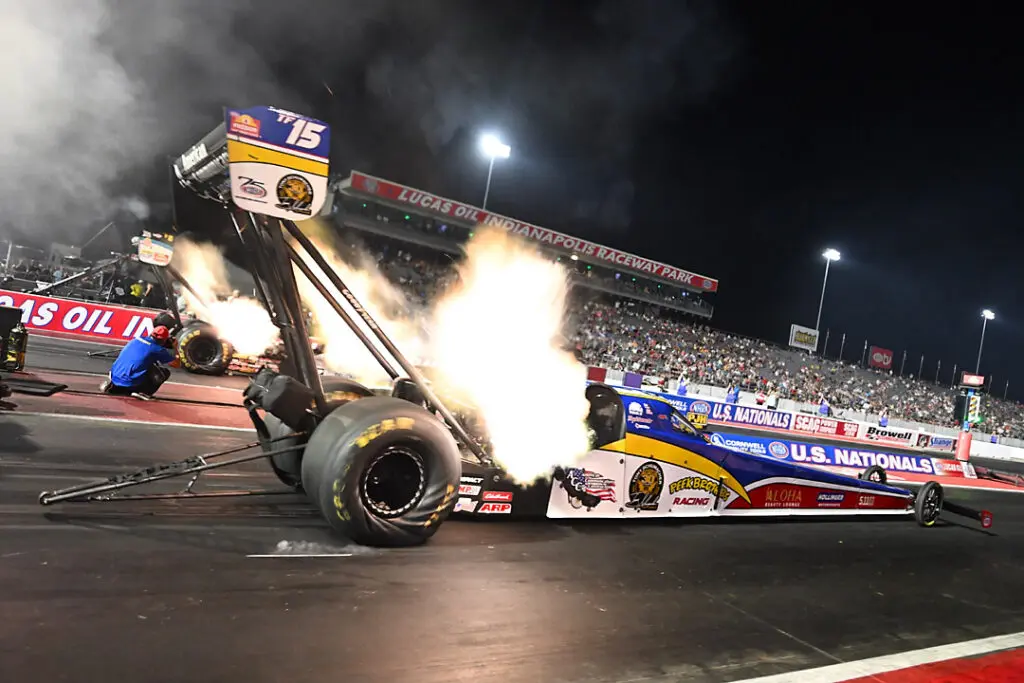
Five qualifying sessions. Every other NHRA national event (except Virginia) runs four qualifying sessions. Indianapolis runs five — one Friday evening, two Saturday, two more Sunday — giving teams more opportunities and fans more nitro action across the extended weekend. Friday night qualifying, with exhaust flames visible against the darkening sky, is among drag racing’s iconic spectacles.
Elevated qualifying and show-up points. The No. 1 qualifier at Indianapolis earns 10 points (vs. 8 at most events), and all entrants receive 15 show-up points (vs. 10). For a driver on the edge of Countdown qualification, the Indy points structure can be decisive.
The last regular-season event. After Labor Day Monday’s eliminations, points are recalculated and the Countdown seeds are set. The winner of The Big Go can be simultaneously achieving drag racing’s greatest individual honor while also completing the most consequential competitive moment for the entire field. No other event on the tour carries both dimensions simultaneously.
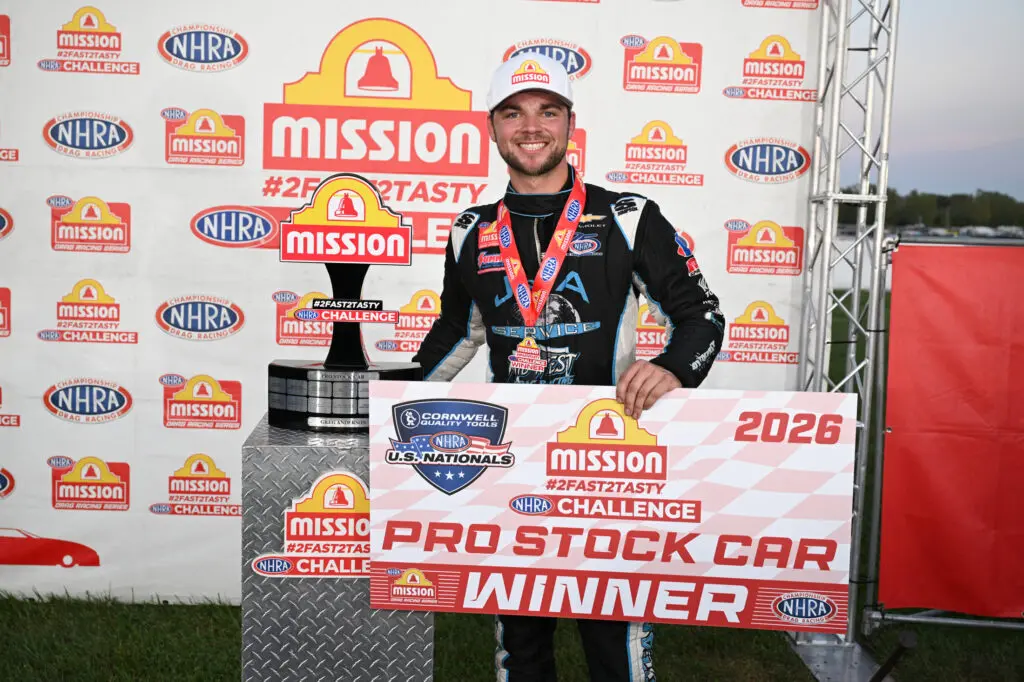
The Mission #2Fast2Tasty Challenge. This bonus event — semifinalists from the previous race compete in a rematch — runs at Indianapolis qualifying in recent seasons, carrying bonus championship points that factor into the Countdown calculation.
The All-Star Callout. A specialty format where drivers select their opponents has run at Indianapolis in recent seasons, adding fan-interactive drama to the qualifying weekend.
The Greatest Moments in US Nationals History
CompetitionPlus.com’s archive contains 25+ years of primary-source US Nationals coverage — starting-line notebooks, winner’s circle interviews, and race reports from the people who were there.
Don Garlits’ first win — 1964 The first Top Fuel winner at the US Nationals established Indianapolis as the event where legends are made. Garlits would win eight times in his career.
The Wally trophy’s debut — 1969 When Don Prudhomme won Top Fuel at the 1969 US Nationals, he received the first Wally ever presented in the winner’s circle. The 18-pound trophy named for Wally Parks became the most coveted object in drag racing.
Bob Glidden’s Indy dominance — 1973–1988 Nine US Nationals Pro Stock victories across 15 years — 1973, 1974, 1978, 1979, 1983, 1985, 1986, 1987, and 1988. During his peak years, Glidden winning The Big Go’s Pro Stock class was a near-formality. His nine Indianapolis wins remain the most by any Pro Stock driver in the event’s history.
Tony Schumacher’s decade of dominance — 2000–2016 Ten Top Fuel wins across 16 years. Schumacher’s wins in 2000, 2002, 2003, 2004, 2006, 2007, 2008, 2009, 2012, and 2016 include several seasons where winning The Big Go was part of a championship-clinching run. No professional-class driver in US Nationals history has won more often.
John Force’s fifth Funny Car win — 2012 Force’s fifth Indianapolis Funny Car victory — at age 63, tying Ed “Ace” McCulloch for the all-time Funny Car record — produced one of the event’s most emotional winner’s circles. Force had survived a massive crash in 2007 and returned through recovery and resilience. “This race really meant a lot,” Force said. “Winning this, I didn’t think I would ever get the chance again.”
Brittany Force’s 343.51 mph qualifying record — 2025 At the 71st US Nationals, Brittany Force set the all-time NHRA Top Fuel speed record in qualifying: 343.51 mph, eclipsing her own 343.16 from Sonoma earlier that season. The record came during her final full competitive season. It stands as the fastest pass in NHRA history — set at drag racing’s grandest venue.
Justin Ashley’s holeshot — 2025 Ashley’s Top Fuel final against Tony Stewart was decided by .002 seconds. Stewart ran 3.815 to Ashley’s 3.839, but Ashley’s .027 reaction time made the difference. His first career Indianapolis win — his 18th overall — on drag racing’s biggest stage.
The All-Time Champions at Indianapolis
| Driver | Class | US Nationals wins | Win years |
|---|---|---|---|
| Frank Manzo | Top Alcohol FC | 11 | 1986, ’94, ’97, 2000, ’01, ’02, ’05, ’06, ’07, ’11, ’13 |
| Tony Schumacher | Top Fuel | 10 | 2000, ’02, ’03, ’04, ’06, ’07, ’08, ’09, ’12, ’16 |
| Bob Glidden | Pro Stock | 9 | 1973, ’74, ’78, ’79, ’83, ’85, ’86, ’87, ’88 |
| Don Garlits | Top Fuel | 8 | 1964, ’67, ’68, ’75, ’78, ’84, ’85, ’86 |
| John Force | Funny Car | 5 | Multiple years |
What to Expect: The Six-Day Format
Wednesday–Thursday: Lucas Oil Drag Racing Series and sportsman events The early days feature NHRA Lucas Oil Drag Racing Series sportsman competition — bracket classes, Super Stock, Stock, and specialty categories. For fans interested in the sport’s grassroots rather than just the professional show, this competition is genuinely compelling. Hot Rod Junction runs throughout the weekend.
Friday: Professional qualifying begins One qualifying session Friday evening at approximately 6:45 p.m. ET. Friday night qualifying at Indianapolis — exhaust flames visible against the darkening sky — is one of drag racing’s iconic experiences. Crowds are smaller than Saturday and Sunday, making Friday an excellent choice for fans wanting accessibility with full professional action.
Saturday: Double qualifying sessions Two professional qualifying sessions, plus the Mission #2Fast2Tasty Challenge and the Funny Car All-Star Callout. Saturday draws the largest crowds outside of Monday eliminations. The afternoon and evening sessions are when teams push hardest for qualifying position.
Sunday: Final qualifying sessions Two more sessions set the final elimination ladder. Sunday afternoon is when teams cement their positions — or make final desperate pushes for the top half of the field.
Monday — Labor Day: Eliminations Four rounds of professional eliminations, with final rounds broadcast live on FOX. The Monday crowd at The Big Go — dedicated fans who’ve often been on-site since Wednesday, alongside casual spectators drawn by the Labor Day occasion — creates an atmosphere unmatched on the NHRA tour.
Attending the US Nationals: A Practical Guide
Tickets and pricing Full Event packages cover all six days and represent the best value for the complete experience. Single-day tickets are available for specific sessions — for fans who can only attend Monday finals or Saturday eliminations. Group tickets serve larger parties. The Top Eliminator Club offers premium seating with food and beverage included, starting-line seats, and driver appearances; contact the NHRA hospitality team at the official event page for suite and club-level pricing.
Military and first responder discounts of up to 20% are available through NHRA’s partnership with GovX. All tickets are available through NHRA.com and Lucas Oil Indianapolis Raceway Park at raceirp.com. For the 2026 75th anniversary season, purchasing early is strongly recommended.
One critical fact: every ticket is a pit pass. No additional credential or fee required to access the working pits, watch crews tear down and rebuild engines between rounds, and pursue driver autographs. This is essentially unique among major motorsports events and is the primary reason new attendees leave converted fans.
Accommodations Book in Brownsburg first — it’s closest to the track. Avon and Plainfield are good secondary options. Labor Day weekend demand plus 30,000-spectator capacity means nearby hotels fill quickly; book as early as possible. On-site camping at Lucas Oil Indianapolis Raceway Park includes hook-up sites across the street from the raceway — the preferred option for fans attending all six days.
Parking and traffic Free main gate parking is available on a first-come basis. Premium trackside parking is available for an additional cost. Private driveway and parking app services (SpotHero and similar) can offer options closer to the venue with reduced exit congestion. US-136 bottlenecks during peak sessions are inevitable. Strategies that work: arrive at least 90 minutes before gates open on Saturday and Monday, use the free main gate lot rather than searching for alternatives during peak periods, and consider leaving before the final round to avoid the worst exit congestion — the final round airs live on FOX if you can’t stay.
Weather and logistics Indiana over Labor Day is unpredictable — afternoon thunderstorms develop quickly. Pack rain gear regardless of the forecast. Ear protection is essential for nitro classes; NHRA provides earplugs at the gate. Download the NHRA app for live schedule updates and weather-related changes during the event.
Venue policies No animals except service dogs. Cooler size restrictions, camera policies, and bag requirements follow standard NHRA event guidelines — check the official event page before attending for current specifics.
The Countdown Connection
For the drivers, the US Nationals has a competitive dimension beyond the event itself. It is the last chance to secure a Countdown position. The top 10 drivers in each professional class after Indianapolis qualify for the six-race playoff. For drivers on the edge of the top 10, every qualifying session at Indianapolis and every round won in Monday eliminations can be the margin between reaching the Countdown or watching it from home.
After the final round on Monday, the Countdown seeds are set, points compress, and the championship hunt begins. The transition from the intensity of winning Indianapolis to beginning the Countdown within days is one of drag racing’s most demanding sequences.
CompetitionPlus.com at The Big Go
CompetitionPlus.com has covered the NHRA US Nationals since 1999 — every qualifying session, every elimination round, every winner’s circle across more than 25 Labor Day weekends. Bobby Bennett and the CompetitionPlus.com team have reported from the starting line and pits at Indianapolis for over two decades, building the deepest independent archive of US Nationals coverage anywhere in drag racing media.
→ Browse U.S. Nationals coverage at CompetitionPlus.com → How NHRA drag racing works: the complete fan guide → Top Fuel: The Ultimate Guide → Funny Car: The Complete Guide → Pro Stock: The Complete Guide → Pro Stock Motorcycle: The Complete Guide