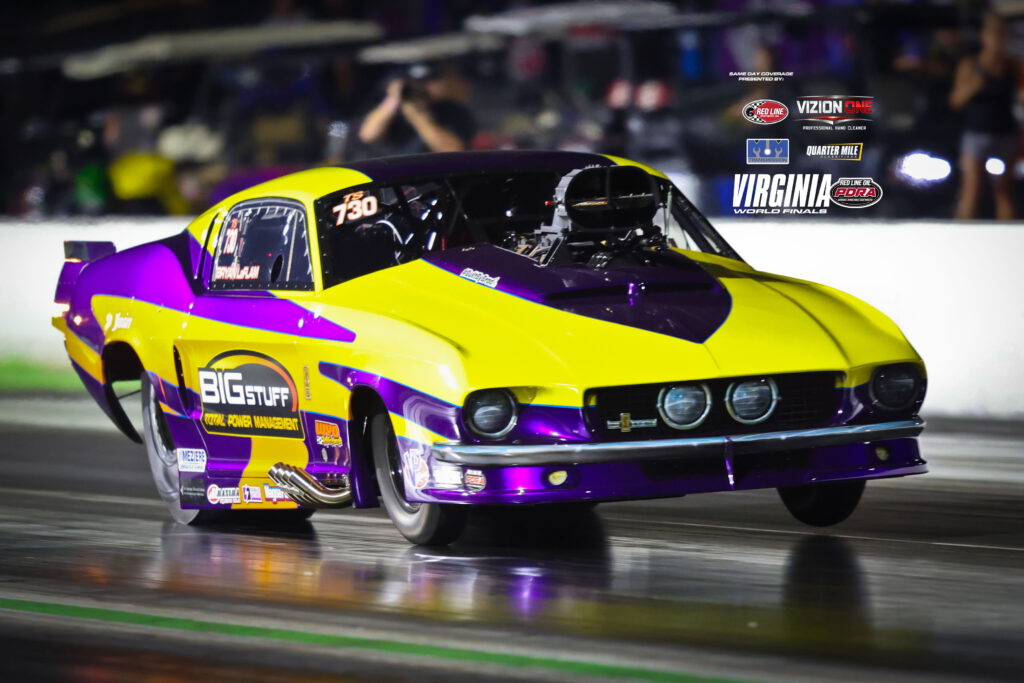
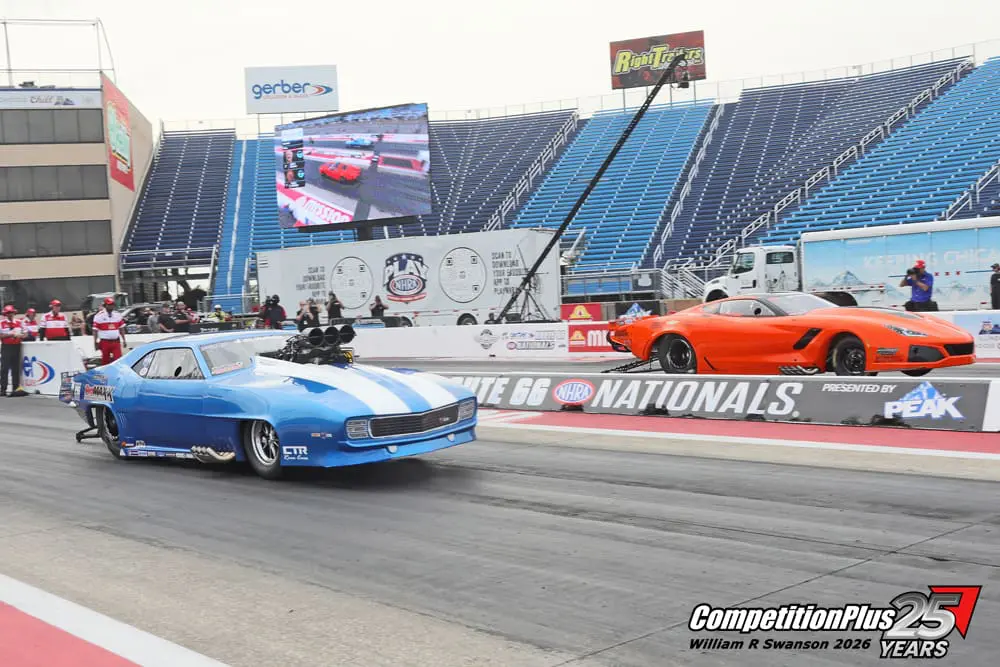

Pro Modified — Pro Mod — is the wildest professional class in NHRA drag racing. Full-bodied cars that look like street machines run the quarter-mile in the high-five-second range at over 250 mph, powered by supercharged, turbocharged, or nitrous-assisted engines producing between 2,500 and 4,000+ horsepower. Unlike any other NHRA professional class, Pro Mod allows competitors to choose their own power adder — blower, turbo, or nitrous — creating a rare heads-up battle between fundamentally different technologies. The result is one of the most visually spectacular, mechanically diverse, and fan-beloved classes in motorsport.
What Is Pro Mod Drag Racing?
Pro Modified sits in a unique position in the NHRA’s professional class structure. It’s not Top Fuel — it doesn’t burn nitromethane or approach 340 mph. It’s not Pro Stock — it is everything Pro Stock is not, built around forced induction, wild power adders, and machines that push the edge of traction and control on every pass.
What it is: a class where a 1941 Willys coupe, a late-model Chevrolet Camaro, and a vintage Corvette can qualify side-by-side. Where a roots-blown big-block competes directly against twin turbos and a nitrous-injected mountain motor. Where the cars look like something that might have rolled off a dealer lot or out of a muscle car restoration shop, and accelerate like nothing else with a full-body silhouette.
Pro Mod exists at the intersection of nostalgia and cutting-edge performance — and for a specific, deeply passionate segment of drag racing’s fan base, nothing else in the sport comes close.
Pro Mod vs. Funny Car: The Doorslammer Distinction
New fans sometimes look at a Funny Car and a Pro Mod and ask the same question: don’t they both look like production cars? The answer reveals the most important distinction in the class.
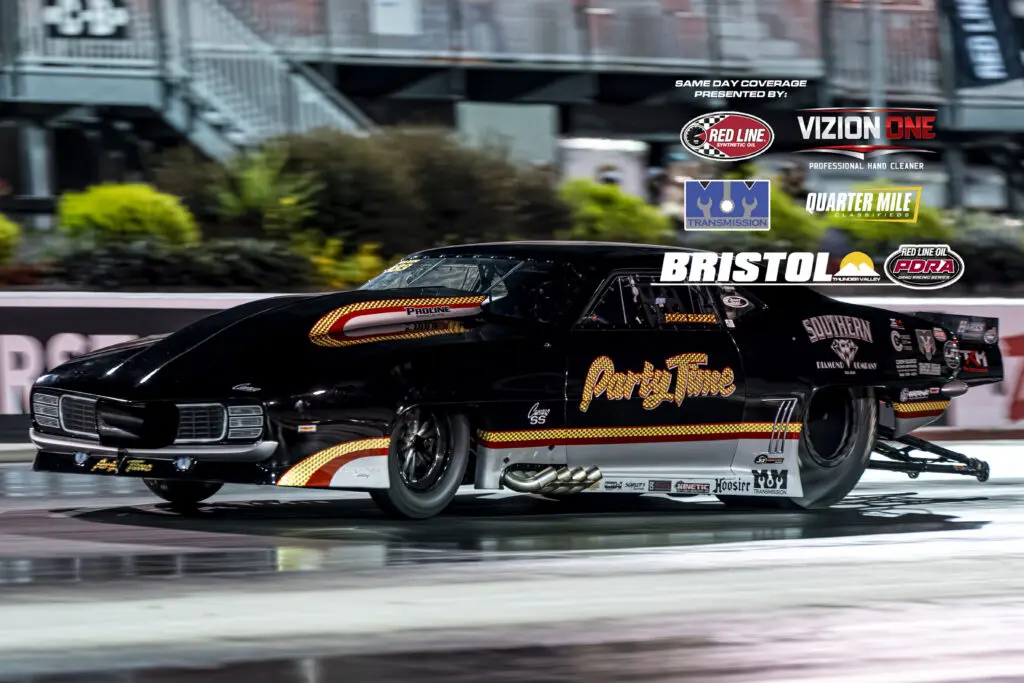
A Pro Mod is a true doorslammer — the car has a full body with functional doors that open and close, just like the production vehicle it resembles. A Funny Car uses a flip-top body that lifts as one complete shell from the front, even though its silhouette resembles a Camaro or Mustang. In Pro Mod, one-piece Funny Car-style bodies are explicitly prohibited. The working doors aren’t a detail — they’re a defining rule that connects the class to its street-machine roots and separates it fundamentally from the nitro Funny Car class.
The performance distinction matters too. Top Fuel dragsters and Funny Cars run on nitromethane over 1,000 feet in the low 3-second range. Pro Mod runs the full quarter-mile on methanol or gasoline in the high 5-second range at 250+ mph — the fastest full-bodied, door-opening race cars competing in professional drag racing anywhere in the world.
Pro Mod at a Glance
| Specification | Figure |
|---|---|
| Race distance | Quarter mile (1,320 feet) |
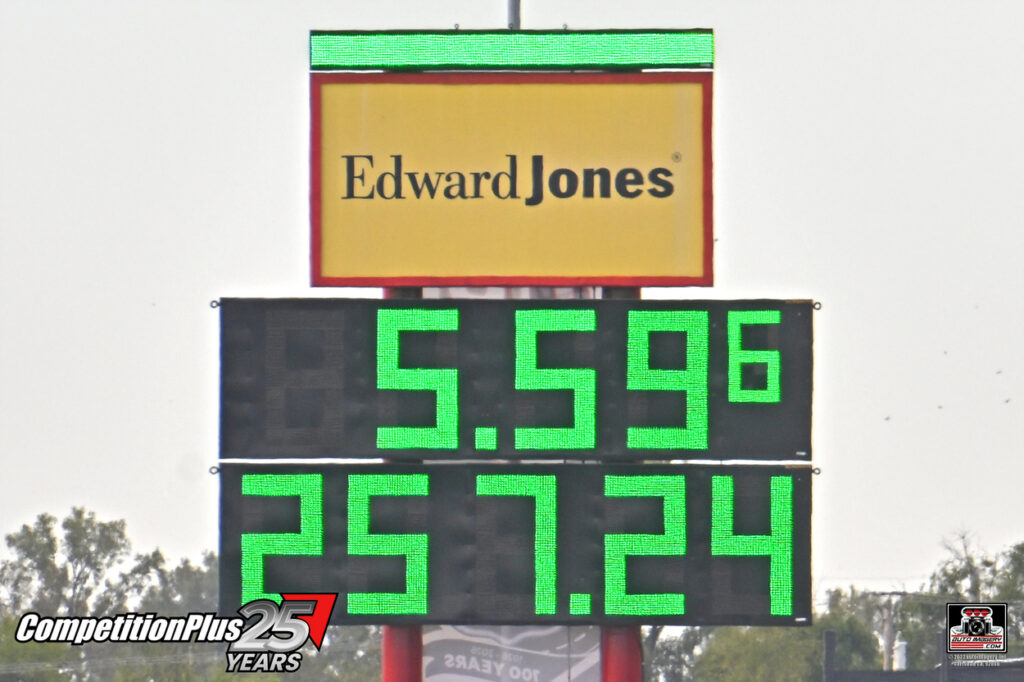
| Elapsed time (competitive) | High 5-second range (5.70–5.90s typical) |
| Top speed (competitive) | 245–260+ mph |
| Horsepower range | 2,500–4,000+ hp depending on combination |
| Power adder options | Supercharger, turbocharger, or nitrous oxide |
| Engine displacement (blown/turbo) | Maximum 526 cubic inches |
| Engine displacement (nitrous) | Up to 959 cubic inches |
| Turbocharger limit | Twin 88mm maximum |
| Minimum weight (supercharged) | 2,600 lbs including driver |
| Minimum weight (turbocharged) | 2,650 lbs including driver |
| Minimum weight (nitrous, no lockup) | 2,425 lbs including driver |
| Body eligibility | 1963 to current model year production-based bodies |
| Body style | Full-bodied with functional doors — no flip-top bodies |
| Fuel (supercharged/turbo) | Methanol or gasoline |
| Fuel (nitrous) | Gasoline |
| 2026 NHRA season | 11 races (25th anniversary season) |
| 2025 NHRA champion | JR Gray (Al Anabi Racing) |
How Pro Mod Racing Works
Pro Mod runs heads-up — first car to the finish line wins. No handicaps, no dial-ins, no index. Every round is a straight contest between two competitors who each believe their combination — blown, turbo, or nitrous — is the right one for the conditions that day.
Qualifying fills a 16-car field based on elapsed time across Friday and Saturday sessions. The quickest ET earns the better position on the elimination ladder — top speed does not determine qualifying order, only elapsed time.
Eliminations run four rounds on Sunday: round of 16, quarterfinals, semifinals, and final. At four-wide events such as the Charlotte 4-Wide Nationals, the format changes — four cars run simultaneously, with the top two advancing — but the fundamental principle is the same.
Championship points accumulate across the season based on both qualifying position and round performance:
| Result | Points |
|---|---|
| First-round loss | 20 pts |
| Quarterfinal (round of 8) | 40 pts |
| Semifinal | 60 pts |
| Runner-up | 80 pts |
| Event winner | 100 pts |
Qualifying position and session bonus points also contribute, meaning every qualifying run matters — not just the final ladder position. At select events, including recent season finales, NHRA has applied 1.5× points multipliers, which can swing a championship dramatically in the closing races. The 2025 title came down to a single point between JR Gray and Billy Banaka at the Las Vegas finale — the most extreme version of that late-season volatility.
The Road to the Championship playoff structure in the 2026 season is a five-race playoff segment beginning at Norwalk, Ohio — a format designed to compress the championship battle and reward consistent performance across the season’s closing events.
The Three Power Adders: The Battle Inside the Battle
What makes Pro Mod unlike anything else in professional drag racing is its power adder diversity. Three distinct technologies compete simultaneously — and their mechanical differences mean combination selection and weather conditions are as strategic as driver skill.
Roots/Screw Supercharger The traditional and most visually iconic Pro Mod combination. A large blower mounted on the intake protrudes through a hole cut in the hood — the image most fans picture when they think “Pro Mod.” Methanol-burning, with immediate throttle response and massive torque from the moment the car launches. The screw supercharger dominated the NHRA ranks through the 2010s and 2020s. Steve Jackson’s back-to-back championships in 2019–20 are the modern benchmark for the blown combination’s potential.
Twin Turbochargers Twin 88mm turbos — the maximum size permitted — mounted low on the car with large intercooler plumbing visible at the front. Turbocharged Pro Mods build power differently: the turbo spool creates a massive top-end velocity surge that requires a different launch and shift strategy than the blower cars. The combination is potentially the most explosive under the right conditions and the most sensitive to track temperature and atmospheric pressure changes.
Nitrous Oxide The original Pro Mod combination, born from the IHRA’s Quick Eight era. Nitrous cars run on gasoline (not methanol), use forward-facing hood scoops rather than supercharger hats, and can run larger displacement engines — up to 959 cubic inches — at lighter minimum weights. The nitrous combination requires precise delivery staging to maximize the hit without spinning the tires, and its weight and displacement advantages are offset by less immediate power than the blower cars.
The parity battle between these three combinations is one of Pro Mod’s defining storylines. NHRA regularly adjusts minimum weights, boost limits, and displacement rules to keep all three competitive — a balancing act that has never been fully resolved and creates constant technical evolution within the class.
The Chassis, Body, and Safety Rules
A Pro Mod is not a modified street car. It is a purpose-built tube-frame chassis with an approved production-based body, a professional engine program, full safety systems, and enough data acquisition to make round-to-round tuning decisions.
Chassis construction must meet NHRA-accepted specifications and, in many cases, must be submitted for NHRA approval. Specialist chassis builders — including Jerry Bickel Race Cars and Race Tech — are the dominant names in the Pro Mod space because the structure must handle enormous torque, violent tire shake, and shutdown forces at 250+ mph while protecting the driver inside a certified safety cell.
Safety systems required in Pro Mod include multi-point roll cages built to NHRA specifications, SFI-rated fire suits, harnesses, and helmets, window nets with external release access, fire suppression systems, and twin parachutes for braking after the finish line. The driver compartment must meet strict NHRA General Regulations covering seat mounting, firewall material (.024-inch steel or titanium minimum), and cage construction.
Body rules permit production-based bodies from 1963 to current model years — Camaros, Mustangs, Corvettes, Firebirds, Challengers, Willys coupes, and more. Aerodynamics are tightly regulated at Pro Mod speeds: the distance from the front spindle to the nose of the car cannot exceed 45 inches, rear body openings are limited to two hinged panels with a combined maximum area of 120 square inches, and carbon fiber front overhang components must carry SFI 54.1 flame-retardant certification. These limits prevent teams from gaining aerodynamic advantages that would make the class unsafe or impossible to regulate for parity.
Weight connects safety and parity together. Different combinations carry different minimum weights because the NHRA uses weight, boost limits, and displacement rules to keep the three power adders on even competitive terms.
How a Pro Mod Run Looks
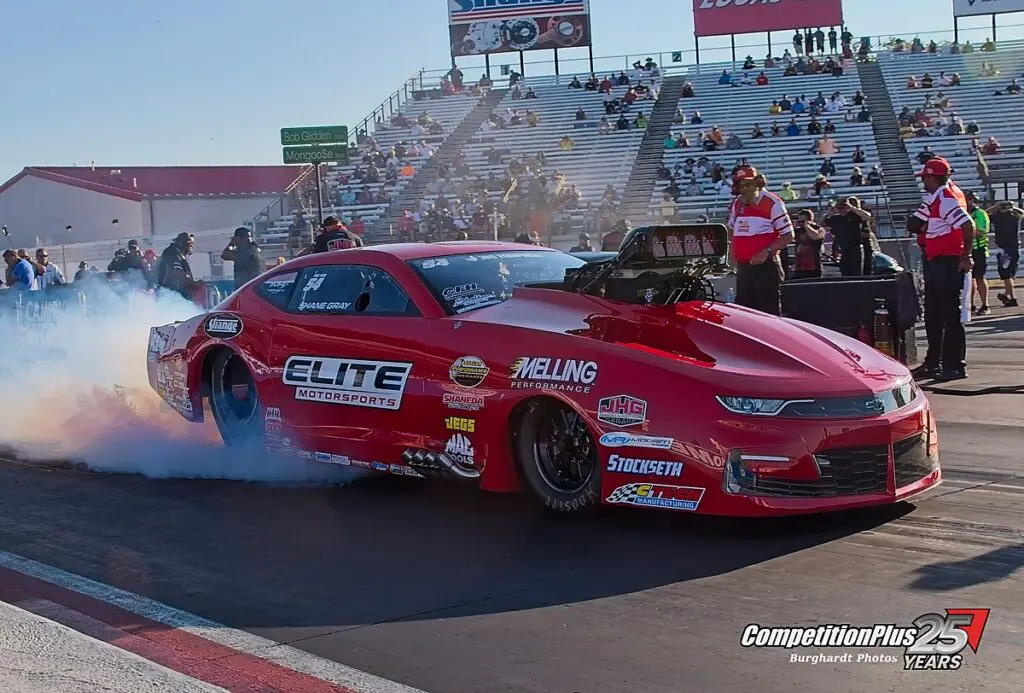
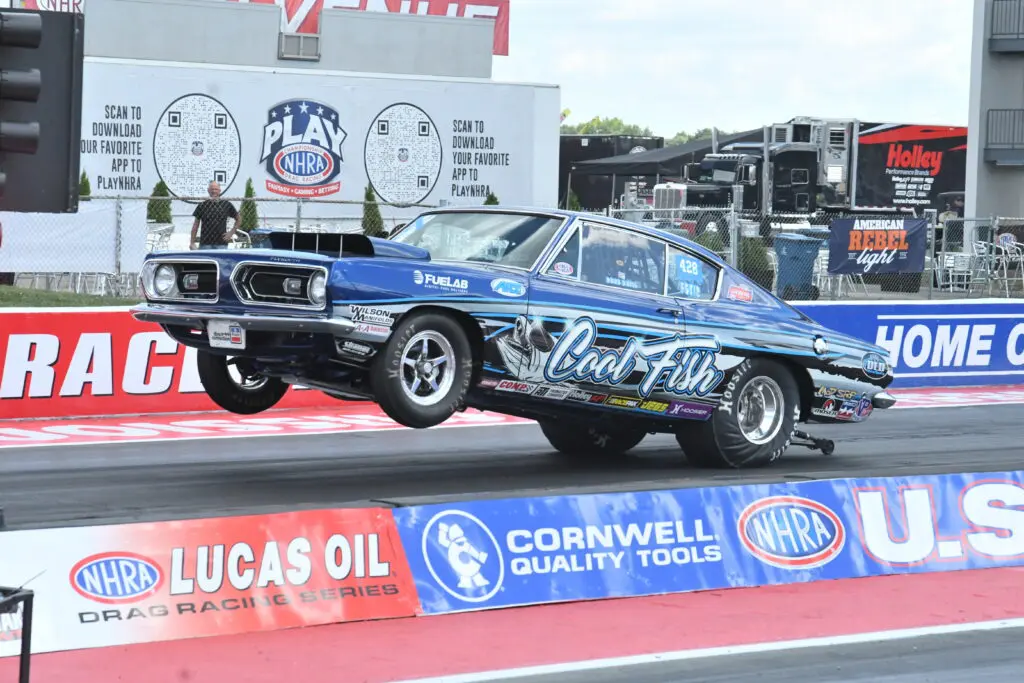
A Pro Mod pass is unlike any other experience in NHRA racing. The front end rises dramatically at launch as the car transfers weight rearward — a phenomenon more pronounced in Pro Mod than in the open-wheel nitro classes because of the body’s aerodynamic effects. Driving a Pro Mod requires managing that front-end rise, reading the tires for grip, and modulating the power delivery through a sequence that happens in under six seconds.
The violent, on-the-edge quality of Pro Mod passes is precisely what its fans love. The cars look barely controlled — because at the cutting edge of the combination, they often are.
Where Pro Mod Came From
Pro Modified’s origin story is documented in CompetitionPlus.com’s archive with a depth no other publication can match. Bobby Bennett’s four-part series — Pro Modified: Two Decades of Thrills — traces the class from its earliest roots to the first professional national events through primary-source interviews with the pioneers who built it.
The short version: Pro Mod was born in the Carolinas in the early 1980s from a group of doorslammer racers running blown and nitrous-injected cars that were too fast for normal sportsman competition. Jack Weller’s supercharged 1959 Corvette, driven by R.C. Sherman, turned heads at IHRA events around 1981. Charles Carpenter’s nitrous-assisted 1955 Chevy running 8.30s in 1983 is widely considered the movement’s true ignition point. Bill Kuhlmann clocked 202 mph at the 1987 IHRA Winternationals and cemented doorslammers as legitimate performance contenders.
Through the mid-to-late 1980s, these cars competed in IHRA Top Sportsman and the Quick Eight Saturday-night shootout format. On March 10, 1990, at Darlington, South Carolina, the IHRA officially launched Pro Modified as a professional class. The class that had been told it didn’t belong had arrived.
→ Read the full history: Pro Modified — The Formative Years
The Champions: NHRA Pro Mod’s Greatest Drivers
The Pioneer Era — IHRA (1990–2001) Tim McAmis won the inaugural IHRA Pro Modified championship in 1990. Scotty Cannon became the class’s first icon — six IHRA championships, flamed Corvettes that became the visual signature of Pro Mod’s golden era, and a competitive dominance that the CompetitionPlus.com all-time Top 20 drivers list — compiled with Pro Mod historians and enthusiasts — placed at the top of the class’s all-time rankings.
The NHRA Era — Champions (2002–2025)
| Year | Champion | Notable |
|---|---|---|
| 2002 | Shannon Jenkins | First NHRA Pro Mod champion; won 6 of 10 events |
| 2005 | Troy Coughlin Sr. | — |
| 2010 | Rickie Smith | Multiple-title class legend |
| 2016 | Mike Castellana | — |
| 2019 | Steve Jackson | First of back-to-back titles |
| 2020 | Steve Jackson | Back-to-back NHRA championships |
| 2021 | Mike Janis | — |
| 2022 | Jose Gonzalez | — |
| 2023 | Kris Thorne | — |
| 2024 | Jordan Lazic | First Canadian NHRA Pro Mod champion |
| 2025 | JR Gray | Winner-take-all final over Billy Banaka by one point |
Scotty Cannon — The Class Icon Six IHRA championships. Flamed Corvettes. A career that defined what Pro Mod greatness looked like in its formative era. The CompetitionPlus.com archive’s Pro Mod historians placed Cannon above every other driver in the class’s history — a ranking that reflects not just his titles but his role in establishing the standard every competitor since has chased.
Steve “Stevie Fast” Jackson — The Modern Era A roots-up career from test-and-tune nights and grudge racing to back-to-back NHRA championships in 2019 and 2020. Jackson combined elite supercharged performance with a social media presence that brought Pro Mod to audiences well outside the traditional drag racing fan base. His presence in a Pro Mod field remains one of the class’s biggest draws.
JR Gray — 2025 Champion Gray dominated the regular season with three wins before the Road to the Championship tightened dramatically. At Las Vegas, with one point separating him from Billy Banaka entering the finale, Gray delivered a winner-take-all championship-round victory — running 5.749 seconds at 250.04 mph to take both the event and the title in one of the most dramatic finishes in Pro Mod’s NHRA history.
Pro Mod vs. Pro Stock: The Opposite Ends of the Doorslammer World
| Pro Stock | Pro Modified | |
|---|---|---|
| Power adder | None — naturally aspirated only | Supercharger, turbocharger, or nitrous oxide |
| Fuel | Racing gasoline only | Methanol (blown/turbo) or gasoline (nitrous) |
| Race distance | Quarter mile | Quarter mile |
| Elapsed time | ~6.4–6.5 seconds | ~5.7–5.9 seconds |
| Top speed | ~213 mph | ~250–260 mph |
| Hood | Stock-appearing | Blower hat protruding or hood scoop |
| Horsepower | ~1,300 hp | 2,500–4,000+ hp |
| Character | Precision, clinical engineering | Aggression, barely controlled power |
Pro Stock’s identity is built on restriction — what you can’t use defines the class. Pro Mod’s identity is built on options. They are the philosophical opposites of drag racing’s professional doorslammer world, which is why they generate such different fan responses and why a comparison between them clarifies both.
→ Read the complete Pro Stock guide
Thinking About Competing in Pro Mod?
Pro Mod attracts competitors from sportsman drag racing who want to step into the fastest professional doorslammer class. The path requires specific preparation before running at full competition speed.
A realistic approach starts with the NHRA Pro Mod rulebook — combination choice, minimum weight, chassis approval requirements, and body eligibility should all be understood before purchasing or building a car. Combination selection is the first major decision: supercharged, turbocharged, or nitrous each carry different operating costs, tuning complexity, and competitive profiles. A nitrous program may cost less in some areas than a high-boost blown or turbo package, but every combination has tradeoffs at this level.
The NHRA competition license process requires documented runs through approved procedures, with the car inspected for technical compliance at each stage. Safety equipment — helmet, fire suit, harnesses, window net, fire system, parachutes — must meet current SFI and NHRA specifications, and certification is ongoing: equipment has expiration dates, and rulebook amendments can require updates at any point.
Budget planning for a full season should account for engine rebuilds, tires, fuel, transport, crew, and spare components. The car is only the beginning. The teams that operate at a competitive level treat Pro Mod as a professional program — planned, resourced, and staffed accordingly.
Pro Mod in 2026: The 25th Anniversary Season
The 2026 NHRA Pro Mod Drag Racing Series celebrates 25 years of NHRA Pro Mod competition. The class joined the NHRA in 2001 as a limited-schedule experiment and has grown into one of its most popular supporting series. The 2026 season expands to 11 races, adding Summit Motorsports Park in Norwalk, Ohio, which opens the Road to the Championship playoffs.
The series continues to stream qualifying and opening eliminations free on YouTube — a distribution approach that reflects Pro Mod’s status as one of drag racing’s most digitally engaged fan bases. JR Gray enters 2026 as defending champion, with Banaka, Jackson, Castellana, Menholt, and a 20-car field of proven contenders making every race genuinely open.
CompetitionPlus.com has covered Pro Mod since the class’s IHRA formative years. For ongoing race results, driver news, and technical coverage throughout the 2026 season:
→ Browse Pro Mod coverage at CompetitionPlus.com
What Makes Pro Mod Different From Every Other Professional Class
Three things define Pro Mod’s identity that no other NHRA professional class shares.
Power adder diversity. Supercharged, turbocharged, and nitrous-assisted cars compete simultaneously, making combination selection as strategic as any other variable. No other NHRA professional class allows this variety, and the resulting parity management creates a constantly evolving technical arms race.
Body style variety. A 1941 Willys coupe can race a current-model Chevrolet Camaro. Vintage muscle cars, modern pony cars, pickup trucks with weight breaks — the visual diversity of a Pro Mod field is unlike anything else on the NHRA tour and directly connects the class to drag racing’s street-machine roots.
The community. Pro Mod grew from the grassroots. Its fans, its sponsors, and many of its competitors came up through the sportsman ranks. The class has a self-managed ethos — unusually community-driven for a professional series — and its fan base carries the intensity of people who feel personal ownership of the class’s identity and future.
That combination of technical diversity, visual spectacle, and passionate community is why Pro Mod fills grandstands and drives social media engagement in ways that other professional classes often don’t. It is the most democratically-rooted professional class in drag racing — and among the most exciting to watch.