NHRA drag racing is a heads-up acceleration contest between two vehicles over a straight track, run side by side from a standing start. The National Hot Rod Association sanctions the sport’s top professional series, which runs 20 events across the United States each year. Races are decided by a combination of reaction time — how quickly the driver leaves the starting line — and elapsed time — how long the car takes to reach the finish. The fastest professional cars cover 1,000 feet in under 3.7 seconds at over 330 mph. This is the complete guide to how it all works — from the origin of the name to the Countdown to the Championship.
Why Is It Called Drag Racing?
The name has nothing to do with aerodynamic drag, and everything to do with where early American hot-rodders raced.
In 19th-century American slang, a “drag” referred to a road or street — specifically the main road through a town, which is why the primary commercial street in American cities came to be called the “main drag.” When hot-rodders in 1930s and 1940s Southern California began racing their cars straight-line down roads, decommissioned military airstrips, and dry lake beds, they were racing on the drag — the road itself. By the late 1940s, “drag racing” had become the established term for straight-line acceleration contests from a standing start.
The National Hot Rod Association was founded in 1951 specifically to take that activity off public streets — where it was illegal, dangerous, and increasingly deadly — and onto purpose-built tracks with rules, timing equipment, and safety standards. Wally Parks, a hot rod enthusiast and automotive journalist, created the NHRA with that mission. Seventy-five years later, in its 2026 anniversary season, the organization he founded sanctions the world’s most watched professional drag racing series.
The word “drag” in drag racing has always meant the road, not air resistance. Although parachutes that rely on aerodynamic drag do stop the fastest cars after the finish line, that’s coincidence, not etymology.
The Basic Concept: Two Cars, One Winner
Every drag race follows the same fundamental logic regardless of class or car type.
Two vehicles line up side by side at the starting line. A series of lights — the Christmas Tree — counts down the start. Both drivers launch when the green light activates. The first car to cross the finish line wins, provided neither driver commits a foul. The loser goes home. The winner advances.
No pit stops. No tire changes. No strategy calls. One straight line, two cars, the best combination of driver reaction and vehicle performance wins — in a run that lasts between three and ten seconds depending on class.
For the teams behind the cars, preparing for those seconds requires days of work between events. The engineering, the chemistry of the fuel, the physics of traction — all of it is compressed into a pass that spectators can barely follow with their eyes. That’s the sport.
What Is the NHRA?
The National Hot Rod Association was founded in 1951 by Wally Parks and has grown into what it describes as the world’s largest auto racing organization, with hundreds of member tracks across North America. Its professional touring series — the NHRA Mission Foods Drag Racing Series — crowns world champions in four professional classes each season and visits 20 national event sites across the United States, opening in Gainesville, Florida and closing in Pomona, California.
The 2026 season is the NHRA’s 75th anniversary, making it a landmark year for the sport and an ideal time to become a new fan.
CompetitionPlus.com has covered the NHRA since 1999 — more than 25 years of race reports, driver interviews, and championship coverage that forms the foundation of everything in this guide.
Understanding the Christmas Tree
The Christmas Tree is the electronic starting device positioned between the two lanes at the starting line. Every NHRA race begins with it, and understanding what each light means transforms the spectating experience.
From top to bottom, each lane has:
Pre-stage (small blue light) — activates when the front tires break the first infrared beam, indicating the car is approximately seven inches from the starting line.
Stage (small blue light) — activates when the front tires break the second beam, indicating the car is on the starting line and ready to race. Once both drivers are staged, the starter can initiate the countdown.
Three amber lights — the countdown. Here the Tree works differently depending on the class:
The Pro Tree — used in all four professional classes (Top Fuel, Funny Car, Pro Stock, Pro Stock Motorcycle) — flashes all three amber lights simultaneously, followed by the green light exactly four-tenths of a second later. Everything happens at once. Four-tenths is not much time.
The Sportsman Tree — used in bracket racing and sportsman classes — flashes the three amber lights consecutively, each five-tenths of a second apart, before the green. The sequential countdown gives drivers more time to read and react to the start.
Green light — go. The moment the green activates, the timing system starts recording each car’s elapsed time.
Red light — foul. If a driver leaves before the green light — crossing the stage beam before the countdown completes — the red light activates and that driver is automatically disqualified regardless of how fast they run. This is called red-lighting. At the professional level, a red light ends the weekend. There are no exceptions.
The four-tenths gap on the Pro Tree is genuinely unforgiving. Elite professional drivers are processing the amber lights and initiating their launch in hundredths of a second. The best reaction times in Top Fuel and Funny Car hover around .05–.08 seconds. Anything over .10 is considered slow at the professional level.
What Happens During a Run
Most spectators see the launch and the finish — but a complete run has several distinct phases worth understanding.
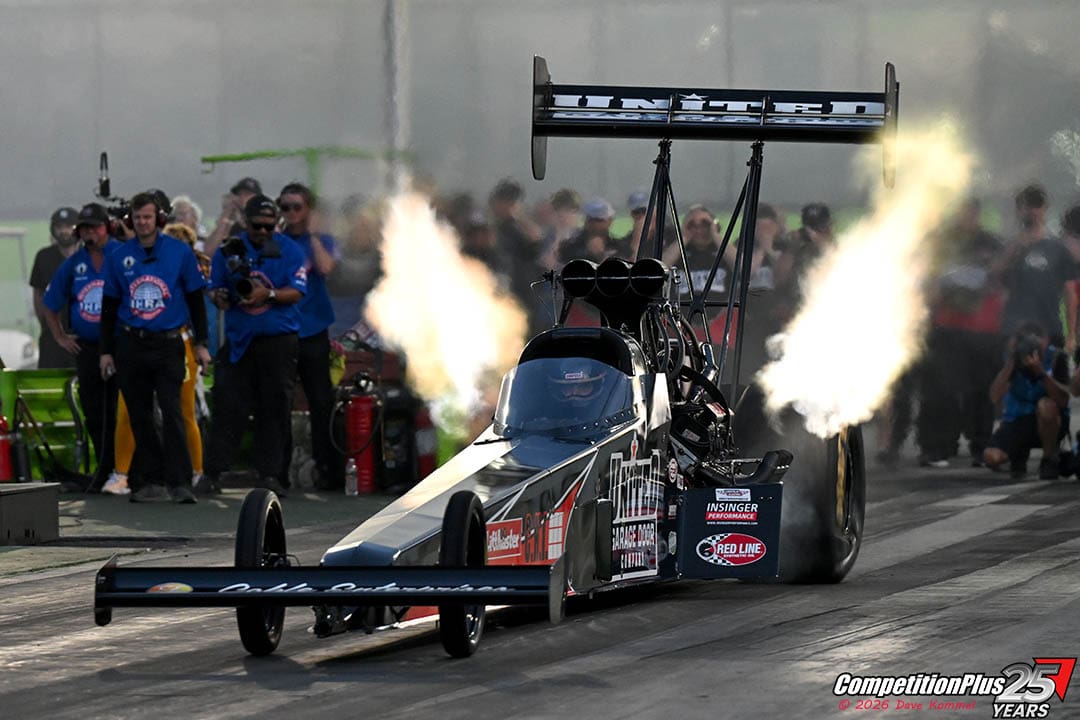
The burnout happens first. Drivers pull forward past the starting line into the water boxes — shallow troughs filled with water — and spin the rear tires at high speed to heat and clean them. Hot, sticky tires grip the track better than cold ones. For nitro cars, the burnout is also a sensory spectacle — clouds of tire smoke, engine shriek, and a physical pressure wave even from the grandstands. After the burnout, drivers reverse behind the starting line.
Staging follows. The driver rolls forward until the pre-stage light comes on, then edges further until the stage beam activates. Deep staging — rolling the car further into the beam until the pre-stage light extinguishes — is a technique some drivers use for marginal timing advantages, though it reduces the margin for error on the line.
The launch at the green is where professional classes separate themselves from everything else in motorsport. A Top Fuel dragster pulls 4–5 Gs of acceleration at launch — comparable to the force experienced by fighter pilots in a steep climb — in under half a second.
The run lasts between 3.6 seconds (Top Fuel at the elite level) and 6.5 seconds (Pro Stock). During those seconds the car is managing traction, the engine is consuming enormous fuel volumes, and the driver is making constant micro-adjustments while also doing very little — because at 300+ mph, any steering input is measured in millimeters.
The shutdown begins immediately after the finish line. Professional cars deploy twin parachutes to assist braking. Conventional brakes alone cannot safely stop a car traveling 330 mph within any reasonable distance. The shutdown area beyond the finish line at Top Fuel events extends for nearly a mile.
How Elapsed Time and Reaction Time Work Together
Two numbers decide who wins every drag race: elapsed time and reaction time.
Elapsed time (ET) is measured from the moment the car’s front tires leave the starting beam to the moment the car crosses the finish line. It is recorded in seconds and thousandths of a second. A lower ET is faster.
Speed is measured in a 66-foot speed trap ending at the finish line — a brief zone where the car’s terminal velocity is captured. The speed you see on a time slip reflects how fast the car was moving as it crossed the line, not its peak speed during the run.
Reaction time (RT) is the measurement from when the green light activates to when the car’s front tires leave the stage beam. A perfect reaction time is .000 — the car leaves exactly when the green comes on. Elite professional drivers typically run .05–.08 seconds. Reaction time is tracked separately from ET — a driver who leaves late simply has more time before their ET clock starts.
How they interact: A car with a slower ET can beat a faster car if its driver reacted significantly quicker at the start. If the faster car leaves .15 seconds late and the slower car leaves on time, that 15-hundredths advantage may be larger than the ET gap between them. This is called a holeshot win — winning through superior reaction time despite having the slower car on raw performance.
Reading a time slip: After each run, drivers receive a printed slip showing reaction time, 60-foot time (how quickly the car covered the first 60 feet — the primary measure of launch quality), elapsed time, and speed. The 60-foot time is the crew chief’s first diagnostic: a poor 60-foot time usually signals a traction problem at launch; a strong 60-foot time that doesn’t produce a strong ET often points to mid-track issues.
Heads-Up Racing vs. Bracket Racing
Not all drag racing works the same way. The two fundamental formats are heads-up racing and bracket racing, and new fans at a live NHRA event will see both.
Heads-up racing is what the professional classes use. Both cars leave at the same time — no handicap, no prediction required. First legal car to the finish line wins. Simple, direct, and immediately legible from the stands.
Bracket racing is the format used across most NHRA sportsman classes and at local tracks everywhere. Before each run, the driver declares a dial-in — a predicted elapsed time for their vehicle. A handicap start system then staggers the two cars: the slower car (higher dial-in) leaves first, and the faster car (lower dial-in) leaves later, calculated so both should theoretically reach the finish line at the same moment if both drivers run exactly their predicted time.
The breakout rule is bracket racing’s most counterintuitive element: if a driver runs faster than their dial-in — crossing the finish line ahead of their predicted time — they lose, even if they physically cross the line first. The dial-in is a commitment. Running under it is a breakout and costs the race.
This structure means bracket racing rewards consistency, judgment, and reaction time rather than outright speed. A heavily modified race car doesn’t automatically beat a slower one if the slower car’s driver is more consistent. It’s drag racing as a test of precision rather than power — and it’s why local bracket racing has sustained a massive participant base for decades alongside the professional spectacle.
Why Race Distance Changed: Quarter Mile to 1,000 Feet
The traditional drag racing distance is the quarter mile — 1,320 feet. Most sportsman classes still race the full quarter. But Top Fuel and Funny Car shifted to 1,000 feet in 2008, and the reason matters.
At speeds exceeding 330 mph, the final 320 feet of a quarter-mile pass exposes cars, drivers, and track safety systems to extreme risk. Engine failures, tire blowouts, and mechanical incidents at those speeds require enormous shutdown distances to manage safely. The June 2008 death of Top Fuel driver Scott Kalitta at Old Bridge Township Raceway Park — when his car suffered an engine failure and fire near the finish line — prompted the NHRA to immediately shorten the professional race distance to 1,000 feet.
The change was controversial among purists, and records set before 2008 carry a different context than modern ones. But the 1,000-foot format preserved the launch, the acceleration, and the spectacle of professional nitro racing while creating safer conditions for everyone involved. All current Top Fuel and Funny Car records and elapsed times reference the 1,000-foot distance.
The NHRA’s Professional Classes: An Overview
Four professional classes compete at every NHRA national event. Each has a full dedicated guide on CompetitionPlus.com — what follows is the essential orientation.
Top Fuel covers 1,000 feet in under 3.7 seconds at over 330 mph. Rear-engine dragsters burning nitromethane through a supercharged 500 cubic-inch engine producing 11,000+ horsepower. The acceleration at launch exceeds that of a NASA Space Shuttle at liftoff. It’s the class that makes first-time spectators feel the racing physically, not just watch it. → Complete Top Fuel guide
Funny Car uses the same nitromethane-burning engine as Top Fuel but sits inside a carbon fiber body resembling a production car — a Chevrolet Camaro, Dodge Charger, or Toyota GR Supra. The shorter wheelbase makes Funny Cars harder to drive than Top Fuel dragsters, and a Funny Car body catching fire or lifting off mid-run is one of drag racing’s most dramatic sights. → Complete Funny Car guide
Pro Stock is the “factory hot rod” class — cars that look like dealer-lot Camaros or Challengers producing over 1,300 horsepower from naturally aspirated gasoline engines. No superchargers, no turbos, no nitrous. The engineering battle is entirely about what can be extracted from a precisely defined platform, and races are often decided by thousandths of a second. → Complete Pro Stock guide
Pro Stock Motorcycle is NHRA’s only professional two-wheeled class. Naturally aspirated motorcycles cover the quarter-mile in under seven seconds at nearly 200 mph with riders lying completely flat under approximately 2.5 Gs at launch. It’s the class that surprises fans who didn’t know professional motorcycle drag racing existed at this level. → Complete Pro Stock Motorcycle guide
Pro Mod isn’t part of the four-class NHRA Mission Foods series but competes at most national event weekends as a supporting series. Full-bodied doorslammer cars with superchargers, turbos, or nitrous oxide run the full quarter-mile in the high 5-second range at 250+ mph — the most visually wild and power-diverse class on the premises. → Complete Pro Mod guide
Sportsman Classes: What You’re Seeing at a Live Event
Professional classes run on Sunday. Sportsman classes run all weekend alongside them — and at a live NHRA event, a significant portion of what fans see in the lanes is sportsman competition.
Sportsman classes cover a wide range: modified street cars, dedicated race cars built for specific indexes, Super Stock entries based on factory vehicles, and bracket racers on dial-ins. Most sportsman classes use the Sportsman Tree (sequential ambers) rather than the Pro Tree.
Three heads-up index classes new fans frequently encounter:
| Class | Index | Vehicles |
|---|---|---|
| Super Comp | 8.90 seconds | Dragsters and open-wheel entries |
| Super Gas | 9.90 seconds | Full-bodied cars and street roadsters |
| Super Street | 10.90 seconds | Street-style full-bodied cars (min. 2,800 lbs) |
In these classes, the goal isn’t simply to run as fast as possible — it’s to run as close to the index as possible without going under it. Running quicker than the index is a breakout and costs the race. This is heads-up racing against the clock as much as against the opponent, and it creates a completely different strategic tension from professional class eliminations.
How Qualifying Works
Professional NHRA events run Friday through Sunday. Friday and Saturday are qualifying days; Sunday is race day.
Each professional class holds multiple qualifying sessions. Drivers make timed runs in each session and their best elapsed time across all sessions sets their qualifying position. The fastest ET earns the No. 1 qualifying position — the top qualifier — and comes with bonus championship points. The slowest cars that don’t make the 16-car field go home without racing on Sunday.
Qualifying points are awarded based on position within the session: 8 points for No. 1 qualifier at a regular-season event, descending to 1 point for positions 13–16. At the U.S. Nationals in Indianapolis, qualifying points are elevated — making Indy qualifying the highest-value session of the season.
How Eliminations Work
Sunday is race day. The 16-car field is bracketed by qualifying position — No. 1 faces No. 16, No. 2 faces No. 15, and so on. The fastest qualifier gets the theoretically easiest first-round opponent.
Rounds proceed in knockout format:
Round 1: 16 cars, 8 advance. Quarterfinals: 8 cars, 4 advance. Semifinals: 4 cars, 2 advance. Final: 2 cars, 1 event winner.
Every round advances the winner and sends the loser home. The trophy — called a Wally, named after NHRA founder Wally Parks — goes to the event winner in each class. It is the goal of every NHRA professional competitor at every race.
Four-wide racing at zMAX Dragway in Charlotte is the exception: four cars run simultaneously in adjacent lanes, with the top two advancing. Four nitro cars launching together represents approximately 44,000 combined horsepower and is unlike anything else in professional motorsport.
How the Championship Works
The NHRA season operates in two phases.
The regular season runs from the Gatornationals in Gainesville, Florida through the U.S. Nationals in Indianapolis — 14 events across which drivers accumulate points through qualifying performance and round results. Championship points are awarded as follows at standard events:
| Result | Points |
|---|---|
| Show-up points (all entrants) | 10 pts (15 at Indy) |
| No. 1 qualifier | 8 pts (10 at Indy and Finals) |
| First-round win | 20 pts |
| Each subsequent round win | 20 pts additional |
A driver who wins an event earns the show-up points, their qualifying position bonus, and 20 points for each of the four rounds — totaling well over 100 points at a single event. That range means a string of early-round losses can fall far behind a driver who consistently goes deep into eliminations, even without winning events outright.
The Countdown to the Championship is NHRA’s six-race playoff, triggered after the U.S. Nationals. The top 10 drivers in each professional class qualify for the Countdown. At the start of the playoffs, points are reset and compressed:
- 1st place: 2,400 points
- 2nd place: 2,380 points
- 3rd–10th place: separated by 10 points each
A driver who led the regular season by 200+ points may begin the Countdown with only a 20-point advantage — the equivalent of roughly one round of racing. Everything is reset. Anyone in the top 10 can win the championship.
The Countdown runs across six events, including the four-wide race at zMAX Dragway, and concludes at In-N-Out Burger Pomona Dragstrip in California. The driver with the most points at the end of Pomona wins the NHRA world championship. The Countdown was introduced in 2007 and has been debated by fans and competitors ever since — its supporters say it creates dramatic late-season racing; its critics argue it can produce a champion who wasn’t the best driver over the full year. That argument is one of drag racing’s most persistent storylines.
What to Expect at Your First NHRA Race
Nothing on television or online prepares you for the physical experience of a professional nitro car making a pass. A few things to know before you go:
The sound of a Top Fuel dragster or Funny Car is not a sound so much as a pressure event. The wave hits the chest before the brain registers it. The burnout alone — 100 feet away — is louder than anything most people have heard. NHRA provides earplugs at the gate. Use them.
The smell of nitromethane is sharp, faintly sweet, nothing like gasoline. If you smell it as cars warm up in the pits, you’re getting the authentic experience.
Where to sit: Grandstand seats opposite the starting line give the full picture — burnout, staging, launch, pass, chutes deploying. Seats closer to the finish line offer better views of top-speed runs. Pit access passes (available at most events) let you walk among the cars between rounds.
Saturday qualifying typically produces the fastest times of the weekend as teams push for qualifying position. Sunday eliminations are when teams tune conservatively enough to win the round they’re in. The most dramatic single sessions are usually Saturday afternoon qualifying runs.
NHRA Terminology: Quick Reference
Breakout — Running faster than your dial-in in bracket racing; results in disqualification even if you cross the finish line first.
Burnout — Spinning rear tires in the water box before the run to heat them for better grip.
Christmas Tree — The electronic starting light device at the beginning of each lane.
Deep staging — Rolling further into the stage beam until the pre-stage light extinguishes; a marginal timing tactic.
Dial-in — In bracket racing, the predicted elapsed time a driver declares before a run; determines the handicap start.
Elapsed time (ET) — Time from leaving the start beam to crossing the finish line, in seconds and thousandths.
Holeshot — Winning a race through superior reaction time despite having a slower elapsed time.
Nitromethane — The primary fuel for Top Fuel and Funny Car engines; produces dramatically more power per volume than gasoline.
No. 1 qualifier — The driver who posted the fastest ET in qualifying; faces the No. 16 qualifier in Round 1.
Parachutes — Twin drag chutes deployed after the finish line to assist braking at speeds above 200 mph.
Pro Tree — Starting sequence where all three amber lights flash simultaneously, 0.4 seconds before green. Used in professional classes.
Reaction time (RT) — Time between the green light activating and the car leaving the start beam, in hundredths of a second.
Red light — Foul for leaving before the green; automatic disqualification.
Speed trap — A 66-foot measurement zone ending at the finish line where terminal speed is recorded.
Sportsman Tree — Starting sequence where three amber lights flash consecutively, 0.5 seconds apart, before green. Used in sportsman classes.
The Wally — The trophy awarded to national event winners, named after NHRA founder Wally Parks.
Water box — The water-filled trough before the starting line where drivers spin their tires during burnout.
Going Deeper: CompetitionPlus.com’s Complete Guides
This guide is the entry point. Each professional class has a full dedicated guide drawn from CompetitionPlus.com’s 25+ years of primary-source coverage.
Professional classes: → Top Fuel: The Ultimate Guide → Funny Car: The Complete Guide → Pro Stock: The Complete Guide → Pro Stock Motorcycle: The Complete Guide → Pro Mod: The Complete Guide
Drivers and teams: → Drag Racers: Profiles, Records, and Legacies → John Force: Legacy, Career, Records → Brittany Force: Career, Records, Legacy