Funny Cars have always been the wildest beasts in drag racing — unpredictable, volatile, and dangerous by design. And when modern drivers like Matt Hagan describe their machines as “bombs waiting to go off,” Billy Meyer’s response could best be summarized as: “Hold my beer.”
Meyer, a man who’s been on nearly every wrong end of a Funny Car catastrophe, lived through moments that would have retired most drivers for good. In the 1970s, when safety standards were still evolving, Meyer’s courage and recklessness helped shape the narrative of a sport that has always walked the tightrope between thrill and tragedy.
He remembers one of his earliest brushes with death vividly — a qualifying pass at the IHRA Winternationals in Lakeland, Florida. As he rocketed down the track, the car’s body collapsed, the throttle stuck wide open, and the parachute failed. In Pomona, that would have meant a sand trap and a catch net. In Lakeland, it meant a lake.

“As I hauled ass through there, I see a lake and a house on the lake,” Meyer recalled in an NHRA.com interview. “When it hit that bank, it was like a ramp that shot me into the air, over a fence, and 250 feet into the middle of the lake.”

The body disintegrated on impact, and the car sank nose-first — but the air trapped in the rear slicks kept it from disappearing completely. Meyer was unconscious. When he woke up underwater, he could see the car pointed straight down to the bottom. The only thing that kept him from drowning was his breather-mask filters keeping water out.
“I tried to hit the seat-belt release, but the water pressure stopped me,” he said. “I remember my hands floating away and passing out — but just as I was passing out, I remember seeing hands.”
📷📷📷 Headed to the Stampede of Speed & #FallNats? 📷📷
— Competition Plus (@competitionplus) October 3, 2025
Don’t miss your chance to SAVE 10% with code 📷 COMPETITIONPLUS10 📷
📷 Grab your tickets here 📷 https://t.co/3S7MSFCe60#DragRacingNews #PEAKSquad 📷 pic.twitter.com/oH6sMKHzvA
Those hands belonged to his crewmember, Ronnie Guymon, who raced the length of the strip, smashed through a barbed-wire fence, and dove into the water to pull him free. Meyer spent three days in the hospital before his mentor, Gene Beaver, retrieved him.
When they returned to the track, a spectator approached. “He said, ‘They killed that guy so bad,’” Meyer recalled. “Beaver said, ‘Nope, this is him.’ The guy was so panicked when he saw it that he dropped his keys into the shag carpet and couldn’t get out of the house to help.”
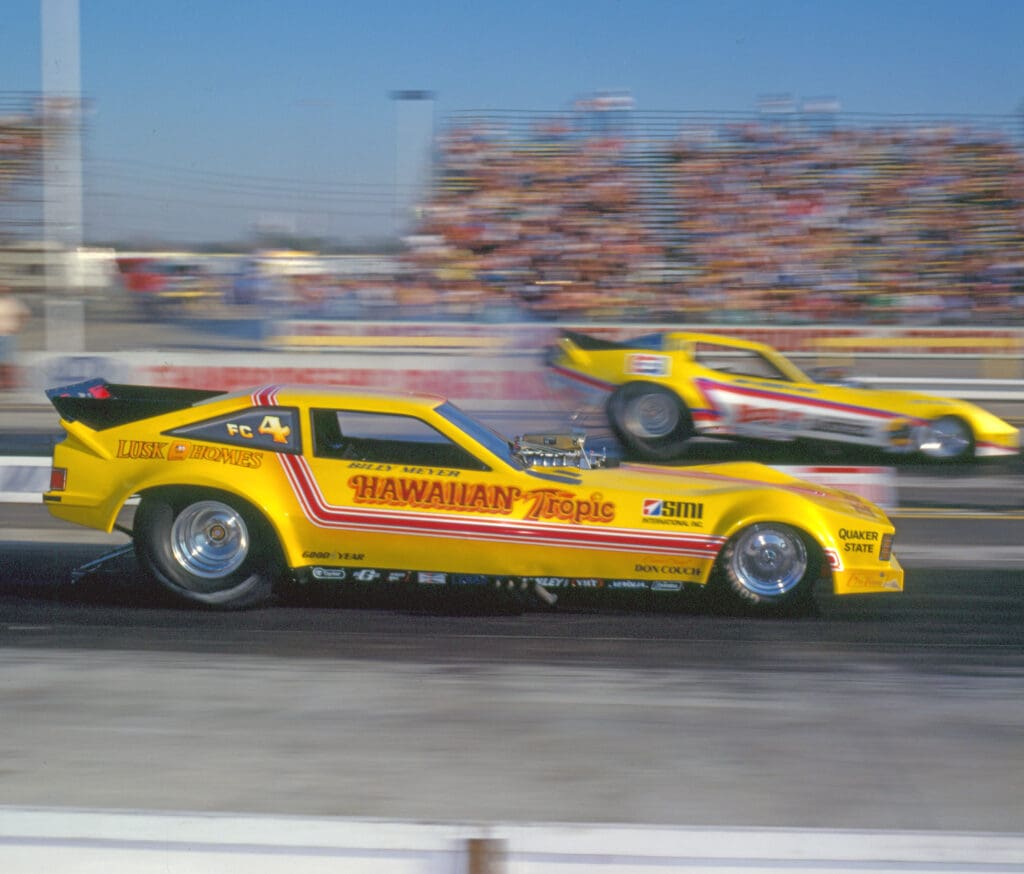
That was 1973, a year that nearly broke Meyer physically and financially. After selling his team in 1974 and spending two years driving for others, Meyer returned to racing with a groundbreaking rig — the first 18-wheeler ever used in the nitro pits. His new Camaro, sponsored by his father’s Success Motivation Institute, was intended to make a statement. It did, but not in the way he expected.
While warming up the car at the 1977 Pomona event, the throttle hung open. With no jack stands and his cowboy boot caught under the pedal, the Funny Car lunged forward — smashing into his van, another racer’s truck, and a Porta Potti.
“The car was so new that I hadn’t had time yet to put nonslip tape on the throttle pedal,” Meyer said. “My boot slipped, stuck under the bellhousing, and it ran full throttle into my van and someone else’s truck. It hit a Porta Potti so hard it knocked [Funny Car driver] John Collins right out of it.”
Meyer was knocked unconscious and spent two days in Pomona Valley Hospital. The crash left him with 180 stitches in his head, a broken collarbone, broken ribs, and a punctured lung. “That’s the most I’ve been hurt in my life,” he mused. “And it didn’t even happen on the racetrack.”
Meyer returned to competition at the Gatornationals six weeks later. But his season of survival was far from over.
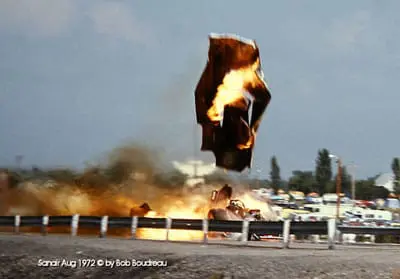
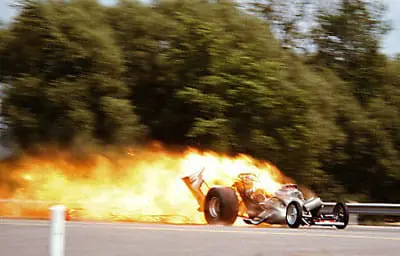
At the Le Grandnational in Quebec, his car erupted in flames after a round win over Al Hanna. The fire ignited the fuel tank vent, causing an explosion that engulfed the car. He suffered severe burns to his hands as the gloves’ stitching melted away.
“Jeb Allen’s wife went to the hospital to get me because they weren’t doing very much for me there,” Meyer said. “They told me I needed to see a doctor when I got back to the States.”
It was Shirley Muldowney who unwrapped his bandages at the track — and nearly vomited. She called Connie Kalitta, who flew in and landed his plane on the racetrack to evacuate Meyer to Ann Arbor’s burn center.
The flight itself became another brush with fate. As Kalitta piloted through storms and lightning strikes, Meyer said, “I was more scared then than I was in the fire.”
Kalitta, unfazed, joked midflight. “I said, ‘Can we land?’ and he said, ‘We’ll get killed hitting a wire.’ We had no radar that low. I asked if there wasn’t anyone we could call, and Cincinnati controllers told us they couldn’t talk to us because we weren’t in American airspace.”
When they finally landed, Meyer said he was “never so happy to go into a burn center.”
Despite severe injuries and doctors’ warnings, Meyer checked himself out early to return to competition. He drove other racers’ cars while his hands were still bandaged and relied on custom “mitten gloves” from Deist to keep racing.
“My hands were bandaged for eight months,” Meyer said. “I couldn’t play golf for five years; I almost lost both thumbs because of the burns.”
That same year, Meyer earned his first NHRA national event victory at the Fallnationals in Seattle, becoming, at age 23, the youngest Funny Car winner in history at that time.
The scars never faded, but neither did his attitude. “I never hit a guard wall and I never red-lighted,” he said proudly on Thursday of the Stampede of Speed. “Most of mine were explosions. I was kind of a mad scientist — I liked to test things, and anytime you try stuff, not everything works.”
That mentality resonates with today’s generation of racers, including four-time world champion Matt Hagan.
At Maple Grove Raceway this year, Hagan climbed from his destroyed Funny Car seething about the NHRA’s body tethering rule — a safety measure that he says is now putting drivers at risk. After his third explosion in two races, Hagan said he couldn’t see a thing because the tethered body remained attached.
“This NHRA tether rule is ridiculous,” Hagan said. “It’s going to get a driver killed. I couldn’t see where I was at. You’re just along for the ride. We’ve got guys making rules that have no idea how to drive one of these things.”
The system was designed after Robert Hight’s car body flew into the grandstands in 2013. But recent incidents — including John Force’s violent 2024 crash — have reignited debate. Hagan believes the tether system contributed to Force’s crash, which ended his full-time driving career.
“I felt like this cost John his career,” Hagan said. “It would’ve been nice to see him walk away on his own terms, not because of that.”