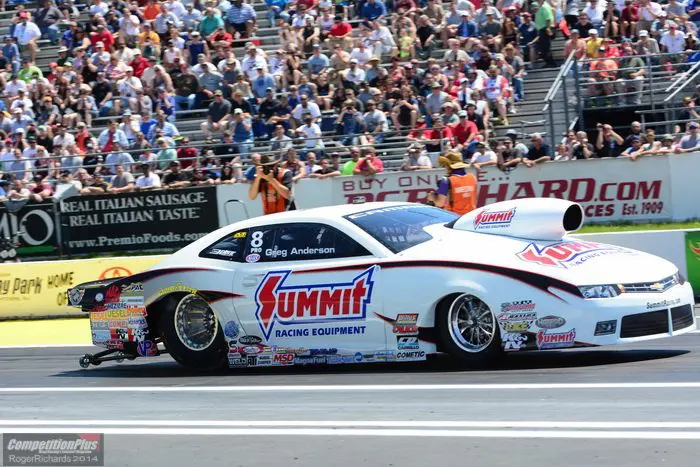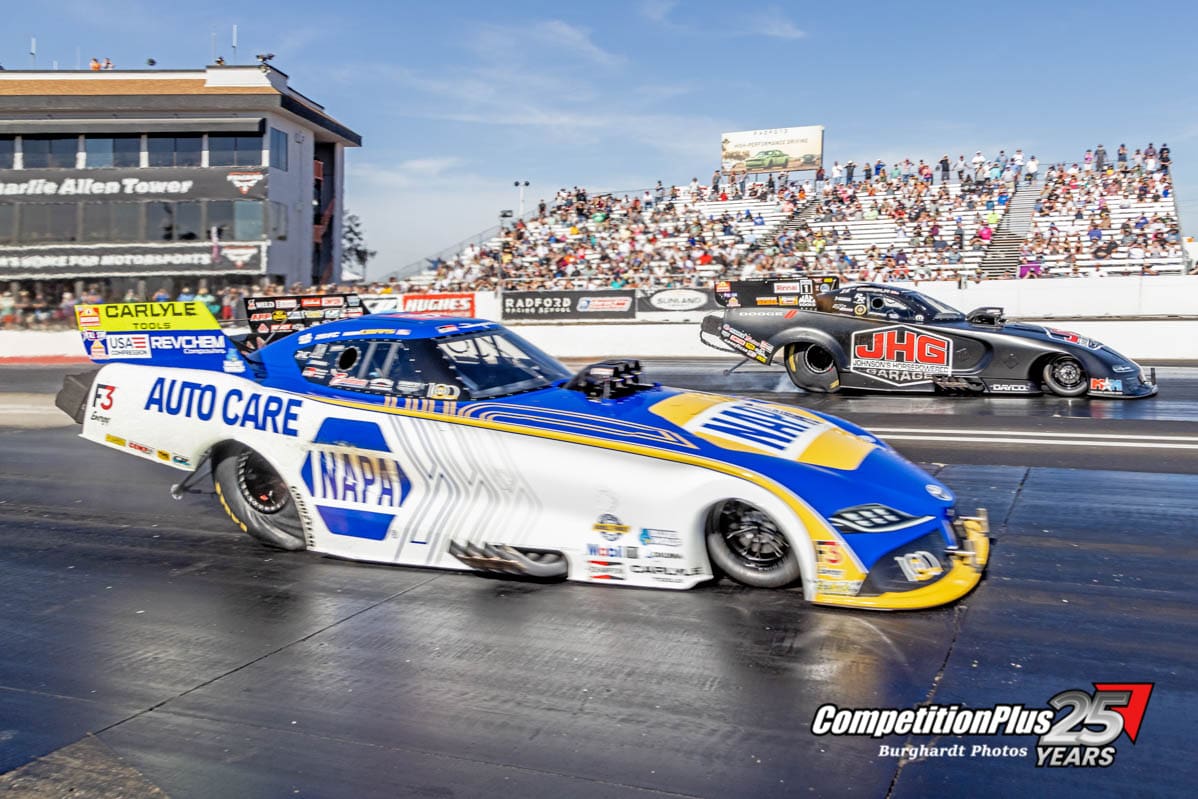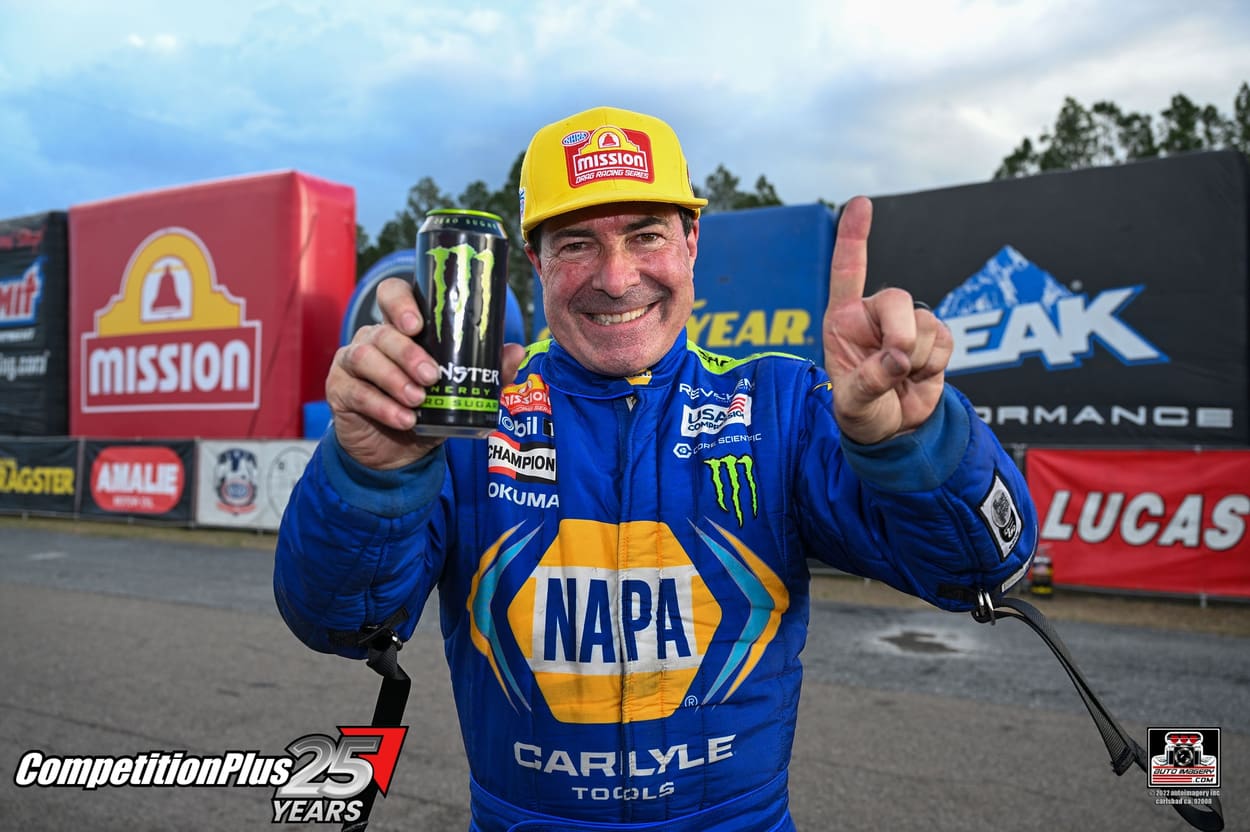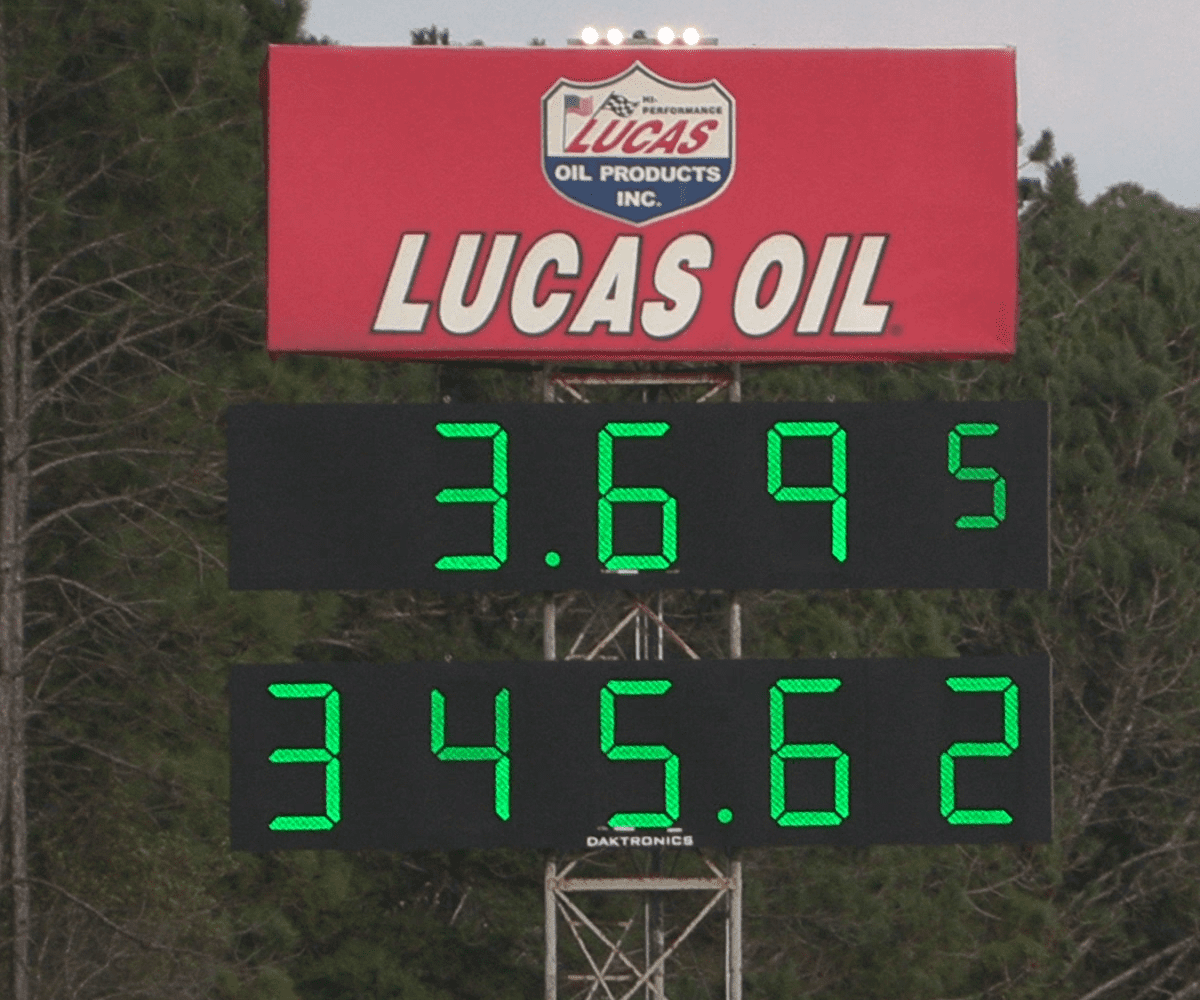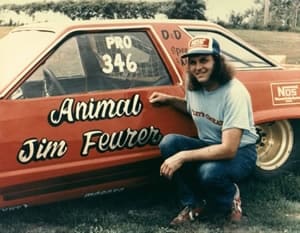
Pro Stock is one of the four professional classes in the NHRA Mission Foods Drag Racing Series. It is a naturally aspirated, heads-up drag racing category — no superchargers, turbochargers, or nitrous oxide — where cars produce over 1,300 horsepower from a 500 cubic-inch V8 on racing gasoline, run the quarter-mile in approximately 6.4–6.5 seconds at over 213 mph, and must visually resemble current production vehicles. Known as the “factory hot rod” class, Pro Stock has been an NHRA cornerstone since 1970. Bob Glidden holds the championship record with 10 titles; Greg Anderson leads all-time with 112 national event victories.
For anyone new to drag racing, Pro Stock sits at a unique intersection of street-car aesthetics and elite motorsports engineering. The cars look like something from a dealership floor — a Chevrolet Camaro, a Dodge Challenger. Look closer and you’ll find a purpose-built racing machine where every horsepower gain is a matter of precision engineering, not boost or exotic chemistry.
No turbochargers. No superchargers. No nitrous oxide. Just displacement, precision, and driver skill.
Pro Stock has been a cornerstone of NHRA competition since 1970, producing iconic rivalries, record-breaking champions, and engineering milestones that reshaped the sport. CompetitionPlus.com has covered the class since 1999. This is the definitive guide to everything you need to know.
Understanding Pro Stock: The Factory Hot Rod Philosophy
The factory hot rod philosophy centers on maintaining strong visual ties to production cars while achieving extreme performance through naturally aspirated power. Pro Stock bodies must replicate manufacturer identity: doors must be operable, headlights and taillights must appear stock, and windshield headers must match production vehicles.
This balance between street-car appearance and race-car performance serves a specific purpose. Fans walking through the pits can immediately identify a Camaro, Mustang, or Challenger, creating manufacturer relevance that benefits automakers investing in the sport. Beneath those familiar shells sits a purpose-built racing chassis with nothing resembling production underpinnings.
NHRA requires that engines match the corporate make of the car body — a Chevrolet Camaro runs a Chevrolet-based engine; a Ford Mustang runs a Ford-based powerplant. This rule preserves marketing relevance and keeps manufacturers engaged in what remains one of drag racing’s most prestigious classes.
What Is Pro Stock? Key Specifications
Pro Stock is one of the four professional categories in the NHRA Mission Foods Drag Racing Series, alongside Top Fuel, Funny Car, and Pro Stock Motorcycle. It is often described as the “all motor” class because competitors must rely entirely on engine displacement and tuning to generate power — no forced induction and no chemical assistance of any kind.
Key Pro Stock specifications:
- Engine: Single-camshaft, naturally aspirated V8, maximum 500 cubic inches
- Fuel: NHRA-approved racing gasoline (no exotic blends, no nitromethane, no alcohol)
- Induction: Electronic fuel injection with NHRA-specified ECU (since 2016); rev-limited to 10,500 rpm
- Horsepower: 1,300–1,500+ hp
- Minimum weight: 2,350 pounds including driver
- Typical elapsed time: 6.4–6.5 seconds (quarter-mile)
- Terminal speed: 210–215 mph
- Transmission: 5-speed clutchless manual (Liberty or G-Force), air-shifted
- Chassis: 4130 chromoly steel tube frame with four-link rear suspension
A complete, competitive Pro Stock engine can cost upward of $100,000 to build. Engine blocks and cylinder heads are typically supplied in raw form and finished entirely by each race team — the engineering battle is as much laboratory as it is racetrack.
The Cars: Engineering Excellence in a Production Wrapper
Chassis and Body
Pro Stock cars are built on purpose-constructed tube-frame chassis fabricated from 4130 chromoly steel with a four-link rear suspension engineered specifically for launching these high-horsepower machines off the starting line. The body — a lightweight composite fiberglass or carbon-fiber replica — maintains the visual identity of the production car it represents. Windows are polycarbonate. The entire front clip lifts away for engine access.
The safety cell surrounding the driver is engineered to the same exacting standards as Top Fuel and Funny Car — a standard strengthened following Bob Glidden’s violent rollover crash at the 1986 Atlanta race. Wheelbase constraints of approximately 105 inches and strict aerodynamic rules maintain visual proportional accuracy to production vehicles. The 2016 rule changes eliminated the distinctive hood scoops that had characterized Pro Stock for 46 years.
The Engine: All Motor, All Out
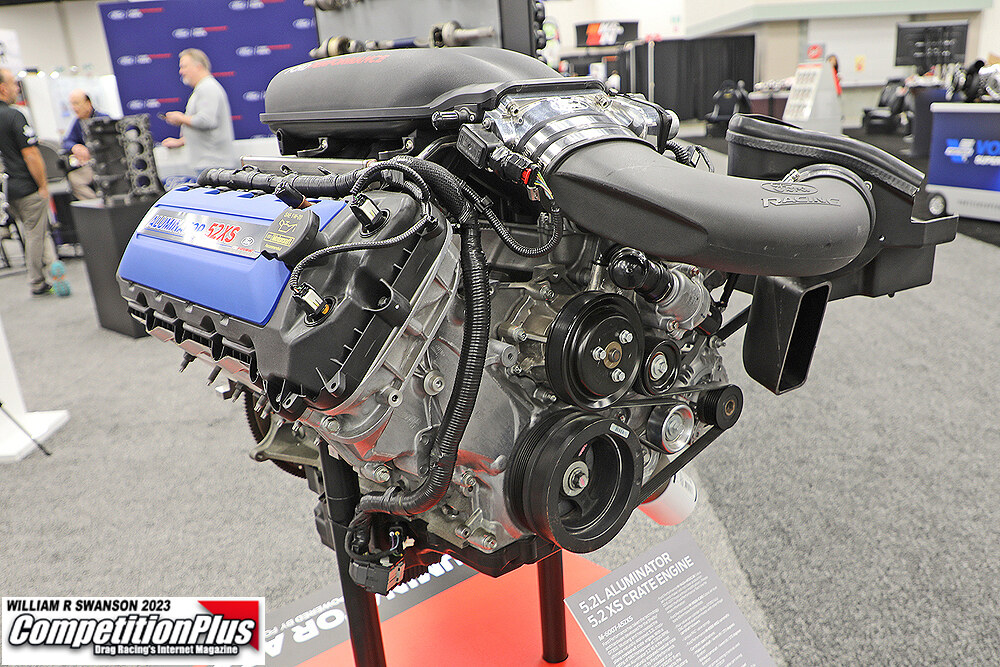
The heart of any Pro Stock car is its engine. A Pro Stock V8 is a naturally aspirated, single-cam unit displacing up to 500 cubic inches — and it must produce its horsepower entirely through engineering, not chemistry or boost.
The cylinder heads in Pro Stock are widely regarded as the most sophisticated in any category of drag racing. Valve lifts in the one-inch range are common, a byproduct of the relentless pursuit of airflow through the combustion chamber. Modern Pro Stock engines generate approximately 2.5 horsepower per cubic inch, meaning a 500 ci engine producing 1,300 hp sits at the conservative end of what today’s programs extract from the platform.
Until 2016, Pro Stock cars used dual four-barrel carburetors on tunnel-ram intake manifolds, with the class’s iconic hood scoops feeding ambient air. The NHRA’s shift to throttle body EFI — with a Holley-supplied spec ECU, Bosch injectors, and a hard 10,500 rpm rev limiter — fundamentally changed how teams approach engine management, torque curves, and drivability. CompetitionPlus.com’s editorial analysis What Is Exactly Wrong With NHRA Pro Stock? Not a Thing documents both the intent and the competitive fallout of that transition.
Transmissions are five-speed clutchless manual units — Liberty or G-Force designs — air-shifted by the driver. Multi-disc clutch systems require rebuilds between rounds to maintain critical tolerances. Modern Pro Stock also requires sophisticated data acquisition and electronics expertise alongside traditional engine-building knowledge.
Pro Stock vs. Other NHRA Professional Classes
Understanding where Pro Stock fits within NHRA’s professional hierarchy helps explain both its appeal and its distinct challenges. The table below compares Pro Stock against the other professional categories.
| Specification | Pro Stock | Funny Car | Top Fuel | Pro Mod |
| Quarter-Mile ET | 6.4–6.7 sec | 3.8–4.0 sec (1,000 ft) | 3.7–3.9 sec (1,000 ft) | 5.6–5.9 sec |
| Top Speed | 210–215 mph | 330–340 mph | 330–340+ mph | 250–270 mph |
| Engine Type | Naturally aspirated V8 | Supercharged V8 | Supercharged V8 | Supercharged / turbo |
| Fuel | Racing gasoline | 90% nitromethane | 90% nitromethane | Methanol / gas |
| Displacement | 500 cu in max | 500 cu in | 500 cu in | Varies by class |
| Horsepower | 1,300–1,500 hp | 11,000+ hp | 11,000+ hp | 3,000+ hp |
| Transmission | 5-speed manual (clutchless) | Direct drive (auto) | Direct drive (auto) | Powerglide / 2-speed |
| Body style | Production replica (tube chassis) | Funny Car shell (carbon) | Open-wheel dragster | Production replica |
The key distinction: Pro Stock occupies a unique position as the only naturally aspirated professional class. While Top Fuel and Funny Car rely on nitromethane and supercharging to generate staggering power, Pro Stock racers must extract maximum performance from engines using pump-style racing fuel. This makes every horsepower gain a matter of precision engineering rather than simply adding boost or fuel.
What Pro Stock offers uniquely: The “factory hot rod” concept gives fans a visual connection to the cars in their own driveways. Championships are often decided by thousandths of a second, creating a tension that rewards consistency and engineering excellence over raw aggression.
The Origins of Pro Stock: How the Class Was Born in 1970
Pro Stock did not emerge from a vacuum. Its origins trace directly to a power struggle between two sanctioning bodies and a group of drivers determined to race heads-up — no handicap starts, no weight breaks, just the fastest car winning.
In the late 1960s, the AHRA was running a popular heads-up Super Stock format that attracted the sport’s most prominent factory-backed drivers. The NHRA’s Wally Parks was resistant — on record in 1969 saying he had no interest in a class so far removed from production cars. The AHRA’s Jim Tice courted drivers like Ronnie Sox, “Dyno” Don Nicholson, Dick Landy, and Bill Jenkins with appearance money and a structured points championship. That leverage forced the NHRA’s hand. CompetitionPlus.com’s definitive history, NHRA Pro Stock: How We Got to Where We Are, documents how Parks changed course within twelve weeks.
In the October 31, 1969 issue of National Dragster, NHRA announced a new Pro Stock class for 1970 — cars from 1968 or later, a minimum of 7 pounds per cubic inch, and at least 2,700 pounds. The first NHRA Pro Stock race was won by Bill Jenkins at the 1970 Winternationals in Pomona, driving a Camaro. The class had begun.
The early years were dominated by Chrysler muscle, with Hemi-powered Dusters and Barracudas winning back-to-back titles in 1970 (Ronnie Sox) and 1971 (Mike Fons) before Bill Jenkins returned the Chevrolet camp with the 1972 title. What followed was decades of class evolution — rule changes, manufacturer shifts, and engineering breakthroughs that have defined Pro Stock to this day.
Key Rule Changes That Shaped Pro Stock History
Few classes in motorsport have been reshaped as dramatically by rule changes as Pro Stock. Each adjustment sent ripples through the competitive order, rewarding the teams quickest to adapt.
1970: Class launch — NHRA debuted Pro Stock after competitive pressure from the AHRA. Bill Jenkins won the first event at the Winternationals in Pomona, CA.
1973: Records and licensing standardized — “Dyno Don” Nicholson set the first official Pro Stock e.t. record with a 9.33 at the Winternationals. NHRA required competition licenses for Pro Stock drivers, bringing parity with Top Fuel and Funny Car.
1982: The 500 ci / 2,350 lb mandate — NHRA introduced the 500 cubic-inch maximum and 2,350-pound minimum weight, replacing the complex weight-break system entirely. CompetitionPlus.com’s Going 500: Early Days of 500-Inch Pro Stock captures Glidden’s reaction in his own words: “Not one single warning.”
1986: Safety cell reinforcement — Following Bob Glidden’s rollover crash at Atlanta, NHRA significantly tightened rollcage standards — the protective cell architecture still used today.
1997: 200 mph barrier broken — Warren Johnson pushed Pro Stock into new performance territory, validating the engineering arms race that had been building through the decade.
2016: EFI mandate — The NHRA replaced dual four-barrel carburetors with throttle body EFI, a spec ECU, and a hard 10,500 rpm rev limiter. As CompetitionPlus.com’s editorial analysis notes, the move coincided with Chrysler’s departure from the class, transforming Pro Stock into essentially a Chevrolet-dominant show through the late 2010s.
2025: ET record — Greg Anderson set the national elapsed time record at 6.443 seconds at the Gainesville Gatornationals, demonstrating that even within a restricted technical formula, performance ceilings continue to fall.
Championship History and All-Time Records
Pro Stock has produced a lineage of champions unlike any other drag racing class. The combination of technical complexity and driver skill required to win consistently has elevated a handful of competitors to legendary status.
Bob Glidden — The Standard-Bearer (10 Championships, 85 Wins)
No name in Pro Stock history carries more weight than Bob Glidden. The Whiteland, Indiana driver won 10 NHRA Pro Stock world championships — a record that still stands — and 85 national event victories. His most dominant stretch came during 1978–79, when he advanced to 18 of 19 final rounds and won 14 times, including nine consecutive victories. He won five consecutive championships from 1985 through 1989, and in 1987 qualified No. 1 at all 14 events he entered, setting records for consecutive top qualifiers (23 straight) and consecutive final-round appearances (17).
CompetitionPlus.com’s Going 500: Early Days of 500-Inch Pro Stock captures Glidden’s own account of the 1982 rules change that upended his program overnight, while the Mountain Motor Pro Stock history feature puts his NHRA dominance in the broader context of the IHRA’s parallel development.
Lee Shepherd — Four Straight Titles (1981–1984)
Lee Shepherd won four consecutive NHRA Pro Stock championships from 1981 through 1984, the only sustained stretch in which Glidden was displaced as the class benchmark. Shepherd’s rivalry with Glidden defined Pro Stock’s early 1980s, two technically brilliant drivers pushing each other toward records that seemed unreachable at the time. Shepherd’s tragic death in a 1985 road accident cut short what was shaping up as one of drag racing’s great career rivalries.
Warren Johnson — The Professor of Pro Stock (6 Championships, 97 Wins)
Warren Johnson owns the Pro Stock career wins record at 97 national event victories. Nicknamed “the Professor” for his technical genius, Johnson was as accomplished an engine builder and chassis tuner as he was a driver. His six world championships spanned 1992–2001, and he was the first Pro Stock driver to break the 200 mph barrier. His pioneering work on the DRCE engine combination for the Oldsmobile program influenced Pro Stock engineering for a generation.
Greg Anderson — The Winningest Driver in Pro Stock History (6 Championships, 112 Wins)
Greg Anderson is the all-time wins leader in Pro Stock with 112 national event victories, having surpassed Warren Johnson’s record at the 2022 U.S. Nationals. His 2024 championship — his sixth — was decided by .002-second in the final round at Pomona. Anderson and John Force are the only two drivers in NHRA history inducted into the 1,000 Round Win Club.
Anderson’s path to greatness began with personal tragedy. CompetitionPlus.com’s feature Anderson’s Pro Stock Career Began With Life’s Lessons and Tragedy recounts how the death of his mentor John Hagen at Brainerd in 1983 briefly drove him from the sport — and how a conversation with Warren Johnson ultimately launched one of the greatest careers in class history. His 2004 campaign stands as one of the greatest single seasons ever: 15 wins in 23 events, 76 round wins, matching Tony Schumacher’s all-time NHRA record for rounds won in a single season.
Erica Enders — The Modern Era Trailblazer (6 Championships)
Erica Enders became the first woman to win an NHRA Pro Stock race in 2012 and the first Pro Stock world champion in 2014. She has since collected five more titles — tying Anderson and Johnson at six. Racing under the Elite Motorsports banner, Enders combines precise reaction times with a deeply competitive program that has redefined sustained excellence in the modern era. Her national speed record and consistent presence in the championship hunt have made her the defining competitor of the 2020s. CompetitionPlus.com covered her sixth championship at Pomona in detail, including her own account of a season that started with her 14th in points after six races.
Pro Stock Champions by Decade
The following table tracks Pro Stock’s championship history by era, capturing how the class’s competitive center of gravity has shifted across more than five decades.
| Decade | Champion(s) | Notable Storyline |
| 1970s | Ronnie Sox, Bob Glidden | Class launched in 1970; Glidden begins dynasty; Chrysler early dominance gives way to Ford |
| 1980s | Lee Shepherd (4), Bob Glidden (5) | Shepherd wins 4 straight (1981–84); Glidden answers with 5 straight (1985–89); 500 ci rule introduced 1982 |
| 1990s | Warren Johnson (4), Jim Yates (2) | “The Professor” era; Johnson’s engineering genius sets new performance benchmarks; 200 mph barrier broken in 1997 |
| 2000s | Greg Anderson (3), W. Johnson (2), Jeg Coughlin Jr. (2) | KB Racing dominance begins; Anderson wins 15 events in 2004 season; EFI transition discussed throughout decade |
| 2010s | Erica Enders (4), Jason Line (2), Greg Anderson (1) | Enders becomes first female champion (2014); EFI mandate in 2016 reshapes competition; Elite vs KB rivalry intensifies |
| 2020s | Greg Anderson (2), Erica Enders (2), Dallas Glenn (1) | Anderson surpasses Johnson’s all-time wins record; generational shift with Glenn & Stanfield; Pro Stock added to all 20 NHRA events in 2026 |
Pro Stock Racing Strategy: Where Engineering Meets Execution
Success in Pro Stock is as much about strategy as raw horsepower. The combination of driver skill, meticulous car setup, and precise engine tuning separates champions from the field in a class where races are decided by thousandths of a second.
Since 2016, EFI has fundamentally changed how teams manage engine performance. Unlike carbureted systems, electronic fuel injection allows real-time adjustments to fuel and air mixtures, giving crew chiefs the ability to fine-tune for every run and every track condition. The spec ECU has simultaneously narrowed the technology gap between well-funded and smaller operations, increasing the importance of driver and setup quality over pure engineering spend.
Cylinder heads remain the primary battlefield for performance gains within the current ruleset. Teams invest countless hours developing and machining heads to extract every legal advantage — optimizing combustion chamber geometry, port shape, valve angles, and runner lengths to maximize airflow and thermodynamic efficiency.
Driver expertise is equally critical. Champions like Greg Anderson have mastered the nuances of Pro Stock from perfecting thousandths-of-a-second reaction times to managing gear shifts with split-second precision. That driver-crew chief feedback loop — translating physical sensations into tuning decisions between rounds — is what separates winners from also-rans at the highest level.
Teams must also adapt to changing track conditions, weather, and altitude across a 20-race national schedule. Data acquisition systems now feed real-time information back to crew chiefs who make tuning decisions in the minutes between runs. In a class where the margin for error is razor-thin, the best programs are those that harmonize technology, talent, and track-reading ability across every single pass.
How Pro Stock Racing Works: From Qualifying to the Winner’s Circle
Pro Stock competes in a side-by-side, single-elimination format. Each run is a one-pass affair — two cars stage at the starting line, the Christmas Tree counts down, and the first car to cross the finish line advances.
Qualifying sessions determine seeding for the eliminations field, with sixteen cars typically qualifying for Sunday eliminations. Each qualifying pass gives teams critical data on track conditions, and unlike the nitro classes where a single poor run can define the weekend, Pro Stock teams often run multiple qualifying attempts to optimize their setup.
Sunday eliminations run four rounds: the opening round of 16, quarterfinals, semifinals, and the final. Consistency across changing temperature, humidity, and track prep is as important as outright speed. A driver can run the quickest elapsed time of the weekend in qualifying and still lose Sunday with a poor reaction time.
The season championship is determined by a points system, with the top ten drivers entering the Countdown to the Championship — a six-race playoff segment beginning at the NHRA U.S. Nationals in Indianapolis. Points reset at the start of the Countdown, compressing competition and creating dramatic title battles in the season’s closing weeks. Major events like the Gatornationals in Gainesville and the U.S. Nationals in Indianapolis are cornerstones of the Pro Stock calendar, drawing large crowds and serving as critical championship battlegrounds.
Pro Stock Today: The 2025–2026 Landscape
Pro Stock enters the NHRA’s 75th anniversary season in 2026 as one of the series’ most complete and competitive classes. For the first time, Pro Stock joins Top Fuel and Funny Car in competing at all 20 national events — a scheduling commitment that reflects the class’s renewed prominence.
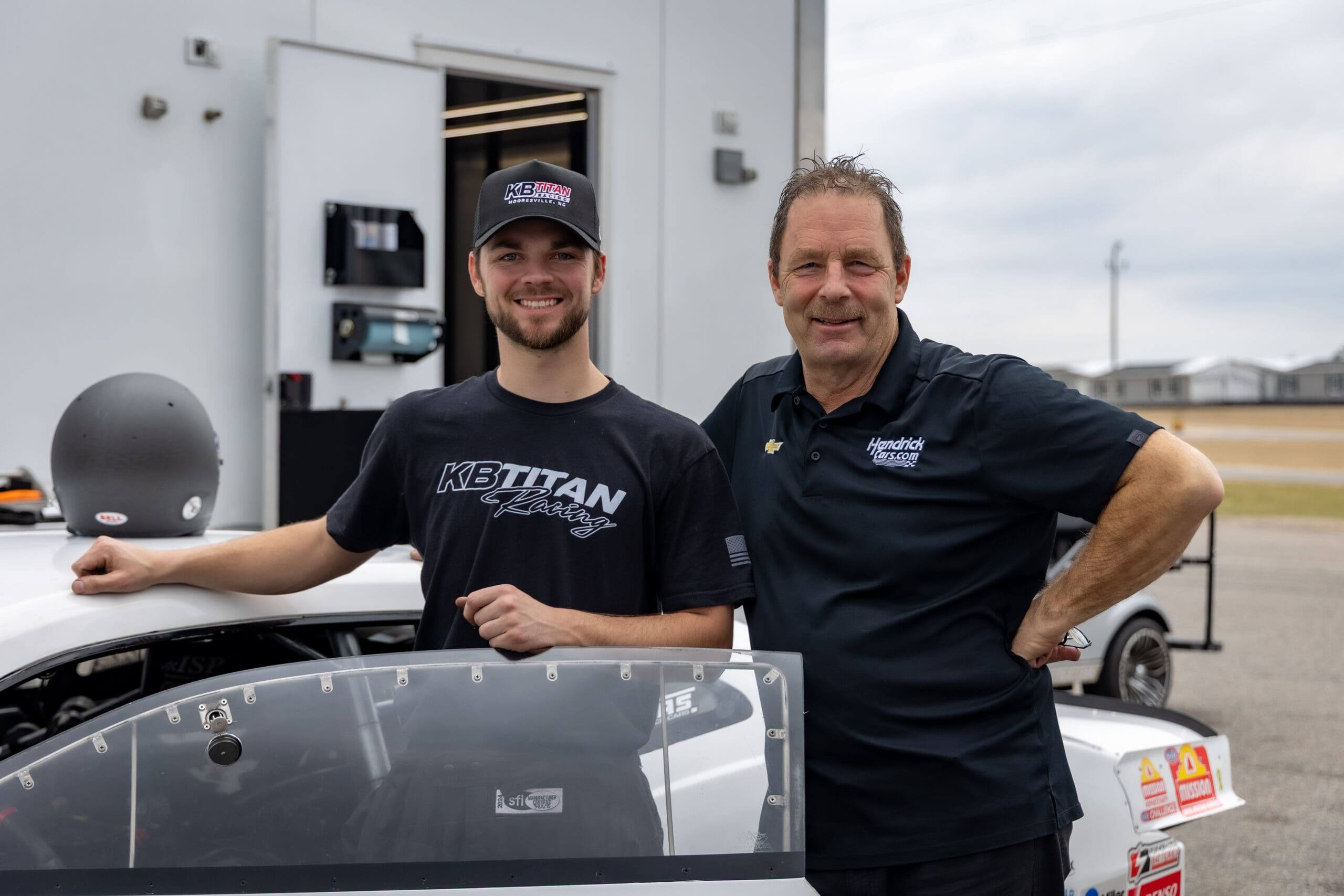
The dominant team of the recent era has been KB Titan Racing, led by Greg Anderson, Dallas Glenn, and Aaron Stanfield. The GETTRX All-Star Callout — a mid-season bonus race where eight of the class’s elite square off in an invitation-only event — has added a compelling new layer to the class calendar. The 2026 season also marks a generational moment: Cody Anderson, Greg’s son, made his Pro Stock debut at the Gatornationals, his license signed off by reigning champion Dallas Glenn.
Key competitive dynamics heading into 2026:
- Manufacturer landscape: Chevrolet Camaros dominate the winner’s circle, with KB Titan and Elite Motorsports as the leading programs
- Tight fields: Multiple cars regularly qualify in the 6.4-second range, making every first-round matchup unpredictable
- Rising talent: Dallas Glenn and Aaron Stanfield have proven capable of challenging established champions for titles
- Veteran excellence: Greg Anderson, racing into his sixties, remains capable of championship-level performances — as his 2024 title proved
Frequently Asked Questions About Pro Stock Drag Racing
How fast do Pro Stock cars go?
Competitive Pro Stock cars run elapsed times in the 6.4–6.5-second range over the quarter-mile, reaching terminal speeds above 213 mph. National records have been set in the low 6.4-second range — Greg Anderson set the ET record at 6.443 seconds at the 2025 Gatornationals.
Why don’t Pro Stock cars use superchargers or turbochargers?
Pro Stock is defined by its “all motor” ruleset — no forced induction of any kind, no nitrous oxide, no exotic fuels. This keeps the engineering battle focused on what teams can extract from a defined, naturally aspirated platform and is what fundamentally distinguishes Pro Stock from every other professional drag racing class.
Who has won the most Pro Stock championships?
Bob Glidden holds the record with 10 NHRA Pro Stock world championships. Warren Johnson, Greg Anderson, and Erica Enders have each won six, placing them second on the all-time list.
Who has the most Pro Stock wins?
Greg Anderson is the all-time wins leader with 112 national event victories. Warren Johnson holds the career wins record for his era at 97. Anderson surpassed Johnson’s total at the 2022 U.S. Nationals in Indianapolis.
Has a woman ever won a Pro Stock championship?
Yes. Erica Enders became the first woman to win an NHRA Pro Stock race in 2012 and the first Pro Stock world champion in 2014. She has since won six titles total — matching Warren Johnson and Greg Anderson for second on the all-time list, behind only Bob Glidden’s 10. CompetitionPlus.com covered her sixth championship in detail here.
When did Pro Stock switch from carburetors to fuel injection?
The NHRA mandated the switch to electronic fuel injection in 2016, replacing the dual four-barrel carburetors and eliminating the iconic hood scoops that had been a visual hallmark of the class for 46 years. The new rules included a spec Holley ECU, Bosch injectors, and a hard 10,500 rpm rev limiter.
How much does a Pro Stock car cost?
A single engine build regularly exceeds $100,000. A complete competitive car — chassis, body, drivetrain, and setup — typically runs well over $300,000. Full multi-car programs at the KB Titan or Elite level invest significantly more across a full national season. NHRA’s spec ECU and standardized fuel systems have helped narrow the technology gap between large and smaller programs, but engine development costs remain the primary participation barrier.
The Enduring Appeal of the Factory Hot Rod
Pro Stock has outlasted every prediction of its demise. When the carburetor era ended, critics said the class would lose its soul. When the field thinned in the 2010s, skeptics questioned its future. Each time, the class adapted — and the competitors within it found new ways to be fast.
That resilience is perhaps the truest reflection of what Pro Stock has always been: a class built on the premise that ingenuity, commitment, and precision engineering can extract performance from a platform that everyone else is working with on equal terms. The “factory hot rod” idea — the notion that what looks like a street car can run 215 mph on pump gas — remains one of the most compelling propositions in motorsport.
Fifty-six years after Bill Jenkins won the first NHRA Pro Stock race at Pomona, the class remains one of the sport’s essential pillars. The names on the scoreboards change. The engineering keeps advancing. And the cars, for all their technological sophistication, still look like something you might drive off a dealer’s lot.
That’s the point. That’s always been the point.
Further Reading on CompetitionPlus.com
CompetitionPlus.com has covered Pro Stock drag racing since 1999. The following articles from our archive provide deeper context on the topics in this guide:
- NHRA Pro Stock: How We Got to Where We Are — definitive CompetitionPlus.com history from inception to the EFI era
- Going 500: Early Days of 500-Inch Pro Stock — how the 1982 displacement rule change upended the competitive order overnight
- The History of Mountain Motor Pro Stock — the parallel IHRA development that forced NHRA’s hand on the 500 ci rule
- Anderson’s Pro Stock Career Began With Life’s Lessons and Tragedy — in-depth interview with Greg Anderson on the mentor whose death shaped his path
- Force and Anderson: NHRA’s 1,000 Round Win Club — one of the rarest milestones in all of motorsport
- Erica Enders Joins Exclusive Pro Stock Club With Her Sixth World Championship — Enders’ own words on clinching title No. 6
- Erica Enders: Firmly Planted in Pro Stock — six-time champion on why Pro Stock remains her home
- What Is Exactly Wrong With NHRA Pro Stock? Not a Thing — Bobby Bennett’s editorial on the class’s evolution and resilience
- Cody Anderson Makes His Pro Stock Debut — the generational passing of the torch at the 2026 Gatornationals
CompetitionPlus.com has covered drag racing since 1999. For ongoing news, race coverage, and in-depth features on Pro Stock and all forms of drag racing, visit competitionplus.com.