
Jason Collins has spent enough years around drag racing to understand how quickly this sport can decide who still matters and who doesn’t.
The young stars get noticed first. The funded teams stay in the spotlight. Meanwhile, racers who have spent decades grinding through outlaw tracks, local programs, test sessions, borrowed rides, and long nights at family-owned dragstrips slowly become part of the background noise.
That’s usually how it goes.
Then every once in a while, somebody like Scott Tidwell looks past all of that and gives a racer one more opportunity.
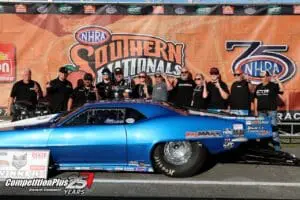
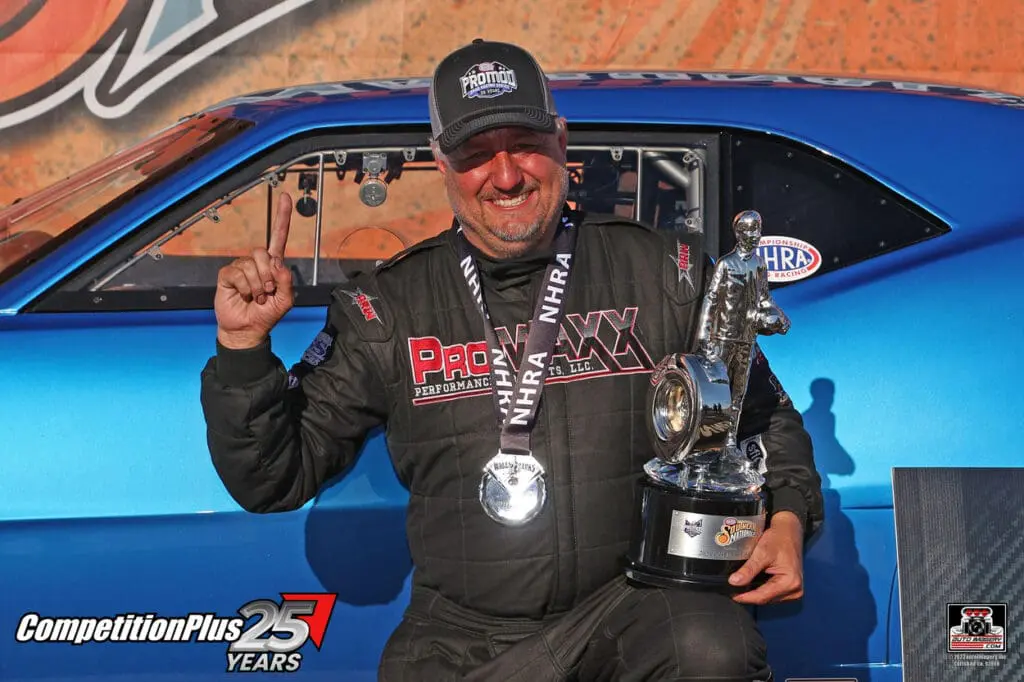
A week after the NHRA Southern Nationals at South Georgia Motorsports Park, Collins was still trying to process what happened after making only his second career start in the JBS Equipment NHRA Pro Mod Drag Racing Series and walking away with a victory.
Collins beat Mike Thielen in the final round Sunday with a 5.731-second run at 252.99 mph after qualifying second and mowing through Mason Wright, Sidnei Frigo, and Lyle Barnett earlier in eliminations. His .009 reaction time in the final left little room for drama.
The easy version of the story is veteran racer wins race in second NHRA start.
The real version started years before Collins ever rolled through the gate at Charlotte.
“I’m like, man, I’ve been doing this stuff like 30-something years,” Collins said.
That number tells the story better than anything else.
Collins came through the Southeastern outlaw scene the hard way. Mountain Motor Pro Stock. Local Pro Mod. Racetrack operations. Drag Radial racing. Test sessions. Match races. Whatever kept him close to race cars and racetracks.
Mostly, he stayed useful.
That matters more in drag racing than people realize.
Scott Tidwell saw value in Collins long before NHRA Pro Mod became part of the conversation.
At first it was testing. Helping with cars. Making laps. Collins became the kind of driver experienced racers trust because he understood what a race car was trying to tell him even when the thing was doing something ugly.
Sometimes especially when it was doing something ugly.
“I started driving and testing some cars for Scott,” Collins said. “He actually bought one of my old Outlaw 10.5 cars from me, which was the red car that they ran in Pro 275 for a while. And I don’t know, I started just doing some driving for him, just testing really.”
That relationship eventually turned into Collins driving Tidwell’s blue Camaro during the radial racing boom, and the results came almost immediately.
“For whatever reason, it all worked,” Collins said. “The very first race, we didn’t even test before we got it going and run it up at the first race. And then went on to, I think we won every race but one that year in the Radial stuff.”
Even then, Collins still wasn’t sitting around believing NHRA Pro Mod was waiting on him.
He became the dependable racer around the shop. The guy teams trusted to shake down cars and make difficult runs. Collins laughed recalling one stretch where he drove four different cars in the same day.
“I think the most passes I made, I think I made 20 laps in one day,” Collins said. “I drove David Mallory’s car and I drove Jose’s car and I drove two of Scott’s cars all the same day.”
Then came the RJ Race Cars machine Collins jokingly called a “military car.”
“I told them it was a military car if it would go left, right, left,” Collins said. “And they ended up finding what was wrong with it. But for whatever reason, call it ignorance or stupidity or whatever, I could poke it down through there.”
That’s the kind of thing veteran racers notice.
Anybody can drive the clean ones.
The valuable drivers are usually the ones willing to wrestle the difficult cars without tearing equipment up in the process. Tidwell kept putting Collins in race cars because Collins kept proving he belonged there.
“Scott’s allowed me to do things that I thought I’d never do in drag racing,” Collins said. “I really got to give some props to him for that.”
That line carried weight coming from Collins because by his own admission, there was a point where he stopped believing any of this was realistically coming together.
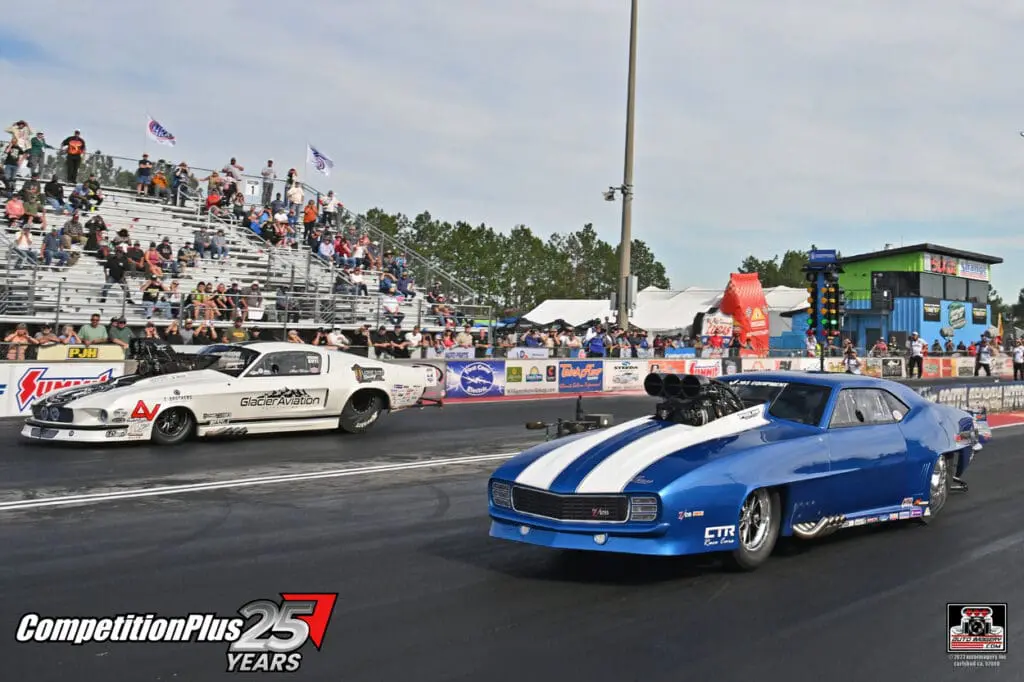
He tested cars. He got licensed. Potential opportunities surfaced, then disappeared. Plans changed. Races came and went.
By the time Charlotte arrived, Collins admitted he still wasn’t fully convinced he would actually be in the car until he physically rolled through the gate.
“They told me I was going to drive it at Charlotte,” Collins said. “And being as that had happened before, until I pulled into the gate of Charlotte, I wasn’t sure that was going to happen.”
That probably sounds strange outside drag racing.
Inside drag racing, it sounds familiar.
Collins finally got the chance and immediately looked comfortable in one of the toughest classes in the sport. Instead of struggling through his four-wide debut at Charlotte, he went straight to the final round. By South Georgia, the team already knew the car could run after a 5.64 test pass at Rockingham.
Collins also knew opportunities in drag racing do not stay open forever.
“For me, I was like, who knows?” Collins said. “This might be my last shot.”
That changes how racers approach Sunday morning.
“I took it serious,” Collins said. “Especially when we qualified second, I was like, ‘I got to finish this.’”
And he did.
Collins admitted afterward he originally believed teammate Derek Menholt would meet him in the final round until somebody informed him Menholt had lost by .0005 in the semifinals.
“I was almost a little bit relieved that I wasn’t running my teammate in the final,” Collins said. “It just felt better running somebody else.”
Nothing polished about the answer. Just honest.
That fit the entire weekend.

The people Collins wanted recognized first after the win were not sponsors or marketing partners.
He pointed directly at his parents, Jack and Sherry Collins.
The family still owns Alabama International Dragway in Steele, Alabama, and Collins knows exactly who spent years funding his racing career long before NHRA Pro Mod entered the picture.
“My parents, they spent a lot of money over the years helping me learn how to drag race,” Collins said. “My dad funded most of my racing until lately, so got to make sure that I credit them for that.”
Then Collins delivered the kind of line racers usually understand better than fans.
“I’ve always said maybe I should learn how to tune them instead of drive them.”
Maybe.
Good thing nobody talked him into it.
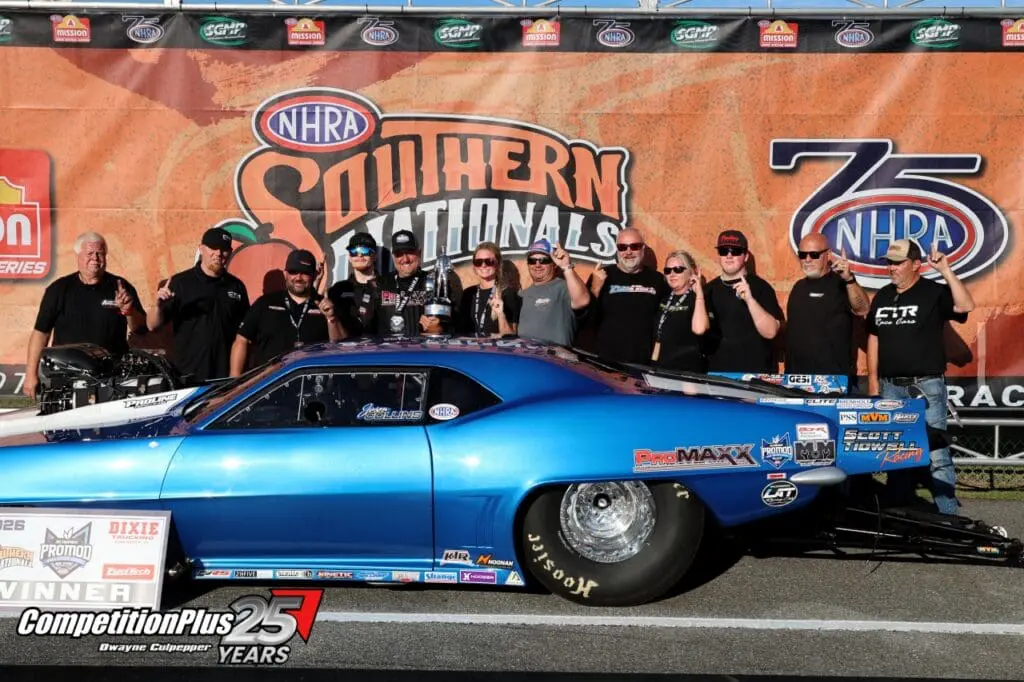
Collins also credited his wife Denise, his sons Chance and Cole, and the people keeping things together back home while he chases races around the country.
“There’s a lot more to it than just going to the race and racing,” Collins said.
That sentence probably carried more truth than anything spoken all weekend.
Because after the burnouts and scoreboards fade away, drag racing becomes travel bills, missed time, pressure, uncertainty, broken parts, and trying to hold businesses and families together while chasing something that rarely guarantees anybody success.
Collins understands that side of the sport because he has lived there most of his life.
Which is why this victory landed differently than the average first-time winner story.
“Everything is top-notch,” Collins said of Tidwell’s operation. “You got the best tuners, the best cars, the best parts, the best of everything. And if you can just make those parts work good together, you can win.”
Then Collins drifted backward for a moment, sounding less like an NHRA winner and more like the same Alabama racer who started this whole thing years ago with his family.
“It’s not like when I first started racing and it was me and my mom and my dad and we were doing it all,” Collins said. “And it’s pretty cool.”
Funny thing about drag racing.
Sometimes the sport waits until a racer nearly stops believing before finally giving him the moment he spent 30 years chasing.