
Among the countless vehicles that have been transformed into drag-and-drive cars over the last decade, few platforms seem less logical for the task than a DeLorean DMC-12. The stainless-bodied gullwing sports car made famous in the Back to the Future movie trilogy in the 1980s has long carried a reputation for questionable build quality, awkward engineering, and underwhelming performance, even among people who genuinely love them. Yet for Pennsylvania fabricator and longtime racer Brian Goldfarb, those shortcomings and the infamous lore of these cars are precisely what made them appealing.

Goldfarb’s DeLorean project, now well into construction at JE Speed in Pennsylvania, is being built as a legitimate drag-and-drive race car intended to run six-second quarter-mile times while remaining street-driven. Once finished, the car will retain its factory stainless steel body panels, fully functional gullwing doors, and much of its original exterior appearance. There will also be enough street-oriented features that Goldfarb still discusses things like air conditioning and road-trip comfort while simultaneously planning for a 25.2-certified chassis and twin-turbo LS power capable of pushing the car beyond 200 mph.

For Goldfarb, the project is simply the latest extension of an automotive obsession that stretches back decades.

“I’ve been an auto mechanic since 1993,” Goldfarb explains. “I opened my own shop about 10 years ago and over the last several years we started doing more fabrication work, turbo LS swaps, Holley EFI installs, and stuff like that for customers. We’ve always done crazy stuff with cars. We just started filming more of it and people seemed to like it.”

Goldfarb operates BG Auto and Performance while also building a substantial online following through his BoostedJunk social media channels, where burnout videos, fabrication projects, and street-driven race cars have developed a loyal audience. But despite the attention his projects have generated, Goldfarb’s automotive interests have always centered around drivable machines rather than purpose-built race cars.

“I love racing, but I like being able to drive the cars,” Goldfarb says. “Something that’s a purpose-built race car, I really don’t have a lot of use for. The drag-and-drive stuff is perfect for me.”
That mindset shaped the construction of his previous project, a turbocharged LS-swapped 1993 Mustang coupe that competed at HOT ROD Drag Week last year. Although the car was limited to 8.50s because of its cage certification, the 3,600-pound Mustang still placed third in Super Street Small Block Power Adder.

Initially, Goldfarb believed the DeLorean project would follow a similar, modest formula, with a cage added for safety, a relatively straightforward drivetrain combination, and an easy path into the 8-second zone. But all that changed after his initial tour of Drag Week.

“Once we came off Drag Week and being limited by the cage, I said we’re not going to do that again,” Goldfarb said. “So we decided to go the whole way.”

The search for a DeLorean itself had been years in the making. Like countless enthusiasts, Goldfarb became fascinated with the cars through the Back to the Future films as a child, though he admits the actual production vehicles leave much to be desired mechanically.

“They’re kind of junk, but still, it’s cool,” Goldfarb says with a laugh. “It’s a gullwing-door car. How many people do you know that have one?”

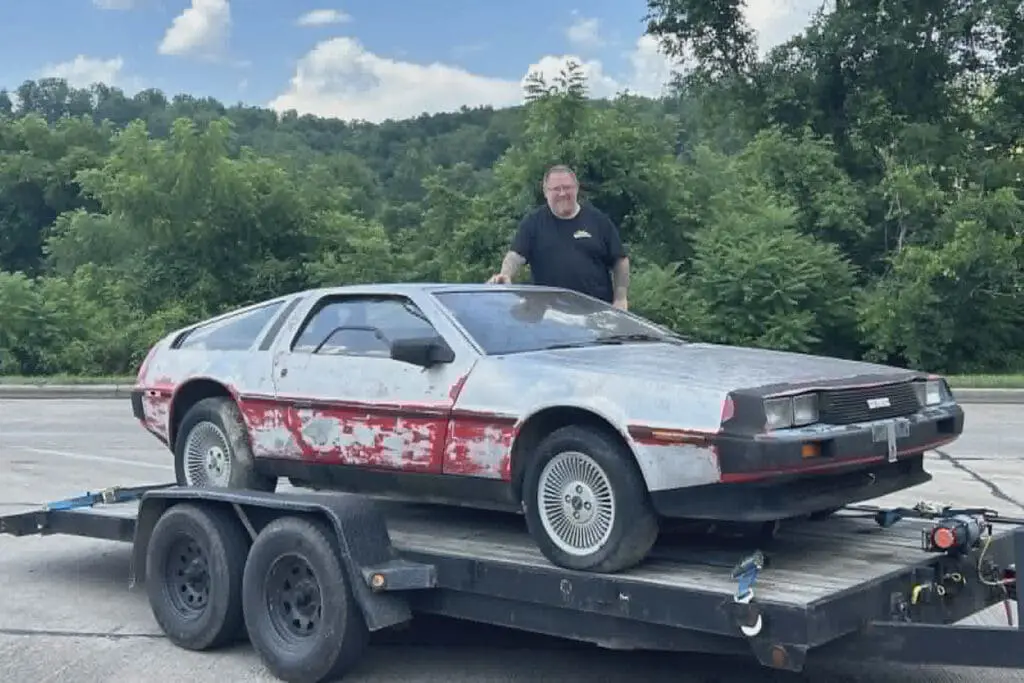
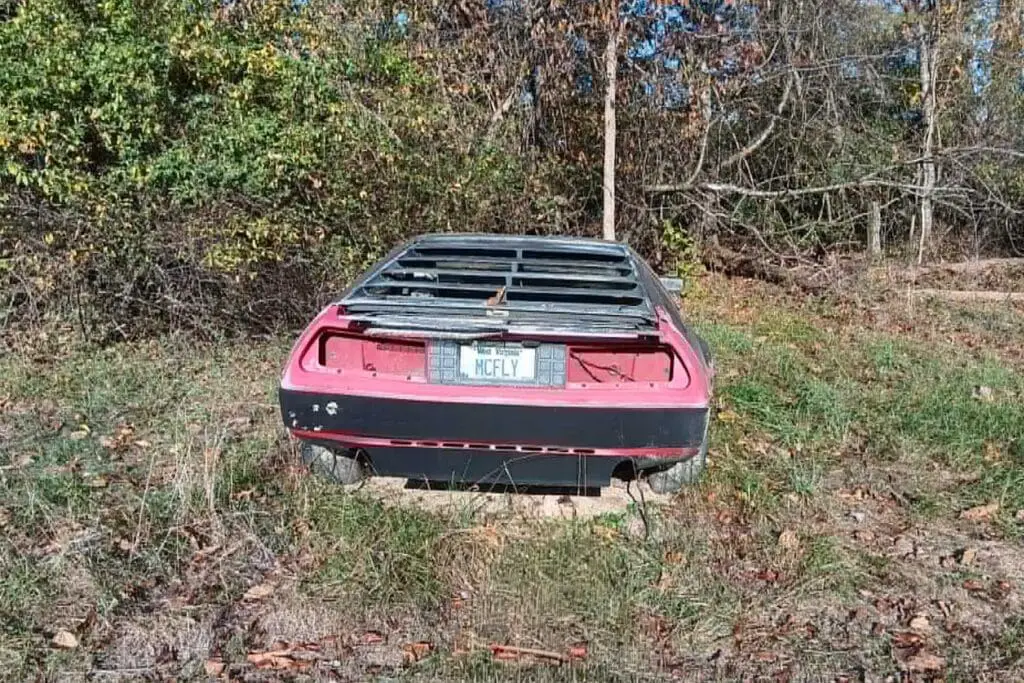
Eventually, after years of near-misses on potential purchases, Goldfarb located a rough project car outside Huntington, West Virginia, after posting online that he was searching for one. The DeLorean had reportedly been sitting in a field for more than 20 years after being discovered by its previous owner while working from a bucket truck high above the property.

The car was rough, had oddly been painted red over its original stainless finish at some point, and the interior had largely deteriorated, but Goldfarb saw exactly what he needed to build something. What that something was, he was not yet quite sure.

“The main parts I wanted were there. The stainless body panels and the fiberglass tub. It was the perfect candidate for what I wanted to do,” he says.

The DeLorean’s original chassis design quickly became the largest obstacle. Unlike more conventional unibody or perimeter-frame platforms commonly found in higher-horsepower applications, the DMC-12 relies on a notoriously weak X-frame chassis arrangement that Goldfarb describes bluntly.

“They’re terribly designed and built cars, really,” he says. “The body starts to twist and it’ll pop the doors open. I talked to DeLorean Industries about one of their replacement stainless frames and they were telling me 700 horsepower was probably tops for it. That’s not even in the realm [of what I’m trying to do].”

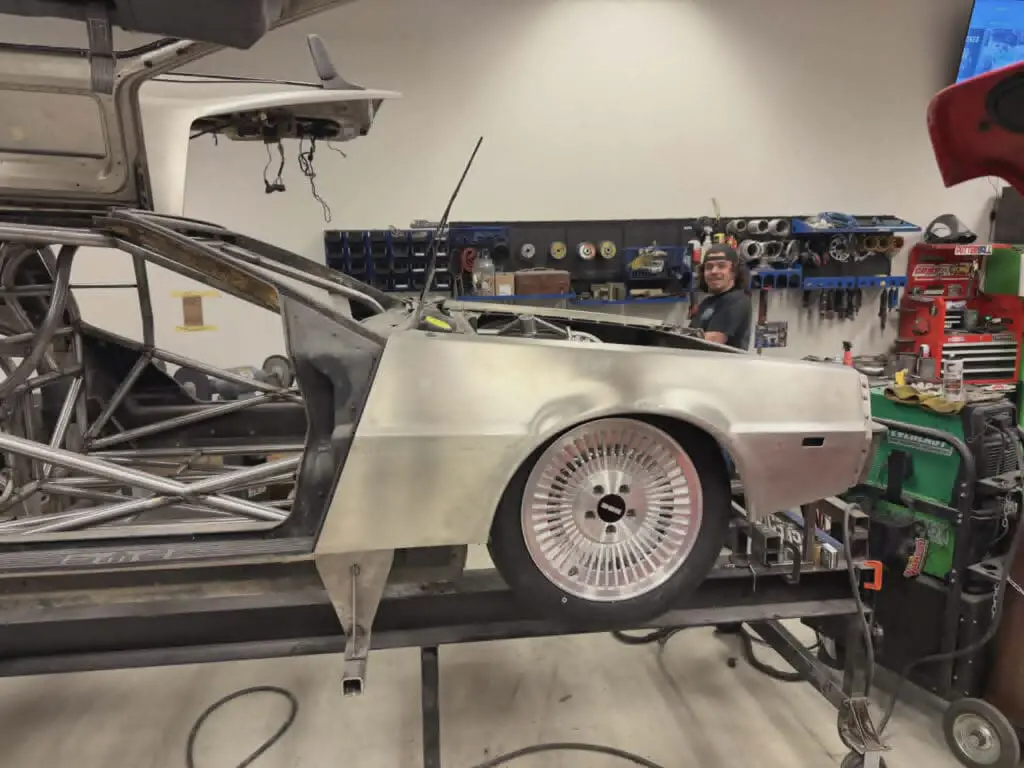
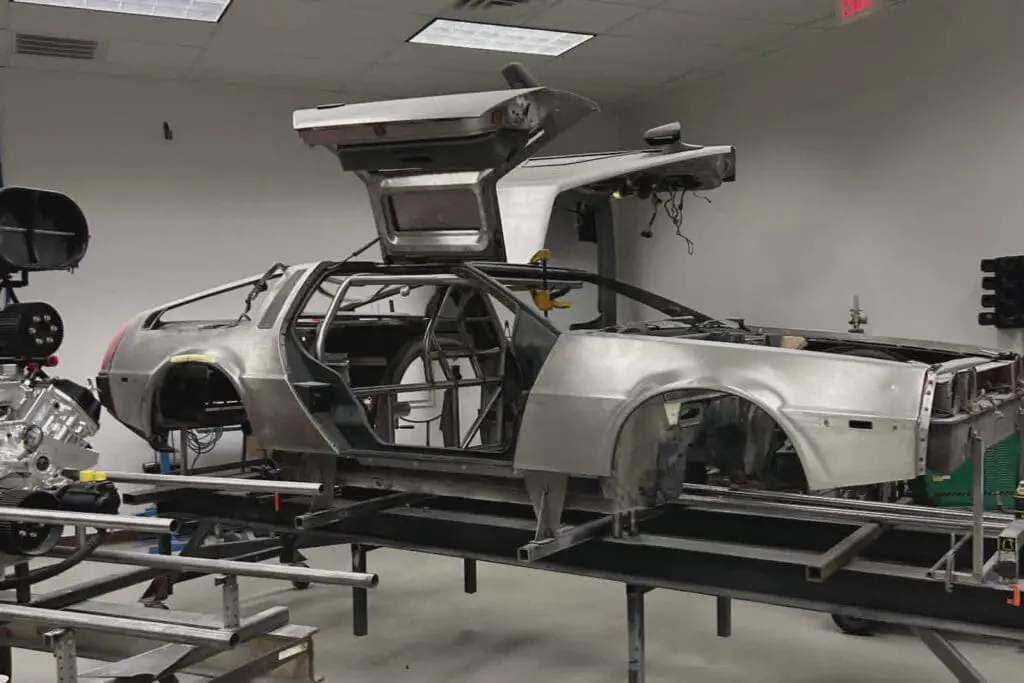
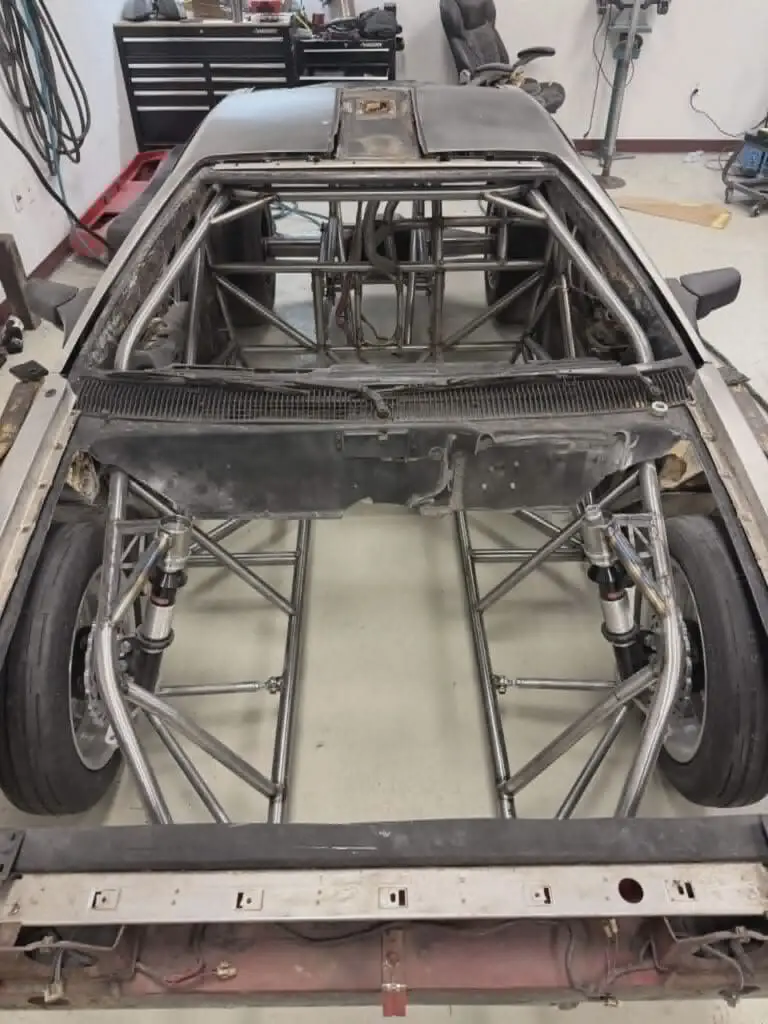
As a result, the car was stripped to its body shell before heading to JE Speed, where Jason Eberle and his team are constructing a full 25.2-certified chassis underneath the factory body. The completed car will retain its original body panels, bumpers, grille, lights, and functional gullwing doors, though the interior will largely become custom-built around the cage structure and modern electronics.

“It’s still going to be factory DeLorean body panels, bumpers, all that stuff,” Goldfarb says. “The interior is really the only thing that’s going to be drastically different.”

The original stainless body itself required extensive restoration work after years of neglect and a poorly executed repaint by a previous owner. Goldfarb and his crew spent roughly 50 hours stripping the red paint from the stainless panels using aircraft stripper, plastic scrapers, and Scotch-Brite pads to restore the factory finish.

“To me, a DeLorean shouldn’t be painted, so I had to get that red paint off of it,” Goldfarb says.

Power will come from a tall-deck 436 cubic-inch LSX-based combination featuring Mast Motorsports LXR LS7-style cylinder heads, an Aviaid dry sump oiling system, a Bryant crankshaft, Oliver connecting rods, and twin Precision 76/80 turbochargers. Engine management duties will be handled through a Holley Dominator EFI system paired with a 12.3-inch Pro Dash display, while a Rossler-built TH400-based transmission rated for 2,500 horsepower backs the combination.

Goldfarb admits the driveline combination is intentionally overbuilt for the performance goals he currently has in mind, but he would rather build the car once than continually upgrade it later.

“I shouldn’t need 2,500 horsepower, but I’m building everything to do that if I need to,” he says.

Out back, the car features a fabricated rearend housing built by JE Speed utilizing Strange Engineering internals and small-tire radial suspension geometry designed around a 275 radial tire package. Strange Evolution brakes will be at all four corners. Custom Santhuff struts with TRZ billet drop spindles will be up front, with Penske shocks in the rear.

Even many of the project’s cosmetic details are being engineered specifically for the car. Victory Custom Wheels produced custom front wheels designed to resemble the unmistakable factory DeLorean wheels while utilizing modern sizing and bolt patterns, while additional beadlock rear wheels are currently being developed to visually match the originals as closely as possible.

“The whole idea is to make it still look like a DeLorean,” Goldfarb explains.

That philosophy extends throughout the build. Despite the extensive chassis work, Goldfarb remains adamant that the car retain its defining visual traits, particularly the gullwing doors.

“You can do anything you want to a DeLorean,” he says, “but if you take the doors away, it’s not a DeLorean anymore.”

The car’s growing popularity online has also pushed Goldfarb to elevate the overall quality and detail level of the project beyond what he originally envisioned. What began as a personal build intended largely for his own enjoyment has rapidly evolved into one of the most closely followed drag-and-drive projects currently under construction.

“I probably would have just slapped together some LS combination with turbos I had sitting on a shelf and gone racing,” Goldfarb admits. “But because of the attention the car’s gotten, it made me rethink how I wanted to finish it. I don’t want people to walk up to it and think it’s junk, so I’m putting everything I’ve got into it.”

Ultimately, Goldfarb’s goals for the DeLorean are straightforward, even if the car itself is anything but.

“I want to average a six-second week at a drag-and-drive race,” he shares. “And I want to go 200 miles an hour in a DeLorean — the worst car ever made.”

Share the Insights?

Click here to share the article.

ad space x ad space

ad space x ad space

Competition Plus Team

Since our inception, we have been passionately dedicated to delivering the most accurate, timely, and compelling content in the world of drag racing. Our readers depend on us for the latest news, in-depth features, expert analysis, and exclusive interviews that connect you to the sport’s pulse.

Sign up for our newsletters and email list.

This field is for validation purposes and should be left unchanged.
Name

WHERE THIS DRAG-AND-DRIVE DELOREAN IS GOING, IT DOESN’T NEED ROADS

Among the countless vehicles that have been transformed into drag-and-drive cars over the last decade, few platforms seem less logical for the task than a DeLorean DMC-12. The stainless-bodied gullwing sports car made famous in the Back to the Future movie trilogy in the 1980s has long carried a reputation for questionable build quality, awkward engineering, and underwhelming performance, even among people who genuinely love them. Yet for Pennsylvania fabricator and longtime racer Brian Goldfarb, those shortcomings and the infamous lore of these cars are precisely what made them appealing.

Goldfarb’s DeLorean project, now well into construction at JE Speed in Pennsylvania, is being built as a legitimate drag-and-drive race car intended to run six-second quarter-mile times while remaining street-driven. Once finished, the car will retain its factory stainless steel body panels, fully functional gullwing doors, and much of its original exterior appearance. There will also be enough street-oriented features that Goldfarb still discusses things like air conditioning and road-trip comfort while simultaneously planning for a 25.2-certified chassis and twin-turbo LS power capable of pushing the car beyond 200 mph.

For Goldfarb, the project is simply the latest extension of an automotive obsession that stretches back decades.

“I’ve been an auto mechanic since 1993,” Goldfarb explains. “I opened my own shop about 10 years ago and over the last several years we started doing more fabrication work, turbo LS swaps, Holley EFI installs, and stuff like that for customers. We’ve always done crazy stuff with cars. We just started filming more of it and people seemed to like it.”

Goldfarb operates BG Auto and Performance while also building a substantial online following through his BoostedJunk social media channels, where burnout videos, fabrication projects, and street-driven race cars have developed a loyal audience. But despite the attention his projects have generated, Goldfarb’s automotive interests have always centered around drivable machines rather than purpose-built race cars.

“I love racing, but I like being able to drive the cars,” Goldfarb says. “Something that’s a purpose-built race car, I really don’t have a lot of use for. The drag-and-drive stuff is perfect for me.”
That mindset shaped the construction of his previous project, a turbocharged LS-swapped 1993 Mustang coupe that competed at HOT ROD Drag Week last year. Although the car was limited to 8.50s because of its cage certification, the 3,600-pound Mustang still placed third in Super Street Small Block Power Adder.

Initially, Goldfarb believed the DeLorean project would follow a similar, modest formula, with a cage added for safety, a relatively straightforward drivetrain combination, and an easy path into the 8-second zone. But all that changed after his initial tour of Drag Week.

“Once we came off Drag Week and being limited by the cage, I said we’re not going to do that again,” Goldfarb said. “So we decided to go the whole way.”

The search for a DeLorean itself had been years in the making. Like countless enthusiasts, Goldfarb became fascinated with the cars through the Back to the Future films as a child, though he admits the actual production vehicles leave much to be desired mechanically.

“They’re kind of junk, but still, it’s cool,” Goldfarb says with a laugh. “It’s a gullwing-door car. How many people do you know that have one?”

Eventually, after years of near-misses on potential purchases, Goldfarb located a rough project car outside Huntington, West Virginia, after posting online that he was searching for one. The DeLorean had reportedly been sitting in a field for more than 20 years after being discovered by its previous owner while working from a bucket truck high above the property.

The car was rough, had oddly been painted red over its original stainless finish at some point, and the interior had largely deteriorated, but Goldfarb saw exactly what he needed to build something. What that something was, he was not yet quite sure.

“The main parts I wanted were there. The stainless body panels and the fiberglass tub. It was the perfect candidate for what I wanted to do,” he says.

The DeLorean’s original chassis design quickly became the largest obstacle. Unlike more conventional unibody or perimeter-frame platforms commonly found in higher-horsepower applications, the DMC-12 relies on a notoriously weak X-frame chassis arrangement that Goldfarb describes bluntly.

“They’re terribly designed and built cars, really,” he says. “The body starts to twist and it’ll pop the doors open. I talked to DeLorean Industries about one of their replacement stainless frames and they were telling me 700 horsepower was probably tops for it. That’s not even in the realm [of what I’m trying to do].”

As a result, the car was stripped to its body shell before heading to JE Speed, where Jason Eberle and his team are constructing a full 25.2-certified chassis underneath the factory body. The completed car will retain its original body panels, bumpers, grille, lights, and functional gullwing doors, though the interior will largely become custom-built around the cage structure and modern electronics.

“It’s still going to be factory DeLorean body panels, bumpers, all that stuff,” Goldfarb says. “The interior is really the only thing that’s going to be drastically different.”

The original stainless body itself required extensive restoration work after years of neglect and a poorly executed repaint by a previous owner. Goldfarb and his crew spent roughly 50 hours stripping the red paint from the stainless panels using aircraft stripper, plastic scrapers, and Scotch-Brite pads to restore the factory finish.

“To me, a DeLorean shouldn’t be painted, so I had to get that red paint off of it,” Goldfarb says.
Power will come from a tall-deck 436 cubic-inch LSX-based combination featuring Mast Motorsports LXR LS7-style cylinder heads, an Aviaid dry sump oiling system, a Bryant crankshaft, Oliver connecting rods, and twin Precision 76/80 turbochargers. Engine management duties will be handled through a Holley Dominator EFI system paired with a 12.3-inch Pro Dash display, while a Rossler-built TH400-based transmission rated for 2,500 horsepower backs the combination.

Goldfarb admits the driveline combination is intentionally overbuilt for the performance goals he currently has in mind, but he would rather build the car once than continually upgrade it later.

“I shouldn’t need 2,500 horsepower, but I’m building everything to do that if I need to,” he says.

Out back, the car features a fabricated rearend housing built by JE Speed utilizing Strange Engineering internals and small-tire radial suspension geometry designed around a 275 radial tire package. Strange Evolution brakes will be at all four corners. Custom Santhuff struts with TRZ billet drop spindles will be up front, with Penske shocks in the rear.

Even many of the project’s cosmetic details are being engineered specifically for the car. Victory Custom Wheels produced custom front wheels designed to resemble the unmistakable factory DeLorean wheels while utilizing modern sizing and bolt patterns, while additional beadlock rear wheels are currently being developed to visually match the originals as closely as possible.

“The whole idea is to make it still look like a DeLorean,” Goldfarb explains.

That philosophy extends throughout the build. Despite the extensive chassis work, Goldfarb remains adamant that the car retain its defining visual traits, particularly the gullwing doors.

“You can do anything you want to a DeLorean,” he says, “but if you take the doors away, it’s not a DeLorean anymore.”

The car’s growing popularity online has also pushed Goldfarb to elevate the overall quality and detail level of the project beyond what he originally envisioned. What began as a personal build intended largely for his own enjoyment has rapidly evolved into one of the most closely followed drag-and-drive projects currently under construction.

“I probably would have just slapped together some LS combination with turbos I had sitting on a shelf and gone racing,” Goldfarb admits. “But because of the attention the car’s gotten, it made me rethink how I wanted to finish it. I don’t want people to walk up to it and think it’s junk, so I’m putting everything I’ve got into it.”

Ultimately, Goldfarb’s goals for the DeLorean are straightforward, even if the car itself is anything but.

“I want to average a six-second week at a drag-and-drive race,” he shares. “And I want to go 200 miles an hour in a DeLorean — the worst car ever made.”

Picture of John Doe

John Doe

Lorem ipsum dolor sit amet consectetur adipiscing elit dolor

More Posts

Send Us A Message

Don’t miss these other exciting stories!

Explore more action packed posts on Competition Plus, where we dive into the latest in Drag Racing News. Discover a range of topics, from race coverage to in-depth interviews, to keep you informed and entertained.