

If the first installment of this conversation confirmed Bill Bader Jr. as one of drag racing’s foremost visionaries, the second half reveals the practical side of that vision.
Bader doesn’t just identify the sport’s challenges. He offers detailed solutions rooted in decades of promoting one of drag racing’s premier destinations. Whether discussing shorter event days, the rise of social media, the importance of turning races into entertainment experiences or what he would do with a hypothetical $500 million investment in the sport, Bader never lacks conviction.
The conversation also turns personal as he reflects on the decline of the International Hot Rod Association, the sanctioning body that gave his family its first national event and helped launch Summit Motorsports Park onto the national stage. His memories are filled with appreciation, but his assessment of the organization’s current state is blunt.
Bader also explains why Night Under Fire has become one of drag racing’s most successful annual events, why he believes promoters should resist the temptation to overexpose signature attractions, and why he sees guest experience—not purse money—as the foundation for the sport’s long-term growth.
Perhaps the most revealing portion of the interview comes when Bader is asked how he would spend $500 million to reshape drag racing. His answer isn’t about buying race tracks or dramatically increasing purses. Instead, it is a blueprint centered on national marketing, fan experience, sponsor activation and creating full fields that give spectators a reason to buy a ticket.
If Part 1 focused on identifying drag racing’s biggest opportunities, Part 2 explores what one of the sport’s most accomplished promoters believes it will take to seize them.
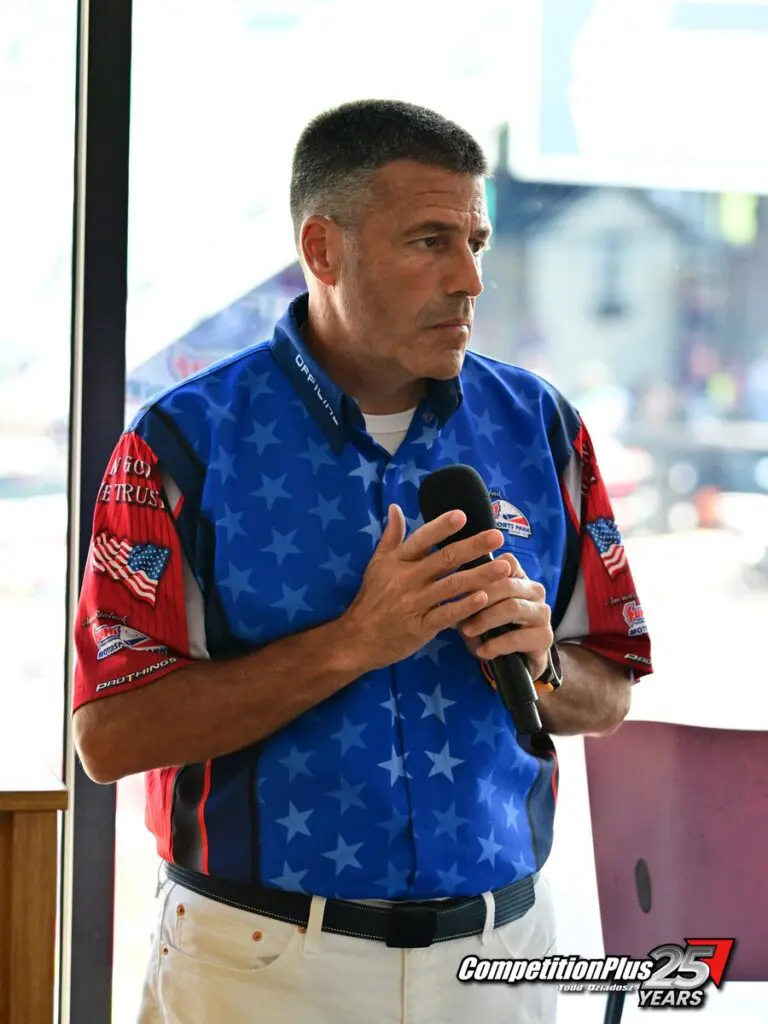
COMPETITION PLUS – With the advent of social media, it has led to a dwindling attention span for America. Could that push us into needing a shorter day at the racetrack?
BILL BADER – I think we should have a shorter day at the racetrack. But we need to remember something I said earlier. If we had true interactive experiences, whether they be simulators, obstacle courses, rock climbing, kids’ playgrounds, whether they were… I introduced a freestyle motocross team at our Chaos event, and that was pretty well received. Live action sports that are relevant today. If we could put that stuff in our pit area and we had organized activities, then we would become a smorgasbord for people to pick their poison. I think the cars going up and down the racetrack, and anything going up and down the racetrack, is good.
And NHRA has worked very diligently. This has been an initiative for the last few years, last several years in fact, to bring those pro category qualifying rounds closer together. So, to try to shorten the day.
When my father was alive, we talked about this for three hours, three hours, three hours, three hours. So I’ll use Night Under Fire as an example. We open at 8 AM. The goal is to shoot fireworks by 10:30, but the show actually is from 7:00 to 10:00 or 7:00 to 10:30. National Anthem, it’s 6:58, flyovers, skydivers from 7:00 to 10:30. Our goal is in a perfect world, I’d like to shoot fireworks at 10. So the show, we need to really work on narrowing the window, but all of the rings and the circus and all of the elements and all of the entertainment are a point of differentiation that drag racing has that other sports don’t have.
So if we’re going to have a longer day, we need to pack it with stuff that people are excited about, receptive to, and interested in. Because if we don’t have that, then we become kind of one-dimensional, where it’s just about the cars again. So, do you want to be a three-hour event or do you want to be a festival, so to speak?
So in an era of needing time between rounds, drag racing inherently will always be longer than the three-hour stick and ball sport because of turn time. I mean, if we want to fix that, we run around to Top Fuel, we put them right back in the lanes, and we run round two. That’s been an age-long debate because that’s what we did in the old days. We weren’t tearing engines apart. We weren’t rebuilding clutches and repacking clutches and doing all that stuff. But the very nature of our sport is that we’re going to have a longer day. Let’s understand it’s going to be a longer day. Let’s shorten it as much as we can, but let’s pack it with rings in the circus that are relevant, compelling, and exciting for fans.
CP – Going back to social media, which has been afire the last couple of weeks. And something very close and near and dear to your heart and your family’s heart has been watching the rise and the fall of the IHRA. Does the situation it’s in now break your heart to see?
BB – Our first IHRA World Nationals, if that was indeed the name back in 1981. NHRA didn’t want us in 1981. They didn’t know us, they didn’t want us. Their event at National Trail Raceway was on Diamond P Sports. So in 1981, we got our first IHRA national event. And so IHRA gave us our shot.
So, no matter how it ended with us and IHRA, IHRA believed in us when NHRA didn’t. And then the fact that we were able to buy the International Hot Rod Association and relocate from Bristol, Tennessee, to Norwalk, Ohio, owned it, operated it, grew it, and then ultimately, obviously, ended up having it change hands. And that’s not relevant to this question. But the point is, yeah, it breaks my heart. It breaks my heart because I constantly have racers reflect on the good old days of IHRA.
I remember announcing the IHRA World Nationals, and I remember Top Sportsman and Top Dragster qualifying Friday night. I’m getting goosebumps talking about it. Over 1,000 race cars at the IHRA World Nationals. The relationships, the fun, it seemed simpler. It always seems simpler when you reminisce because things are always more complicated in current times than in past times, but it’s where we got our start.
We were with the IHRA for almost 35 years. We were with the IHRA for a long time through a series of events. It was time to make a change. And we did that. And we’ve been with NHRA for 20 years, but the IHRA is where we came from. And if a person is so selfish or so lacking in awareness that they can’t reflect on where they came from fondly, then shame on them. So what’s happening right now is beyond sad. It’s tragic.
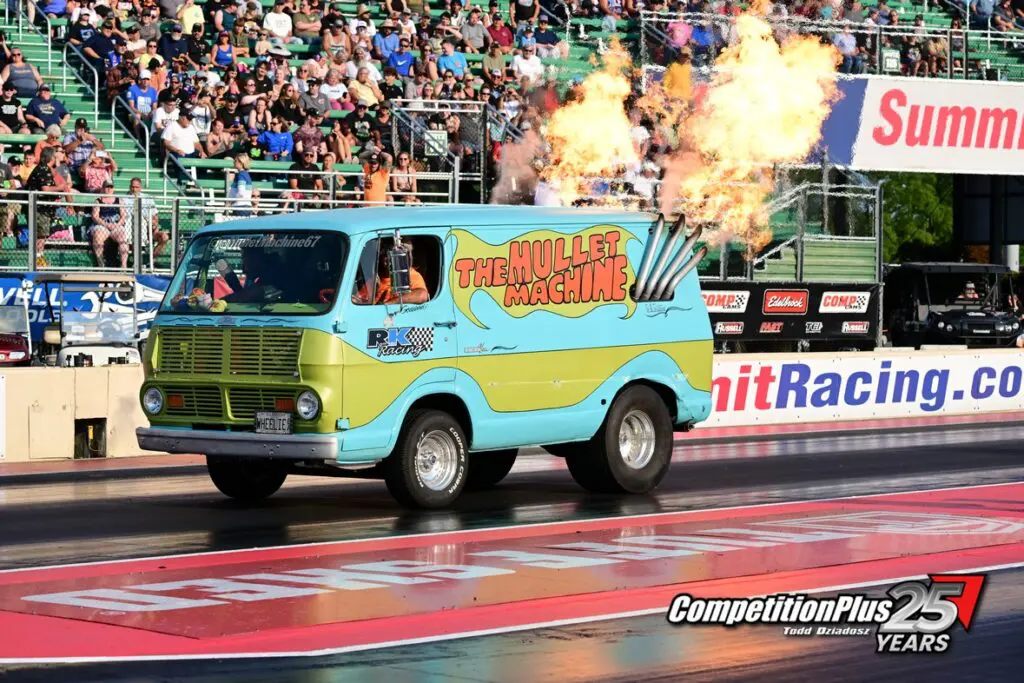
CP – So one of the things that has survived over the decades for you guys has been your Night Under Fire. What is it that has made that event so great? And how hard has been the temptation to not do more than one of them a year?
BB – Night Under Fire is an entertainment event. It’s not a drag race. And I think one of the things that we are most guilty of as an industry is thinking that we’re putting on drag racing events. Other than the NFL, if you go to an arena experience, I don’t care if it’s basketball, hockey, I don’t care what it is, the NHL, Minor League Baseball in their smaller stadiums, they are in the entertainment business. That’s what they are. They’re in the entertainment business.
We are in the entertainment business. And the Night Under Fire is an entertainment event where you don’t have to necessarily be a hardcore race fan, where you don’t have to know who’s leading in points, and you don’t have to know who won the last race. Just come out for an evening and let us entertain you. That event right now on my floor, I have all of the different elements of the Night Under Fire because literally I am crafting the show.
When I was younger, and I would have these meetings with my dad, we would always talk about taking them on a rollercoaster ride. An event is a ride. And so for those three or three and a half hours, we take them on the ride we want them to take. We want the slow climb. We want the unexpected drop. We want the unexpected twists and turns. We want to take them on a ride. We want to fully immerse them in that.
So we’re not talking at them. We’re talking with them. I learned very early that as an announcer, my job is to say what everybody in the seating bowl is thinking, but doesn’t have 30,000 watts of power to be able to say it. You see things on the racetrack that take place, and they shock you. It’s like, “Holy s***, did you just see that?” But the point is you are one of them. You’re not talking at people. You’re bringing people in. And that’s what a properly scripted show is supposed to do. It’s supposed to bring them in, and we take the ride together.
That methodology or that way of thinking hasn’t been very well embraced because we all think we’re putting on races. And putting on races, Bobby, I have no interest in doing that. I want to create experiences. We say this all the time. I say this all the time. Let’s say you’re a six Top Sportsman or top dragster cars. And you get to run; you have two qualifying rounds in a 24-hour period. Okay. And you go out, and you run a 6-10, and you run a 6-12.
You just spent 12 and a quarter seconds racing your car in a 24-hour day. What are you going to do for the rest of the 24 hours? Let’s say you’re a fisherman. And you get to go to one of the best fishing spots in the world, but you can only fish for 12 seconds a day. So that’s a problem in our sport.
So we have to figure out how to entertain people and create a culture and an environment that… And that’s why the racer’s experience off track is so important. They get together, and they cook out, and they have fun, and they bench race, and they talk, and they laugh, and they drink adult beverages, or whatever it is they’re doing.
So we have to have facilities that are able to facilitate or allow them to have that experience. I know racetracks that, when the race is over, usher you out. You’ve got to be out. Even on a multi-day race, you can’t stay in the pits. Why? Because you’re worried about being cheated out of a few crew tickets? So I think we are in the entertainment business, not the drag race business. And that’s what makes Night Under Fire what it is.
CP – How hard is the temptation not to do a second one or a third one in the same year?
BB – The circus comes to town once a year. That’s the golden rule. So there is no temptation to do a second one or a third one because you will… And I’ve said this with the NHRA doubling up at venues, you never have two good ones. You have two mediocre ones. So you have mediocre revenue twice, and you have exactly doubled the expenses. So, one of the golden rules is that the circus comes to town once a year, period.
CP – My last question. Let’s say you had $500 million to transform this sport. What would you do?
BB – I would be very successful. I can tell you that. And I don’t say that arrogantly. That is life-altering money. That is industry-trajectory-altering money that would allow you to make a proper investment in venues, not own venues. I do not believe that a sanctioning body should own venues. I think that is a kiss of death. I think a drag racing series should be marketed globally, meaning there should be continuity in branding, continuity in messaging over the entire series versus this differentiation so the Texas Motorplex… And Christie and her team are lights-out fantastic at what they do, but they’ve created a unique experience with the Stampede of Speed versus what I do at my national event, versus what some other venue might do with their national event.
That’s fine, to create, whether it’s the cowboy hat, the grandfather clock, the ice cream scoop, I think creating unique experiences on the tour is an absolute. I support that fully. But I do think that that kind of money would give us the ability to market on a national stage versus on a localized stage, Number one.
Number two, it would allow us to be able to help some of the lesser-funded teams come to the racetrack and compete, so we could get back to 20- or 22- or 24-car fields trying to qualify for a 16-car show.
IHRA just demonstrated to us what throwing a ton of money at the project will do, or can do. The problem was that while there was a heavy investment in certain things, there was an over-investment, and we didn’t have the expertise on how to sell tickets, how to activate marketing partners, and how to drive attendance. So I think what a lot of people would say is, “You’ve got to pay racers more money.” Well, we just tried that. I think it’s very easy to say we’re just going to put money in the purse, and maybe some of it should go there.
Ultimately, I serve one master. My master, after God, is my guest. The person who comes in and buys a $70 or $60 ticket to come to a race, or a $50 ticket. The people buying tickets are my masters. And if I can put 40,000 people in my racetrack, everybody else has to come along. Sponsors have to be there. Race teams have to be there because they’re getting to race in front of people, which is ultimately the goal. So I think I would invest that money in strategically placed national advertising campaigns with continuity. Let the tracks individualize certain experiences, but I would invest in a national marketing approach, number one.
Number Two, I would invest in the guest experience. And that’s everything from on-premise to various rings in the circus. I mean, we need flush bathrooms. We need to get away from porta-johns. We need good ingress and egress because that’s the first thing and last thing our guests remember. We need certain amenities like WiFi. We need to have good food and diverse food courts. We need great attractions in our midway. And we need to have full fields. We need to have compelling content that says, “Man, I don’t know that Erica’s going to get in or not.” Or “I don’t know if Kalitta is even going to qualify.” I use those as pure examples, but you get the idea.
I think it’s an investment in a lot of areas that people probably aren’t even thinking about, and ultimately, it’s investing in the long-term health and sustainability of the sport. Cost containment is a problem because everything has gotten so incredibly expensive. But when you let all the horses out of the barn, oftentimes it’s hard to collect up all those horses again. We keep talking about that, and we become intimidated when you have a few crew chiefs who scream and holler and rant and rave about slowing these cars down.
There are lots of things to work on. But with that kind of investment, I guarantee you there would be an ROI on that money. There would be a return on investment if it were done the right way, you surrounded yourself with the right people, you got buy-in. So you had the sponsors, and you had your guests, and you had your racetracks, and you had your teams all rowing in the same direction.
Maybe they all need to be invested in the success or failure of the sanctioning body or the series. But it’s bringing everybody together, getting everybody to buy into a vision, understanding that it’s not going to happen tomorrow. I guarantee you that everybody who was at my racetrack two weeks ago is passionate and has an incredible love for drag racing. That’s why they were all here. So while it is widely discussed what to do or how to do it, when you have that community and you have that amount of passion, it can be accomplished. But I think it’s investing in the experiential elements of a drag race.
The other area we haven’t talked a lot about is the importance of sponsors and how vitally important sponsors are, and the activation of those sponsors. We have some really good partners. I don’t know that we’re leveraging them well because, ultimately, 20 years ago, when we announced the NHRA and the Summit Racing Equipment NHRA Nationals, I had an influx of companies that threw big money at me because they just wanted to be part of it. They wanted to have a presence. They wanted signage. They wanted PA. They just wanted to be a part of the excitement.
And that’s gone now because, remember, that was in 2007. We had the Great Recession of ’08. That shook the world forever. Then we had COVID, which has been life-altering. Now, what sponsors want to see is how many widgets I can sell as a result of being involved. So we are now in the business of putting buyers and sellers together. And we identified that back in 2009-’10, post-Great Recession. So we are in the business of putting buyers and sellers together. That’s what we do. And if we can be successful at finding buyers for all of our sellers and all of their items, we will have sponsorship. But what are we doing in market?
What are we doing in store? What are we doing? Because I feel like one of our greatest deficits is that we just keep preaching to the choir because we don’t have the money to go beyond our core customer. And our core customer is old. So we have a graying fan base. We all know it. Everybody’s afraid to talk about it. And the reality of it is, how do we reach beyond our graying fan base? And you know what? That’s where the $500 million comes in.
The IHRA took the risk and threw out big money. And I applaud IHRA and Darryl Cuttell for taking that risk because it was an extraordinary risk, but it didn’t produce positive results. And to me, that is a case study on how just throwing money at purses doesn’t move the needle the way we need to move the needle. But a wonderful friend, John Asher, always talked about how we have to pay more, we have to pay more and pay more and pay more, and it will produce a positive outcome.
Well, we just lived that. We lived that last year, lived that this year. And I don’t think it produced the outcome that the management team at the International Hot Rod Association wanted it to produce. So there’s more to it. People think that money fixes everything. Money is a tool to fix things, but to just throw money out into the sky in and of itself won’t produce the positive result or the desired result.
Our sport is complicated, and our sport is sophisticated. And what I mean by that is sometimes when we put together a marketing campaign, and it works, we don’t even understand why it works. Or when it doesn’t work, we don’t always understand why it doesn’t work.
We don’t oftentimes understand why people buy tickets to an event or don’t buy tickets to an event. It is a complicated, ultra-complex equation that, at the end of the day, despite all of the metrics and KPIs and all of the crap that media buyers and everybody wants to show you about ROI and ROAS and all that other stuff, it is still an intuition that experienced people in this sport have about what might work, what might not work. It’s becoming more of a science, but it’s very much an art.