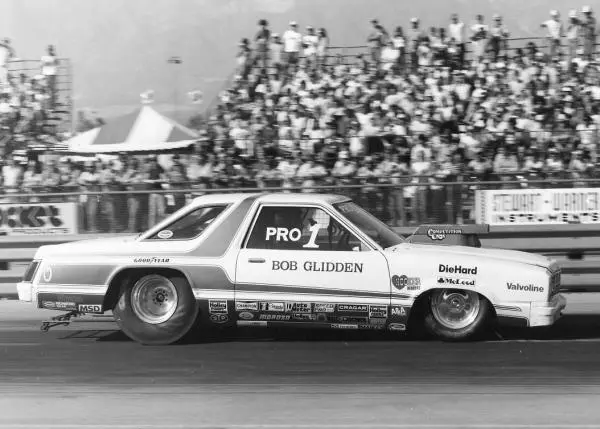

Bob Glidden — “Mad Dog” — won ten NHRA Pro Stock world championships (1974, 1975, 1978, 1979, 1980, 1985, 1986, 1987, 1988, 1989) and 85 national events, making him the most decorated driver in Pro Stock history. Among NHRA professional drivers, only John Force (16) has won more championships. Born August 18, 1944, in Whiteland, Indiana, Glidden died there on December 17, 2017, at age 73, after a brief illness; NHRA and his family did not publicly specify a cause. A Ford dealership line mechanic who went professional in 1972 in a secondhand Pinto, he held NHRA’s all-time career wins record from 1980 until John Force passed him in 2000, and he was the first driver in NHRA history to reach 50 wins and then 75 wins. His wife Etta and sons Billy and Rusty were part of the team in every pit. NHRA ranked him No. 4 on its Top 50 Drivers list, and Ford Performance Parts named an annual award, the Bob Glidden “85/10,” after him.
Bob Glidden: Quick Reference
| Category | Details |
|---|---|
| Name | Bob Glidden |
| Nickname | “Mad Dog” |
| Born | August 18, 1944, Whiteland, Indiana |
| Died | December 17, 2017 (age 73), Whiteland, Indiana |
| Cause of death | Not publicly specified; NHRA and the family cited a “brief illness” |
| Survived by | Wife Etta (married 54 years); sons Billy and Rusty |
| NHRA Pro Stock championships | 10 (1974, 1975, 1978, 1979, 1980, 1985, 1986, 1987, 1988, 1989) – most in Pro Stock history; second-most of any NHRA professional driver behind John Force (16) |
| Other titles | One IHRA series championship |
| NHRA national event wins | 85, all in Pro Stock – first at the 1973 U.S. Nationals, last at the 1995 Englishtown event |
| Career wins record | NHRA’s all-time winningest driver from 1980 until John Force passed him in 2000; first driver to reach 50 and then 75 wins |
| Final rounds | 122 (final-round win rate of 69.6% as of 2017) |
| No. 1 qualifiers | 102 as of 2017 (second in Pro Stock to Warren Johnson’s 138) |
| U.S. Nationals wins | 9 (1973, 1974, 1978, 1979, 1983, 1985, 1986, 1987, 1988) – most by any Pro Stock driver |
| Best seasons | 1978 (7 wins, 5 straight, undefeated Fairmont); 1987 (8 wins, No. 1 qualifier at all 14 events); 1989 (9 wins, 10th title) |
| Quickest run | 7.277 seconds, 1988 Supernationals, Ford Probe – quickest in Pro Stock history at the time |
| Pro debut | 1972 Supernationals – runner-up to Bill Jenkins, in a Pinto bought from Wayne Gapp and Jack Roush |
| Wins by make | Ford 78 (Thunderbird 30, Probe 20, Pinto 13, Fairmont 12, Mustang 2, EXP 1); Plymouth Arrow 7 |
| Retirement | February 1997; occasional appearances through 2010 (no further wins) |
| Hall of Fame | Motorsports Hall of Fame of America (1994); International Motorsports Hall of Fame (2005); No. 4 on NHRA’s Top 50 Drivers list |
| Award in his name | Ford Performance Parts Bob Glidden “85/10” Award (established 2018) |
| Local honor | Bob Glidden Boulevard, Whiteland, IN (named 2019); roundabout and sculpture dedicated August 18, 2026 |
| Estimated net worth | Not documented; online estimates range from about $2 million to $50 million with no verifiable sourcing |
Is Bob Glidden Still Alive?
No. Bob Glidden died on Sunday, December 17, 2017, at 9:40 p.m., at age 73. He would have turned 82 on August 18, 2026. That was the day his hometown of Whiteland, Indiana, dedicated a new roundabout and sculpture in his honor (details below).
How Did Bob Glidden Die?
Bob Glidden died on December 17, 2017, after what NHRA and his family described as a brief illness. Neither NHRA nor the family has publicly specified a cause of death.
Here is what the primary sources say:
- CompetitionPlus.com reported he died “following a brief illness,” with his wife of 54 years, Etta, and sons Billy and Rusty at his bedside. Billy said his father fought for his life over the final two weeks. “He fought like you wouldn’t believe,” Billy said. “He even tried to get out of bed last night at 8:20. But today, his condition took a turn for the worse.”
- NHRA announced his death without naming a cause. NHRA’s National Dragster editor wrote five days later that Glidden’s “declining health had been known to many of us for a few months.”
- Fox News reported he had been hospitalized earlier in December for an “undisclosed illness.”
Some websites assert a specific diagnosis. None cites an obituary, family statement, or NHRA announcement, and CompetitionPlus has not found a primary source confirming any of them.
Glidden’s heart history is well documented. After a December 1994 heart attack he underwent six-way bypass surgery, and doctors initially gave him two to four years to live. He lived 23 years. Billy noted he “lived 19 years longer than anyone believed he would.” That history is separate context, and no source connects it to his death.
NHRA President Peter Clifford said: “He was a true competitor who left a lasting legacy of excellence both on and off the track.”
Who Was Bob Glidden?
Bob Glidden was the racer other racers hoped to be: a self-made Hoosier who out-worked a sport. NHRA’s Phil Burgess called him “the epitome of the ground-up success story, the hard-working patriarch, the driven soul for whom pretty good was seldom enough.”
For readers new to the class: Pro Stock is NHRA’s “factory hot rod” category — naturally aspirated, production-bodied cars running the quarter-mile, where races are often decided by thousandths of a second. Our complete Pro Stock guide explains how it works.
He earned the nickname “Mad Dog” for his tireless work ethic. Don Prudhomme, who shared a winner’s circle with him a dozen times, put it this way: “No one worked as hard as Bob Glidden, but he knew I worked for what I had.” Prudhomme saw the same origin in both men: “We both kind of came up the same way, both cut from the same mold; he was a line mechanic and I painted cars.”
Don Garlits ranked him “in my top five, for sure.” Garlits said: “He didn’t get it handed to him on a silver spoon; he came right out of nothing and did it, and I really respect that.”
Burgess described Glidden, Garlits, and Prudhomme as the “holy trinity” of 1970s drag racing, “each the master of his own class.” The man in that trinity was a gentle, accessible presence in the pits. After winning his 36th Wally at the 1983 Springnationals he was, in Burgess’s words, “incredibly humble and gracious.” Burgess remembers the family hitching a basketball hoop to the trailer to play in the pits “as if they were playing in their own driveway,” and Glidden pitching quarters against his car’s tire in the staging lanes while a crowd gathered to watch.
When asked what he credited for his success, Glidden answered: “Common sense and the will to survive. I know that I have to hustle to win and that I have to go all out to afford to race.”
The Career: From Line Mechanic to Ten Championships
From Fairlanes to a Used Pinto (1960s-1972)
Glidden was a Ford man from the start. He campaigned a series of 427 Fairlanes, then switched in 1968 to the more potent 428 Cobra Jet Mustangs. His sponsor was Ed Martin Ford, where he worked as a line mechanic. He became one of Division 3’s most prolific winners.
In 1972 he sold his two Super Stock Mustangs and bought a Pro Stock Pinto from Wayne Gapp and Jack Roush. The Pinto, newly built, ran a 351-cubic-inch Cleveland V8 and wore red, white, and blue livery. By one account, about $18,000 covered the truck, trailer, car, and a spare engine. He left his job at Ed Martin Ford to race full time. In his first Pro Stock race, the season-ending Supernationals, he finished runner-up to Bill “Grumpy” Jenkins.
The First Titles (1973-1977)
In 1973 Glidden won his first national event at the U.S. Nationals, the sport’s biggest race. He paced the quickest Pro Stock field ever with a 9.03 at a national-record 152.54 mph and beat fellow Ford racer Gapp in the final.
In 1974, his second full season, he won three major events, including the Springnationals and U.S. Nationals, and set both ends of the national record on the way to his first championship. In 1975 he won seven times, including the Winternationals, Gatornationals, Fallnationals, and World Finals, for title No. 2. That season he qualified No. 1 five times, set top speed eight times, and set low ET six times, using three different cars.
Then the run stalled. He finished a distant sixth in 1976 behind Larry Lombardo and second to Don Nicholson in 1977.
The Fairmont, the Arrow, and the Streak (1978-1980)
In 1978 Glidden accumulated a record 16,035 points and lowered the national ET record to 8.59. He fielded two winning cars. The Pinto won two of his seven victories, the Winternationals and the Cajun Nationals. The famed Ford Fairmont carried the rest and finished the season undefeated in national event competition. His seven wins, including five straight, tied Prudhomme’s single-season record and broke Jenkins’s Pro Stock record of six. He beat the Lombardo-driven Jenkins Monza in the Summernationals final, 8.55 to 8.71. “That was by far the biggest spread that I ever had over the guys in any race that I’ve ever ran,” he recalled.
That summer he began a streak of nine straight national event victories that stretched across a full calendar year. He also qualified No. 1 at a then-record string of consecutive races.
In 1979 he retired the undefeated Fairmont for a Plymouth Arrow, his only departure from Ford, and lost only three times all year. He won seven national events, opened the season with the Winternationals, and went 50 consecutive rounds without a loss. The streak ended when a foul start in the second round of the Mile-High Nationals snapped it.
The 1980 title was his fifth, his third straight, and his most dramatic. Facing the Lee Shepherd-driven Reher-Morrison Camaro, Glidden led the points only once all year, on the last day. He entered the Ontario, California, finale trailing Shepherd by two rounds and caught a break when Shepherd’s transmission broke in round two. Glidden won the race, beating Frank Iaconio in the final. That 31st career win also made him NHRA’s all-time winningest driver, passing Don Prudhomme, a title he held for nearly two decades.
The Wilderness and the Thunderbird (1981-1984)
Shepherd’s Reher-Morrison team took four straight championships (1981-84). Part of their motivation was Glidden himself. “We finally got tired of losing and of Glidden winning so easily,” team co-owner Buddy Morrison said. “We decided that we either had to make the same kind of commitment to racing that he did or get out. We didn’t want to get out.”
Glidden’s answer was the Ford Thunderbird. He and Ford teammate Rickie Smith debuted new Thunderbirds at the 1983 Winternationals, and by mid-1984, in NHRA’s words, his was the dominant car in the class. The Ford EXP he’d run in 1982 had been a different story: as Glidden put it, it was “the worst handling race car he ever drove,” something that handled like a fuel altered.
Five Straight: The Dynasty (1985-1989)
1985 — He led the points from start to finish and won five national events for title No. 6.
1986 — The season began badly and nearly ended in disaster. At the Southern Nationals in Atlanta, after a semifinal win over Butch Leal, a gust of wind caught his parachute and sent the Thunderbird into a tailspin. It hit the opposite guardrail and barrel-rolled six times. The car was destroyed and Glidden was unhurt. He returned a month later with a new Thunderbird, scored his first win of the year at the Mile-High Nationals in July, and won six of the final seven races for title No. 7. NHRA still calls his covering of the broken, homemade intake manifold after the crash “infamous,” a snapshot of how closely he guarded his horsepower secrets.
1987 — He won eight races, including his 60th career victory, and reached the final ten times. He won the last five in a row, qualified No. 1 at all 14 events, and set a record with 42 round wins.
1988 — He won five of the final seven races for his ninth championship and fourth straight. He retired the Thunderbird in favor of a new Ford Probe and debuted it at the Supernationals with a 7.277, the quickest Pro Stock run in NHRA history at the time. He won that race to clinch the title.
1989 — This was his most dominant season. He won nine times, including five of the first seven races, and clinched his tenth and final championship. The win at the season-ending finale was his 76th, and 49 of them came in the 1980s alone.
The Final Chapter (1990-2010)
Glidden won three times in 1990, once in 1991, and twice each in 1992 and 1993. After the December 1994 heart attack and bypass surgery he missed the first half of 1995, then came back and won his 85th and final national event at the Mopar Parts Nationals in Englishtown. Pro Stock’s all-time champion never won again.
He retired in February 1997, just two races into the season, to focus on engine development for Ford’s NASCAR Winston Cup teams. NHRA’s obituary noted he also felt the sponsorship package he’d been offered was unsatisfactory. CompetitionPlus’s reporting on Billy Glidden’s career adds context: after 1995, Ford shifted its marketing budget to John Force Racing, and the Glidden family eventually sold its Pro Stock operation.
He was back in a Pontiac at the 1998 U.S. Nationals, and he stayed in the sport as an engine specialist and advisor. Dragzine lists advisory and crew-chief roles with Cunningham, Gray Motorsports, Knoll-Gas Motorsports, and Don Schumacher Racing’s Mopar program, and he joined Justin Humphreys’ RaceRedi/Knoll-Gas Pontiac GTO team in the late 2000s. In 2010, at age 66, he came out of retirement to drive a Pro Stock Mustang in a handful of events. He didn’t win, but he showed up.
The Numbers
| Statistic | Figure |
|---|---|
| NHRA Pro Stock championships | 10 |
| National event wins | 85 |
| Final rounds | 122 |
| Final-round win rate | 69.6% (as of 2017) |
| No. 1 qualifiers | 102 (as of 2017) |
| U.S. Nationals wins | 9 |
| Opponents faced in final rounds | 29 |
| Winning final-round record vs. opponents | 26 of 29 |
| Final-round record vs. Warren Johnson | 12-6 |
| Final-round record vs. Lee Shepherd | 10-9 |
| Final-round record vs. Frank Iaconio | 8-5 |
| Final-round record vs. Darrell Alderman | 1-4 |
| Record for rounds won in a season | 42 (1987) |
| 1987 No. 1 qualifying | All 14 events |
How he compares (per NHRA’s 2017 tally, with Anderson’s current win total):
| Bob Glidden | Warren Johnson | Greg Anderson | |
|---|---|---|---|
| Championships | 10 | 6 | 6 |
| Career wins | 85 | 97 | 116 (2026) |
| Final-round win rate (2017) | 69.6% | 64.2% | 60.4% |
| U.S. Nationals wins (2017) | 9 | 6 | 6 |
Glidden’s final-round win rate was better than that of Johnson, Anderson, or even John Force (59.6%). He won 76 of his 85 titles in the 1970s and ’80s, when seasons ran only 8 to 19 events. Anderson and Johnson built their totals over 23- and 24-race seasons.
The Cars: Every Win, by Make
NHRA’s final accounting of Glidden’s 85 victories, by the car he drove:
| Car | Wins | Notes |
|---|---|---|
| Ford Thunderbird | 30 | Debuted at the 1983 Winternationals; dominant by mid-1984; powered the 1985-88 championships; survived a six-barrel-roll crash in 1986 |
| Ford Probe | 20 | Debuted at the 1988 Supernationals with a 7.277; 1989 championship car |
| Ford Pinto | 13 | Bought from Wayne Gapp and Jack Roush in 1972; 351-cubic-inch Cleveland V8; 1974 and 1975 titles |
| Ford Fairmont | 12 | Undefeated in national event competition in 1978 |
| Plymouth Arrow | 7 | His one non-Ford; 1979 championship car |
| Ford Mustang | 2 | Late-career Pro Stock Mustang |
| Ford EXP | 1 | 1982 car; Glidden called it the worst-handling race car he ever drove |
The Pinto he bought from Gapp and Roush was the most famous car of his career. A 1972 Pinto attributed to Glidden sold at Mecum Kissimmee in January 2020 for $220,000 (Lot S149). It is the only car he sold with its original engine and transmission combination; the rest went as rollers.
The undefeated Fairmont survives. On August 18, 2026, his undefeated 1978 Ford Fairmont, recently purchased by Ed Martin Ford, the dealership that sponsored his early career, drove down Bob Glidden Boulevard for a ceremonial lap.
The Engines and the Work Ethic
Glidden’s edge was not a secret formula. It was labor. Garlits recalled stories of the Gliddens working three days and nights on a new intake manifold without knowing whether it would pay off. Prudhomme remembered: “He’d work all night long on his stuff looking for more power, and he was doing it by hand, not on a CNC machine.”
That hunger for horsepower carried over into Ford’s NASCAR engine programs after he left Pro Stock in 1997. CompetitionPlus captured the family’s philosophy in its Billy Glidden feature: “The Glidden mantra was always to make the most out of the least, and even during the championship seasons the family replaced money with work ethic.”
Garlits, whose world was fuel dragsters, said Glidden was endlessly curious: “He loved the way that the fuel cars ran. He didn’t want to do it himself, but he spent a lot of time in my trailer with me talking about the fuel curves and nozzling for each port.”
The Rivalries
Lee Shepherd. The Ford-versus-Chevy rivalry defined Pro Stock’s golden era. Their final-round record was nearly even, with Glidden ahead 10-9. Shepherd’s Reher-Morrison team beat him for four straight championships (1981-84). NHRA’s Burgess noted that only Shepherd and Darrell Alderman (1-4) really got the better of him in finals.
Warren Johnson. Glidden led their final-round series 12-6. Johnson, the engineer who would eclipse his win total, was part of what NHRA called Pro Stock’s “Gang of Four” with Glidden, Shepherd, and Frank Iaconio.
Don Garlits and Don Prudhomme. The three shared a winner’s circle only twice, bookending the 1975 season. Glidden shared one with Garlits eleven times and with Prudhomme twelve, from the 1973 U.S. Nationals to Sonoma in 1989.
The wins record. Don Prudhomme passed Ronnie Sox as NHRA’s winningest driver in 1976. Glidden passed Prudhomme in 1980, and John Force passed Glidden with his 86th win at Chicago in 2000. Glidden’s 85 now sits third on the all-time Pro Stock wins list, behind Greg Anderson and Warren Johnson.
The Glidden Family: Etta, Billy, and Rusty
The Glidden story is not a one-man story. Etta, his wife of 54 years, was a fixture of the operation and is long described as the team’s crew chief. Sons Billy and Rusty grew up in the pits, wrench in hand. Ford later called the operation Glidden Family Racing.
Billy Glidden, the eldest, spent his youth working on his father’s Pro Stock cars and dreaming of driving them. In 1983 he was set to drive his father’s old Ford EXP at the U.S. Nationals, then learned Bob had sold the car. “Punch to the gut,” Billy said. “I learned quickly on that day that if something was going to happen for me to drive, I would have to create my opportunity.”
His chance came in 1993, when Bob let him make the final run of a Houston test session in his new Pro Stock Mustang. Billy ran a 7.32 at 191 mph. In 1994 he made his NHRA Pro Stock debut at Phoenix, qualified No. 8, and beat his own father in the first round. He then beat Warren Johnson in round two before a foul start ended his day. Two races later he ran a 6.99 and became the fourth member of the Six-Second Club.
When the family’s Pro Stock program ended, Billy built his own career. He won four NMCA Super Street championships and, with wife Shannon, two ADRL Outlaw 10.5 championships. His black Mustang was reportedly the first small-tire car to run in the sevens. Bob even drove a few events in Billy’s small-tire Mustangs. “Where there’s a will, there’s a way,” Billy said. “That’s our motto.”
How His Name Lives On
| Date | Tribute |
|---|---|
| February 2018 | Ford Performance announces the Bob Glidden “85/10” Award, presented each December at the PRI Show in Indianapolis |
| December 2018 | John Calvert, a Mustang Cobra Jet racer, becomes the first 85/10 Award recipient |
| 2019 | The Town of Whiteland names Bob Glidden Boulevard |
| January 2020 | His 1972 Pinto sells at Mecum Kissimmee for $220,000 |
| June 2026 | His undefeated 1978 Fairmont joins the game NHRA Legends of Drag Racing |
| August 18, 2026 | Whiteland dedicates a roundabout and sculpture on what would have been his 82nd birthday |
The Bob Glidden “85/10” Award goes each year to the Ford drag racer who best embodies Glidden’s grit and determination. The numbers stand for his 85 wins and 10 championships, and the selection panel includes his son Bill. Glidden and his family lived in Whiteland for more than 40 years, and he ran a performance shop there. In 2019 the town named the main corridor into its Whiteland Exchange industrial park Bob Glidden Boulevard.
On August 18, 2026, what would have been his 82nd birthday, Whiteland dedicated a new roundabout at Whiteland Road and Bob Glidden Boulevard with a custom sculpture honoring him. Nearly 100 people attended, including Etta and the family, and a checkered-flag ribbon was cut. The highlight was the undefeated 1978 Fairmont driving down the boulevard and around the roundabout.
What Is Bob Glidden’s Net Worth?
Bob Glidden’s net worth is not documented. Online estimates range from roughly $2 million to $50 million, with no estate filing, financial disclosure, or interview behind any figure. Several of the pages publishing them contain basic factual errors about his life.
What the record does show is that money was never easy. His own words: “I know that I have to hustle to win and that I have to go all out to afford to race.” He started professionally with a used Pinto and a modest budget, and he left Pro Stock in 1997 partly over a sponsorship package he considered unsatisfactory. CompetitionPlus does not endorse any specific net worth figure.
Honors and Hall of Fame
| Honor | Year |
|---|---|
| Motorsports Hall of Fame of America | 1994 |
| NHRA Top 50 Drivers (sport’s first 50 years) | Ranked No. 4 |
| International Motorsports Hall of Fame | 2005 (Class of 2005) |
| Ford Performance Parts Bob Glidden “85/10” Award | Established 2018 |
| Bob Glidden Boulevard, Whiteland, IN | Named 2019 |
The Legacy
Bob Glidden’s ten championships are still the Pro Stock record, and no other driver has won more than six. His 85 wins were enough to make him NHRA’s winningest driver for two decades. More telling is how he got there: a Ford line mechanic who sold his Mustangs to buy a used Pinto, outworked the sport’s best factory-backed teams, and carried the Ford banner almost by himself.
Edsel B. Ford II said at his passing: “Bob represented what drag racing was all about during his era. He was a self-made man who left his job as a mechanic at a Ford dealership to go racing full-time with a dream, a tireless work ethic and a winning determination.”
John Force, the man who eventually passed him, said it best: “We all know what Bob Glidden has accomplished in a lifetime. Feats that will never be broken, accomplishments that will never be broken. But there’s the other side of Bob Glidden, the personal side of Glidden, him as a person. The love that he had for his family, his boys and Etta. How he always treated everyone with respect, even if it was just in passing.”
CompetitionPlus.com’s obituary opened with a line that still fits: “A drag racer who successfully defined the will to succeed against the odds has passed away.”
Frequently Asked Questions
Is Bob Glidden still alive?
No. Bob Glidden died December 17, 2017, at age 73 in Whiteland, Indiana.
How did Bob Glidden die?
He died after what NHRA and his family called a brief illness. No cause of death has been publicly specified by NHRA or the family. His son Billy said he fought for his life over his final two weeks.
How old was Bob Glidden when he died?
73. He was born August 18, 1944, and died December 17, 2017.
Why was Bob Glidden called “Mad Dog”?
For his tireless work ethic. He was known for working through the night to find more horsepower.
How many championships did Bob Glidden win?
Ten NHRA Pro Stock championships (1974, 1975, 1978-80, 1985-89) plus one IHRA series championship. Ten is the most in Pro Stock history, and among NHRA professional drivers only John Force (16) has more.
How many races did Bob Glidden win?
85 NHRA national events, all in Pro Stock. He held NHRA’s career wins record from 1980 until John Force passed him in 2000. He is third on the all-time Pro Stock wins list behind Greg Anderson and Warren Johnson.
What is Pro Stock?
NHRA’s “factory hot rod” class: naturally aspirated, production-bodied cars running the quarter-mile.
Who was Bob Glidden’s wife?
Etta Glidden. They were married for 54 years, and she was a long-time fixture of his race team.
Who are Bob Glidden’s sons?
Billy and Rusty Glidden. Billy raced in Pro Stock, small-tire, and outlaw competition; both sons worked on their father’s teams.
What cars did Bob Glidden drive?
Mostly Fords: Thunderbird (30 wins), Probe (20), Pinto (13), Fairmont (12), Mustang (2), and EXP (1), plus a Plymouth Arrow (7 wins) in 1979.
Why is Bob Glidden associated with Ford?
78 of his 85 wins came in Fords, and his early sponsor was the Ford dealership where he worked as a mechanic. He later worked on Ford’s NASCAR engine program.
What engine did Bob Glidden’s Pinto use?
A 351-cubic-inch Ford Cleveland V8.
Where is Bob Glidden’s Pinto?
A 1972 Pinto attributed to him sold at Mecum Kissimmee in January 2020 for $220,000; the buyer isn’t public.
What was Bob Glidden’s undefeated Fairmont?
His 1978 Ford Fairmont, which finished that season undefeated in national event competition. It survives and was recently purchased by Ed Martin Ford, his original sponsor.
What is the Bob Glidden 85/10 Award?
Ford Performance Parts’ annual honor for the Ford drag racer who best embodies his grit. The numbers are his 85 wins and 10 championships; John Calvert was the first recipient (2018).
Did Bob Glidden race after the 1990s?
He retired from full-time driving in 1997, was back in a Pontiac at the 1998 U.S. Nationals, made a few appearances in his son Billy’s small-tire Mustangs, and returned for several Pro Stock Mustang starts in 2010.
Did Bob Glidden ever drive a non-Ford?
Yes. In 1979 he won the championship in a Plymouth Arrow, scoring seven wins. Before that, he drove a Chevrolet Monza at the 1976 NHRA U.S. Nationals for one race before returning to his Ford. In later years, he did drive other manufacturers after his perceived retirement.
Is Bob Glidden’s championship record still standing?
Yes. His ten Pro Stock championships remain the class record. His 85 wins have been passed by Warren Johnson (97) and Greg Anderson.
Related Coverage
- Pro Stock: The Complete Guide to Drag Racing’s Factory Hot Rod Class
- Warren Johnson: The Professor of Pro Stock
- Don Garlits: Legacy, Career Records
- Don Prudhomme “The Snake”: Legacy, Career Records
- Drag Racers: Profiles, Records, and Legacies
- The NHRA U.S. Nationals: Complete Guide
- John Force Racing: The Complete Guide
- How NHRA Drag Racing Works: The Complete Fan Guide
- Drag Racing Loses a Legend, Bob Glidden Passes
- Having a Will to Make a Way Is What Kept Billy Glidden Going in Drag Racing