
Don “The Snake” Prudhomme is one of the most decorated and influential drivers in NHRA history. Born April 6, 1941, in San Fernando, California, he is 85 years old and still alive as of 2026. In 32 years of professional driving (1962-1994), Prudhomme won 49 NHRA national events — sixth most in NHRA history — across both Top Fuel and Funny Car, with four consecutive NHRA Funny Car championships (1975-1978), the first driver to achieve that streak. He reached the finals 68 times with a career round-winning percentage of .660 across 589 rounds. Off the track, Prudhomme and rival Tom “The Mongoose” McEwen pioneered the corporate sponsorship model that transformed drag racing from an outlaw sport into a professionally funded competition, securing the groundbreaking Hot Wheels/Mattel deal in 1970 that introduced drag racing to a generation of mainstream American fans. As a team owner after retiring from driving, he won two more NHRA championships with driver Larry Dixon in 2002 and 2003.
Don Prudhomme: Quick Reference
| Stat | Value |
|---|---|
| Full name | Donald Ray Prudhomme |
| Nickname | “The Snake” |
| Born | April 6, 1941 |
| Age (2026) | 85 |
| Birthplace | San Fernando, California |
| Status | Retired (driving 1994; team owner 2010); still active in the sport |
| NHRA Funny Car championships | 4 (1975, 1976, 1977, 1978) |
| NHRA championships as team owner | 2 (Top Fuel: Larry Dixon 2002, 2003) |
| Total NHRA championships | 6 |
| NHRA national event wins (driver) | 49 (6th most in NHRA history) |
| Total wins (driver + owner) | 112 national events |
| Finals appearances | 68 |
| Funny Car finals record | 35 wins in 45 finals |
| Top Fuel finals record | 14 wins in 23 finals |
| Career round win percentage | .660 (389 wins in 589 rounds) |
| U.S. Nationals wins | 7 (3 TF, 4 FC) |
| First NHRA win | 1962, Smokers March Meet, Bakersfield, CA (Top Fuel) |
| Final win as driver | 1994, Texas NHRA Fall Nationals (Top Fuel) |
| Best single season | 1975: won 7 of 8 events; 1976: lost only 1 race all season |
| Competitive first | First driver to win NHRA Winternationals AND U.S. Nationals in same season (1965) |
| Speed firsts | First FC driver to exceed 240 mph (1975), 250 mph (1982); first sub-5.20 sec (1989); 3rd TF driver to exceed 300 mph (1992, age 51) |
| Business achievement | Co-architect of Hot Wheels/Mattel corporate sponsorship deal (1970) — first major corporate sponsorship in drag racing history |
| Film | Snake and Mongoose (2013, PG-13) |
| Estimated net worth | $4-6 million (estimated; not publicly confirmed) |
| NHRA Top 50 Drivers ranking | No. 3 (list of 50 most significant drivers, 2001) |
| Hall of Fame | Motorsports Hall of Fame of America (1991); International Motorsports Hall of Fame (2000) |
Is Don Prudhomme Still Alive?
Yes. Don Prudhomme was born April 6, 1941, and is 85 years old as of 2026. He remains active in motorsports — attending NHRA events, participating in industry recognitions, and maintaining his connection to the sport he helped reshape. In November 2024, Prudhomme received the Robert E. Petersen Lifetime Achievement Award at the SEMA Show Industry Awards Banquet, presented by the Petersen Automotive Museum.
His competitive spirit has never fully retired. In 2021, at age 80, Prudhomme won his class at the Yokohama NORRA Mexican 1000 — a grueling 1,000-mile desert race across Baja California — co-driving a CanAm Maverick Turbo with Rich Minga, winning by more than three hours over their nearest competitor. Still The Snake.
Who Is Don Prudhomme?
Don Prudhomme is two things simultaneously, and understanding both is necessary to understand his full significance.
On the track: He is one of the most technically accomplished drag racers in the sport’s history — a driver whose .660 career round-winning percentage across 589 rounds reflects consistent execution under pressure across three decades. His four consecutive Funny Car championships (1975-1978) are a feat no driver had achieved before. The 1975 season — seven wins in eight events, the inaugural NHRA Winston championship — remains one of the most dominant individual seasons in NHRA history. The 1976 season was, by round-win consistency, even more remarkable: Prudhomme lost only one race all year.
Off the track: He is arguably the most important figure in drag racing’s commercial evolution. The Hot Wheels/Mattel corporate sponsorship deal he and Tom McEwen architected in 1970 was the first major corporate sponsorship in drag racing history. Without that deal, professional drag racing’s path to national television, Fortune 500 sponsorship, and mainstream sports legitimacy looks very different.
Prudhomme grew up in San Fernando, California. Before drag racing claimed him fully, he appeared headed toward a career as a custom car painter — a skill that supported him during the early years when prize money was inconsistent. The discipline and eye for detail from that work translated directly into the precision driving style that earned him his nickname. “The Snake” came from his high school years — his quick-strike reflexes on the starting line, his ability to read and react to the Christmas Tree faster than anyone around him.
The Career: From Bakersfield to the Hall of Fame
The Greer-Black-Prudhomme Era (1962-1964)
The Greer-Black-Prudhomme Top Fuel dragster is one of the most dominant race cars in the history of motorsport. The team — chassis builder Tommy Greer, engine genius Keith Black, and driver Don Prudhomme — assembled a combination that was essentially unbeatable in Southern California match racing through 1962-1964. Records indicate approximately 230 event victories against roughly 7 losses — a winning percentage approaching .970. The car appeared on the cover of Hot Rod Magazine in November 1962.
The financial arrangement was unusual: Prudhomme received half the prize money after every final round — real, steady income week after week. For a young driver who had been painting cars to survive, it was transformative. As Roland Leong later observed: “McEwen was the smartest of the bunch. When he came up with the Hot Wheels deal… it shook the world of drag racing big time. He produced a sponsorship package that allowed him and Prudhomme to buy the best equipment, pay expenses, make money and sell their image all over the United States. I hate to admit it but McEwen and Prudhomme showed us the way to the future.”
Roland Leong and the Hawaiian (1965)
When the Greer-Black-Prudhomme partnership dissolved, Prudhomme found a new ride with Roland Leong — a Hawaii-based enthusiast who had commissioned a Top Fuel car from Kent Fuller with a Keith Black engine. Leong had crashed on his maiden pass and needed a driver. Keith Black recommended Prudhomme.
The 1965 season was one of the most celebrated single-season performances in early NHRA history. Prudhomme won the NHRA Winternationals and the U.S. Nationals — becoming the first driver in NHRA history to win both events in the same season. The team was beaten only twice all year, both times by the Ramchargers. After the Leong season and a year on his own, Prudhomme drove the Shelby Super Snake dragster for Lou Baney in 1967-1968, then the Wynn’s-sponsored dragster in 1969-1970.
The Hot Wheels Deal: How Prudhomme Changed Drag Racing Forever (1970)
The Mattel Hot Wheels sponsorship deal of 1970 is the single most consequential business transaction in drag racing history.
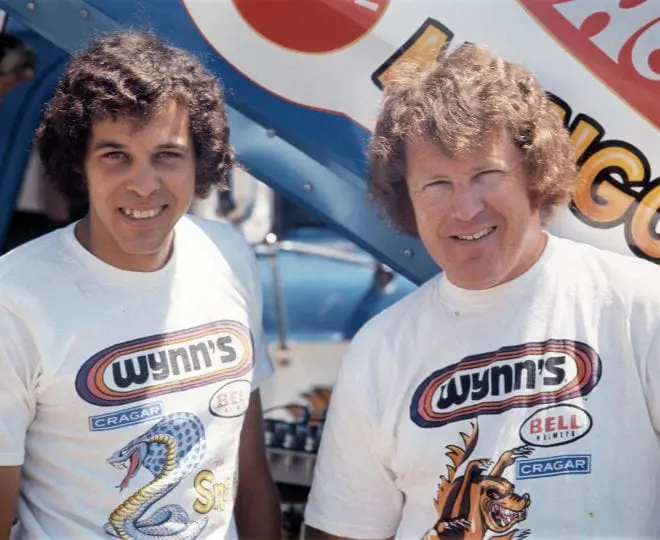
Tom McEwen — The Mongoose — was Prudhomme’s fiercest rival and closest friend simultaneously. McEwen’s genius was promotional; Prudhomme’s was driving. McEwen’s pitch to Mattel was audacious: sponsor both of them, produce Hot Wheels toy versions of both their cars, and use the Snake vs. Mongoose narrative as a marketing platform. Prudhomme’s yellow Plymouth Barracuda (The Snake) and McEwen’s red Plymouth Duster (The Mongoose) competed in Funny Car under Hot Wheels livery. The Snake and Mongoose Hot Wheels cars became the best-selling items in the product line in 1970.
Snake and Mongoose were the first drag racing team with major corporate sponsorship. The model they created — manufacturer partner, branded race car, merchandise licensing, competitive team structure — became the template for every NHRA sponsorship that followed. When Mattel withdrew in 1973, the two drivers had drawn so much exposure they were able to form Wildlife Racing, attracting other corporate sponsors including Coca-Cola. The Shell, Army, and Skoal sponsorships that defined the sport’s commercial era in subsequent decades all traced their lineage back to 1970.
As CompetitionPlus.com documented: off the track, Prudhomme gained notoriety in the early 1970s when Mattel introduced the Snake and Mongoose Hot Wheels car sets, helping introduce drag racing to a larger, more mainstream audience.
By 1973, Prudhomme had a new Funny Car chassis built by John Buttera, with sponsorship from Carefree Sugarless Gum layered over earlier Hot Wheels and later U.S. Army backing. He claimed major national Funny Car victories including No. 1 qualifications at the Springnationals and U.S. Nationals. By 1973, the Funny Car world understood it had a problem.
The Funny Car Dynasty (1975-1989)
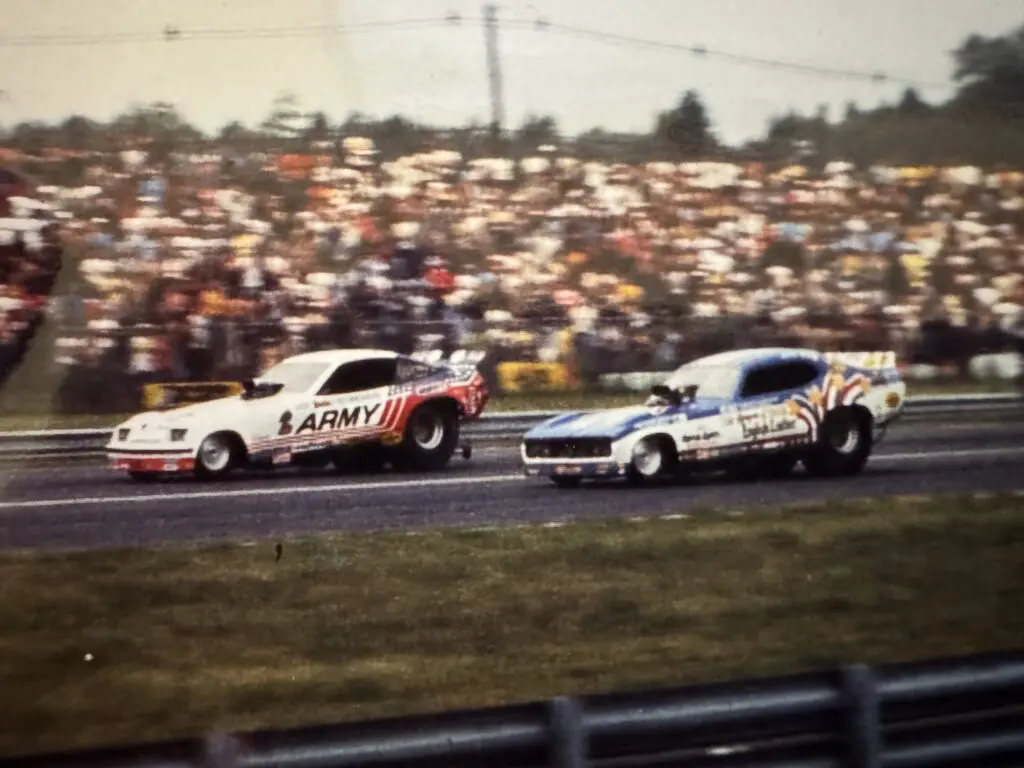
The 1975 season was Prudhomme’s masterpiece. Behind the wheel of the U.S. Army-backed Chevrolet Monza, with crew chief Bob Brandt calling the tuning shots, Prudhomme won seven of eight national events — including six of the first seven — and clinched the inaugural NHRA Winston championship at the World Finals. He became the first NHRA Winston World Champion.
The 1976 season was, by round-win consistency, even more dominant: Prudhomme lost only one race all year — a U.S. Nationals final to Gary Burgin. National Dragster coverage from the era documented 13 straight finals appearances from 1975 to 1977 with only two losses — one of the most impressive consistency streaks in NHRA Funny Car history. Four consecutive Funny Car championships followed: 1975, 1976, 1977, 1978. No driver had won four consecutive titles in any NHRA professional class before.
Speed milestones from the Funny Car years:
| Year | Milestone | Figures |
|---|---|---|
| 1975 | First Funny Car driver to exceed 240 mph | 241.53 mph in qualifying |
| 1976 | First Funny Car driver in the five-second ET range | Sub-6.00 second territory |
| 1982 | First Funny Car driver to exceed 250 mph | Ran 5.63-sec ET; previous barrier was 5.70 |
| 1989 | First Funny Car driver to run sub-5.20 seconds | — |
| 1992 | Third Top Fuel driver to exceed 300 mph | At age 51 |
His Funny Car career produced 35 wins in 45 final-round appearances — a .778 finals winning percentage.
The Top Fuel Return (1990-1994)
In 1990, at age 49, Prudhomme returned to Top Fuel for his “Final Strike” campaign. Working with engine tuner Wes Cerny during the comeback years, he won nine additional Top Fuel events: three wins in 1991, three in 1992, and three in 1994. In 1992, at age 51, he became the third driver in NHRA history to exceed 300 mph in Top Fuel, joining Kenny Bernstein and Gary Ormsby. In 1994, he finished second in the Top Fuel standings — his highest points finish of the comeback era. His final professional win as a driver came at the 1994 Texas NHRA Fall Nationals.
At 68 finals appearances over 32 years, Prudhomme averaged more than two final-round appearances per year for his entire career.
The Career Record: By the Numbers
| Statistic | Figure |
|---|---|
| NHRA national event wins (driver) | 49 |
| Finals appearances | 68 |
| Funny Car wins | 35 |
| Top Fuel wins (driving) | 14 |
| Round win percentage | .660 (389 of 589 rounds) |
| Funny Car finals record | 35-10 (.778) |
| Top Fuel finals record | 14-9 (.609) |
| NHRA championships (driver) | 4 (FC: 1975, 1976, 1977, 1978) |
| NHRA championships (owner) | 2 (TF: Larry Dixon 2002, 2003) |
| U.S. Nationals victories | 7 (3 TF, 4 FC) |
| Best single season (wins) | 7 of 8 events (1975) |
| Best single season (losses) | 1 loss all season (1976) — U.S. Nationals final to Gary Burgin |
| Consecutive finals (1975-1977) | 13 straight appearances, only 2 losses |
| Top Fuel comeback wins by year | 3 (1991), 3 (1992), 3 (1994) |
| Best comeback-era points finish | 2nd in Top Fuel standings (1994) |
| Total wins (driver + owner) | 112 national events |
The Team Owner Chapter (1994-2010)
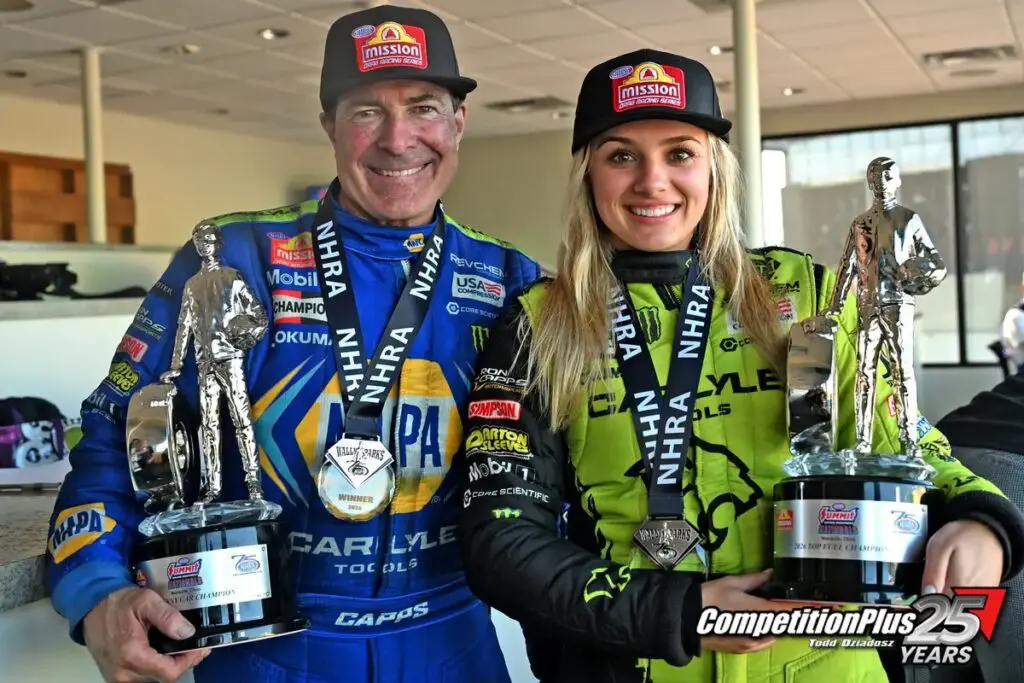
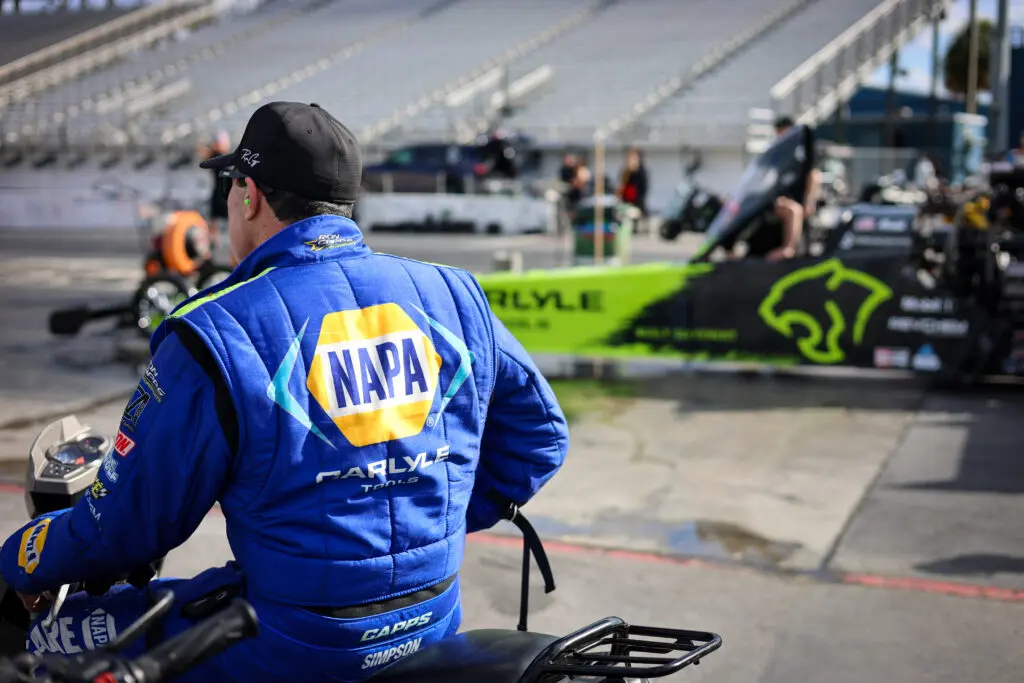
Don Prudhomme Racing fielded competitive cars in both Top Fuel and Funny Car simultaneously. His driver combination of Larry Dixon (Top Fuel) and Ron Capps (Funny Car) was one of the most formidable team pairings in the sport during the late 1990s and early 2000s.
Dixon won nine races in 2002 under Prudhomme’s ownership and claimed the Top Fuel championship. Dixon repeated as champion in 2003, giving Prudhomme back-to-back titles as an owner. The 1998 Winternationals wins by Dixon (Top Fuel) and Capps (Funny Car) made Prudhomme only the fifth owner in NHRA history to have cars in two different categories win event titles at the same race — a feat repeated at Brainerd in 2001 and Columbus in 2002.
When sponsorship dried up after the 2009 season, Prudhomme retired from team ownership. His 47-year involvement in professional drag racing — 32 as a driver, 15 as an owner — produced 112 national event victories and six NHRA championships.
What Don Prudhomme’s Net Worth Is
Don Prudhomme’s net worth is not publicly confirmed. Estimates from various automotive and motorsports databases place him in the range of $4-6 million, reflecting career earnings as a professional driver across 32 seasons, income as a team owner across 15 additional seasons, endorsements, appearance fees, the 2013 film, and the value of his extensive collection of historic race cars — including the fully restored Hot Wheels Funny Cars whose collector value is significant.
The Snake and Mongoose Rivalry: What It Meant
The relationship between Don Prudhomme and Tom McEwen defied simple categorization. Rivals who competed against each other for decades. Business partners who architected the most important commercial deal in drag racing history together. Close friends whose personal relationships ran deeper than anything on the track.
Their competitive dynamic was genuine. McEwen was a skilled driver and brilliant promoter. Prudhomme was the better driver. That gap — real but not overwhelming — created the tension that made the rivalry commercially viable.
One of drag racing’s most emotionally powerful moments belongs to the McEwen side of the ledger. In 1978, just days after the death of his son Jaime, Tom McEwen drove to the Funny Car final at the NHRA U.S. Nationals in Indianapolis — and beat Don Prudhomme. It was McEwen’s most famous win. It was the only race at the sport’s biggest event where the result mattered less than the courage it took to compete.
The 2013 film Snake and Mongoose (PG-13), starring Jesse Williams as Prudhomme and Richard Blake as McEwen, dramatized the story for a new generation, screening at NHRA events nationally.
Tom McEwen died June 10, 2018, at age 81. Prudhomme acknowledged McEwen’s role consistently in his public remarks: “Tom was the one who came up with the Hot Wheels deal. Without Tom, that never happens.”
The Baja Chapter: Still Racing at 80
In 1968, actor Steve McQueen asked Prudhomme to co-drive in the Mexican 1000 Baja race in a Porsche-powered buggy built by Tony Nancy. McQueen had a movie conflict; Nancy reached out to Prudhomme. The car burned up before it reached the dirt. “Never even made it onto the dirt, which I’m embarrassed to tell you,” Prudhomme told CompetitionPlus.com fifty years later.
He came back. In 2018, at age 77, Prudhomme returned to Baja competition. In 2021, at age 80, he and co-driver Rich Minga won their class at the Yokohama NORRA Mexican 1000 — the Evolution Stock Turbo class — in a CanAm Maverick Turbo, winning by more than three hours over their nearest competitor in a race where 26 of 90 starters didn’t finish. CompetitionPlus.com covered the win directly: “Snake proves he can still win.” He did.
The Sponsorship Legacy: What Prudhomme Built for Everyone Who Followed
Before the Hot Wheels deal: drag racing relied on gate receipts and prize money. Drivers funded their own cars or found individual backers. National television was nonexistent. After Snake and Mongoose proved that major corporations would pay to associate their brands with professional drag racing, the sport’s commercial architecture changed permanently. Shell, Budweiser, Army, Skoal, and dozens of Fortune 500 brands followed. Television coverage became viable. The audience became national. Every driver who has collected a sponsorship check in NHRA history owes a debt to what Prudhomme and McEwen proved was possible in 1970.
Hall of Fame Recognitions
| Hall of Fame / Recognition | Year |
|---|---|
| Motorsports Hall of Fame of America | 1991 |
| International Motorsports Hall of Fame (Talladega, AL) | 2000 |
| NHRA Top 50 Drivers | No. 3 (50 most significant drivers, 2001) |
| SEMA Robert E. Petersen Lifetime Achievement Award | 2024 |
Don Prudhomme’s Enduring Influence
“Ask even the most casual of motorsports fans who the biggest name in drag racing is, and you are almost always sure to hear one name,” CompetitionPlus.com wrote in its retrospective on Prudhomme’s career. “Don ‘The Snake’ Prudhomme.”
The championships, the records, the round-winning percentage — these are impressive. The Hot Wheels deal, the corporate sponsorship model, the mainstream cultural visibility — these are transformative. Together they define a career that shaped the sport in two completely different dimensions simultaneously.
At 85, Prudhomme remains connected to the sport he spent seven decades reshaping. He still shows up. He still wins desert races. He still understands something fundamental about what makes drag racing matter to people. The Snake. Still out there.
Frequently Asked Questions
Is Don Prudhomme still alive?
Yes. Born April 6, 1941, Don Prudhomme is 85 years old as of 2026.
How old is Don Prudhomme?
85 years old, born April 6, 1941, in San Fernando, California.
What is Don Prudhomme’s nickname?
“The Snake” — earned in high school for his quick-strike reaction times.
How many championships did Don Prudhomme win?
Six total: four NHRA Funny Car championships as a driver (1975-1978), plus two NHRA Top Fuel championships as team owner (Larry Dixon, 2002 and 2003).
How many races did Don Prudhomme win?
49 NHRA national events as a driver (6th most in NHRA history), plus 63 more as a team owner — 112 total.
What is Don Prudhomme’s net worth?
Not publicly confirmed. Estimates place his net worth in the $4-6 million range.
What was the Snake and Mongoose Hot Wheels deal?
In 1970, Prudhomme and Tom McEwen secured the first major corporate sponsorship in drag racing history with Mattel’s Hot Wheels brand. Mattel funded both cars, produced Hot Wheels toys of each, and the cars became Hot Wheels’ best-selling items. The deal transformed drag racing’s financial model and introduced the sport to millions of mainstream American fans.
What is the Snake and Mongoose movie?
Snake and Mongoose (2013, PG-13) starring Jesse Williams as Prudhomme and Richard Blake as McEwen. Available for streaming.
What were Don Prudhomme’s biggest career firsts?
First to win NHRA Winternationals and U.S. Nationals same season (1965). First four consecutive NHRA championships (1975-1978). First Funny Car driver to exceed 240 mph (1975), 250 mph (1982), and run sub-5.20 seconds (1989). Third Top Fuel driver to exceed 300 mph (1992, age 51).
When did Tom McEwen die?
Tom “The Mongoose” McEwen died June 10, 2018, at age 81.
Did Don Prudhomme race outside drag racing?
Yes. He co-drove in the 1968 Baja Mexican 1000 (car burned before reaching the dirt), returned in 2018, and won his class at the 2021 NORRA Mexican 1000 at age 80.