

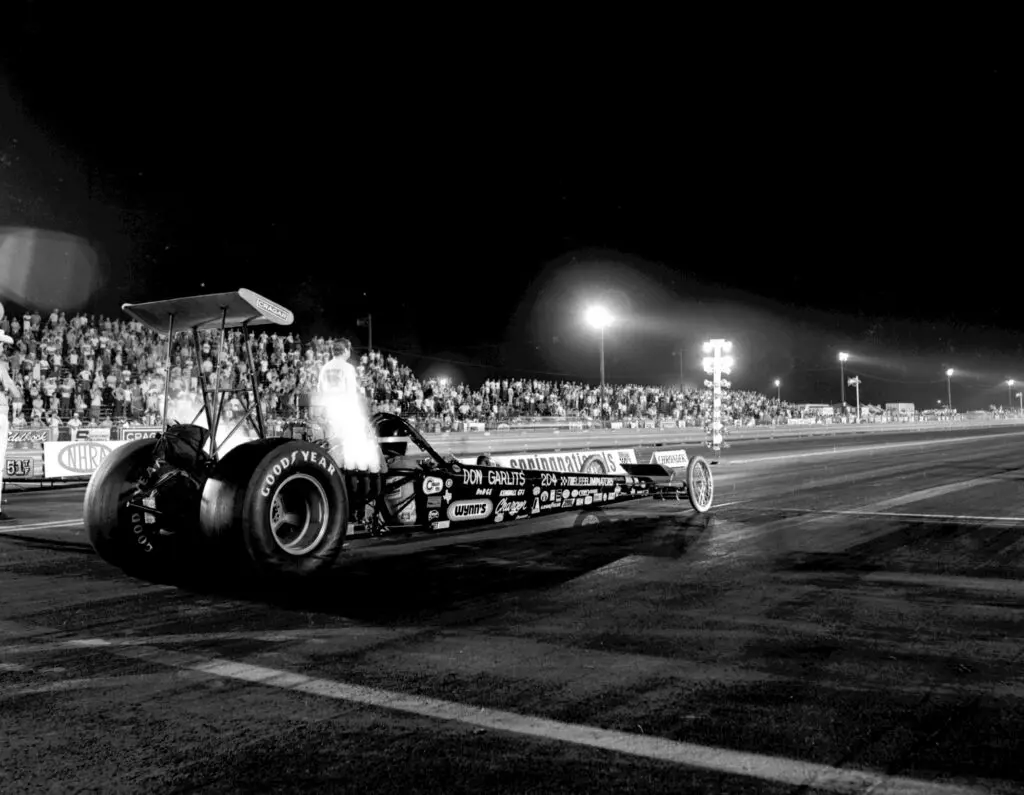

Don Garlits — known universally as “Big Daddy” — is the most consequential figure in the history of drag racing. Born January 14, 1932, in Tampa, Florida, he is 94 years old and still alive as of 2026. Over a career spanning five decades, Garlits won 144 national events and 17 world championships across the NHRA, AHRA, and IHRA. His three NHRA Top Fuel championships (1975, 1985, 1986) made him the first driver to win consecutive NHRA titles. He was the first drag racer to officially exceed 170, 180, 200, 240, 250, 260, and 270 mph from a standing start. His most transformative achievement came in 1971, when — recovering from the loss of half his right foot in a transmission explosion — he designed and debuted the rear-engine Top Fuel dragster, a configuration that became the universal standard within two years and has protected every Top Fuel driver since.
Don Garlits: Quick Reference
| Full name | Donald Glenn Garlits |
| Nickname | “Big Daddy” |
| Born | January 14, 1932 |
| Age (2026) | 94 |
| Birthplace | Tampa, Florida |
| Status | Retired from competition (2003); still active as ambassador |
| NHRA championships | 3 (1975, 1985, 1986) |
| IHRA championships | 4 |
| AHRA championships | 10 |
| Total championships | 17 |
| Total national event wins | 144 |
| NHRA national event wins | 35 |
| U.S. Nationals wins | 8 (all-time record) |
| NHRA Top 50 Drivers ranking | No. 1 (period 1951-2000) |
| Most famous achievement | Rear-engine Top Fuel dragster (1971) |
| Signature car series | Swamp Rat (30+ cars built) |
| Speed records | First official 170, 180, 200, 240, 250, 260, 270 mph passes |
| Museum | Don Garlits Museum of Drag Racing, Ocala, Florida (est. 1984) |
| Smithsonian | Swamp Rat XXX enshrined October 20, 1987 |
| Hall of Fame | NHRA; Intl Motorsports HOF (1989); Motorsports HOF of America; Automotive HOF; SEMA HOF (1980) |
Is Don Garlits Still Alive?
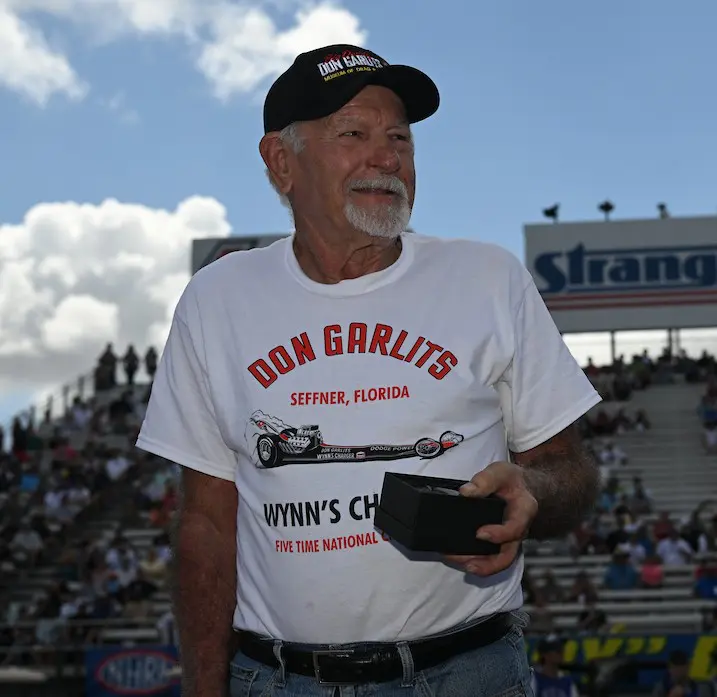
Yes. Don Garlits was born January 14, 1932, and is 94 years old as of 2026. He remains active as drag racing’s most prominent elder statesman — attending major NHRA events, advocating publicly for returning the sport to the quarter-mile distance, and continuing to operate the Don Garlits Museum of Drag Racing in Ocala, Florida, which he founded in 1984.
At the 2026 NHRA Gatornationals in Gainesville — the race he won five times during his career — Garlits appeared alongside Kenny Bernstein and Joe Amato as part of the NHRA’s 75th anniversary celebration. He used the occasion to make his clearest statement yet about the sport’s direction. “I want somebody in this room to tell me if it’s entertaining to watch something for three and a half seconds,” he told the assembled media. “Something has got to be done if we’re going to save the sport.” Garlits, now 94, still shows up. He still has opinions. And drag racing still listens.
Who Is Don Garlits?
Don Garlits is the figure most responsible for making Top Fuel drag racing what it is today — both as a competitive discipline and as a survivable one.
When Garlits began racing in the mid-1950s, Top Fuel was a sport where serious injury and death were accepted as the price of participation. Front-engine slingshot dragsters placed the driver directly behind a supercharged, nitromethane-burning engine that could — and frequently did — disintegrate without warning. Garlits raced these machines, won with them, and was nearly destroyed by one of them. His response to near-destruction was not retirement but reinvention.
He grew up in Tampa, Florida, in a family shaped by the Great Depression — an upbringing that instilled the practical engineering resourcefulness that defined his entire career. Mechanically inclined from childhood, he built his first race car under an oak tree at his North Tampa home in 1954. The car was assembled from specific components that illustrated both his resourcefulness and his engineering instinct: a 1927 Ford T roadster body, a 1948 Mercury engine block, a 1939 Ford floor-shift transmission, and a Ford rear differential. He was not a formally trained engineer. He was a mechanic who thought like one.
As CompetitionPlus.com documented in its Legends: The Series interview with Garlits, he learned how to drag race by growing up in a family affected by the Great Depression, carrying that banner into a male-dominated sport where resourcefulness and self-reliance were survival skills. The name “Big Daddy” arrived organically from the racing community — a recognition of stature that Garlits himself has never fully embraced. “I’m just me,” he says. The sport knows differently.
The Career: From Tampa Backyard to the Smithsonian
The Early Years (1954-1964)
Garlits won his first NHRA race in 1955 — in Lake City, Florida, piloting his flathead-powered roadster to a 12.1-second pass at 108 mph. He turned professional three years later and immediately established himself as the fastest man in the sport.
His speed record progression through the late 1950s and early 1960s reads like a systematic assault on what was thought possible:
| Year | Milestone | Speed / ET | Details |
|---|---|---|---|
| 1957 | First official 170 mph pass | 176.40 mph / ~8.78 sec | In Swamp Rat I |
| 1958 | First official 180 mph pass | 180+ mph | — |
| 1964 | First official 200 mph pass | 201.34 mph | Island Dragway, New Jersey (NHRA-sanctioned) |
| 1968 | First to 240 mph | 240+ mph | Swamp Rat 12 |
| 1975 | First official 250 mph pass | 250.69 mph / 5.63 sec | Ontario Motor Speedway |
| 1986 | First official 270 mph pass | 271.08 mph | NHRA record at the time |
A note on the early records: some speed claims from the 1950s and early 1960s are contested among historians due to unreliable timing equipment and occasional promoter pressure of the era. Garlits himself acknowledged that certain runs were not officially accepted until proper sanctioned timing was in place — a testament to his commitment to verified achievement.
Each barrier required not just raw power but corresponding advances in tire technology, aerodynamics, chassis engineering, and fuel chemistry. During this period Garlits accumulated championships across all three major American sanctioning bodies simultaneously — a cross-organization dominance no other driver has matched.
Championship Titles
| Sanctioning body | Championships |
|---|---|
| AHRA (American Hot Rod Association) | 10 |
| IHRA (International Hot Rod Association) | 4 |
| NHRA (National Hot Rod Association) | 3 |
| Total | 17 |
The Accident That Changed Everything (March 8, 1970)
On March 8, 1970, at Lions Drag Strip in Southern California, Don Garlits’ front-engine Swamp Rat XIII reached the end of its usefulness in the most violent way possible. In the final of the AHRA Grand American season opener, the transmission he had custom-built — the “Garlitsdrive,” assembled from Chrysler 727 Torqueflite parts — exploded. The blast severed half of Garlits’ right foot.
He was taken to Pacific Coast Hospital in Long Beach, California. From his hospital bed, Don Garlits began designing what would become the most important engineering innovation in drag racing history. The front-engine slingshot configuration placed the driver directly behind the engine — the most dangerous failure point on the car. As power outputs climbed through the 1960s, the layout became progressively more lethal. Garlits’ solution was elegant in concept and revolutionary in execution: move the engine behind the driver. Put him in front of the components that could kill him.
The Swamp Rat XIV and the Revolution (1971)
The rear-engine concept was not entirely new — earlier experiments by Woody Gilmore, Steve Swaja, Roger Lindwall, and Kent Fuller had attempted rear-engine configurations before Garlits. What Garlits did was categorically different: he made the first fully successful, safe, and competitive rear-engine Top Fuel dragster, then proved it by winning at the sport’s highest level in its very first major event appearance. The distinction between conceiving an idea and making it work so convincingly that everyone else abandons their current approach is the distinction that matters in engineering history.
Swamp Rat XIV debuted in January 1971 at Lions Drag Strip, then came to Pomona for the NHRA Winternationals. Working alongside longtime crew chief Connie Swingle, Garlits won the 1971 NHRA Winternationals in its debut over a full field of traditional front-engine cars. Within two years, every Top Fuel dragster had the engine behind the driver. By 1975, the front-engine slingshot was a museum piece.
The NHRA has ranked Garlits’ first rear-engine Top Fuel win as the No. 3 moment in the organization’s 75-year history. No single engineering decision by any individual driver has had a more lasting safety impact on the sport.
NHRA Championships (1975, 1985, 1986)
Garlits’ first NHRA Top Fuel championship arrived in 1975 at the NHRA World Finals, where he clinched the title at age 43. His relationship with the NHRA and founder Wally Parks was complicated throughout his career — a fact Garlits discussed candidly in his CompetitionPlus.com Legends: The Series interview, revealing both admiration for Parks’ vision and frustrations with the organization’s boundaries.
In 1985 and 1986, at ages 53 and 54, Garlits won back-to-back NHRA Top Fuel championships — becoming the first driver to win consecutive NHRA titles in any professional class. In 1986, Swamp Rat XXX set the NHRA Top Fuel speed record at 271.08 mph. The back-to-back titles at ages 53 and 54 have no parallel in professional drag racing history. No other driver has won a professional championship at that age in this sport.
U.S. Nationals Dominance
Garlits won the NHRA U.S. Nationals eight times — the all-time record for any driver in any class at the event. His Indianapolis wins span from 1964 (the first year Top Fuel competed at the event) through 1986, covering more than two decades of dominance at the sport’s most prestigious race.
Later Career Comebacks and the Electric Frontier
Garlits officially retired from nitro competition in 1992 after a detached retina suffered under heavy deceleration, then made multiple subsequent returns that demonstrated his competitive fire had never dimmed.
In 2003, at age 71, he ran over 323 mph in a Top Fuel car at the Gatornationals. In 2009, he competed in Stock Eliminator with a Dodge Challenger Drag Pak, including at the NHRA 4-Wide Nationals — where, characteristically, he corrected the media’s assumption that four-wide racing was new. “Now see, you’re not informed,” he told assembled reporters. “I raced a lot of 4-Wide. Not at this level, but Top Fuel.”
His most unexpected late-career chapter involved electric propulsion:
| Car | Year | Record | Age |
|---|---|---|---|
| Swamp Rat 37 | 2014 | 184.01 mph / 7.25-sec ET at Bradenton, FL | 82 |
| Swamp Rat 38 | 2019 | 189.03 mph quarter-mile record | 87 |
| Updated electric dragster | 2022 | Returned to competition | 90 |
The electric programs were not nostalgia projects. They were the continuation of a 70-year pattern: Don Garlits identifying the frontier and building his way to it.
The Swamp Rat Legacy
Over his career, Garlits hand-built more than 30 dragsters under the Swamp Rat name — a practice essentially unheard of at the top level of motorsport.
| Car | Year | Significance |
|---|---|---|
| Swamp Rat XIII | 1970 | Front-engine car; transmission explosion severed Garlits’ foot; inspired the rear-engine revolution |
| Swamp Rat XIV | 1971 | First successful rear-engine Top Fuel dragster; won 1971 NHRA Winternationals on debut |
| Swamp Rat XXX | 1986 | Set 271.08 mph NHRA record; 1986 championship car; enshrined in the Smithsonian in 1987 |
| Swamp Rat 37 | 2014 | Electric dragster; 184.01 mph / 7.25-sec ET at Bradenton Motorsports Park, FL |
| Swamp Rat 38 | 2019 | Electric dragster; 189.03 mph at age 87; 800-hp electric motor, ~1,500 lb chassis |
The Safety Legacy: What Every Modern Driver Owes Don Garlits
The rear-engine dragster is Garlits’ most consequential safety contribution, but not his only one. He was an early and vocal advocate for the full-body Nomex fire-resistant driving suit — complete suit, gloves, balaclava, and socks — at a time when many competitors dismissed fire protection as unnecessary. He pioneered the rear aerodynamic wing as a stability and safety tool. He experimented systematically with extended wheelbase geometry for predictability at high speed.
The modern Top Fuel dragster is dramatically safer than what drivers raced in the 1960s, and Don Garlits is more responsible for that improvement than any other individual in the sport’s history. As CompetitionPlus.com’s Bobby Bennett has written: Don Garlits didn’t just win Top Fuel championships — he redesigned the dragster itself, and every driver who has sat in a rear-engine machine since 1971 owes him their safety.
The Professional Racers Association
One of Garlits’ most overlooked contributions was organizational. He was a founding force behind the Professional Racers Association — a drivers’ collective that negotiated with sanctioning bodies to increase winners’ purses by as much as 300%. The PRA helped transform nitro racing from a sport where drivers essentially paid to compete into one where the top level was financially viable as a profession.
The Don Garlits Museum of Drag Racing
In 1984, Don Garlits opened the Don Garlits Museum of Drag Racing in Ocala, Florida at 13700 SW 16th Ave. The facility houses approximately 90 racing cars in the main drag racing building and over 50 antique vehicles in a companion building. Most of the Swamp Rat series cars are on permanent display, alongside memorabilia from across the sport’s history.
Open: Daily 9 AM-5 PM
Location: 13700 SW 16th Ave, Ocala, Florida (~70 miles north of Tampa)
Pet policy: Pet-friendly — pets welcome on leash or in stroller
The museum also houses the International Drag Racing Hall of Fame — the sport’s primary institutional archive. Garlits founded both.
Internal link: /museum-of-drag-racing-complete-guide-to-americas-premier-drag-racing-collections/
Don Garlits and the Quarter-Mile Debate
In the final chapter of his public life, Garlits has become the most prominent voice for returning Top Fuel and Funny Car to the quarter-mile distance — shortened to 1,000 feet in 2008 following Scott Kalitta’s death. At the 2026 Gatornationals, he was direct: “I want somebody in this room to tell me if it’s entertaining to watch something for three and a half seconds. Something has got to be done if we’re going to save the sport.”
Modern teams have indicated preference for the 1,000-foot format for cost and safety reasons. The NHRA has shown no indication of reverting. But Garlits makes the argument with the authority of the man who arguably made the quarter-mile survivable in the first place.
Clarifying the Record: Common Misconceptions
Garlits invented the rear-engine dragster — not quite
Earlier rear-engine experiments by Woody Gilmore, Steve Swaja, Roger Lindwall, and Kent Fuller preceded Swamp Rat XIV. What Garlits did was make the first fully successful, safe, and competitive rear-engine Top Fuel dragster — then proved it by winning in its first major event. The distinction between a concept and a proven race-winner that the entire sport adopts within two years is the distinction that matters. Garlits didn’t invent the idea. He made it work.
He retired after 1987 — not accurate
Garlits made multiple competitive returns after the 1987 blowover accident at the AHRA World Finals in Spokane: active again in 1991, returned in 1998, ran 323 mph at age 71 at the 2003 Gatornationals, competed in Stock Eliminator in 2009, and set electric dragster records as recently as 2019 at age 87.
Hall of Fame Recognitions
| Hall of Fame | Year inducted |
|---|---|
| SEMA Hall of Fame | 1980 |
| Motorsports Hall of Fame of America | 1989 |
| International Motorsports Hall of Fame | 1992 |
| Automotive Hall of Fame | — |
| International Drag Racing Hall of Fame (founder) | Founding member |
| NHRA Hall of Fame | Founding class |
His Swamp Rat XXX was enshrined in the Smithsonian Institution’s National Museum of American History in 1987 — the first and only drag racing vehicle in the Smithsonian.
Don Garlits at 94: The Enduring Legacy
The sport Don Garlits entered in the mid-1950s was dangerous, disorganized, and dismissed. The sport he helped build is a professionally structured championship series, internationally televised, with safety standards that make the 1960s slingshot era seem incomprehensible in retrospect.
He built that change through engineering, advocacy, and the willingness to rebuild after the worst consequences of the sport’s risks had been visited on him personally. Half a foot. A career-long willingness to show up anyway.
As CompetitionPlus.com documented in its primary-source coverage: “Most every drag racing fan will proclaim ‘Big Daddy’ Don Garlits as the greatest drag racer who ever strapped himself into a dragster. But mention it to Garlits, and he will say he never liked being branded this. Instead, he offers, ‘I’m just me.'”
The sport knows differently. Every driver sitting in front of a rear-mounted engine, in every Top Fuel dragster that has ever run since 1973, knows differently. The safety standard Garlits built with his own hands out of necessity has outlasted every championship he won, every record he set, every speed barrier he broke. It will outlast him. It already belongs to the sport permanently.
Frequently Asked Questions
Is Don Garlits still alive?
Yes. Born January 14, 1932, Don Garlits is 94 years old as of 2026 and remains active as a racing ambassador and museum operator.
How old is Don Garlits?
94 years old, born January 14, 1932, in Tampa, Florida.
What is Don Garlits’ nickname?
“Big Daddy” — given by the racing community; Garlits himself deflects it with “I’m just me.”
How many championships did Don Garlits win?
17 total: 3 NHRA Top Fuel (1975, 1985, 1986), 4 IHRA, and 10 AHRA.
How many races did Don Garlits win?
144 national events total, including 35 NHRA victories and 8 wins at the NHRA U.S. Nationals — an all-time record.
What did Don Garlits invent?
He perfected the rear-engine Top Fuel dragster — making the first fully competitive and safe version, debuted as Swamp Rat XIV in 1971. Earlier rear-engine experiments existed, but Garlits was first to make the design work convincingly at the highest level of competition.
Why did Don Garlits build a rear-engine dragster?
After a transmission explosion in Swamp Rat XIII on March 8, 1970 at Lions Drag Strip severed half of his right foot, Garlits designed a new configuration protecting the driver from the engine’s failure points. He conceptualized the car from his hospital bed.
What is a Swamp Rat?
The name of Garlits’ personal series of dragsters — 30+ cars built over his career, referencing his Florida roots. The most famous, Swamp Rat XXX, is in the Smithsonian.
Where is the Don Garlits Museum of Drag Racing?
13700 SW 16th Ave, Ocala, Florida. Open daily 9 AM-5 PM. Pet-friendly. Houses approximately 140 vehicles including most Swamp Rat cars and the International Drag Racing Hall of Fame.
Is Don Garlits’ car in the Smithsonian?
Yes. Swamp Rat XXX — championship car and 271.08 mph record-setter — was enshrined at the Smithsonian’s National Museum of American History on October 20, 1987.
















SUSAN WADE: THREE KEY TOPICS NHRA MIGHT USE TO GROW DRAG RACING FAN BASE