

by Andrew Wolf

Blackbird Performance has earned its reputation by wringing record-setting performance from the Gen III HEMI platform in Factory Stock Showdown and Factory X competition. Yet company founder Geoff Turk knew that the architecture’s potential went far beyond elite, high-budget drag racing. His Race Spec engine program, such as the 6.4-liter (392 cubic-inch) naturally aspirated package, was conceived to make professional-grade HEMI performance attainable for the grassroots racer. “We wanted to keep it simple, reliable, durable, and very consistent—all the things that matter to bracket racers,” Turk explains. “And we wanted to keep it at a very competitive price point.”


The Race Spec 700 is part of a line of naturally aspirated engines that begins with the 600-horsepower pump-gas version and extends upward through 700, 800, and 900-horsepower variants. Beyond those sit supercharged Race Spec 1300, 1500, and 1700 packages. But the 700 is a standout offering, bridging entry-level affordability and durability with a power output that nestles into a sweet spot for many weekend warrior bracket racers. Its foundation is the production 6.4-liter BGE block, the same iron casting used in Hellcat, Redeye, and TRX applications. “That basic block is capable of supporting 1,500 horsepower, routinely,” Turk notes. “You get a 1,500-horsepower block, a 1,500-horsepower crank, and heads that, with a little bit of work, will support up to 1,700 horsepower. There aren’t many other factory platforms you can say that about.”


Turk’s assertion rests on physics, not brand loyalty. “I’ve worked on every platform, including the LS and the Coyote, and objectively, based on measured data, the Gen 3 HEMI just has a lot of inherent strengths. It’s like an LS in that it’s a two-valve, pushrod, cam-in-block engine, but it is better in almost every way.”


Those advantages begin with geometry. The hemispherical chamber’s valve layout allows straighter airflow paths and larger valves than any wedge-style head. “If you’re an air molecule, in a wedge head you run in one door, turn right, and run out another. In a HEMI, you fall in one side and run straight out the other. It’s just better physics,” Turk explains. Two spark plugs per cylinder accelerate combustion, allowing ignition timing six to eight degrees later than an LS without detonation. “The quicker you can make that burn happen right where optimum crank angle is, the more effective the cycle. It’s like lighting a bonfire with two torches from two sides instead of one torch in the middle.”


From a structural standpoint, the deep-skirt, cross-bolted main design ties the crankcase together with exceptional rigidity, while the likewise overbuilt forged factory crankshaft routinely survives well past 1,500 horsepower. Blackbird capitalizes on those OEM strengths rather than replacing them. “You’re not going to find another production block and crank that can take that abuse right out of the box,” Turk says.

 

Building the 700 starts with those OE components, then layers in forged connecting rods and pistons to raise compression above 12:1 (from the already-solid stock 11:1). The cast aluminum cylinder heads receive CNC machine work developed by Blackbird and BES Racing Engines, a precision valve job that helps at low lifts with blended bowls, and PSI 1515 beehive springs with titanium retainers. “We take the stock 6.4L head, which already flows exceptionally, and just clean it up where it matters most. The result supports over 700 horsepower naturally aspirated,” Turk explains.


The valvetrain remains largely factory: stock rocker shafts and arms, the same parts Blackbird runs all the way up to 8,000 rpm in hydraulic-cam combinations up to 1,500 horsepower. “As long as you stay hydraulic, you’ll never need any other valvetrain stuff at all,” Turk stresses. “People add hardware for stability, but the reality is you don’t need it. Those stock rocker arms are light, strong, and proven.”


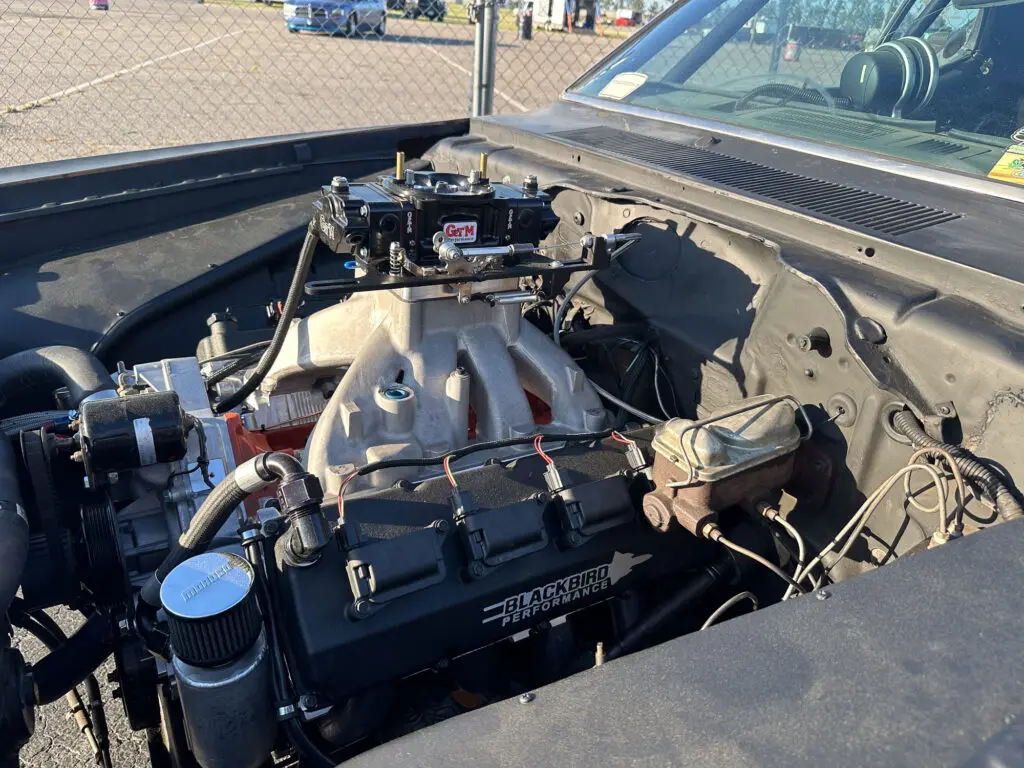
On top sits a single four-barrel 4150-flange intake manifold and carburetor. The Race Spec 700 package as-tested makes roughly 715 horsepower, whether fed by gasoline, E85, or methanol. Bracket racer Mark Dudley, Jr.’s ’73 Duster served as the test mule for the combination; that car replaced a cast-iron-headed small-block Mopar that had run 10.50 seconds; with the 700 installed, it produced consistent 6.0’s to 6.20s in the 1/8-mile and 9.50-second 1/4-mile passes. “That engine now has over 320 passes this season,” Turk reports. “Zero failures, zero issues. He’s changed the oil once and still has the same plugs in it. It’s one of the most deadly consistent cars he’s ever owned, and he double enters it in two classes, so it’s making back-to-back-to-back runs all day.”


The simplicity of maintenance and repeatability were deliberate design targets. “Bracket racers care about consistency,” Turk explains. “They don’t want to chase tune-ups or spend money every 20 runs. So we built it from parts that are readily available, proven, and affordable to replace if anything ever happens.”


Ignition control is handled by Blackbird’s own Afterburner system, included with every carb-to-pan engine package. It uses the stock dual-plug coils, identical components to those firing Blackbird’s 1,700-horsepower Top Dragster-style engine, and is plug-and-play for racers unfamiliar with EFI. “The night that Duster was getting fired up, Mark texted me at 12:45 a.m. with a video. He had never had any electronics in the car. He said it took 15 minutes to hook up the ignition system and it fired right up.” The Afterburner controller, which sells separately for $749, comes bundled with the Race Spec 700’s base price. The packages are configurable with an EFI conversion that includes injectors, fuel rails, throttle body, and a calibrated control unit.


On race gasoline the engine reaches the same peak power as its methanol counterpart (it can also be configured with an E85 carburetor), but the alcohol variant gains torque down low and has better thermal stability. Says Turk: “For bracket racing, methanol is wonderful. Mark buys a 55-gallon drum for two bucks a gallon, adds top lube, and treats it like race gas all year. He doesn’t drain it, doesn’t have a vacuum pump, and the oil doesn’t dilute. He’s got 130-plus passes on the same oil.”


Compared with the entry-level Race Spec 600, the 700 uses the forged rotating assembly, higher compression, taller manifold, and a more aggressive hydraulic camshaft. The 600 retains the stock hypereutectic pistons and PM rods, remains 11:1 compression, and runs happily on pump gas. The 800 and 900 builds step up camshaft and airflow again, but all share the same fundamental architecture. Every engine is assembled exclusively from new components—no used or remanufactured cores—and each includes the control system in the price. “When you compare true new-part, carb-to-pan packages across LS, Coyote, or Gen III platforms, these are the lowest price-per-horsepower engines you can find,” Turk asserts.


That cost efficiency and longevity is a result of smart engineering and careful component sourcing decisions. “None of this stuff is made in China,” Turk says proudly. “The timing gears are from Italy because we couldn’t find a U.S. source, but the rest is American-made. The factory components come from Stellantis’ global supply chain—blocks, cranks, heads—but all are high-precision, OEM-quality parts.” Even the billet timing-gear and chain set, unique to Blackbird Performance, replaces the factory cam phaser and allows accurate degreeing, something the Gen III market previously lacked. “Before we did it, there was no aftermarket solution, you just had to lock out the phaser. Now we’ve got a true billet adjustable set,” Turk says.


Turk also highlights the inherent value in the factory valvetrain and fasteners. “The 6.4-liter passenger-car valves (or the Hellcat valves) are hollow-stem, high-strength, lightweight pieces, about as close as you can get to titanium without being titanium. That’s part of why these engines can run 8,000 rpm with hydraulic cams and moderate spring pressures. If you start with a truck head, you swap in the hollow-stem intakes, and we do that automatically on our race-prepped heads,” Turk explains.


By combining that careful parts selection with minimal aftermarket complexity, the Race Spec 700 achieves a rare balance of OEM reliability and race-engine performance. The complete assembly weighs similar to an LS with comparable components yet delivers significantly greater airflow and combustion efficiency. For a bracket racer moving from an aging small-block or big-block Mopar, the transformation is dramatic: instant throttle response, repeatable elapsed times, and durability measured in hundreds of runs. “It’s the same philosophy that made our Factory X and Showdown engines successful, just scaled down into a package that’s perfect for the guy who wants to go rounds every weekend without spending thousands on maintenance.”


As more examples reach tracks around the country, the platform’s reputation continues to spread. The Plymouth Duster test-bed has already logged more than a dozen final-round appearances this season without fault, proving that the combination delivers in every way. In Turk’s words, “You can take out a worked-over small-block, drop this in, and go plenty quick and fast, with fewer moving parts, less tuning, and a lot more confidence.”


For decades, Mopar racers lacked a turnkey, affordable, high-performance bracket motor equivalent to the LS or Coyote crate options (or even the standard-fare small- and big-block Chevrolets). Blackbird Performance’s Race Spec lineup fills that void while showing why the very design of the Gen III HEMI platform deserves much wider adoption. By leveraging the semi-race-spec OEM engineering rather than fighting it, Blackbird Performance has built a package that is as common sense a win from an engineering perspective as it is potent. It’s an engine that proves the modern HEMI’s advantages aren’t only theoretical, but are measurable from the dyno room to the dragstrip.


Share the Insights?

Click here to share the article.

ad space x ad space

ad space x ad space

Competition Plus Team

Since our inception, we have been passionately dedicated to delivering the most accurate, timely, and compelling content in the world of drag racing. Our readers depend on us for the latest news, in-depth features, expert analysis, and exclusive interviews that connect you to the sport’s pulse.

Sign up for our newsletters and email list.

This field is for validation purposes and should be left unchanged.
Name

BLACKBIRD PERFORMANCE RACE SPEC 700: A MODERN N/A HEMI BUILT FOR BRACKET RACERS

by Andrew Wolf

Blackbird Performance has earned its reputation by wringing record-setting performance from the Gen III HEMI platform in Factory Stock Showdown and Factory X competition. Yet company founder Geoff Turk knew that the architecture’s potential went far beyond elite, high-budget drag racing. His Race Spec engine program, such as the 6.4-liter (392 cubic-inch) naturally aspirated package, was conceived to make professional-grade HEMI performance attainable for the grassroots racer. “We wanted to keep it simple, reliable, durable, and very consistent—all the things that matter to bracket racers,” Turk explains. “And we wanted to keep it at a very competitive price point.”


The Race Spec 700 is part of a line of naturally aspirated engines that begins with the 600-horsepower pump-gas version and extends upward through 700, 800, and 900-horsepower variants. Beyond those sit supercharged Race Spec 1300, 1500, and 1700 packages. But the 700 is a standout offering, bridging entry-level affordability and durability with a power output that nestles into a sweet spot for many weekend warrior bracket racers. Its foundation is the production 6.4-liter BGE block, the same iron casting used in Hellcat, Redeye, and TRX applications. “That basic block is capable of supporting 1,500 horsepower, routinely,” Turk notes. “You get a 1,500-horsepower block, a 1,500-horsepower crank, and heads that, with a little bit of work, will support up to 1,700 horsepower. There aren’t many other factory platforms you can say that about.”


Turk’s assertion rests on physics, not brand loyalty. “I’ve worked on every platform, including the LS and the Coyote, and objectively, based on measured data, the Gen 3 HEMI just has a lot of inherent strengths. It’s like an LS in that it’s a two-valve, pushrod, cam-in-block engine, but it is better in almost every way.”


Those advantages begin with geometry. The hemispherical chamber’s valve layout allows straighter airflow paths and larger valves than any wedge-style head. “If you’re an air molecule, in a wedge head you run in one door, turn right, and run out another. In a HEMI, you fall in one side and run straight out the other. It’s just better physics,” Turk explains. Two spark plugs per cylinder accelerate combustion, allowing ignition timing six to eight degrees later than an LS without detonation. “The quicker you can make that burn happen right where optimum crank angle is, the more effective the cycle. It’s like lighting a bonfire with two torches from two sides instead of one torch in the middle.”


From a structural standpoint, the deep-skirt, cross-bolted main design ties the crankcase together with exceptional rigidity, while the likewise overbuilt forged factory crankshaft routinely survives well past 1,500 horsepower. Blackbird capitalizes on those OEM strengths rather than replacing them. “You’re not going to find another production block and crank that can take that abuse right out of the box,” Turk says.


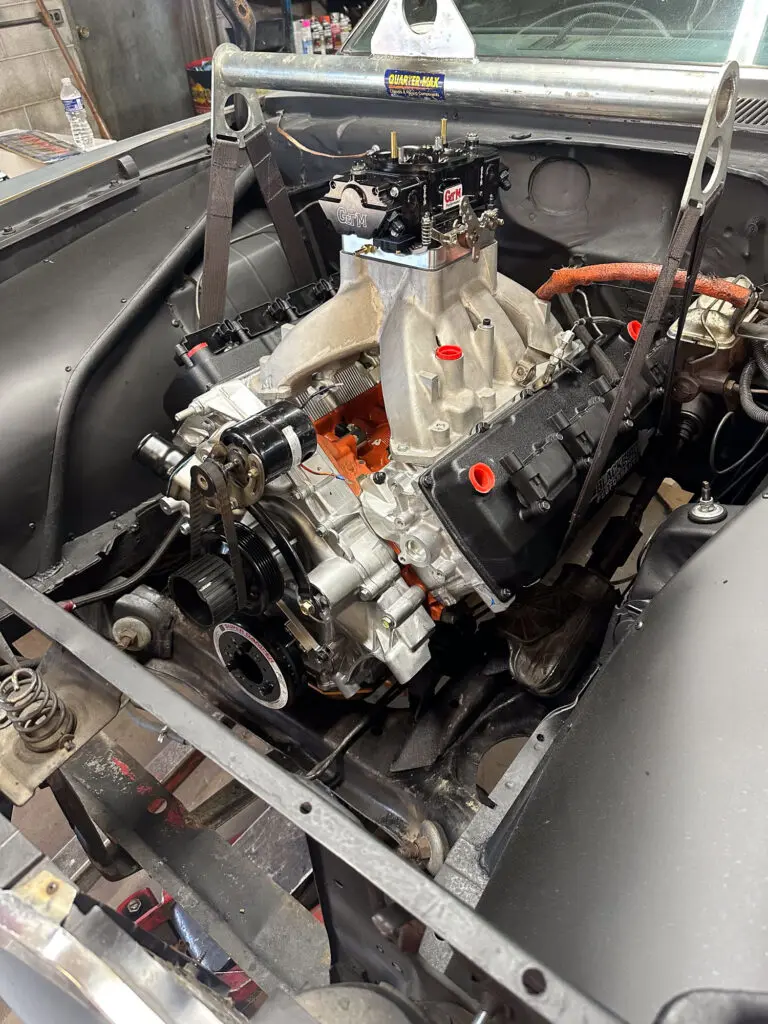
Building the 700 starts with those OE components, then layers in forged connecting rods and pistons to raise compression above 12:1 (from the already-solid stock 11:1). The cast aluminum cylinder heads receive CNC machine work developed by Blackbird and BES Racing Engines, a precision valve job that helps at low lifts with blended bowls, and PSI 1515 beehive springs with titanium retainers. “We take the stock 6.4L head, which already flows exceptionally, and just clean it up where it matters most. The result supports over 700 horsepower naturally aspirated,” Turk explains.


The valvetrain remains largely factory: stock rocker shafts and arms, the same parts Blackbird runs all the way up to 8,000 rpm in hydraulic-cam combinations up to 1,500 horsepower. “As long as you stay hydraulic, you’ll never need any other valvetrain stuff at all,” Turk stresses. “People add hardware for stability, but the reality is you don’t need it. Those stock rocker arms are light, strong, and proven.”


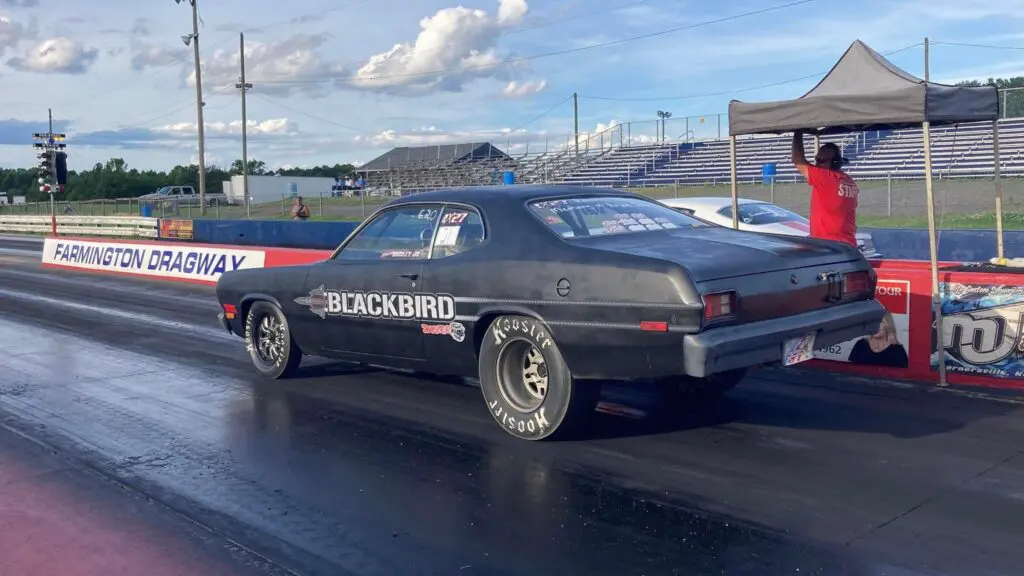
On top sits a single four-barrel 4150-flange intake manifold and carburetor. The Race Spec 700 package as-tested makes roughly 715 horsepower, whether fed by gasoline, E85, or methanol. Bracket racer Mark Dudley, Jr.’s ’73 Duster served as the test mule for the combination; that car replaced a cast-iron-headed small-block Mopar that had run 10.50 seconds; with the 700 installed, it produced consistent 6.0’s to 6.20s in the 1/8-mile and 9.50-second 1/4-mile passes. “That engine now has over 320 passes this season,” Turk reports. “Zero failures, zero issues. He’s changed the oil once and still has the same plugs in it. It’s one of the most deadly consistent cars he’s ever owned, and he double enters it in two classes, so it’s making back-to-back-to-back runs all day.”


The simplicity of maintenance and repeatability were deliberate design targets. “Bracket racers care about consistency,” Turk explains. “They don’t want to chase tune-ups or spend money every 20 runs. So we built it from parts that are readily available, proven, and affordable to replace if anything ever happens.”


Ignition control is handled by Blackbird’s own Afterburner system, included with every carb-to-pan engine package. It uses the stock dual-plug coils, identical components to those firing Blackbird’s 1,700-horsepower Top Dragster-style engine, and is plug-and-play for racers unfamiliar with EFI. “The night that Duster was getting fired up, Mark texted me at 12:45 a.m. with a video. He had never had any electronics in the car. He said it took 15 minutes to hook up the ignition system and it fired right up.” The Afterburner controller, which sells separately for $749, comes bundled with the Race Spec 700’s base price. The packages are configurable with an EFI conversion that includes injectors, fuel rails, throttle body, and a calibrated control unit.

 

On race gasoline the engine reaches the same peak power as its methanol counterpart (it can also be configured with an E85 carburetor), but the alcohol variant gains torque down low and has better thermal stability. Says Turk: “For bracket racing, methanol is wonderful. Mark buys a 55-gallon drum for two bucks a gallon, adds top lube, and treats it like race gas all year. He doesn’t drain it, doesn’t have a vacuum pump, and the oil doesn’t dilute. He’s got 130-plus passes on the same oil.”


Compared with the entry-level Race Spec 600, the 700 uses the forged rotating assembly, higher compression, taller manifold, and a more aggressive hydraulic camshaft. The 600 retains the stock hypereutectic pistons and PM rods, remains 11:1 compression, and runs happily on pump gas. The 800 and 900 builds step up camshaft and airflow again, but all share the same fundamental architecture. Every engine is assembled exclusively from new components—no used or remanufactured cores—and each includes the control system in the price. “When you compare true new-part, carb-to-pan packages across LS, Coyote, or Gen III platforms, these are the lowest price-per-horsepower engines you can find,” Turk asserts.


That cost efficiency and longevity is a result of smart engineering and careful component sourcing decisions. “None of this stuff is made in China,” Turk says proudly. “The timing gears are from Italy because we couldn’t find a U.S. source, but the rest is American-made. The factory components come from Stellantis’ global supply chain—blocks, cranks, heads—but all are high-precision, OEM-quality parts.” Even the billet timing-gear and chain set, unique to Blackbird Performance, replaces the factory cam phaser and allows accurate degreeing, something the Gen III market previously lacked. “Before we did it, there was no aftermarket solution, you just had to lock out the phaser. Now we’ve got a true billet adjustable set,” Turk says.


Turk also highlights the inherent value in the factory valvetrain and fasteners. “The 6.4-liter passenger-car valves (or the Hellcat valves) are hollow-stem, high-strength, lightweight pieces, about as close as you can get to titanium without being titanium. That’s part of why these engines can run 8,000 rpm with hydraulic cams and moderate spring pressures. If you start with a truck head, you swap in the hollow-stem intakes, and we do that automatically on our race-prepped heads,” Turk explains.


By combining that careful parts selection with minimal aftermarket complexity, the Race Spec 700 achieves a rare balance of OEM reliability and race-engine performance. The complete assembly weighs similar to an LS with comparable components yet delivers significantly greater airflow and combustion efficiency. For a bracket racer moving from an aging small-block or big-block Mopar, the transformation is dramatic: instant throttle response, repeatable elapsed times, and durability measured in hundreds of runs. “It’s the same philosophy that made our Factory X and Showdown engines successful, just scaled down into a package that’s perfect for the guy who wants to go rounds every weekend without spending thousands on maintenance.”


As more examples reach tracks around the country, the platform’s reputation continues to spread. The Plymouth Duster test-bed has already logged more than a dozen final-round appearances this season without fault, proving that the combination delivers in every way. In Turk’s words, “You can take out a worked-over small-block, drop this in, and go plenty quick and fast, with fewer moving parts, less tuning, and a lot more confidence.”


For decades, Mopar racers lacked a turnkey, affordable, high-performance bracket motor equivalent to the LS or Coyote crate options (or even the standard-fare small- and big-block Chevrolets). Blackbird Performance’s Race Spec lineup fills that void while showing why the very design of the Gen III HEMI platform deserves much wider adoption. By leveraging the semi-race-spec OEM engineering rather than fighting it, Blackbird Performance has built a package that is as common sense a win from an engineering perspective as it is potent. It’s an engine that proves the modern HEMI’s advantages aren’t only theoretical, but are measurable from the dyno room to the dragstrip.

 

Picture of John Doe

John Doe

Lorem ipsum dolor sit amet consectetur adipiscing elit dolor

More Posts

Send Us A Message

Picture of Bobby Bennett
Bobby Bennett
Thank you for joining us on this journey. Your support and trust inspire us every day to deliver the best in drag racing journalism. We are excited about the future and look forward to continuing to serve you with the same dedication and passion that has defined CompetitionPlus.comfrom the very beginning.

Don’t miss these other exciting stories!

Explore more action packed posts on Competition Plus, where we dive into the latest in Drag Racing News. Discover a range of topics, from race coverage to in-depth interviews, to keep you informed and entertained.