


Photos courtesy of Total Venue Concepts

If a crew chief is the key spoke in a wheel for a race team, a traction specialist would hold the same role for a national event facility. And when it comes to preparing a race track for high-horsepower vehicles, the process is an art.
Kurt Johnson, the driving force behind Total Venue Concepts, in many drag racing circles is considered a Picasso of sorts.
Drivers get the trophies. Crew chiefs get the credit for finding horsepower. Team owners get their pictures taken in the winner’s circle. None of it means much if the race track can’t hold what those race cars are trying to do.
That’s where Johnson has built a reputation that stretches from national event facilities to independent drag strips across the country. His name might not be familiar to every fan, but many of the quickest runs made over the last decade have taken place on surfaces he helped build, improve or maintain.
The best compliment a traction specialist can receive is often silence. When a race track performs as expected, nobody talks about the preparation. The conversation shifts to elapsed times, reaction times and championship points.
When a race track struggles, everyone suddenly becomes a track-prep expert.
“It’s kind of one of those things not a lot of people do and we’re pretty good at it and I like crafting the art,” Johnson said. “I mean, it has become kind of a scientific art and we find little things here and there, typically by mistake, and find out it works and we add that to the formula.”
Johnson’s description isn’t marketing language. It’s how he views the job. Most people see concrete, rubber and traction compound. Johnson sees a long list of variables that can either help a race car make a clean run or send it into tire shake before it reaches half-track.
It came from years of working race tracks, making mistakes, studying results and figuring out why one approach worked while another didn’t.

The obsession is evident when Johnson starts explaining the process. Many fans assume track preparation begins when traction compound touches the racing surface. Johnson sees it differently. Before glue ever comes into play, he wants to know whether the surface is flat, whether it has the proper texture and whether contamination has been removed.
The first step is determining whether the race track itself is contributing to problems.
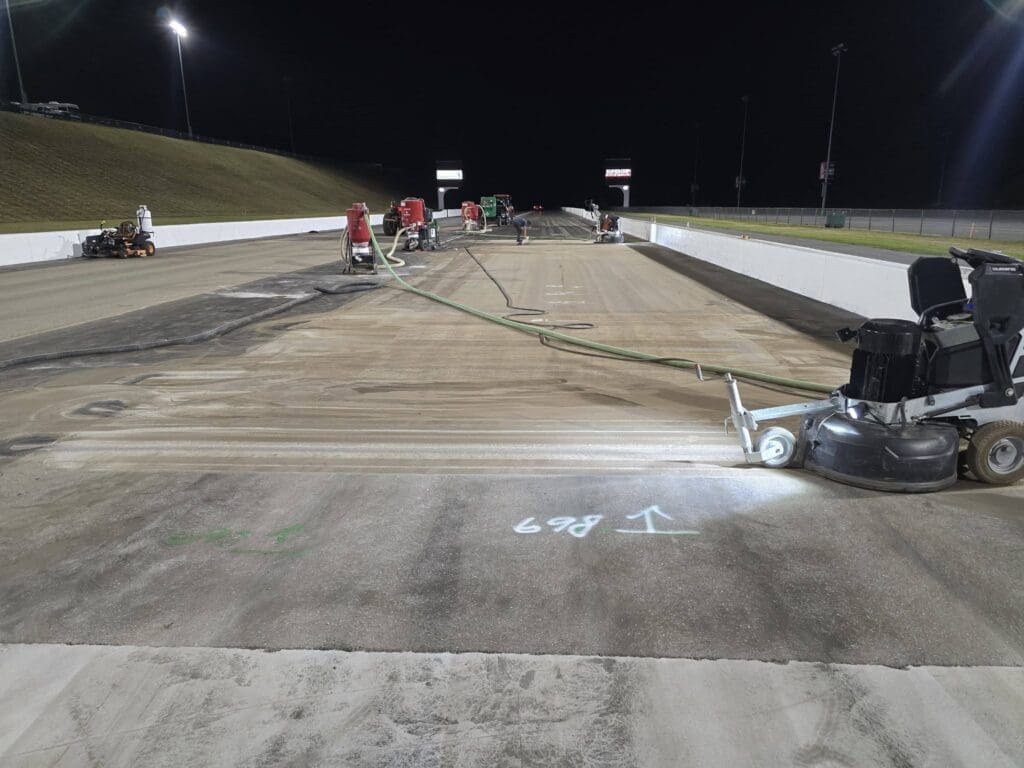
“Well, the first thing we’re going to do is use a profile graph machine and we’re going to measure the bumpiness, see how bumpy it is, see if that’s what’s upsetting the cars,” Johnson explained. “And if that’s the case where it’s too bumpy, we come in and we profile grind it with a big machine that makes it flat and uses just basic geometry to flatten a racetrack.”
Once the surface is flat, attention turns to texture.
“So then once we get it flat, we got to have a good texture on it,” Johnson said. “And so we come back in with rotary machines, rotary grinders, and we grind it one more time and that gives it texture, teeth for the rubber to hook to.”
Johnson talks about scraping with the same seriousness some crew chiefs reserve for cylinder heads, clutch settings and ignition timing.
“If that’s not needed, let’s say it’s a flat track and it seems to adhere pretty good, we’re just going to come in and we’re going to scrape it bare, because scraping is one of the most important things you can do,” Johnson said. “It removes contaminants, removes the old rubber and gives you a nice even surface.”
It’s not glamorous work.
Nobody stands at the fence applauding a scraper or taking photos of a washing crew. Yet Johnson would argue that many races are influenced long before the engine fires. The goal is consistency.
“I’m sure you’ve been to tracks where you see little chunks of rubber missing here and there,” Johnson said. “It’s almost impossible to fill those in, you got to scrape it down to where everything is the same level so the tires can touch the concrete.”
After scraping comes washing. After washing comes static dragging, a process Johnson says continues cleaning the racing surface while moving rubber where it needs to be.
“Static drag just basically moves rubber from high spots to low spots,” Johnson explained. “At the same time, it puts a little bit of rubber down, but really more what it does is it just moves rubber from high spots to low spots.”
The process sounds simple until Johnson explains the science behind it.
“They call it a static drag, because that creates static electricity in the tires and the tires that hang off the back have an electrical charge in them and bits of dirt and rubber stick to the tires,” Johnson said.
Only after those steps are completed does traction compound become part of the equation.
Even then, Johnson rejects the idea that successful track preparation is simply spraying more glue than the next guy. His philosophy revolves around creating a unified surface rather than stacking layers on top of one another.
“Once we get a good base built and we haven’t put any traction compound on it yet, we’ll start spraying traction compound, probably 50%,” Johnson said.
The key piece of equipment is the rotator, a machine Johnson compares to a giant bread mixer.
“The rotator mixes it in like bread dough, so that the traction compound becomes part of the rubber,” Johnson said. “It’s not just sitting on top. You hear some people say we’re building layers, I’m not really trying to build layers, I’m trying to build a congealed surface that’s all one piece.”
That process repeats several times with varying concentrations of traction compound and methanol.
“It doesn’t take tons of glue,” Johnson said. “You just got to make the glue and rubber one piece on a clean surface. It’s like painting a car, if you try to build a racetrack on a dirty racetrack, it’s like painting a dirty car, you’re not going to have good results.”
The analogy works because Johnson views the racing surface differently than most people. He’s not trying to cover problems but trying to eliminate them.

One statement from Johnson may explain more about modern drag racing than any dyno sheet or engineering report.
“No different than like a crew chief building a motor, we keep building these tracks better and better and better so they can put more and more power down and we’re creating our own future because the more track we give them, the more horsepower they can make and the more racetrack they expect.”
That observation speaks directly to where drag racing finds itself today.
For years racers complained there wasn’t enough race track for the horsepower being produced. Now many facilities are better prepared than ever, and engine builders have responded exactly as racers always do. They found more power. The relationship has become self-perpetuating.
Track specialists improve the surface. Crew chiefs become more aggressive. Horsepower increases. The expectations placed on the race track increase again.
Nobody involved is asking the other side to slow down. In many ways, Johnson isn’t just preparing race tracks. He’s helping determine how far performance can continue to advance.

Johnson’s journey into track preparation wasn’t planned. Many longtime racers remember him from his years in NHRA marketing before he eventually moved into facility management at Indianapolis Raceway Park.
“When I went to Indy Track, it was known for horrible track prep and I’m like, ‘How am I going to change this?'” Johnson recalled.
The search for answers led him to Jason Ruckert, who introduced him to many of the fundamentals that still influence Johnson’s approach today.
“Jason had understood the basics of track prep 20 years ago and he taught me those and I listened to them, used them,” Johnson said. “I just knew that we needed to make Indy, if we gave them traction, they would come.”
Johnson credits that period as the foundation for everything that followed.
“And once we kind of got a handle on it, that’s where I learned it, that’s where I started perfecting my form of traction track prep, that’s where it all started,” he said.
The next chapter came at Summit Motorsports Park in Norwalk, Ohio, a facility already known for producing strong racing surfaces and one where expectations were considerably higher.

“Norwalk’s always been known for good traction and I didn’t want to let him down,” Johnson said. “And I think we elevated even higher then.”
Johnson also credits Bill Bader Jr. for pushing him toward what eventually became Total Venue Concepts.
“He was like, ‘You need to be out doing this everywhere,'” Johnson said. “And he kind of gave me the kick in the butt to go do it.”
Years later, Johnson still talks less about accomplishments than improvements. He’s constantly thinking about better equipment, better procedures and more efficient ways to achieve the same result. That mindset also explains one thing he still struggles to tolerate.
“It’s difficult,” Johnson said of watching race tracks being prepped by others. “I mean, there’s times where I’m like, ‘God, if they just did this.'”
Johnson understands every facility faces challenges and every track crew is working with different circumstances.
What frustrates him isn’t failure. It’s complacency.
“But when they sit back on their laurels and, ‘This is the way we do it,’ oh, that frustrates the heck out of me.”























REYES ON TOUR: INVASION OF THE CHEVROLET VEGA — PART 1