
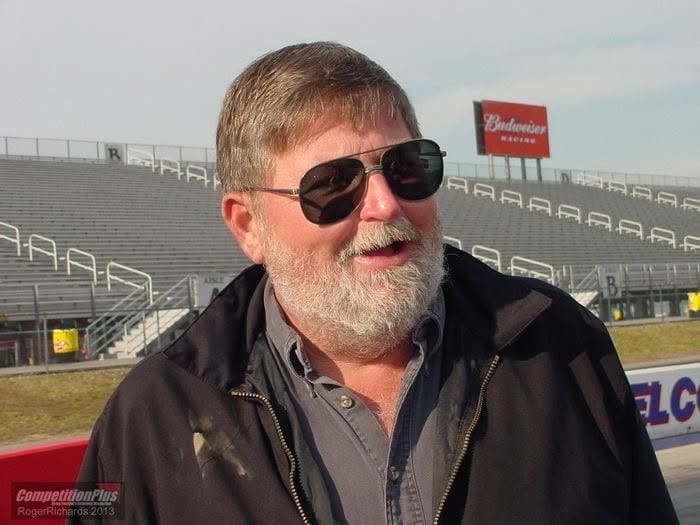

He was the man who learned how to prepare a dragstrip as well as anyone ever did.
A man who probably never received the full recognition he deserved because loyalty meant more to him than opportunity. His approach to track preparation made him one of the most sought-after specialists in drag racing, but the racers who admired him most will tell you his greatest accomplishment wasn’t the racing surfaces he built. It was the people he shaped along the way.
He carried himself like a 1950s Marine Corps drill instructor with the fairness of a sheriff’s deputy and the uncanny wit of the late Bill Bader Sr., the man who first entrusted him with the starting line at Norwalk Raceway Park before eventually bringing him to the IHRA. Jim “Big Jim” Weinert never worried about hurting your feelings because he believed honesty carried more value than diplomacy, and if you earned his respect, you had a friend for life.
“If I’m going into battle and I get to pick first, I pick Jim first,” Bill Bader Jr. said. “Jim was as tough and as honest and as hardworking and fierce and loyal as anyone I’d ever met.”
The cigar became part of the image, but it wasn’t what people remembered most. More than a decade after Weinert’s passing in 2012, racers still compare exceptional track preparation to the standard he established, while those fortunate enough to work beside him remember something much bigger than traction compound, rubber and horsepower.
Ask racers about Jim Weinert and sooner or later they’ll talk about a starting line that simply held better than anywhere else. Ask the people who worked alongside him and they’ll spend far more time talking about the man than the tracks he prepared.
He never considered himself an innovator. He wasn’t chasing recognition or trying to become drag racing’s foremost authority on track preparation. He simply wanted every racer, whether they were racing a Top Fuel dragster or a Sportsman car, to have the best racing surface he could possibly give them.
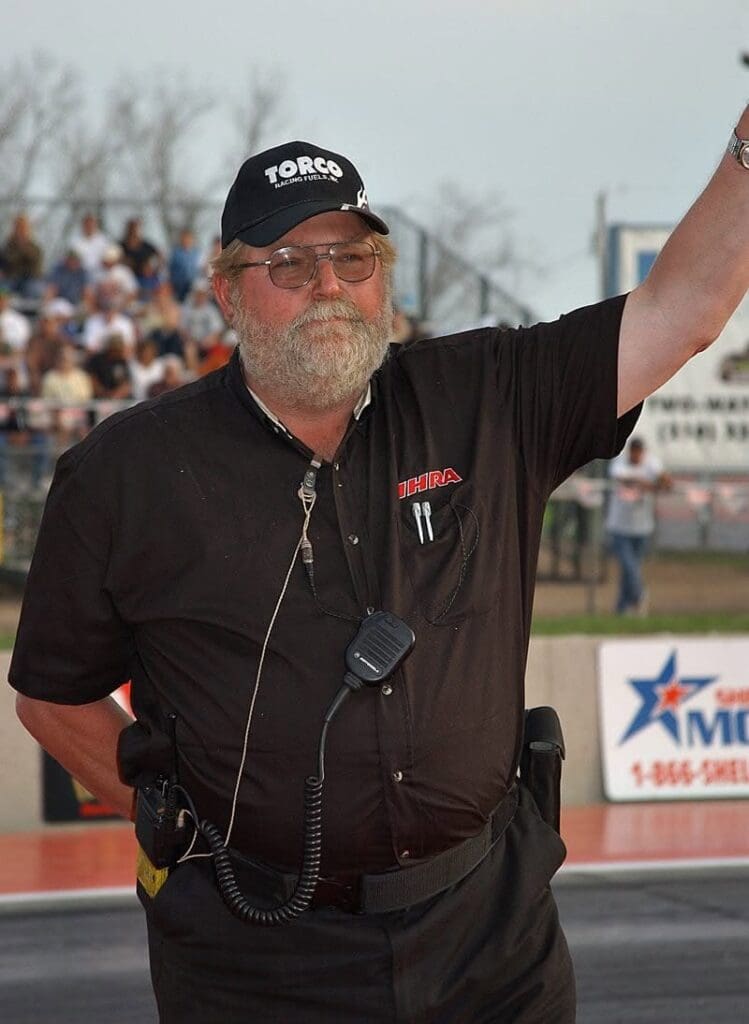
That mindset was created in Norwalk, where Weinert started on the track crew before moving into the maintenance department and eventually becoming maintenance manager. Working alongside Bill Bader Sr., he learned the craft through trial, error and an unwillingness to accept “good enough.”
“Jim learned that here,” Bader said. “Between he and my father, they kind of learned as they went.”
Before long, racers were noticing the difference.
Drivers didn’t always understand why a Weinert-prepared racing surface was different. They just knew when they rolled into the throttle, the car usually responded the way it was supposed to, thanks to the man standing near the starting line.
His reputation spread far beyond Ohio and eventually throughout drag racing, not because he worked at the biggest facilities but because he could arrive at almost any racetrack and leave it better than he found it. Tracks with tired surfaces, worn timing systems or limited equipment weren’t obstacles to Weinert. They were simply problems waiting to be solved.
For instance, during the organization’s memorable San Antonio event, where fresh asphalt was laid overnight before racing resumed, it was Weinert who transformed an unproven surface into one racers trusted within 24 hours. His confidence calmed the anxious drivers, and his preparation gave them a reason to believe the racetrack would do its job.
His work eventually attracted attention from throughout the industry.
When word spread that NHRA had made a run for Weinert, many expected him to accept what was widely viewed as a prestigious position in drag racing. The opportunity promised more money and a larger stage, but neither carried the same measure of loyalty he felt toward the people who had become his extended family.
For Weinert, loyalty was never an empty word. It was the only way he lived.
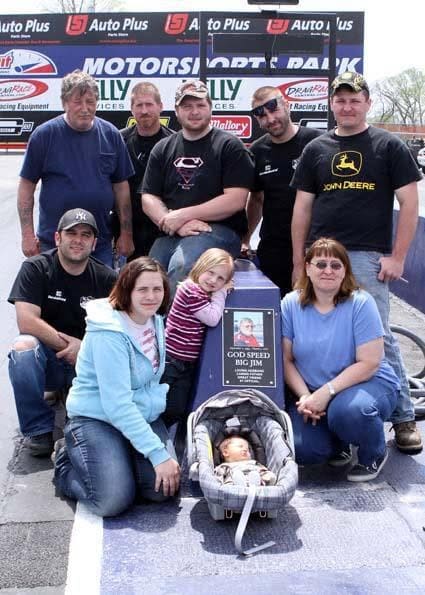
His wife, Carrie, and sons Matthew and Wes lived that life with him, growing up around race cars, tractors, sweepers and the endless miles that came with taking an IHRA national event from one racetrack to the next. Long before many racers came to think of Big Jim as family, Carrie, Matt and Wes were already sharing him with a sport that seemed to need him every weekend.
For many racers, the Weinerts eventually became more than another family they saw on weekends. They became part of their own.
Bobby Lagana Jr. understands that better than most because what began as a friendship through racing gradually became a relationship that reached well beyond the starting line. Long before he became a championship-winning crew chief, he found himself looking at Big Jim as a second father.
The relationship grew during some of the toughest years the Lagana family faced in racing. As they rebuilt after Bobby’s 1998 IHRA Empire Nationals crash and fought to keep their operation moving, Weinert was almost always there, not because anyone asked him to be, but because that’s who he was.
“Jim was just this big superhero-like figure that was always at the starting line,” Lagana said. “You knew that he’s the one that got the equipment there and he’s the one that put the tracks together.”
It didn’t take Lagana long to realize the starting line was only one small part of Weinert’s job.
“He would come to these tracks and help them rebuild timing systems, never complaining,” Lagana said. “It was always just go to the tracks and make them right so that we could bring an event there.”
The work rarely stopped there. If a truck broke down, Weinert grabbed his tools. If equipment failed, he fixed it. When the Laganas lost their transporter in a fire and needed somewhere to regroup, Weinert welcomed them to the Dellisanti Farm outside Norwalk, where IHRA stored much of its road equipment, and helped them build another place to work.
His relationship with the Lagana became one of give-and-take. The Laganas pitched in with track preparation while Weinert made sure they always had what they needed to keep racing, and before long, it stopped feeling like racers helping racers. It felt like family.
“We would go to the tracks early with Jim and actually help him with track preparation,” Lagana said. “It turned into a family-style atmosphere.”
That atmosphere extended to everyone around him.
Matt and Wes Weinert weren’t spectators growing up around drag racing. They were expected to work, just like everyone else, learning their father’s trade, one task at a time, until helping to prepare a race car or a racetrack simply became another day’s work.
“Wes went on the road with us,” Lagana said. “I mean, he was a 12-year-old kid doing a clutch on our car.”
The lessons Jim Weinert taught had very little to do with horsepower.
Every afternoon, no matter how much work remained, the crew stopped for lunch. There was one rule, and it wasn’t negotiable.
“There was always one check,” Lagana said. “It was never separate checks. That did not exist in his world.”
Years later, Lagana admits he still thinks about that lesson whenever a server asks how the bill should be divided.
“Jim was always like, ‘Hey, I’ll pay for lunch. You’ll pay for it when you can,'” Lagana said. “But there’s something magical to that statement. There’s something magical to that mentality that you’re out to lunch, you’re out to dinner with people that you care about and love so much.”
Looking back, Lagana believes those moments explained Weinert better than any perfectly prepared starting line ever could.
“He was absolutely a father to us,” Lagana said. “He taught us so many values. Our dad loved Jim and his family, and Jim was the same person.”
When Weinert died in 2012, the Laganas left Gainesville as quickly as they could. Missing a race no longer mattered as much as getting home to stand beside Carrie, Matt and Wes did.
“I mean, it was the same as losing your biological father,” Lagana said.
Kurt Johnson saw the same qualities through a different lens. He credits Weinert with shaping much of his own approach to track preparation, but says the biggest lesson had nothing to do with spray patterns or rubber buildup. It was about accountability.
“He really had a pretty big influence,” Johnson said. “As far as work ethic, it’s probably the biggest, right way or no way.”
Weinert’s delivery wasn’t always gentle, but Johnson says nobody questioned his motives because his actions always matched his words.
“Jim Weinert was a hardass that people respected because he did what he said he was going to do,” Johnson said. “He wasn’t always nice about the way he delivered what was coming.”

Johnson believes Weinert’s greatest strength was learning to make difficult racetracks better instead of simply maintaining good ones. Throughout the IHRA years, crews often arrived at facilities that demanded ingenuity, long hours and determination before the first pair could even think about making a pass.
“He ran hard, fast, lean,” Johnson said. “They would come into a track that maybe hadn’t been scraped for a month, or ever.”
Today’s track preparation relies on better equipment than Weinert had, improved products and decades of additional knowledge, but Johnson isn’t convinced the sport has produced another Weinert.
“I don’t know any young person that’s a Jim Weinert,” Johnson said. “Everybody’s too politically correct, and … Jim Weinert got s*** done.”
That may be the greatest compliment anyone could pay him.
Weinert built some of the best starting lines drag racing has ever known, but that isn’t why racers still tell his stories. They tell them because somewhere between the tractors, the timing systems, the burned trucks, the long lunches and the miles on the road, Big Jim built something that has outlasted every racing surface he ever prepared.
Somewhere along the way, without ever trying, he made racers better, crews better and friends better, too. More than a decade after his final race, that’s still the part people remember first.


















REYES ON TOUR: INVASION OF THE CHEVROLET VEGA — PART 1