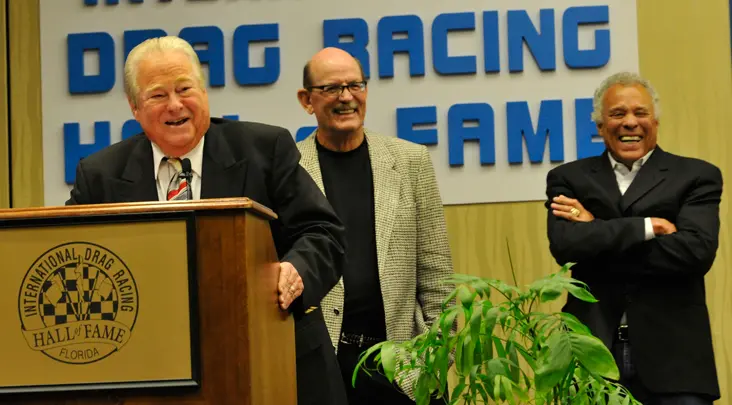

While a roast might be the one place where embellished stories are expected, Hall of Fame announcer Jon Lundberg stepped to the microphone at Bill Doner’s testimonial and delivered perhaps the truest description ever spoken about the promoter who transformed Seattle into drag racing’s midsummer capital.
God and the devil will have it out in some future time.
Some say it will happen here on earth.
Boy, we sure are prime.
Cosmic forces fry the cities.
Battles rage among the thickets.
But Armageddon just can’t take place unless Bill Doner sells the tickets.
The room erupted in laughter because everyone recognized the punchline. Those who knew Doner best also recognized it as the truth.
As the NHRA Mission Foods Drag Racing Series returns to Pacific Raceways this weekend, it’s impossible to separate the facility from the promoter who made Seattle one of drag racing’s most coveted destinations. Doner didn’t pour the concrete or design the quarter-mile, but he created an event so compelling that racers crossed a continent to compete and fans planned vacations around it.
Today, Pacific Raceways hosts one of the NHRA’s premier national events. During the 1970s and into the 1980s, however, Seattle became something entirely different under Doner’s direction.
Seattle was the place where Funny Car dreams were measured.
In a different day and time, long before promoters chased today’s world of digital impressions and social media engagement, Doner understood something that never changes in entertainment. Fans weren’t buying a ticket to watch qualifying. They were buying Monday morning bragging rights and the chance to tell friends what they had witnessed.
That philosophy became 64 Funny Cars, the independent spectacle that grew beyond a race and evolved into a cultural event. The idea sounded impossible when Doner first floated it, because gathering that many nitro Funny Cars in one place required convincing teams from California, the Midwest and the East Coast to tow thousands of miles into the Pacific Northwest.
Most people thought he had lost his mind. The late Jim Rockstad, who spent years documenting the event’s history, believed Doner’s greatest accomplishment wasn’t simply creating the largest Funny Car show drag racing had ever seen. It was changing the aspirations of an entire region.
“One man’s concept became his legacy,” Rockstad wrote. “Doner’s event changed the entire landscape of drag racing in the Northwest.”
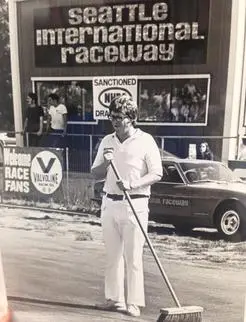
Seattle International Raceway, now Pacific Raceways, had struggled to establish an identity before Doner’s arrival. A former Southern California sportswriter, Doner first tried promoting road racing and quickly discovered the Northwest wasn’t responding the way he’d hoped.
He wasn’t discouraged. He simply looked for another audience. Nitro Funny Cars already possessed everything a promoter could ask for. They shook the ground, filled the air with nitromethane fumes, breathed fire after sunset and featured personalities every bit as colorful as the machines they drove.
Doner decided Seattle didn’t need another drag race. It needed a spectacle. More often than not, he backed up every outrageous promise.
“There is nothing in all of motorsports like nitro Funny Cars at night,” Doner often said, and he built an empire around that belief.
The first Seafair Funny Car Championships proved the concept. Fans packed the facility to witness something unlike anything else in motorsports, and Doner immediately started wondering whether success had made him think too small.
If 16 Funny Cars could fill the grandstands, why couldn’t 64? Most promoters would have stopped there because the logistics bordered on impossible. Doner looked at impossible the way most promoters looked at inconvenient.
The obstacle wasn’t finding enough Funny Cars. It was giving racers enough reasons to make the trip.
Instead of asking teams to tow across North America for one payday, Doner began assembling what Ed “The Ace” McCulloch would later call the original Western Swing. Portland became part of the equation, followed by races in Eugene, Yakima, Calgary, Edmonton and other stops, turning one event into a profitable tour through the Pacific Northwest.
“We talk about the Western Swing today; Doner is the one who invented the real Western Swing,” McCulloch recalled in an NHRA.com article written by Phil Burgess. “We would race from Eugene, Ore., Portland, Seattle, Yakima, Calgary, and Edmonton all in about 10 days. He didn’t own all of those tracks, but he booked the events. What I could make on those 10 days was my funding to get ready for the next year.”
Suddenly, Seattle wasn’t asking racers to travel thousands of miles for one race. It was asking them to become part of the biggest Funny Car tour drag racing had ever seen.
By the time the first Funny Car fired, Doner already had his audience exactly where he wanted them.
Doner carpet-bombed the local radio stations with commercials designed to convince fans they couldn’t afford to miss the event. His advertising didn’t just promote a race. It promised an experience unlike anything else in motorsports, and used catchy descriptions such as “ground-pounding” Funny Cars, a “fiberglass forest,” and generated enough spectacle to make Monday morning regret part of the sales pitch.
Time and time again, Doner delivered.
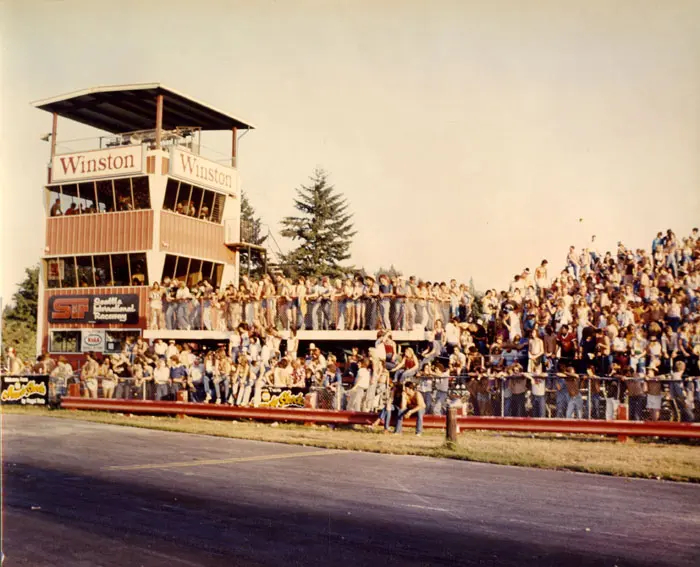
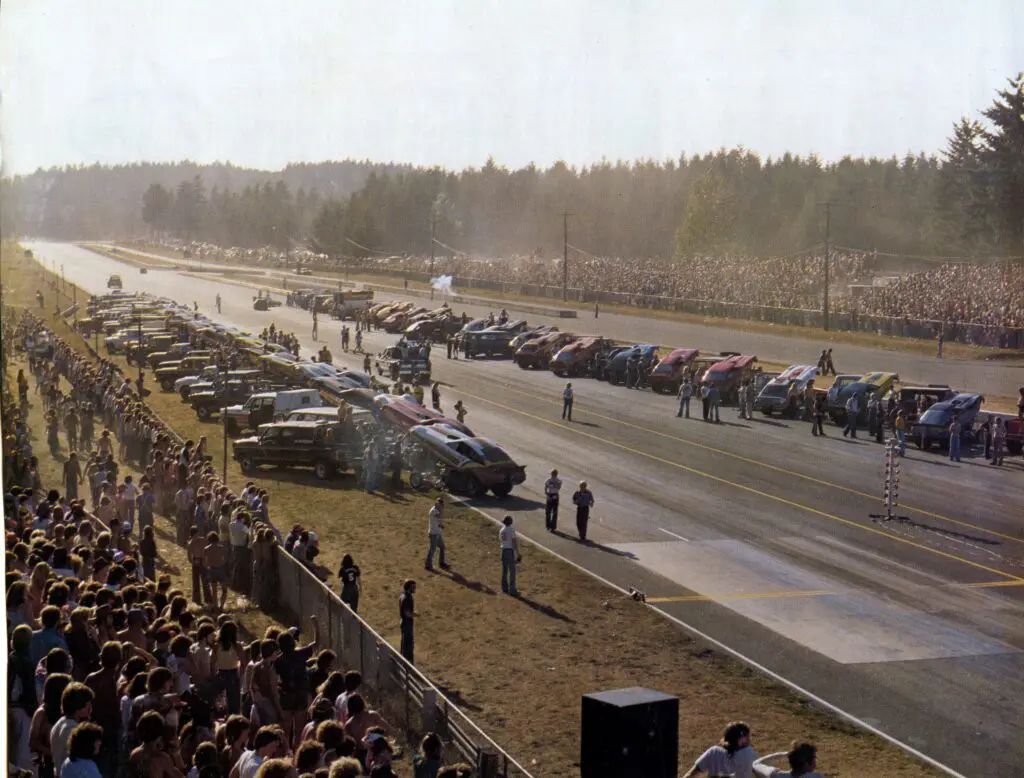
Long before the first pair rolled to the starting line, Seattle International Raceway looked more like a rock festival than a dragstrip. Two rows of Funny Cars stretched across the racing surface while thousands of fans packed every available grandstand and lined the fences, waiting for the moment that became as famous as the racing itself.
Gary Densham remembers the crowds being so thick they practically became part of the staging procedure.
“You could not see the racetrack,” Densham recalled. “As you rolled forward, it was just like a wave. It would part, you’d do the burnout, then it’d close up again. I had a guy reach in one time with a joint and say, ‘Hey, you want a hit before you go?'”
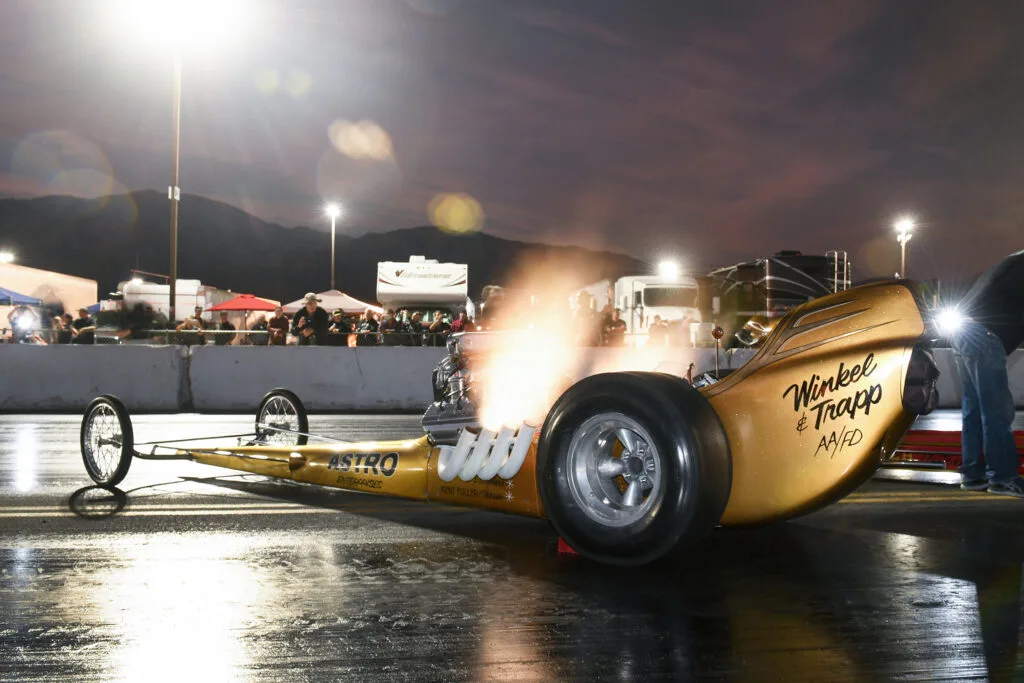
On Doner’s signal, all 64 engines roared to life. The simultaneous fire-up rattled the ground beneath spectators’ feet as nitromethane fumes drifted across the facility and header flames pierced the evening sky. Wheelstanders, jet dragsters and stunt performers filled every pause in the action because Doner refused to let the show slow down for even a moment.
“It was the start of 64 Funny Cars,” Densham recalled. “Nothing but Funny Cars and jets and wheelstanders ran until one or two o’clock in the morning. People would sit on the guardrail with their coolers and watch the cars go by.”
Before long, the racing was sharing top billing with the show itself. Doner never chased the race itself. He chased what people talked about on the drive home. He wanted their post event banter focused on synchronized fire-up, the eighth-mile burnouts, the smoke hanging over the racetrack and the feeling that every pass somehow had to top the one before it.
His promotional instincts bordered on outrageous. And, the word outrageous, was a conservative description.
One year it meant hiring adult film star Linda Lovelace to appear at the Northwest National Open, creating controversy that reached far beyond drag racing. When sponsors objected, Doner swung the pendulum completely the other direction the following season by inviting child television star Rodney Allen Rippy to sing “God Bless America” before eliminations.
“People ask me why I brought Linda Lovelace to Seattle,” Doner said years later. “I was pretty full of myself in those days, and I kind of did it on a dare.”
McCulloch laughed at the memory because with Doner, there was always another surprise waiting.
“He’d come running up and say, ‘Ace, I need you to do something,'” McCulloch remembered. “‘I need you to do a burnout down the return road when we fire the cars up and I’ll give you $500.’ I’d do a burnout down the return road. Was it safe? Was it smart? Probably not, but we got away with it. Those are the kinds of things Doner loved, anything to be a little bit different.”
That willingness to think differently extended far beyond Seattle.
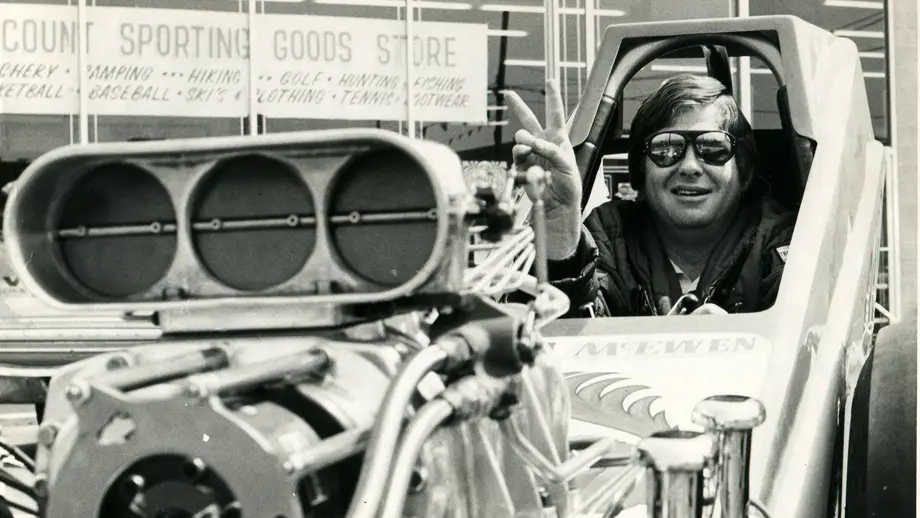
Doner wasn’t satisfied with attracting the biggest stars. He turned them into characters long before sports marketing became an industry. Don Prudhomme, Tom McEwen, Raymond Beadle, Jungle Jim Liberman, Ed McCulloch and dozens of others weren’t merely entered in the program.
“When guys came up to run, whether it be the Snake or the Mongoose, Jungle Jim or the Blue Max, we had storylines,” Doner explained. “We got the people involved. They came through with the commercials and the things leading up to the event. When they were over, it was magnificent.”
Hall of Fame announcer Dave McClelland once joked during the Bill Doner Roast that Doner’s career included everything from lawsuits to riots, describing him as “drag racing’s answer to Vlad the Impaler and Attila the Hun.” The humor reflected Doner’s reputation as someone who constantly pushed limits in pursuit of a bigger crowd.
Phil Burgess perhaps summarized Doner’s impact best.
Every Doner race became a spectacle. Jets, wheelstanders, motorcycle jumps and overflowing grandstands weren’t sideshows. They were part of a philosophy that believed a ticket buyer deserved more than a race. They deserved something worth talking about all winter.
More than four decades later, Pacific Raceways still hosts one of the NHRA’s signature events. The names have changed, the scoreboards are digital and the promotion now lives as much on phones as it once did on radio speakers.
Doner always insisted drag racing was entertainment before it was anything else.
“It’s a show,” Doner said. “That’s what it is. It’s a show. It’s an entertainment.”