
Nobody needed to tell an NHRA driver the Christmas tree at Martin was different. The time slips handled that job just fine.

Reaction times that normally would have raised eyebrows suddenly became common, and the red-lights followed. Before long, racers weren’t talking only about getting down U.S. 131 Motorsports Park; they were trying to figure out exactly what was happening before they ever left the starting line.

That would have been enough to get everyone’s attention at just about any race on the schedule. Having it happen at the opening race of the Countdown to the Championship made the timing considerably harder to ignore.

U.S. 131 Motorsports Park uses an AccuTime Christmas tree with an AccuTime timing system instead of the CompuLink combination NHRA professional racers were accustomed to seeing. The equipment wasn’t malfunctioning, but racers were about to discover that familiar settings plugged into different electronics didn’t necessarily produce familiar results.

“We were notified briefly before the event that the Accutime tree was going to be used in conjunction with the Accutime Timing System, which also entailed different pre-stage stage bulbs,” Top Fuel points leader Shawn Langdon said. “So we kind of took that as it was.”

Then the cars started making runs, and what had been little more than a technical footnote in the weekend information became impossible to overlook. Langdon had a pretty good idea what was coming because he’d already seen a version of it.

He raced at Martin about a month earlier during a bracket event and remembered the tree being quick. The difference was that a bracket racer has a delay box available to compensate, while a Top Fuel driver has his foot.

“In the bracket racing world, you just make the adjustments because you add delay to the delay box,” Langdon said. “So it’s really no big deal.”
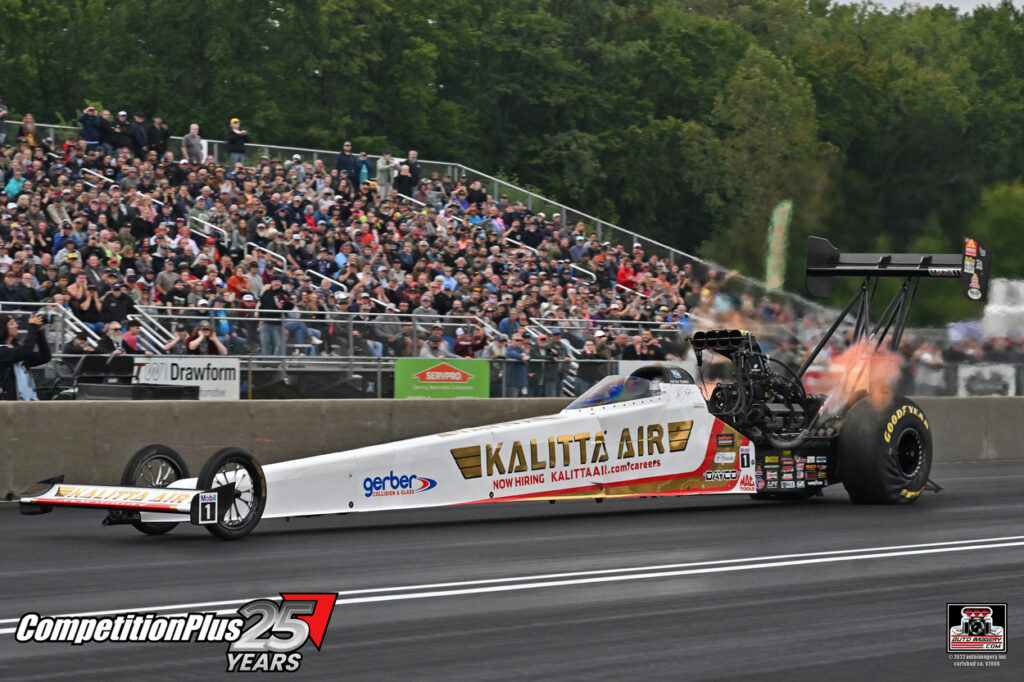

ShawnLangdon GreatLakesNationals 26 01

Langdon’s first NHRA qualifying run produced a .040 reaction time even though he didn’t believe he had hit the tree particularly well. His next was somewhere in the .020s, which removed whatever doubt remained.
The tree wasn’t just quick enough for somebody to complain about it. It was quick enough that the numbers were eventually going to make the argument for them.

There were only five foul starts among the four professional categories during the entire NHRA U.S. Nationals at Indianapolis. None came in Top Fuel or Funny Car.

Michigan produced six red-lights in the first round alone and six more before the final round, pushing the total to 12. The green lights were just as revealing.

According to DragRaceCentral.com data generated from NHRA’s timing system, the opening round at Martin produced 12 “double-oh” reaction times between .000 and .009 across Top Fuel, Funny Car, Pro Stock and Pro Stock Motorcycle.

Indianapolis produced only five .00 reaction times during the entire event in all four rounds combined. Martin more than doubled Indy’s four-round total before the second round fired.
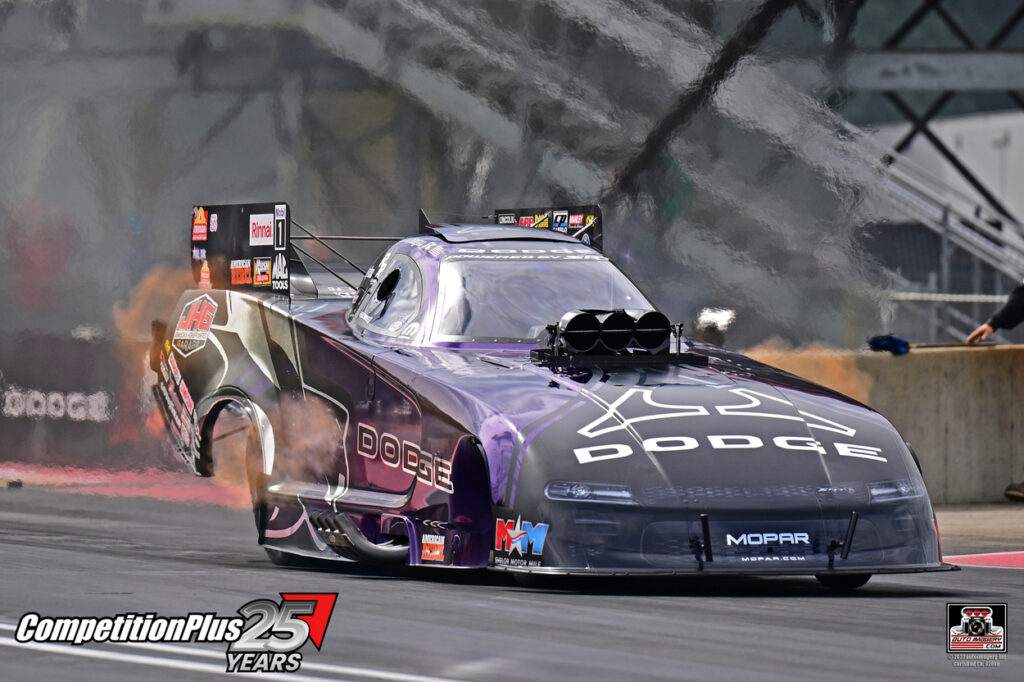
MattHagan GreatLakesNationals 26 01 2

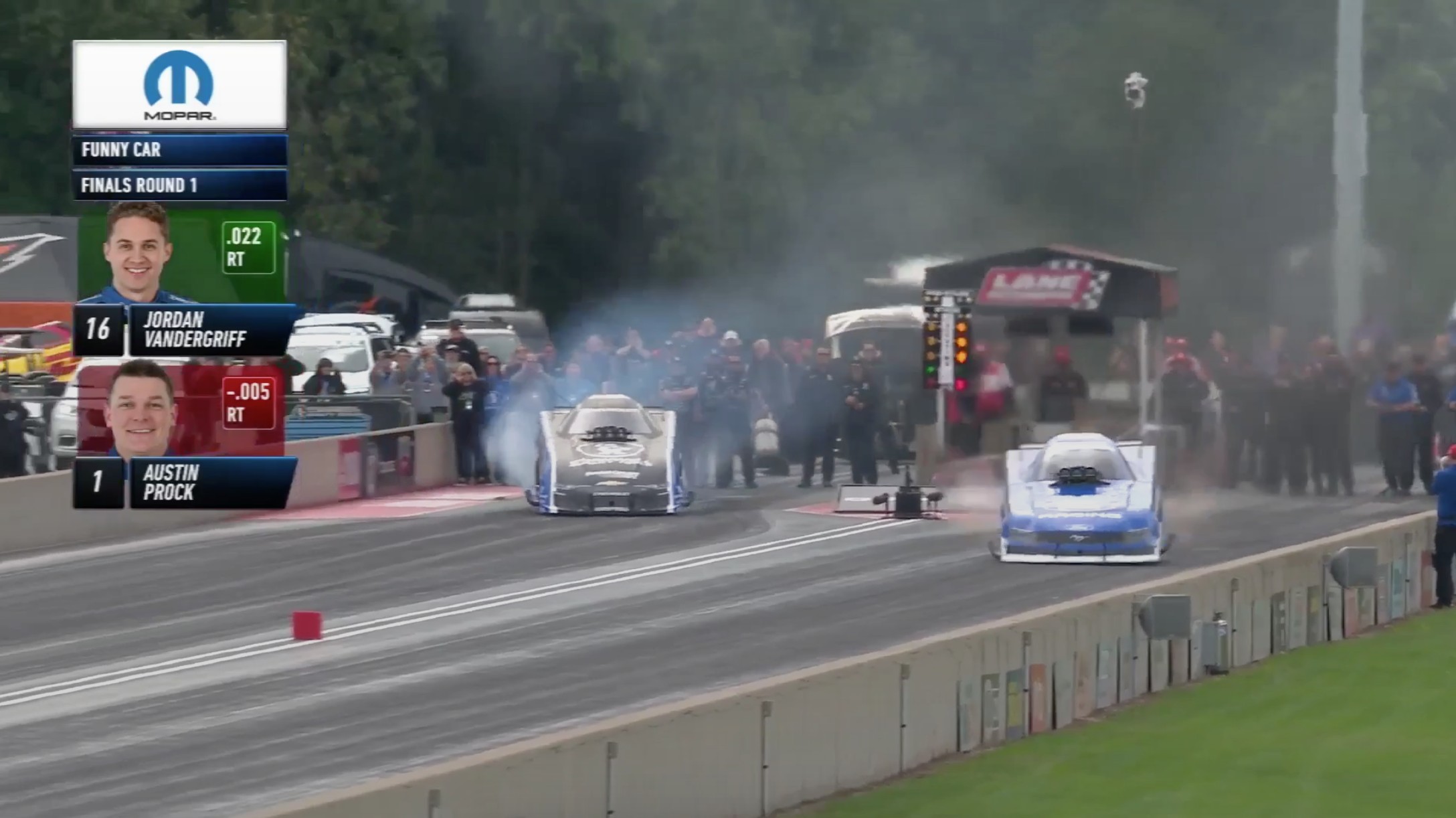
Funny Car driver Matt Hagan didn’t need the statistics to tell him something was different. He could feel it from the seat.

“As soon as you stage the car, it dropped the tree,” Hagan said of his Friday experience. “And I was like, ‘What the f**?’ You know what I mean?”

Hagan’s issue wasn’t with U.S. 131 Motorsports Park. He praised the facility, called the lanes equal and described the racing surface as phenomenal.

His problem was when NHRA introduced the variable, especially with the championship playoffs beginning.

“I understand NHRA coming to a new racetrack,” Hagan said. “And you know, this is kind of a challenge that we have to face because that timing system has been there. But in the end of the day that we probably shouldn’t have put that in as a Countdown race. Loved the facility, loved the track. The lanes were equal. The racing surface was phenomenal.”

Rockingham Dragway also uses Accutime. For Hagan, a championship playoff already has enough moving pieces without adding another at the starting line.

“But as a competitor, it just blows my mind that in today’s world with 75 years of NHRA Drag Racing that we wouldn’t say, ‘Nope. Sorry, we’re going to rip this up and we’re going to put in this system that we race off of,’” Hagan said. “Especially for a championship that people dream of winning one race, much less a championship and what’s on the stake at line. You know what I mean?”

The obvious question was why NHRA couldn’t just install what everybody normally raced. The answer wasn’t sitting in the trailer.

There was more happening electronically than taking familiar settings and punching the same numbers into another timing system.

Jason Kennedy, president of Trackside Systems and Accutime Timing Systems, said settings normally associated with CompuLink were put into the Accutime system at Martin. The numbers might have been familiar, but the electronics processing them weren’t.

“What they did was they took the settings that they typically use for a Compulink system and put them into the Accutime, those various delay in timing settings,” Kennedy said. “But Accutime is a much more modern and different architecture. So when you put those same settings that were used in a Compulink into an Accutime, it results in a much faster tree.”

That explained what the time slips had already exposed. Kennedy said a CompuLink installation relies on a computer card and can include converters and other connections between the computer initiating the starting sequence and the tree responding.

AccuTime takes another route. Its timer box contains a purpose-built circuit board with embedded firmware controlling the timing system’s core functions.

Once that box sends the signal to fire the tree, Kennedy said the response is essentially instantaneous.

“It’s direct wired, there’s no delay, there’s no converters, there’s no anything,” Kennedy said. “So that’s why when you put the same settings that you had in a Compulink into an Accutime, especially concerning tree delay and all that, that’s why you get a different outcome.”
Same numbers. Different tree.
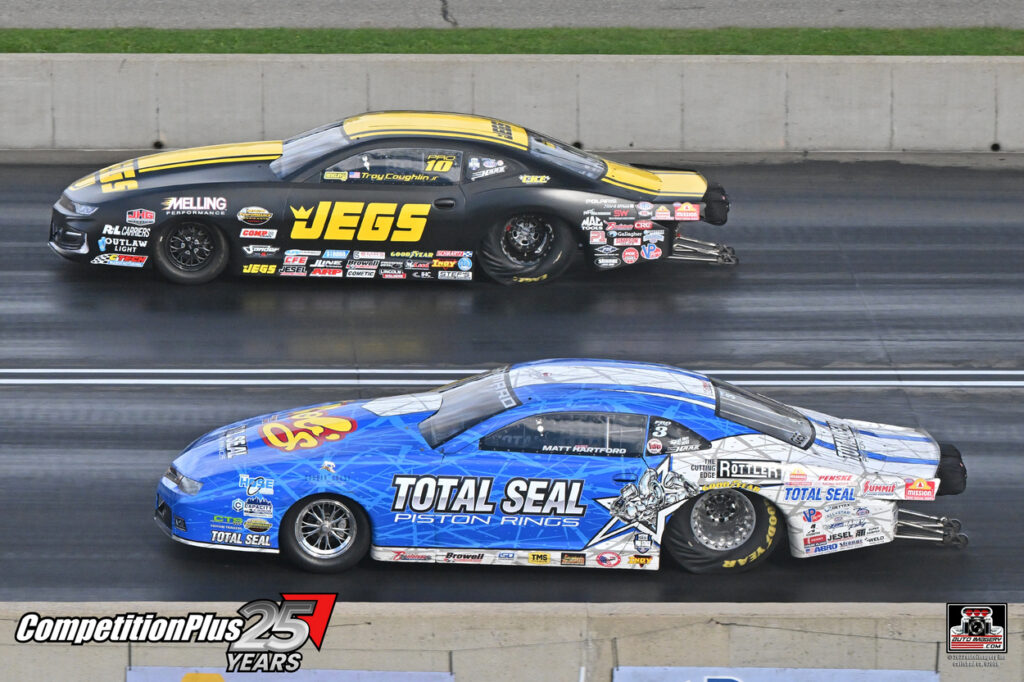
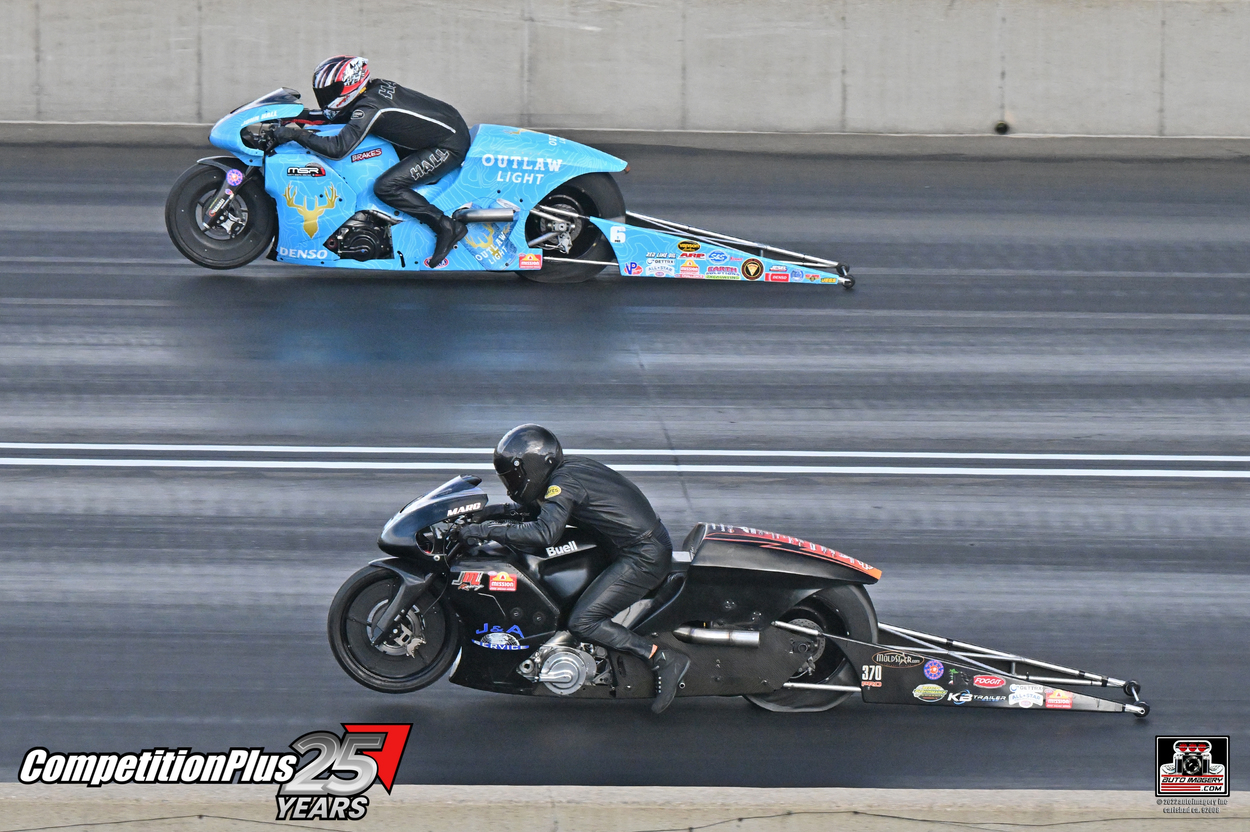
PS Final GreatLakesNationals 26 01

Kennedy said Accutime has the capability to incorporate variability into the starting sequence, although he couldn’t say whether that feature was enabled at Martin. He also said the professional drivers were given an opportunity during the weekend to slow the tree and voted against changing it after competition had begun.

None of this meant Accutime had malfunctioned. The system was operating through a different electronic architecture, and settings borrowed from another system produced a different result.

Swapping hardware wasn’t a five-minute fix, either. Kennedy said Accutime and CompuLink can use the same third-party photocell sensors along the racetrack.

Beyond those sensors, the wiring and connections are different. An Accutime timing system cannot operate a CompuLink tree, or vice versa.

“You could not, no,” Kennedy said. “Now, there are situations where trees have been retrofitted over the years, but it requires opening that tree up and completely changing out all the wiring and everything.”

Bob Brockmeyer knows the problem from the other side. Brockmeyer, who recently retired as NHRA’s official timing-system provider through CompuLink, agreed the systems aren’t interchangeable.

His explanation required considerably less engineering terminology.
“Just different,” Brockmeyer said. “It’s like putting a Chevrolet head on a Ford motor that won’t bolt on.”


NHRA racing with something other than its familiar CompuLink arrangement isn’t unprecedented.

The Texas Motorplex [NHRA FallNationals] has used a Portatree system without creating the reaction Michigan produced. Clay Millican said racers have gone there without encountering anything approaching U.S. 131 Motorsports Park’s starting-line upheaval.

That experience also explains why Millican wasn’t prepared to hammer NHRA for failing to anticipate what happened.

“I don’t think anybody could have predicted that it obviously was that much difference in reaction time,” Millican said. “All of these systems measure into the thousands, and even the time slip’s different with the Accu-Time and the Portatree system because you get an extra digit on your time slip. It measures that far out.”

The racers nevertheless had a problem in front of them. By then, they also had a new way to address it.

Antron Brown, vice president of the Professional Racers Organization [PRO], recently helped organize a driver committee designed to give competitors a formal avenue for discussing safety, rules, racetracks and other driver-related issues. The group includes five representatives each from Top Fuel and Funny Car, with an emphasis on drivers rather than team owners.

“The driver committee is just a driver committee,” Brown said. “I’m just the one that regulates it. So basically it’s all the drivers just putting their input in.”

Its first meeting came Saturday morning at Martin, and the timing couldn’t have been better or, considering the subject, maybe worse. The Christmas tree immediately landed in the middle of the discussion.
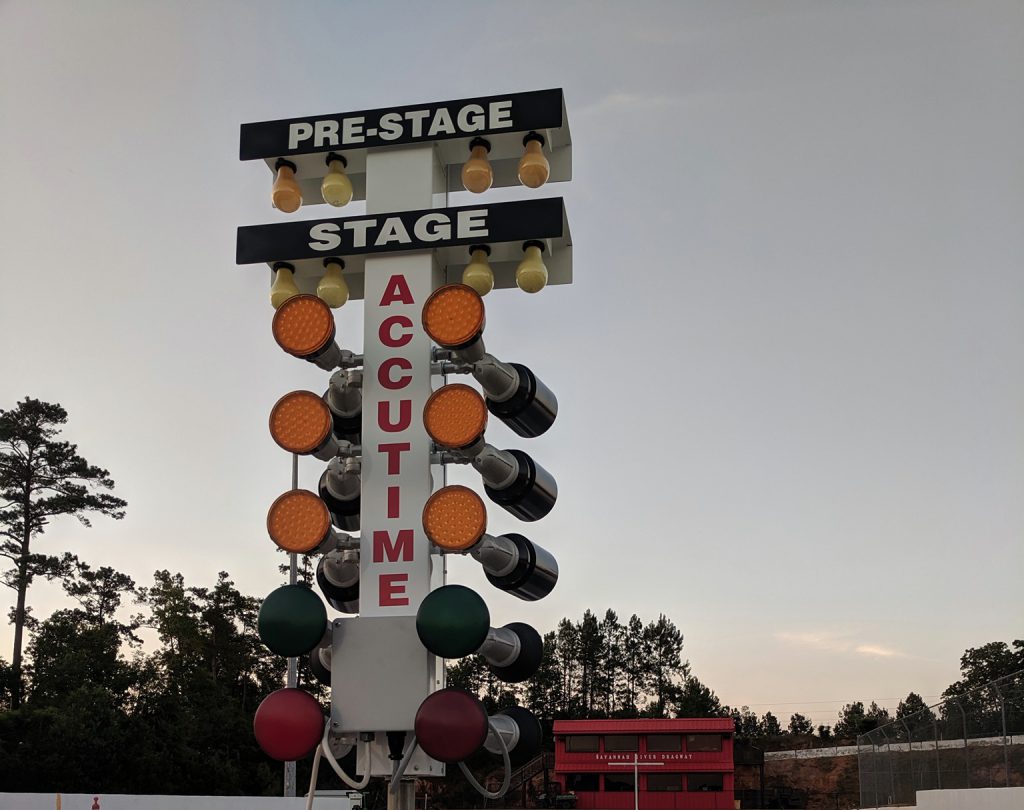
accutime tree

The committee didn’t meet directly with NHRA, Brown said. The drivers established their position, and the message was relayed through the Professional Racers Owners Organization.

Then came the question nobody could answer without creating another: Do you change the tree after the race has already started?

The vote was 6-5 to leave it alone. Hagan was among the five who wanted a change.

“The six-to-five vote was to leave it alone after we started qualifying,” Hagan said. “And then, Antron took that to NHRA and to PRO. And then they said, ‘We’re good with it as drivers.’ And NHRA said, ‘Well, that’s fine. We’ll leave it alone and move forward.’”

Leaving it alone wasn’t necessarily an endorsement of what they had. It was an acknowledgement that changing the starting-line parameters after competitors already had made runs might create a second fairness problem while trying to fix the first.

Brown said the drivers essentially decided they started the race one way and should finish it that way. Millican saw another complication.

Alcohol competitors already had raced under the quicker configuration. Changing it afterward could leave racers competing for points and Wallys under different starting-line conditions during the same event.

“Would that be fair to those people that are chasing points, chasing a Wally?” Millican said. “So do you make a change in the timing system to take it from a .373 to say a .353, is that fair to the people that red light it?”

 

There wasn’t a clean answer, and then the story took a turn few might have expected after watching a score of foul starts. Some racers actually liked the quicker tree.

Langdon didn’t just tolerate it. Instead, he wanted more of it.

“My opinion on it was I loved it,” Langdon said. “I thought it was great. I think it provides better racing. I feel like the announcers can call the race better with the better reaction times.”

Langdon’s argument wasn’t about putting prettier reaction times on the scoreboard. It was about how drivers got them.

Professional drivers can shallow stage in an effort to improve reaction time. A quicker tree reduces the room for gamesmanship [or deep-staging] because moving deeper into the beams can make an already fast setup dangerously close to a foul start.

“If you guess at the tree in any other category in the sport, you’re going to red light,” Langdon said. “Top fuel and funny car are the only two classes that you can guess at the tree and sometimes get away with it. So I feel as professionals, driver accountability is a huge thing.”

Hagan, despite criticizing how the system was introduced, discovered the same upside.

“But what I did like about it and the positive that came out of it was when we’re racing at 0.370, everyone had to be shallow,” Hagan said. “There was no one dreaming of turning the top bulb off. Everyone’s 60-foots were the same. It kept everyone honest.”
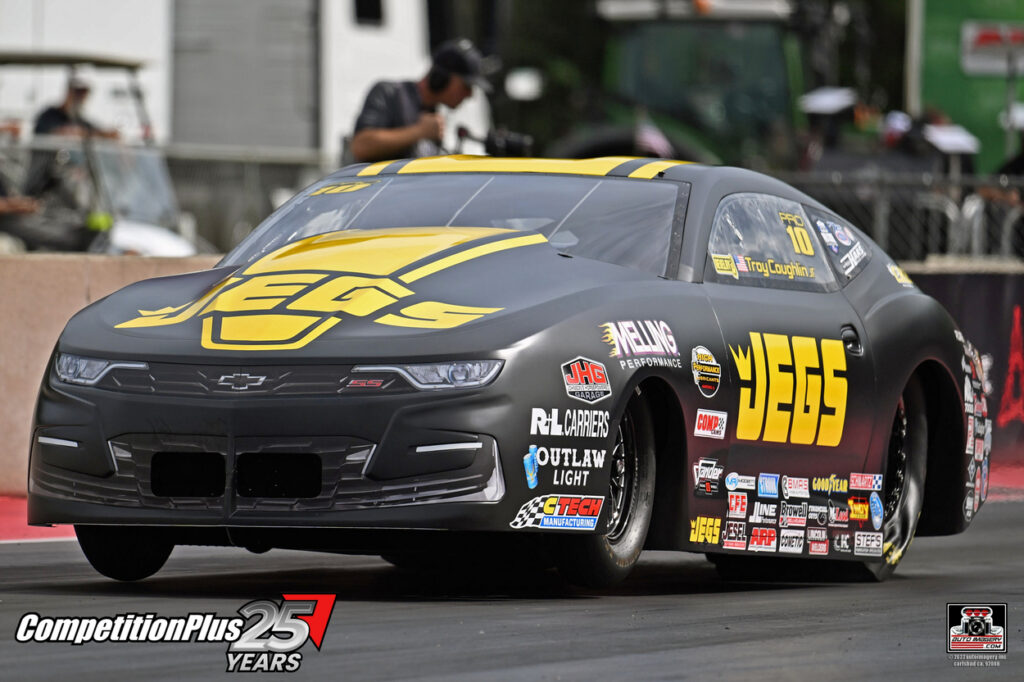
TroyCoughlin GreatLakesNationals 26 01 1

Suddenly, Michigan wasn’t just a timing-system controversy, it had become an experiment.

For years, Hagan said, racers had discussed addressing how staging could be manipulated. At Martin, intentionally or otherwise, everybody got to see what happened when drivers had considerably less room to play those games.

“There was no one that was going to dive it in there because they didn’t know where they were at and they didn’t know how much they had to give,” Hagan said. “And so, it made everybody just stage the car like we’re in qualifying and race your race car.”

Top Fuel presented another issue. Dragsters react differently than Funny Cars, and Hagan believed the quicker configuration pushed them too far. Justin Ashley became the obvious example.

“I mean, if you took a kid like Justin Ashley, I mean, how do you penalize that kid for being so good, whether it’s mechanical or just God-given talent?” Hagan said. “He was going to be put in a situation where majority, if he was up and adrenaline going, he would probably go red because he was cutting double Os in qualifying. So I don’t feel like that’s fair.”

Langdon agreed with the principle even while supporting the quicker tree.

“Justin Ashley is in a world of his own on reaction times,” Langdon said. “So taking out .03 could put him close to the range of red lighting and he’s done a great job at creating, him and Will Smith have both done a great job at creating an advantage for themself on reaction times.”

Langdon doesn’t want the sport legislating that advantage away.

“My opinion of that is I wouldn’t want to change the tree to take away their advantage,” Langdon said. “I think it’s up to us as competitors to rise to the challenge to get better and to try to narrow that deficit that we have between our reaction times and theirs.”

Buried underneath the red-lights, electronics and debate was probably the NHRA Great Lakes Nationals’ most interesting question: How quick should a professional Christmas tree actually be?

That question follows the tour directly to Rockingham. Hagan said the Martin setting was .370 and drivers subsequently discussed moving the AccuTime setting to .350 at the next race, a change he said should move reaction times approximately .020 slower and closer to what racers normally see.

“It won’t be the same, but it’ll be a little better,” Hagan said.

NHRA also is developing its own timing system, although there is no announced timetable for its introduction or whether track’s will be required to run during the national event..

For many of the drag racers who discovered the nuances of tree on Friday in Michigan, one aspect, whether they liked it or not, remains the same – drag racers don’t like surprises.

“Us as drag racers, we’re all about consistency,” Brown said. “So anything that’s out the norm is not something that we’re not used to, because we race within a thousandth of a second, and being a bracket racer besides a pro racer, we all know … I know how important it is to be dead on each and every time.”


Share the Insights?

Click here to share the article.

ad space x ad space

ad space x ad space

Competition Plus Team

Since our inception, we have been passionately dedicated to delivering the most accurate, timely, and compelling content in the world of drag racing. Our readers depend on us for the latest news, in-depth features, expert analysis, and exclusive interviews that connect you to the sport’s pulse.

Sign up for our newsletters and email list.

This field is for validation purposes and should be left unchanged.
Name

NHRA RACERS ADJUST TO ACCUTIME DIFFERENCES AT MICHIGAN

Nobody needed to tell an NHRA driver the Christmas tree at Martin was different. The time slips handled that job just fine.

Reaction times that normally would have raised eyebrows suddenly became common, and the red-lights followed. Before long, racers weren’t talking only about getting down U.S. 131 Motorsports Park; they were trying to figure out exactly what was happening before they ever left the starting line.

That would have been enough to get everyone’s attention at just about any race on the schedule. Having it happen at the opening race of the Countdown to the Championship made the timing considerably harder to ignore.

U.S. 131 Motorsports Park uses an AccuTime Christmas tree with an AccuTime timing system instead of the CompuLink combination NHRA professional racers were accustomed to seeing. The equipment wasn’t malfunctioning, but racers were about to discover that familiar settings plugged into different electronics didn’t necessarily produce familiar results.

“We were notified briefly before the event that the Accutime tree was going to be used in conjunction with the Accutime Timing System, which also entailed different pre-stage stage bulbs,” Top Fuel points leader Shawn Langdon said. “So we kind of took that as it was.”

Then the cars started making runs, and what had been little more than a technical footnote in the weekend information became impossible to overlook. Langdon had a pretty good idea what was coming because he’d already seen a version of it.

He raced at Martin about a month earlier during a bracket event and remembered the tree being quick. The difference was that a bracket racer has a delay box available to compensate, while a Top Fuel driver has his foot.

“In the bracket racing world, you just make the adjustments because you add delay to the delay box,” Langdon said. “So it’s really no big deal.”

ShawnLangdon GreatLakesNationals 26 01

Langdon’s first NHRA qualifying run produced a .040 reaction time even though he didn’t believe he had hit the tree particularly well. His next was somewhere in the .020s, which removed whatever doubt remained.
The tree wasn’t just quick enough for somebody to complain about it. It was quick enough that the numbers were eventually going to make the argument for them.

There were only five foul starts among the four professional categories during the entire NHRA U.S. Nationals at Indianapolis. None came in Top Fuel or Funny Car.

Michigan produced six red-lights in the first round alone and six more before the final round, pushing the total to 12. The green lights were just as revealing.

According to DragRaceCentral.com data generated from NHRA’s timing system, the opening round at Martin produced 12 “double-oh” reaction times between .000 and .009 across Top Fuel, Funny Car, Pro Stock and Pro Stock Motorcycle.

Indianapolis produced only five .00 reaction times during the entire event in all four rounds combined. Martin more than doubled Indy’s four-round total before the second round fired.

MattHagan GreatLakesNationals 26 01 2

Funny Car driver Matt Hagan didn’t need the statistics to tell him something was different. He could feel it from the seat.

“As soon as you stage the car, it dropped the tree,” Hagan said of his Friday experience. “And I was like, ‘What the f**?’ You know what I mean?”

Hagan’s issue wasn’t with U.S. 131 Motorsports Park. He praised the facility, called the lanes equal and described the racing surface as phenomenal.

His problem was when NHRA introduced the variable, especially with the championship playoffs beginning.

“I understand NHRA coming to a new racetrack,” Hagan said. “And you know, this is kind of a challenge that we have to face because that timing system has been there. But in the end of the day that we probably shouldn’t have put that in as a Countdown race. Loved the facility, loved the track. The lanes were equal. The racing surface was phenomenal.”

Rockingham Dragway also uses Accutime. For Hagan, a championship playoff already has enough moving pieces without adding another at the starting line.

“But as a competitor, it just blows my mind that in today’s world with 75 years of NHRA Drag Racing that we wouldn’t say, ‘Nope. Sorry, we’re going to rip this up and we’re going to put in this system that we race off of,’” Hagan said. “Especially for a championship that people dream of winning one race, much less a championship and what’s on the stake at line. You know what I mean?”

The obvious question was why NHRA couldn’t just install what everybody normally raced. The answer wasn’t sitting in the trailer.

There was more happening electronically than taking familiar settings and punching the same numbers into another timing system.

Jason Kennedy, president of Trackside Systems and Accutime Timing Systems, said settings normally associated with CompuLink were put into the Accutime system at Martin. The numbers might have been familiar, but the electronics processing them weren’t.

“What they did was they took the settings that they typically use for a Compulink system and put them into the Accutime, those various delay in timing settings,” Kennedy said. “But Accutime is a much more modern and different architecture. So when you put those same settings that were used in a Compulink into an Accutime, it results in a much faster tree.”

That explained what the time slips had already exposed. Kennedy said a CompuLink installation relies on a computer card and can include converters and other connections between the computer initiating the starting sequence and the tree responding.

AccuTime takes another route. Its timer box contains a purpose-built circuit board with embedded firmware controlling the timing system’s core functions.

Once that box sends the signal to fire the tree, Kennedy said the response is essentially instantaneous.

“It’s direct wired, there’s no delay, there’s no converters, there’s no anything,” Kennedy said. “So that’s why when you put the same settings that you had in a Compulink into an Accutime, especially concerning tree delay and all that, that’s why you get a different outcome.”
Same numbers. Different tree.

PS Final GreatLakesNationals 26 01

Kennedy said Accutime has the capability to incorporate variability into the starting sequence, although he couldn’t say whether that feature was enabled at Martin. He also said the professional drivers were given an opportunity during the weekend to slow the tree and voted against changing it after competition had begun.

None of this meant Accutime had malfunctioned. The system was operating through a different electronic architecture, and settings borrowed from another system produced a different result.

Swapping hardware wasn’t a five-minute fix, either. Kennedy said Accutime and CompuLink can use the same third-party photocell sensors along the racetrack.

Beyond those sensors, the wiring and connections are different. An Accutime timing system cannot operate a CompuLink tree, or vice versa.

“You could not, no,” Kennedy said. “Now, there are situations where trees have been retrofitted over the years, but it requires opening that tree up and completely changing out all the wiring and everything.”

Bob Brockmeyer knows the problem from the other side. Brockmeyer, who recently retired as NHRA’s official timing-system provider through CompuLink, agreed the systems aren’t interchangeable.

His explanation required considerably less engineering terminology.
“Just different,” Brockmeyer said. “It’s like putting a Chevrolet head on a Ford motor that won’t bolt on.”

NHRA racing with something other than its familiar CompuLink arrangement isn’t unprecedented.

The Texas Motorplex [NHRA FallNationals] has used a Portatree system without creating the reaction Michigan produced. Clay Millican said racers have gone there without encountering anything approaching U.S. 131 Motorsports Park’s starting-line upheaval.

That experience also explains why Millican wasn’t prepared to hammer NHRA for failing to anticipate what happened.

“I don’t think anybody could have predicted that it obviously was that much difference in reaction time,” Millican said. “All of these systems measure into the thousands, and even the time slip’s different with the Accu-Time and the Portatree system because you get an extra digit on your time slip. It measures that far out.”

The racers nevertheless had a problem in front of them. By then, they also had a new way to address it.

Antron Brown, vice president of the Professional Racers Organization [PRO], recently helped organize a driver committee designed to give competitors a formal avenue for discussing safety, rules, racetracks and other driver-related issues. The group includes five representatives each from Top Fuel and Funny Car, with an emphasis on drivers rather than team owners.

“The driver committee is just a driver committee,” Brown said. “I’m just the one that regulates it. So basically it’s all the drivers just putting their input in.”

Its first meeting came Saturday morning at Martin, and the timing couldn’t have been better or, considering the subject, maybe worse. The Christmas tree immediately landed in the middle of the discussion.

accutime tree

The committee didn’t meet directly with NHRA, Brown said. The drivers established their position, and the message was relayed through the Professional Racers Owners Organization.

Then came the question nobody could answer without creating another: Do you change the tree after the race has already started?

The vote was 6-5 to leave it alone. Hagan was among the five who wanted a change.

“The six-to-five vote was to leave it alone after we started qualifying,” Hagan said. “And then, Antron took that to NHRA and to PRO. And then they said, ‘We’re good with it as drivers.’ And NHRA said, ‘Well, that’s fine. We’ll leave it alone and move forward.’”

Leaving it alone wasn’t necessarily an endorsement of what they had. It was an acknowledgement that changing the starting-line parameters after competitors already had made runs might create a second fairness problem while trying to fix the first.

Brown said the drivers essentially decided they started the race one way and should finish it that way. Millican saw another complication.

Alcohol competitors already had raced under the quicker configuration. Changing it afterward could leave racers competing for points and Wallys under different starting-line conditions during the same event.

“Would that be fair to those people that are chasing points, chasing a Wally?” Millican said. “So do you make a change in the timing system to take it from a .373 to say a .353, is that fair to the people that red light it?”


There wasn’t a clean answer, and then the story took a turn few might have expected after watching a score of foul starts. Some racers actually liked the quicker tree.

Langdon didn’t just tolerate it. Instead, he wanted more of it.

“My opinion on it was I loved it,” Langdon said. “I thought it was great. I think it provides better racing. I feel like the announcers can call the race better with the better reaction times.”

Langdon’s argument wasn’t about putting prettier reaction times on the scoreboard. It was about how drivers got them.

Professional drivers can shallow stage in an effort to improve reaction time. A quicker tree reduces the room for gamesmanship [or deep-staging] because moving deeper into the beams can make an already fast setup dangerously close to a foul start.

“If you guess at the tree in any other category in the sport, you’re going to red light,” Langdon said. “Top fuel and funny car are the only two classes that you can guess at the tree and sometimes get away with it. So I feel as professionals, driver accountability is a huge thing.”

Hagan, despite criticizing how the system was introduced, discovered the same upside.

“But what I did like about it and the positive that came out of it was when we’re racing at 0.370, everyone had to be shallow,” Hagan said. “There was no one dreaming of turning the top bulb off. Everyone’s 60-foots were the same. It kept everyone honest.”

TroyCoughlin GreatLakesNationals 26 01 1

Suddenly, Michigan wasn’t just a timing-system controversy, it had become an experiment.

For years, Hagan said, racers had discussed addressing how staging could be manipulated. At Martin, intentionally or otherwise, everybody got to see what happened when drivers had considerably less room to play those games.

“There was no one that was going to dive it in there because they didn’t know where they were at and they didn’t know how much they had to give,” Hagan said. “And so, it made everybody just stage the car like we’re in qualifying and race your race car.”

Top Fuel presented another issue. Dragsters react differently than Funny Cars, and Hagan believed the quicker configuration pushed them too far. Justin Ashley became the obvious example.

“I mean, if you took a kid like Justin Ashley, I mean, how do you penalize that kid for being so good, whether it’s mechanical or just God-given talent?” Hagan said. “He was going to be put in a situation where majority, if he was up and adrenaline going, he would probably go red because he was cutting double Os in qualifying. So I don’t feel like that’s fair.”

Langdon agreed with the principle even while supporting the quicker tree.

“Justin Ashley is in a world of his own on reaction times,” Langdon said. “So taking out .03 could put him close to the range of red lighting and he’s done a great job at creating, him and Will Smith have both done a great job at creating an advantage for themself on reaction times.”

Langdon doesn’t want the sport legislating that advantage away.

“My opinion of that is I wouldn’t want to change the tree to take away their advantage,” Langdon said. “I think it’s up to us as competitors to rise to the challenge to get better and to try to narrow that deficit that we have between our reaction times and theirs.”

Buried underneath the red-lights, electronics and debate was probably the NHRA Great Lakes Nationals’ most interesting question: How quick should a professional Christmas tree actually be?

That question follows the tour directly to Rockingham. Hagan said the Martin setting was .370 and drivers subsequently discussed moving the AccuTime setting to .350 at the next race, a change he said should move reaction times approximately .020 slower and closer to what racers normally see.

“It won’t be the same, but it’ll be a little better,” Hagan said.

NHRA also is developing its own timing system, although there is no announced timetable for its introduction or whether track’s will be required to run during the national event..

For many of the drag racers who discovered the nuances of tree on Friday in Michigan, one aspect, whether they liked it or not, remains the same – drag racers don’t like surprises.

“Us as drag racers, we’re all about consistency,” Brown said. “So anything that’s out the norm is not something that we’re not used to, because we race within a thousandth of a second, and being a bracket racer besides a pro racer, we all know … I know how important it is to be dead on each and every time.”

Picture of John Doe

John Doe

Lorem ipsum dolor sit amet consectetur adipiscing elit dolor

More Posts

Send Us A Message

Picture of Bobby Bennett
Bobby Bennett
Thank you for joining us on this journey. Your support and trust inspire us every day to deliver the best in drag racing journalism. We are excited about the future and look forward to continuing to serve you with the same dedication and passion that has defined CompetitionPlus.com from the very beginning.

Don’t miss these other exciting stories!

Explore more action packed posts on Competition Plus, where we dive into the latest in Drag Racing News. Discover a range of topics, from race coverage to in-depth interviews, to keep you informed and entertained.