

After Daniel Wilkerson survived an earlier Funny Car explosion that could have left him seriously injured, his father, Tim Wilkerson, and veteran chassis builder Murf McKinney looked for a better way to keep a disintegrating race car from becoming an even greater danger to its driver. Their answer was a body-tethering and pressure-relief system designed to control what happens when a nitro engine blows apart beneath a fiberglass Funny Car body.
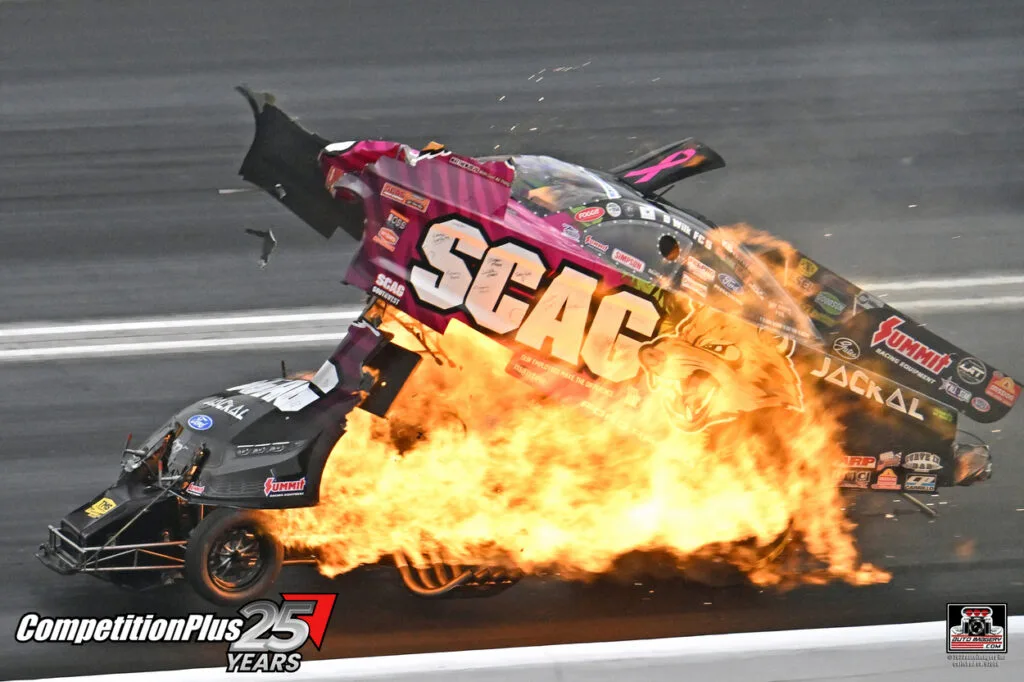
The system had shown promise in an earlier on-track incident, but Saturday at the NHRA Las Vegas Nationals provided a test nobody wanted. Daniel escaped injury when his SCAG Racing Ford Mustang suffered a violent engine explosion, sending flames over the cockpit, shredding the body and forcing the chassis into the retaining wall.
“Well, it kind of did what it was supposed to do until the air got underneath of it and just ripped the body into shreds,” Tim Wilkerson said. “The NHRA Tech Department came down and we all talked about it a little bit.”
Tim had hoped the tethers would allow the explosion’s pressure to escape without destroying the body. NHRA officials reviewed slow-motion video showing the system initially responding as designed before the body came apart.
“Yeah, Joey [Gorman, NHRA official] liked what it did outside of… Because he said he had a slow-motion video of it blowing up and the front end got to where the tethers grabbed it,” Tim said. “And when the tethers grabbed it, the air just… The rest of the explosion just shredded the middle side of the body. So, I don’t know. It didn’t really do what I thought it would do.”
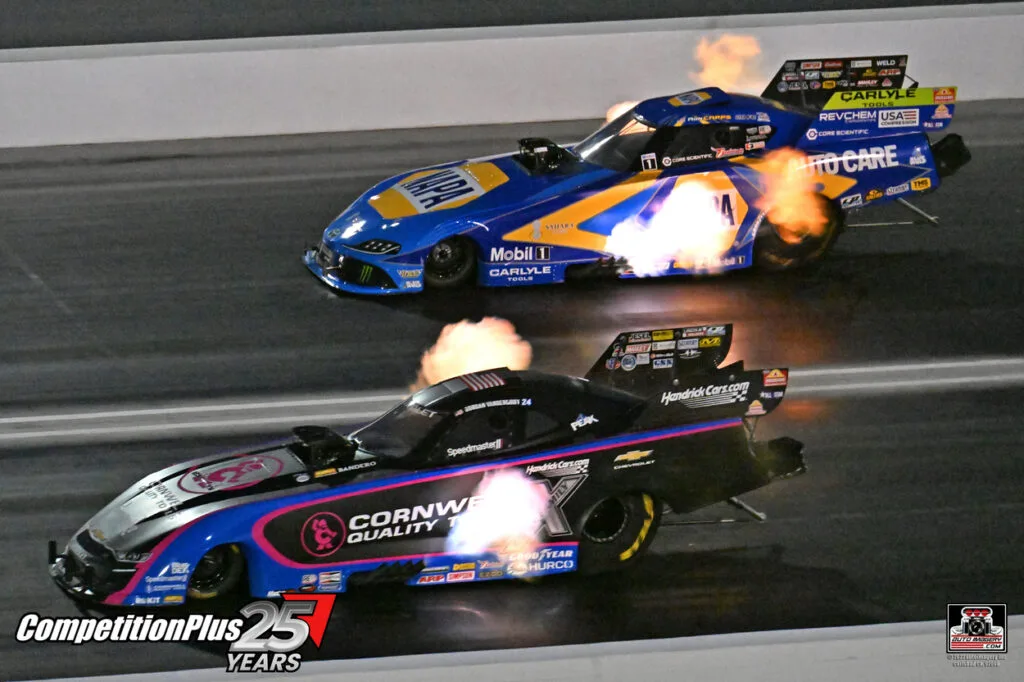
Daniel had a different perspective, particularly after experiencing enough heat to singe his firesuit sleeves. He was more concerned about losing his vision while trying to keep his damaged race car away from J.R. Todd in the opposite lane.
“I don’t know if it was adrenaline of me trying not to hit JR or what was going on,” Daniel said. “But I honestly did not notice it was hot. Once I got out, I had to get my gloves off real fast because my gloves were hot. Then I could tell my suit was hot. But yeah, honestly, the part about the fire that bothered me was I couldn’t see where I was going.”
Daniel wasn’t convinced the tethers had failed him. He believed the body separating during the explosion actually worked in his favor.
“I was glad that the body did that. I mean, the body worked in my favor on that one, honestly,” Daniel said. “The reason I couldn’t see was because my shield actually melted. It melted and got foggy.”
Oil and damage further obscured his vision, leaving him able to make out little more than the outline of his surroundings. Considering the circumstances, Daniel wasn’t complaining about how the body came off.
“I think it was oil and I could see the outline of the world,” Daniel said. “Everything was blurry because of the oil and damage on the body.”
Tim, however, had expected something different from the system he and McKinney developed. An earlier engine failure had produced encouraging results, but Saturday’s explosion was considerably more violent.
“Initially we had a pop and it didn’t hurt a thing. It just whooped one time and it came up,” Tim said. “But yeah, that definitely tested it. But I don’t know, I wasn’t happy that the body ended up breaking in half. I was hoping that it would just fail the front latches and the exposure would come out the sides and it would fall back down, but it didn’t do that.”
Daniel wasn’t sure any system could have contained an explosion of that magnitude. He had experienced engine failures before, but Saturday’s was in another category.
“I mean, that was one of the biggest bangs I’ve had in my life. I’m not Don Garlits, but I’ve been through some s*** and that was the biggest bang I’ve ever had,” Daniel said. “I mean, there’s something to… At some point it just can’t…”
Tim’s concern wasn’t necessarily with the cables. He questioned whether the Funny Car body itself possessed enough structural strength to withstand an explosion that severe.
“I think the body just doesn’t have enough integrity. You know what I mean?” Tim said.
He pointed to Ron Capps’ recent explosion as another example, noting that the different front-end mounting arrangements produced a different result. Even so, he wasn’t prepared to blame the mounting system alone.
“Like you watch Capps’ blow up and his did basically the same thing. It’d come up and his front end stayed on the car because he’s still got regular front latches,” Tim said. “And ours didn’t stay on the car because the tethers, it came up and the tether let it loose.”
Tim also acknowledged that body construction and the severity of individual explosions could influence the results. He wasn’t ready to say which factor played the greatest role Saturday.
“I don’t know if it’s… I mean, we sure tested it. There’s no doubt about that,” Tim said. “But I didn’t think it would fall off like that. And I think we’re still, we’re just back at point A where the thing’s just not got enough integrity to hold a explosion like that.”
The Wilkersons now have slow-motion footage, observations from NHRA technical officials and a destroyed Mustang body to examine before deciding whether changes are necessary. Daniel, however, wasn’t interested in second-guessing a system that allowed him to walk away from one of the worst explosions of his career.
“I don’t know if they did exactly what they were supposed to, but it definitely… I wouldn’t want to do it different than what happened,” Daniel said. “I’ll tell you that.”