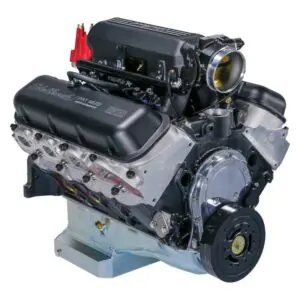


Good things take time, and for the Edelbrock Musi 555 crate engine, almost two decades of development went into what its creators believe is one of the better low-maintenance big-block combinations available for the street.

Edelbrock and Musi could have chased a bigger horsepower number. Instead, they spent those years figuring out how to make nearly 700 horsepower behave itself on the street.

For Pat Musi, an eight-time world champion and one of drag racing’s best-known engine builders, it’s what separates the project from the racing engines that built his reputation.

“It’s good and really gaining traction,” Musi said. “Now, all these guys with this LS, because they think it’s a plug-and-play. Well, we’re plug-and-play, but it’s a big block. This is a big block. And it drives like your new Suburban, new Cadillac, or whatever. You can get in it, cold start. So we’re pretty proud about that.”

Strip away Musi’s usual needling of the LS crowd, and there is the story behind the engine. The Musi 555 is aimed at the owner who wants traditional Chevrolet big-block architecture without accepting the traditional race-engine temperament that comes with it.

Edelbrock Cylinder Head and Crate Engine Product Manager Jamie Wagner said the program dates to 2008. Development took place at Edelbrock and on Musi’s dyno, with changes made gradually rather than through wholesale redesigns.

“The development cycle on this thing has been long,” Wagner said. “When we started this program, we did everything there in-house at Edelbrock in Torrance, and then Pat also ran it on his dyno. And we’ve just been constantly refining it over the years.”
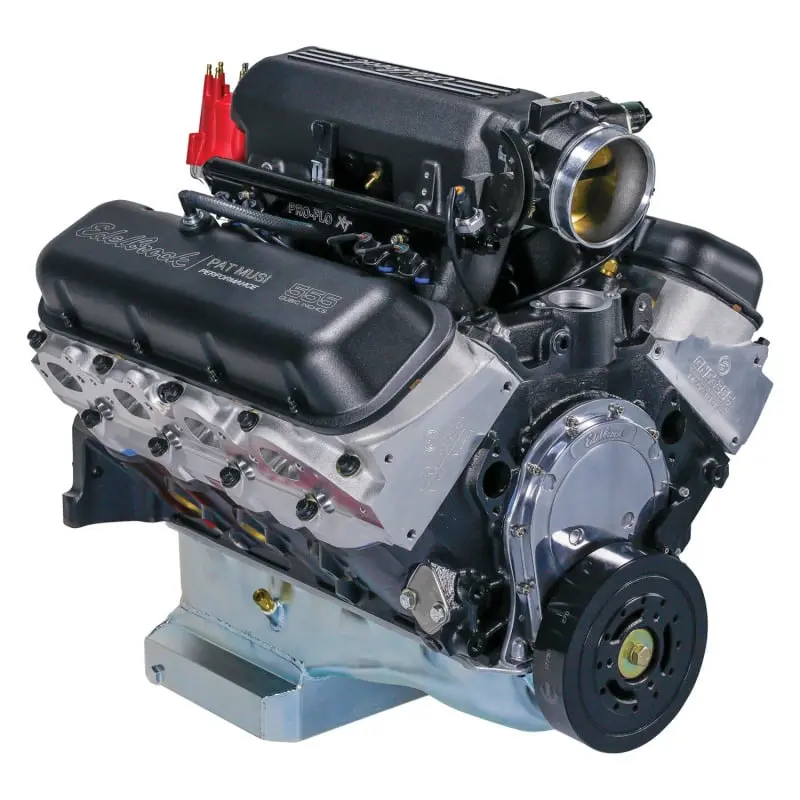
The refining process eventually included a revised camshaft profile and successive generations of electronic fuel injection. The current Pro-Flo 4 version is the configuration Edelbrock sells most often, and the one Wagner said benefits most from the years spent sorting out starting, hot restarts and everyday drivability.

The advertised numbers are 697 horsepower and 643 pound-feet of torque. Wagner said a recent engine produced approximately 705 horsepower, though Edelbrock has continued advertising the lower figure.
There are 555-cubic-inch combinations on the market with considerably larger horsepower numbers. Wagner does not attempt to argue otherwise, and that helps explain what this engine is supposed to be.

“We wanted to make it a very streetable, dependable, and reliable engine, not maximum horsepower,” Wagner said. “We knew we could lean on it pretty hard to get more horsepower out of it, but we didn’t want a horsepower number.

“We wanted something that would go in a car and could be driven daily and not have to worry about using a super low tension ring pack or anything like that to get power with. We wanted to make sure that everything we put in it was reliable and would last a long time for everyday use. We didn’t want it to be a race car engine. We wanted it to be a streetcar engine.”

Musi has spent much of his career building engines where horsepower comes first. The 555 was built for a customer who still wants big-block power but doesn’t want to fight the engine every time the car leaves the garage.

One answer can be found at idle. Wagner said the engine pulls roughly 14 inches of vacuum, enough that a car equipped with vacuum-assisted power brakes should not require a separate vacuum pump or hydraulic brake booster. That may not carry the appeal of a 900-horsepower dyno pull, but it matters considerably more when maneuvering a heavy Chevelle through traffic.

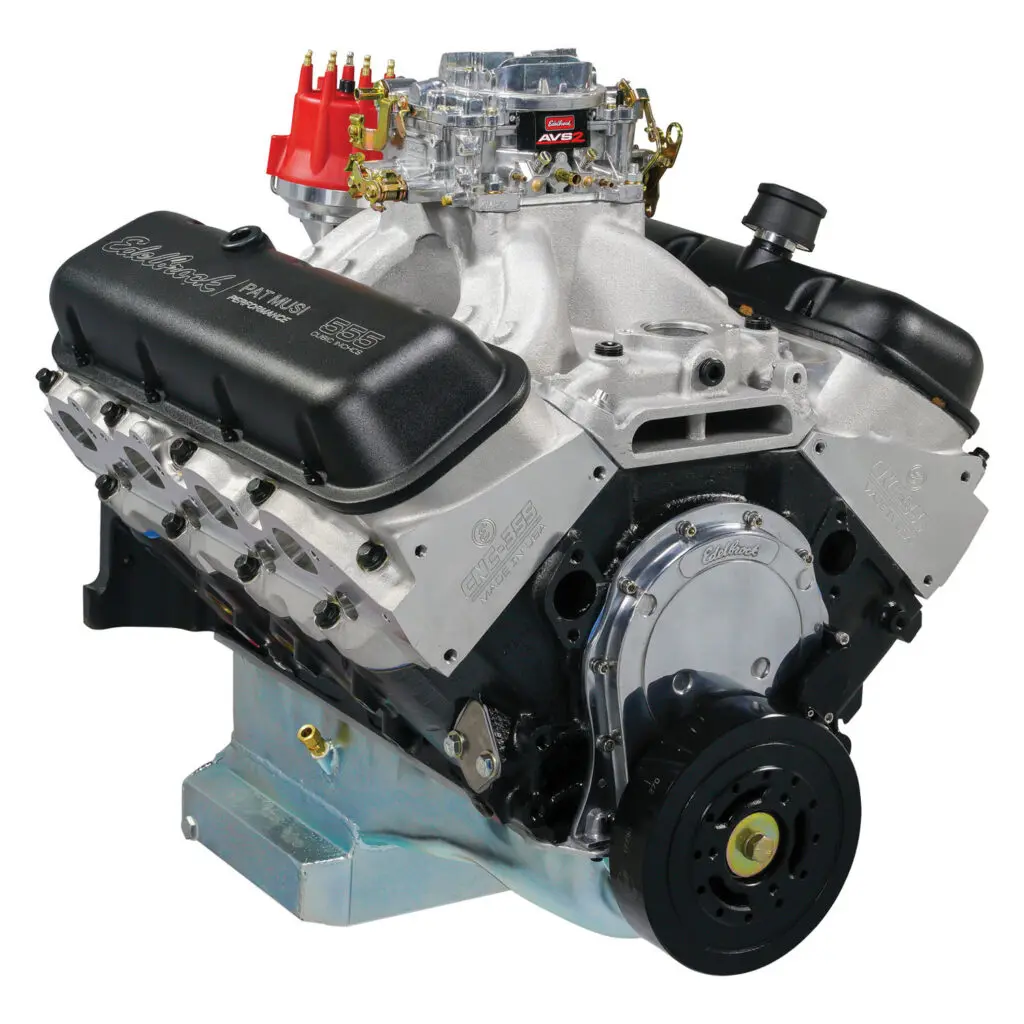
The engine’s physical foundation also keeps it familiar. Musi said the 555 is based on the Mark IV platform and will install much like a 454 LS6, making headers, pulleys and other supporting pieces readily obtainable.

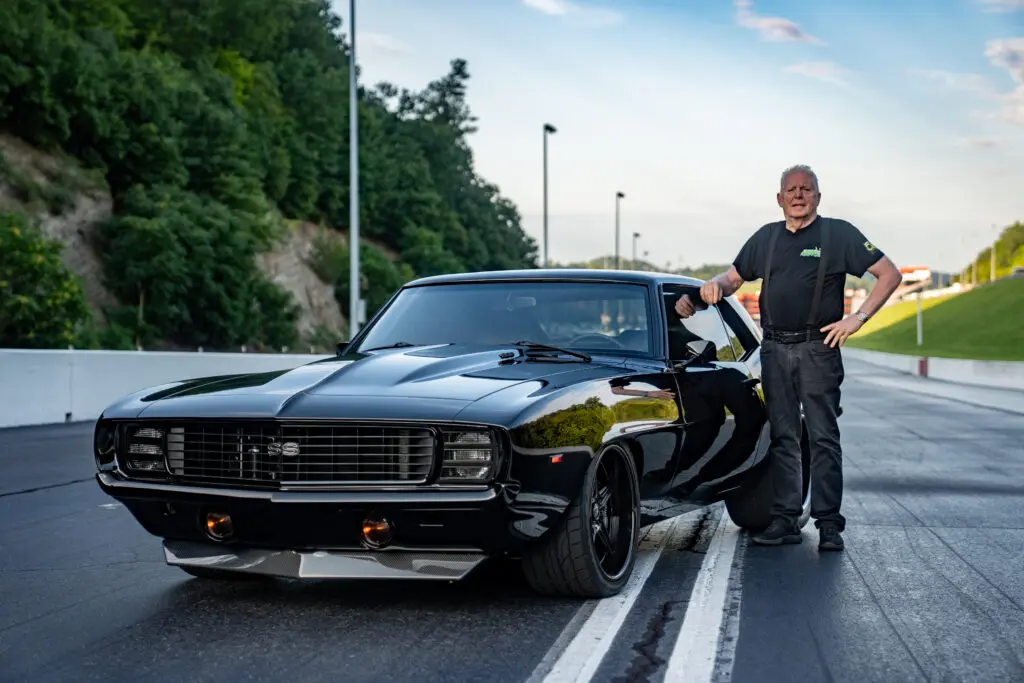
“The guy that’s got an old Chevelle, an old Camaro, but we got guys, those ’69, ’70 pickup, Chevy pickup, just about anything,” Musi said. “We’ve had guys take them and run mud racing with them. It’s crazy. It’ll bolt in just like a 454 LS6. It’s based on a Mark IV platform. So it’s pretty easy to get headers for, pulleys for.”

The 555’s roots go back to a conversation between Musi and the late Vic Edelbrock Jr. nearly 18 years ago. Edelbrock wanted something for the street and asked Musi what they could build.

Musi suggested 565 cubic inches. Edelbrock had another number in mind.

“So Vic came to me, I don’t know, maybe 18 years ago now. He’s calling me kid, imagine,” Musi said. “But I was a kid to him. He said, ‘Kid, what can we build for the street?’ So I said, ‘Well, we can do a 565.’ He said, ‘Well, what about a triple nickel 555?’ I said, ‘Done.”

“So I went back. And the first one went is his personal red Chevelle that he did the Hot Rod Power Tour with. So that was pretty cool. It was his idea, and that’s how it got started.”

The engine has changed less mechanically than one might expect over that span. Wagner said the oil pan was modified to accommodate a wider range of installations, while the camshaft received a relatively modest update.

Fuel injection has undergone the most significant evolution, progressing from Pro-Flo 2 through a brief Pro-Flo 3 period to Pro-Flo 4. The latter is designed more around production-style street use than a racing application.

A big horsepower number wasn’t going to mean much if the 555 was a handful in traffic. Wagner said considerable work went into cold starts, hot restarts and getting the engine to behave at low speeds.

“And the startup is one of the things that is really good on it and a lot of people just really don’t appreciate all that much, is how easy they start and hot restart and cold restart,” Wagner said. “There’s a lot of systems out there that I’ve run, and the thing has to crank and crank. People nowadays kind of expect them to start like a Lexus or a brand-new GM truck or something like that, where you just push the button, and it fires right up.”

That did not happen immediately. Wagner said getting those characteristics right required considerable development, particularly as the fuel-injection system evolved.

“Getting that hot restart and everything on these types of engines is really tough,” Wagner said. “It took us a while to get it sorted out. The very first iterations of it weren’t nearly as good as it is now. And that’s primarily because the fuel injection system helps that. And then just the hours and hours and hours of fine-tuning that we’ve put on it has helped a tremendous amount.”

There is another element Musi believes matters to the customer: the engine is not shipped as a collection of expensive parts, leaving the owner to find someone capable of making them work together.

The engines are assembled at the Edelbrock Race Center housed in Musi’s facility. Some of the same personnel who work on his large-displacement nitrous racing engines are involved in the crate-engine program.

“They’re all built at the race center, which is housed in my building,” Musi said. “So the same guys are working on the big nitrous motors. We assemble them there. We build them. We put the map in it. You get it. So you, as a consumer, have to plug three wires in, run your fuel system, you’re done. You have the tune in there. You don’t have to call a tuner in. You just go out.”

Wagner describes it in less colorful terms, but the point is the same. The Pro-Flo 4 calibration is intended to arrive close enough that an owner should not need a dyno appointment to make the car usable.

“The thing that we like to really emphasize is how the tune-up on it is ready to go,” Wagner said. “You should have just very, very minor personal adjustments on it if you want to idle a little higher, a little lower, things like that. You don’t have to take it to a Dyno shop to have it dyno’d for you. You should be able just to set it and forget it to some extent.”

Those adjustments can be handled through a mobile phone or tablet rather than requiring a laptop. That is another departure from the days when aftermarket EFI could turn a Saturday cruise into a computer exercise.

There is room for more power, and Wagner readily acknowledges it. A newer camshaft profile could probably squeeze more from the combination, but he questions whether the additional number would be worth the cost of what might disappear elsewhere.

“Gosh, if we wanted to improve on it, we could probably try to maximize the camshaft profile just a little bit more with the little later technology that we have now with COMP Cams, and maybe make a little more peak power with it,” Wagner said. “But quite honestly, I wouldn’t want to sacrifice the drivability of it, because if you get in one of these and just drive it around, the thing is… not saying it’s the best thing out there, but it’s really good. I mean, it’s very easy to drive.

“You don’t have to worry about, let’s say, the off-idle cruising through parking lots, and parking, and the thing wanting to be all lopey, and hard to ease into parking spots and things like that, like a lot of stuff is. It’s just very, very docile and very, very easy to drive.”

That might be the fairest way to judge the Musi 555. It does not pretend to be the highest-horsepower crate engine available, and its builders concede that more power could be extracted if they were willing to change priorities.

Nearly 20 years after Vic Edelbrock Jr. asked Musi what they could build for the street, those priorities remain largely where they started. It is still a 555-cubic-inch big-block built for someone who wants the sound, torque and personality of an old-school Chevrolet without having to treat every trip across town like the first round of qualifying.

“And it’s all about a brand, but we want to give the consumer… I want to give them what I would want,” Musi said. “We got a lot of phone calls. They buy an engine. Now, they got to buy a standalone ECU, a turnkey, three wires, plug it in, go. So we’re proud of that fact. So we made it easy for a guy in his garage to put it in. We can recommend header sizes, transmissions, that kind of thing.”

Share the Insights?

Click here to share the article.

ad space x ad space

ad space x ad space

Competition Plus Team

Since our inception, we have been passionately dedicated to delivering the most accurate, timely, and compelling content in the world of drag racing. Our readers depend on us for the latest news, in-depth features, expert analysis, and exclusive interviews that connect you to the sport’s pulse.

Sign up for our newsletters and email list.

This field is for validation purposes and should be left unchanged.
Name

EDELBROCK MUSI 555 PROVES BIG-BLOCK POWER DOESN’T HAVE TO COME WITH RACE-ENGINE MANNERS

Good things take time, and for the Edelbrock Musi 555 crate engine, almost two decades of development went into what its creators believe is one of the better low-maintenance big-block combinations available for the street.

Edelbrock and Musi could have chased a bigger horsepower number. Instead, they spent those years figuring out how to make nearly 700 horsepower behave itself on the street.

For Pat Musi, an eight-time world champion and one of drag racing’s best-known engine builders, it’s what separates the project from the racing engines that built his reputation.

“It’s good and really gaining traction,” Musi said. “Now, all these guys with this LS, because they think it’s a plug-and-play. Well, we’re plug-and-play, but it’s a big block. This is a big block. And it drives like your new Suburban, new Cadillac, or whatever. You can get in it, cold start. So we’re pretty proud about that.”

Strip away Musi’s usual needling of the LS crowd, and there is the story behind the engine. The Musi 555 is aimed at the owner who wants traditional Chevrolet big-block architecture without accepting the traditional race-engine temperament that comes with it.

Edelbrock Cylinder Head and Crate Engine Product Manager Jamie Wagner said the program dates to 2008. Development took place at Edelbrock and on Musi’s dyno, with changes made gradually rather than through wholesale redesigns.

“The development cycle on this thing has been long,” Wagner said. “When we started this program, we did everything there in-house at Edelbrock in Torrance, and then Pat also ran it on his dyno. And we’ve just been constantly refining it over the years.”
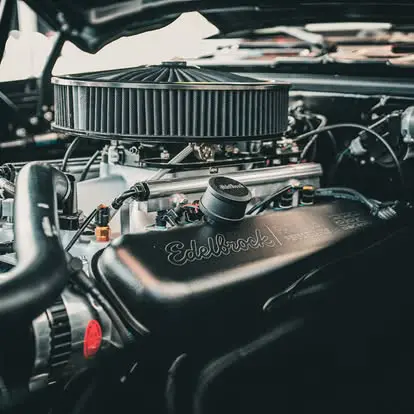
The refining process eventually included a revised camshaft profile and successive generations of electronic fuel injection. The current Pro-Flo 4 version is the configuration Edelbrock sells most often, and the one Wagner said benefits most from the years spent sorting out starting, hot restarts and everyday drivability.

The advertised numbers are 697 horsepower and 643 pound-feet of torque. Wagner said a recent engine produced approximately 705 horsepower, though Edelbrock has continued advertising the lower figure.
There are 555-cubic-inch combinations on the market with considerably larger horsepower numbers. Wagner does not attempt to argue otherwise, and that helps explain what this engine is supposed to be.

“We wanted to make it a very streetable, dependable, and reliable engine, not maximum horsepower,” Wagner said. “We knew we could lean on it pretty hard to get more horsepower out of it, but we didn’t want a horsepower number.

“We wanted something that would go in a car and could be driven daily and not have to worry about using a super low tension ring pack or anything like that to get power with. We wanted to make sure that everything we put in it was reliable and would last a long time for everyday use. We didn’t want it to be a race car engine. We wanted it to be a streetcar engine.”

Musi has spent much of his career building engines where horsepower comes first. The 555 was built for a customer who still wants big-block power but doesn’t want to fight the engine every time the car leaves the garage.

One answer can be found at idle. Wagner said the engine pulls roughly 14 inches of vacuum, enough that a car equipped with vacuum-assisted power brakes should not require a separate vacuum pump or hydraulic brake booster. That may not carry the appeal of a 900-horsepower dyno pull, but it matters considerably more when maneuvering a heavy Chevelle through traffic.

The engine’s physical foundation also keeps it familiar. Musi said the 555 is based on the Mark IV platform and will install much like a 454 LS6, making headers, pulleys and other supporting pieces readily obtainable.

“The guy that’s got an old Chevelle, an old Camaro, but we got guys, those ’69, ’70 pickup, Chevy pickup, just about anything,” Musi said. “We’ve had guys take them and run mud racing with them. It’s crazy. It’ll bolt in just like a 454 LS6. It’s based on a Mark IV platform. So it’s pretty easy to get headers for, pulleys for.”
The 555’s roots go back to a conversation between Musi and the late Vic Edelbrock Jr. nearly 18 years ago. Edelbrock wanted something for the street and asked Musi what they could build.

Musi suggested 565 cubic inches. Edelbrock had another number in mind.

“So Vic came to me, I don’t know, maybe 18 years ago now. He’s calling me kid, imagine,” Musi said. “But I was a kid to him. He said, ‘Kid, what can we build for the street?’ So I said, ‘Well, we can do a 565.’ He said, ‘Well, what about a triple nickel 555?’ I said, ‘Done.”

“So I went back. And the first one went is his personal red Chevelle that he did the Hot Rod Power Tour with. So that was pretty cool. It was his idea, and that’s how it got started.”

The engine has changed less mechanically than one might expect over that span. Wagner said the oil pan was modified to accommodate a wider range of installations, while the camshaft received a relatively modest update.

Fuel injection has undergone the most significant evolution, progressing from Pro-Flo 2 through a brief Pro-Flo 3 period to Pro-Flo 4. The latter is designed more around production-style street use than a racing application.

A big horsepower number wasn’t going to mean much if the 555 was a handful in traffic. Wagner said considerable work went into cold starts, hot restarts and getting the engine to behave at low speeds.

“And the startup is one of the things that is really good on it and a lot of people just really don’t appreciate all that much, is how easy they start and hot restart and cold restart,” Wagner said. “There’s a lot of systems out there that I’ve run, and the thing has to crank and crank. People nowadays kind of expect them to start like a Lexus or a brand-new GM truck or something like that, where you just push the button, and it fires right up.”

That did not happen immediately. Wagner said getting those characteristics right required considerable development, particularly as the fuel-injection system evolved.

“Getting that hot restart and everything on these types of engines is really tough,” Wagner said. “It took us a while to get it sorted out. The very first iterations of it weren’t nearly as good as it is now. And that’s primarily because the fuel injection system helps that. And then just the hours and hours and hours of fine-tuning that we’ve put on it has helped a tremendous amount.”

There is another element Musi believes matters to the customer: the engine is not shipped as a collection of expensive parts, leaving the owner to find someone capable of making them work together.

The engines are assembled at the Edelbrock Race Center housed in Musi’s facility. Some of the same personnel who work on his large-displacement nitrous racing engines are involved in the crate-engine program.

“They’re all built at the race center, which is housed in my building,” Musi said. “So the same guys are working on the big nitrous motors. We assemble them there. We build them. We put the map in it. You get it. So you, as a consumer, have to plug three wires in, run your fuel system, you’re done. You have the tune in there. You don’t have to call a tuner in. You just go out.”

Wagner describes it in less colorful terms, but the point is the same. The Pro-Flo 4 calibration is intended to arrive close enough that an owner should not need a dyno appointment to make the car usable.

“The thing that we like to really emphasize is how the tune-up on it is ready to go,” Wagner said. “You should have just very, very minor personal adjustments on it if you want to idle a little higher, a little lower, things like that. You don’t have to take it to a Dyno shop to have it dyno’d for you. You should be able just to set it and forget it to some extent.”
Those adjustments can be handled through a mobile phone or tablet rather than requiring a laptop. That is another departure from the days when aftermarket EFI could turn a Saturday cruise into a computer exercise.

There is room for more power, and Wagner readily acknowledges it. A newer camshaft profile could probably squeeze more from the combination, but he questions whether the additional number would be worth the cost of what might disappear elsewhere.

“Gosh, if we wanted to improve on it, we could probably try to maximize the camshaft profile just a little bit more with the little later technology that we have now with COMP Cams, and maybe make a little more peak power with it,” Wagner said. “But quite honestly, I wouldn’t want to sacrifice the drivability of it, because if you get in one of these and just drive it around, the thing is… not saying it’s the best thing out there, but it’s really good. I mean, it’s very easy to drive.

“You don’t have to worry about, let’s say, the off-idle cruising through parking lots, and parking, and the thing wanting to be all lopey, and hard to ease into parking spots and things like that, like a lot of stuff is. It’s just very, very docile and very, very easy to drive.”

That might be the fairest way to judge the Musi 555. It does not pretend to be the highest-horsepower crate engine available, and its builders concede that more power could be extracted if they were willing to change priorities.

Nearly 20 years after Vic Edelbrock Jr. asked Musi what they could build for the street, those priorities remain largely where they started. It is still a 555-cubic-inch big-block built for someone who wants the sound, torque and personality of an old-school Chevrolet without having to treat every trip across town like the first round of qualifying.

“And it’s all about a brand, but we want to give the consumer… I want to give them what I would want,” Musi said. “We got a lot of phone calls. They buy an engine. Now, they got to buy a standalone ECU, a turnkey, three wires, plug it in, go. So we’re proud of that fact. So we made it easy for a guy in his garage to put it in. We can recommend header sizes, transmissions, that kind of thing.”


Picture of John Doe

John Doe

Lorem ipsum dolor sit amet consectetur adipiscing elit dolor

More Posts

Send Us A Message

Picture of Bobby Bennett
Bobby Bennett
Thank you for joining us on this journey. Your support and trust inspire us every day to deliver the best in drag racing journalism. We are excited about the future and look forward to continuing to serve you with the same dedication and passion that has defined CompetitionPlus.com from the very beginning.

Don’t miss these other exciting stories!

Explore more action packed posts on Competition Plus, where we dive into the latest in Drag Racing News. Discover a range of topics, from race coverage to in-depth interviews, to keep you informed and entertained.