

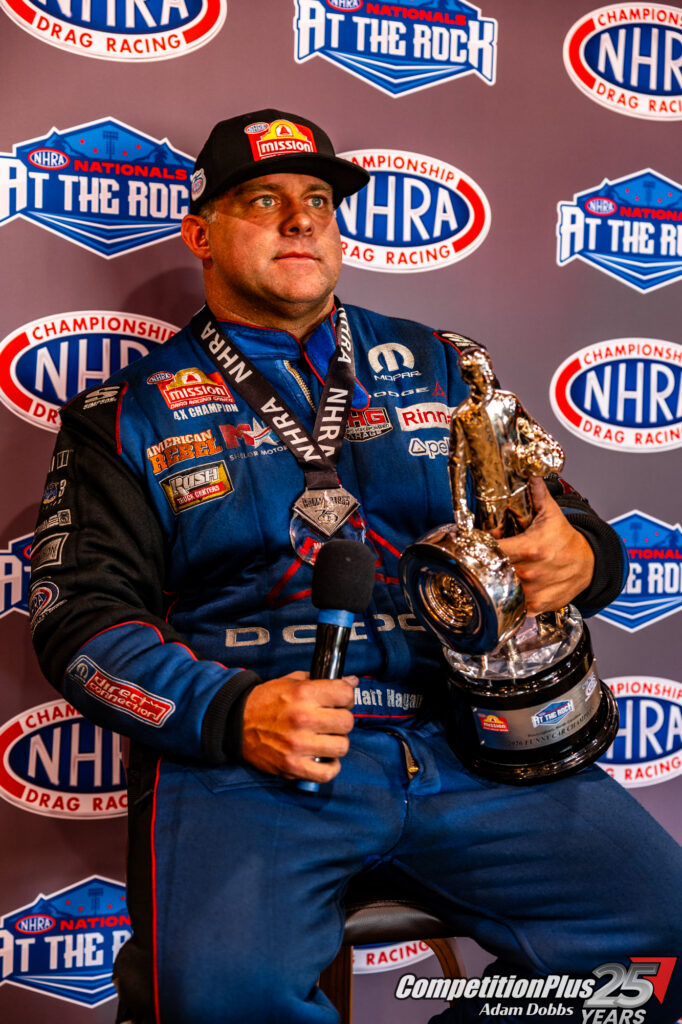
Matt Hagan remembers when NHRA tried to mandate Funny Car body tethers, only to make them optional after Don Schumacher Racing threatened to park its race cars. More than a decade later, the four-time world champion is wondering what it will take to get the sanctioning body to reconsider a rule he believes could eventually kill somebody.
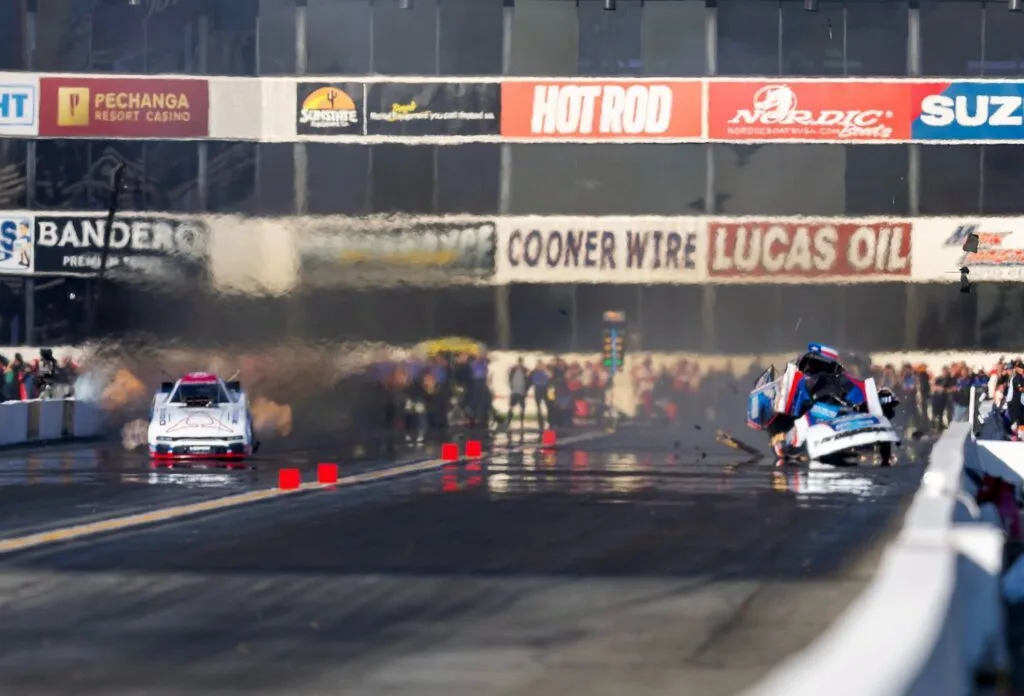
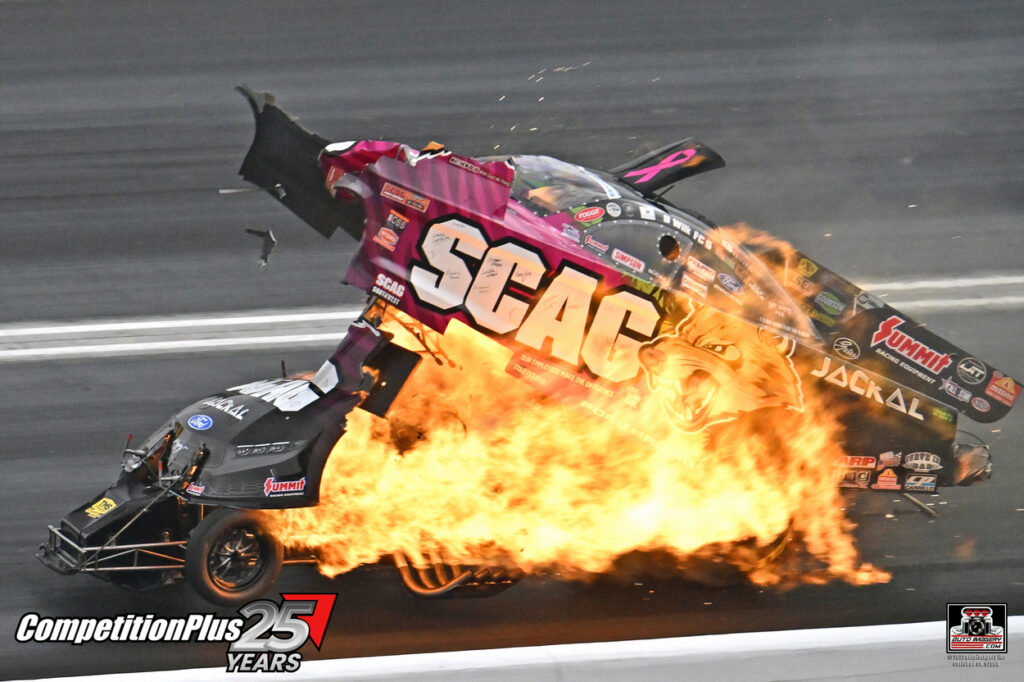
Terry Haddock’s Funny Car exploded Saturday at Pomona, tearing his Mustang body apart before the car struck the wall. Haddock couldn’t get out until safety workers removed the wreckage covering his cockpit.
Hagan took to Facebook afterward, demanding NHRA remove the mandatory body tethers.
“Hey NHRA I’m begging you to take the damn tethers off, enough is enough with this!!” Hagan wrote on Facebook. “We should not have to go through this as drivers and team owners, ruining chassis’s and hitting walls every blowup. You can’t see. You can’t steer. The parachutes are not coming out. You’re trapped in the car. The fires are bigger.”
“I cannot understand these team owners are not up in arms about this,” Hagan said. “It puts their drivers in an unsafe condition and not only that costs them a lot of money. If they all stepped up, we might see some action.”
This wasn’t Hagan’s first public confrontation with NHRA over tethers. In September 2025, after suffering his third body-destroying engine explosion in two races, including testing, Hagan unloaded on the sanctioning body at Maple Grove Raceway.
“This NHRA tether rule is ridiculous,” Hagan told CompetitionPlus.com at the time. “It’s going to get a driver killed. I couldn’t see where I was at. I couldn’t see where the other driver’s at, couldn’t see anything. You’re just along for the ride.”
Two months earlier at Sonoma, Daniel Wilkerson and Buddy Hull suffered separate engine explosions that left both drivers dealing with the consequences of damaged Funny Car bodies.
Hull’s Funny Car body ripped apart, sending debris into the cockpit and severely injuring his left hand. The injury required surgery and rehabilitation, forcing him to miss seven races before returning at Las Vegas with additional protective cockpit shielding.
Wilkerson escaped his July 2025 Sonoma explosion without injury, although the tethered rear section of his Mustang body obstructed his vision. He feared crossing into Chad Green’s lane because he couldn’t determine where his race car was headed.
The Wilkerson family subsequently worked with chassis builder Murf McKinney on an alternative system intended to relieve explosion pressure while controlling the body’s movement. Their design showed promise earlier this season before receiving its toughest examination at Las Vegas, one race before Pomona.
Daniel’s Mustang erupted in flames, shredding the body and sending the chassis into the wall. He remained trapped under a protion of the body where he heat was so intense that it melted his helmet shield, leaving him struggling to see while trying to avoid J.R. Todd in the opposite lane.
“The reason I couldn’t see was because my shield actually melted,” Wilkerson told CompetitionPlus.com. “It melted and got foggy.”
Wilkerson said his gloves and firesuit sleeves became extremely hot, although he didn’t immediately realize how much heat he had experienced. Unlike his earlier Sonoma explosion, he believed the body separating from the car had worked in his favor.
“I was glad that the body did that,” Wilkerson said. “I mean, the body worked in my favor on that one, honestly.”
Hagan gave Tim Wilkerson and McKinney credit for attempting to improve the system, even though their latest design couldn’t withstand the Las Vegas explosion as intended.
“The only person that’s tried anything is Wilkerson and God bless him,” Hagan said. “I mean, it didn’t work, but God bless Murf and Wilk and those guys got together and said, ‘Well, let’s try it.’”
Hagan remembers what happened when his Don Schumacher Racing teammate Johnny Gray suffered an engine explosion and found himself trapped beneath the Funny Car body. According to Hagan, Gray was so fed up that he threatened to pull his sponsorship unless something was done about the tethers.
Hagan said he also opposed the tethers, prompting Schumacher to confront NHRA with the possibility of parking his entire operation. He recalled the sanctioning body responding by making the equipment optional.
“Don went to NHRA and he said, ‘We’re going to park all of our cars, including our dragsters and everything. We’re not going to run,’” Hagan said. “And NHRA said, ‘Well, no. We can’t have that.’ So they made it optional.”
Hagan also remembers confronting an engineer at the Don Schumacher Racing shop during the early development of the tether system. The engineer explained how the equipment was supposed to function, but Hagan wasn’t convinced that calculations on paper could account for what happened when a nitro Funny Car exploded.
“It was to the point where you couldn’t talk any sense to him,” Hagan recalled. “He was just like, ‘Well, this is physics and this is how this is going to work and this is why,’ and yada, yada, yada. And it couldn’t be wrong and it had to be right.”
Hagan decided to offer the engineer a demonstration, using a Funny Car engine that he estimated cost approximately $150,000 at the time. His proposal didn’t involve putting the engineer inside a race car, either.
“I said, ‘Well, bud, I tell you what, this motor here back in the day is about 150 grand,’” Hagan recalled. “I said, ‘We’re going to put it up on the jack stands and it’s not even moving. It’s just going to be on the jack stands. I’m going to blow it up in your face and you tell me what you think about the experience.’”
According to Hagan, the engineer wanted no part of the demonstration. That was exactly the reaction Hagan had hoped to get.
“I was like, ‘Well, you’re asking me to trust you with what you’re trying to design and go through those explosions. Well, why wouldn’t you take one to the face right off the rip just to make sure I feel better about it?’”
“The racetrack and the race car is the dyno when you test parts and pieces because you don’t know how it’s going to react with that kind of energy,” Hagan said.

The rules changed again following Robert Hight’s 2013 Charlotte explosion, which launched Funny Car bodywork into the spectator area. NHRA subsequently mandated body-retention equipment intended to prevent another such incident.
Hagan even suggests moving grandstands farther from the racing surface, as well as limiting seating near the starting line or installing additional protective barriers. He questioned why those alternatives weren’t receiving more consideration.
Hagan hasn’t forgotten what happened to John Force at Richmond in 2024. Force suffered a traumatic brain injury in that crash, and Hagan believes the tethers contributed to its severity, although there has been no independent confirmation of that claim.
“Out of the six explosions I had last year, three of them I had no control over and you’re just along for the ride,” Hagan said. “And that is a helpless feeling being strapped into something at 300 miles an hour that you have zero control over.”
Hagan said he approached senior NHRA officials at Pomona after posting his criticism on social media. He wanted an about what would be necessary to eliminate the mandatory tethers and said nobody provided an answer.
He also believes some drivers are reluctant to speak publicly because they fear losing their rides. Hagan described conversations with younger driver Jordan Vandergriff, who had approached him seeking advice about surviving a major Funny Car explosion.
“F***ing pray, bro,” Hagan recalled telling Vandergriff. “You’re along for the ride. You know what I mean?”
Haddock proposed a single tether that would allow the body to separate from the chassis while remaining attached behind the race car.
“The problem with all this stuff is that they’ve made everything so strong, meaning the double latches, the tethers, that the whole thing ties itself together,” Haddock said. “I understand that to protect the fans, but there’s a better way of doing this.”
“But the worst part of what happened to me on Saturday is I’m trapped in there with the fire and all the stuff and I can’t get out, I just had to sit there and wait for someone to come get this piece of … Well, yeah. To get this body off the top of me.”
Hagan contends he will scream from the mountaintops about the tethers, and eventually, he says, it will affect someone else so he isn’t the only vocal critic.
“Well, it ain’t going away with me,” Hagan said. “I’m the only one saying anything about it.”