

A lot can change in 30 years, and when eight-time NHRA Top Fuel champion Tony Schumacher rolled through the gates at Indianapolis Raceway Park as a first-time Top Fuel racer, he could have had no idea where life would take him over the next three decades.
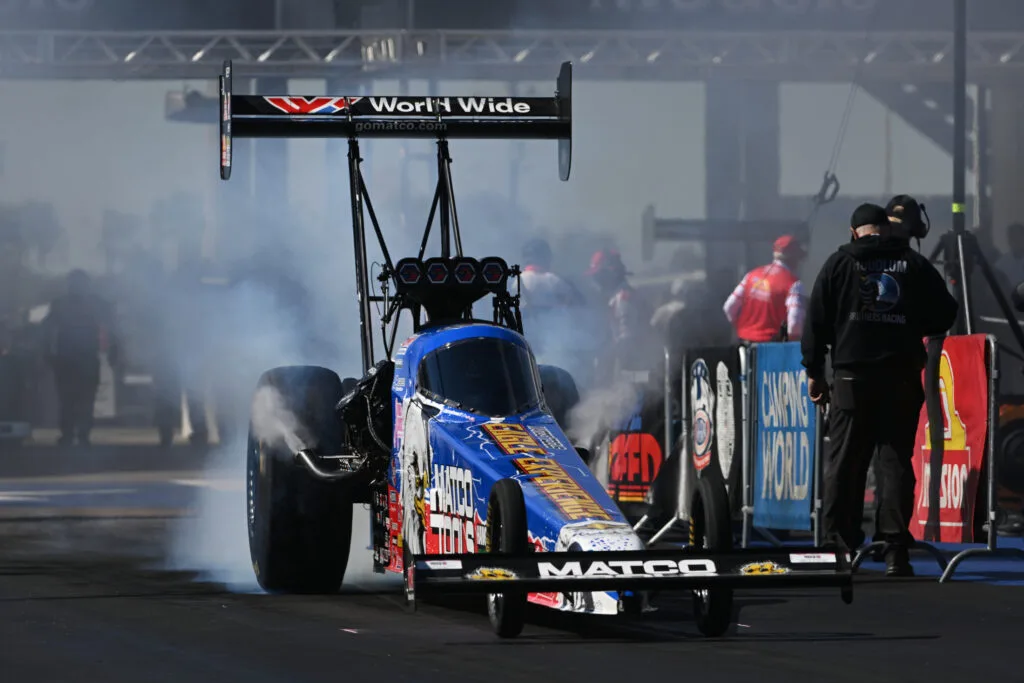
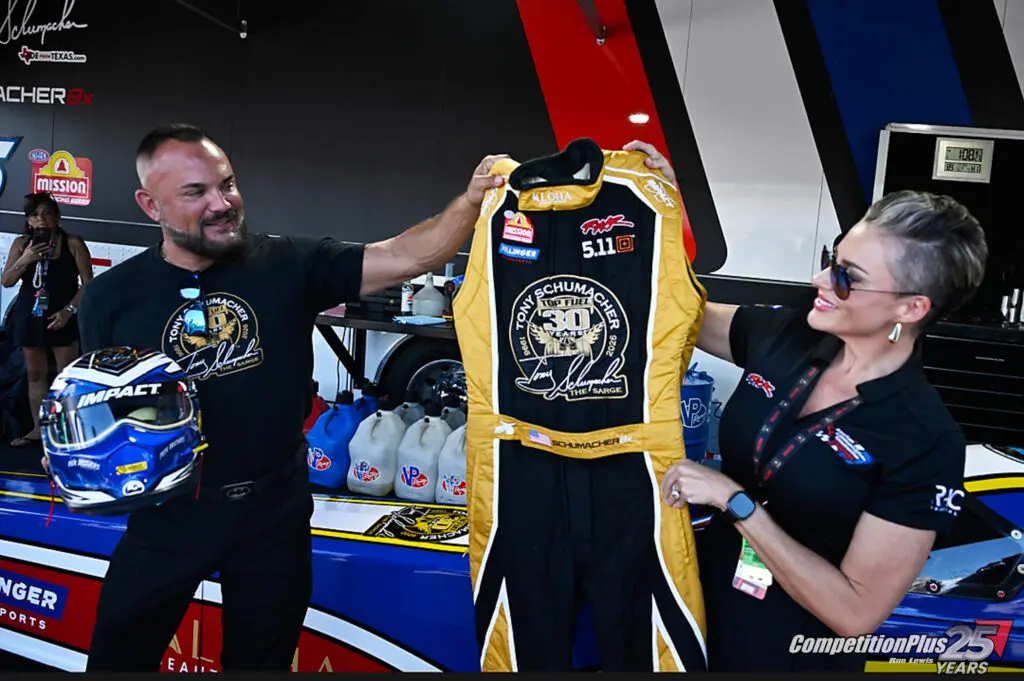
Schumacher returned to the NHRA U.S. Nationals this weekend with 88 national event victories and a career that eventually made him the winningest Top Fuel driver in NHRA history. His team provided the reminder by unveiling a throwback scheme patterned after the dragster he drove at Indianapolis in 1996.
The surprise brought Schumacher back to a time when championships and record books weren’t part of the conversation. At 26, his immediate concern was considerably more basic.
“I was just hoping the darn car starts,” Schumacher said when asked what he would have thought in 1996 if someone had predicted what was coming. “To be honest, I had met these guys a week ago. We were having the time of our life. I flew down there. The story is so nuts because I flew down to meet Mike and Greg Peek. I didn’t know what levers to pull. I didn’t know where the throttle pedal was, brake handles were.”
There was no carefully mapped path toward Top Fuel greatness.
Schumacher had found himself strapped into one of the quickest breeds of race car in the world while still figuring out who around him was going to show him how to operate it.
“I get down there and they’re like, ‘All right, let’s go,'” Schumacher said. “I got in the car and we went to start this thing. And I thought, I looked around and realized there’s not even someone here that’s ever driven one of these. Who’s really going to teach me? I look back on it and all of them were really good at what they did. They had all been around Clayton Harris, tons of race cars before that. I just didn’t know them. And I’m sitting in that car.”
Schumacher wasn’t contemplating championships. Instead, he was just trying to survive the major learning curve in front of him.
“If you would have told me 30 years ago, ‘Your future’s bright.’ I’d have said, ‘Man, I’m not even thinking about a future. I’m thinking about tomorrow,'” Schumacher said. “And I tell all kids this, at the age of 26, you’re not looking into the future. You’re wondering what happened yesterday and what might happen tomorrow, and that is the vision you have.”
This past Tuesday marked 30 years ago that Schumacher made his first race day.
The 1996 U.S. Nationals offered Schumacher more than most rookies could have expected to process. He qualified No. 16 in a field loaded with established Top Fuel teams, earning a first-round pairing against No. 1 qualifier Blaine Johnson.
Johnson never made it to race day. He was killed in a qualifying accident Saturday, leaving Schumacher with a first-round single and a memory that would remain tied to his first Indianapolis appearance forever.
Schumacher kept going and reached the final round, where Cory McClenathan ended his improbable run. A rookie who had barely accumulated Top Fuel seat time before arriving at Indy suddenly had a U.S. Nationals runner-up finish.
Even getting there had been rushed. Schumacher had gone to Denver the previous weekend to earn his Top Fuel license and arrived at Indianapolis without having made a full run.
“I literally had not made a full pass on a Top Fuel car until we got to this track,” Schumacher said. “And when we got here, it was Denver. So I flew into Denver, got the job, flew home, got a fire suit, went back, licensed on Friday, Saturday and Sunday the week before Indy. But we smoked the tires. It’s a really hard place to run. It’s nothing like coming down here and running all of a sudden. You got air and you got volumes and performances that you don’t see in Denver. That was the first time I had to hit the gas pedal. So pretty unique. And then there were 24, 26 cars. There were quite a few great cars that didn’t qualify at that race.”
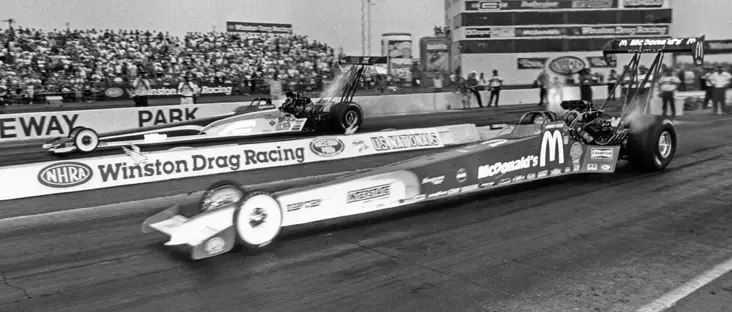
Thirty years later, Schumacher can now appreciate how much was coming at him. At the time, there wasn’t much opportunity to process any of it.
“We’re up against the Johnsons,” Schumacher said. “It’s so many things happened that weekend and the weekend before. It was overwhelming for a young kid like myself. The amount of stuff that was thrown at me to see at my first race was incredible.”
Indianapolis eventually became one of the defining tracks of Schumacher’s career. He won the U.S. Nationals 10 times, including six consecutive years from 2002 through 2007, turning the race that introduced him to NHRA’s biggest stage into one he owned for stretches of his career.
The place also carries the other side of the ledger. Schumacher cannot look back at 1996 without remembering Johnson and the first-round race that never happened. He couldn’t imagione that one day he would see drag racing in the same vein as a young driver who knew how to command respect.
“Guys like Blaine Johnson and Darrell Russell, they had so much ahead of them,” Schumacher said. “It’s really hard to compare yourself to those guys because you don’t know how high they would’ve gone. Blaine would’ve been a multi, multi-year champion. They were that far ahead of the rest of the world and Darrell was just a kid, but just starting to peek with a [inaudible] car. Those are great questions. You look back and you think, ‘Did I ever, have I even reached this? So we’ve got 88 wins and eight championships, what would they have had?’ You just don’t know.”
It’s that thought process that shapes how Schumacher views his place alongside the racers whose records he eventually surpassed. Numbers can establish where a driver sits in a record book, but Schumacher isn’t interested in pretending every generation raced under identical circumstances.
“Glad that I’m here, glad that I’ve been through some real bad crashes and I’m still driving these things, but it’s really hard to compare,” Schumacher said. “People ask me about Big Daddy [Don Garlits] all the time. They go, ‘Well, you’ve won more.’ Well, hang on for a second. They had eight races a year. What if they had 20, 25 races a year their whole career? What number would they be at? It’s not a fair comparison. Those guys were a legend.”
Schumacher has also worked with some of the most successful crew chiefs in Top Fuel history, including Dan Olson, Mike Green and Alan Johnson. The combination produced championships, landmark victories and numbers the 26-year-old rookie at Indianapolis couldn’t have reasonably imagined.
“I’m pleased with where I’m at.,” Schumacher said. “I think we’ve done a great job with Dan Olson, with Mike Green, with Alan Johnson. We’ve won championships, finished second with Mike Neff. I’ve had a lot of good ones, but it’s really hard to compare because apples and oranges; you just can’t add them up and unless we’re fighting the same fight, the same amount of races, the same time, you can’t compare eras.”
His respect runs deeper when Schumacher considers what racers such as Don Garlits and Shirley Muldowney endured to build the sport he inherited. Their version of Top Fuel bore little resemblance to the highly specialized teams Schumacher raced with during his championship years.
“Those racers, [Don] Garlits, Cha Cha [Muldowney], them people, they ran the race, drove the car to the next race, the next day, there were 200 cars trying to make the show,” Schumacher said. “It’s a whole different world. It’s mind-blowing. But what they did is they gave us a stage.
“And they said it, ‘On the shoulders of Giants.’ Those guys were the people that brought the fans in at the beginning to give us an opportunity to race under the best racing sanctioning body there is.”
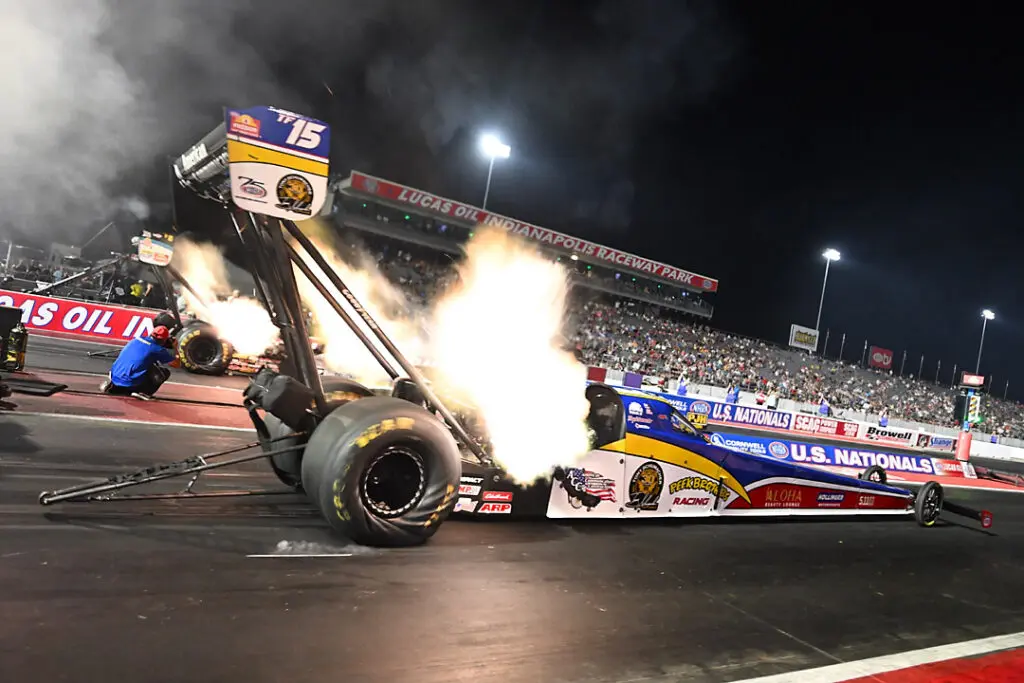
The throwback dragster that brought his 30 years together without Schumacher knowing it was coming. His wife, Summer, helped organize the surprise, and Mike Peek’s appearance made the connection to 1996 complete.
“I thank my wife, Summer, for putting this thing together, I had no idea,” Schumacher said. “I knew there could be a different car because they were asking about paint jobs. No one asked me about anything like that. When I saw Mike Peek here, it was great.”
Schumacher also credited sponsor Aven McBride [American Communications Construction] for surrendering the branding opportunity at the biggest race of the season. For Schumacher, allowing the car to look backward instead of serving as a conventional sponsorship platform said plenty about the people around him now.
“I thank Aven McBride, who sponsors my car, giving up a whole race in not only a race, but Indy to have a paint job just to show appreciation is so him,” Schumacher said. “It’s what he is. He’s a giver, he’s a loving guy. He loves the sport. For him to go out and do something like this for someone he had never met, it shows how blessed I am.”
Thirty years have given Schumacher something the rookie who qualified 16th in 1996 didn’t possess: perspective. He knows what followed that first Indianapolis weekend, but he also knows there is no honest way to determine how he would have stacked up against Garlits, Muldowney or Johnson if time had put them in equal equipment under equal circumstances.
“Man, I don’t know. I think I do a good job against the people I race against now,” Schumacher said. “I think that the level of competition is insane. It’s different than it was then, but those guys were as good as they could drive them. That’s like saying, how come you go faster? I go faster. I got a bigger tire. I got more horsepower.
“I don’t know if it was the same time and we ran the same people, what it would’ve been like. Would I have stepped up and beat them? Would I have been competition? I’m just thankful they did what they did and pass it on to me.”
That’s gratitude that never wears off, no matter how many decades pass.