

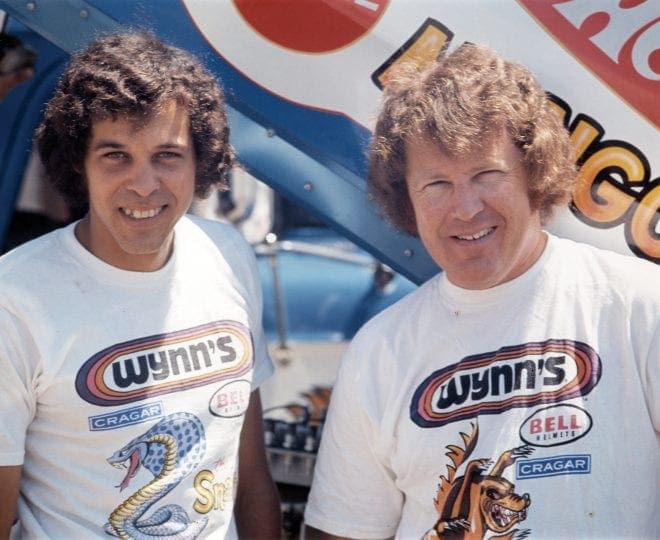

If Don “The Snake” Prudhomme and Tom “The Mongoose” McEwen were the litigating type, they could have made a case against the creators of The Odd Couple for borrowing from their lives, because everything about them screamed contrast. They were polar opposites in temperament, approach, and philosophy, yet somehow found common ground in the one place neither would ever compromise, the racetrack.
One was driven by precision and an unrelenting need to win, the kind of competitor who would sacrifice equipment and sanity for a finish-line advantage, while the other understood the bigger picture and could turn a single match race into something larger than the result. Together, they didn’t just race, they changed what Funny Car could be, building something that extended beyond competition into culture, business, and identity.
Prudhomme still traces it back to a moment that didn’t feel historic at the time, a simple exchange at Lions Drag Strip when the sport was still raw and unpolished and racers were pushing cars to get them started. “Well, first time I met him was at Lions Drag Strip and I was in a little T roadster that belonged to Ivo and I was pushing Ivo,” Prudhomme said. “Mongoose was standing by the gate when I was driving there and he goes, ‘Hey, can I ride with you?’ I said, ‘No, man.’ I didn’t even know him.”
That wasn’t the beginning of a friendship, at least not in the traditional sense, because it started with distance and turned into friction before it ever resembled respect. “And he kind of busted my balls ever since then, but we’ve become the best of friends,” Prudhomme said. “Way before the Hot Wheels deal, we were buddies. He’d come out to the valley and we had Triumph motorcycles and we’d go into Hollywood, do all kinds of s***.”
What developed between them wasn’t built on immediate chemistry but on shared miles, shared risk, and a mutual understanding that both were chasing something bigger than a single win light. Prudhomme was wired to dominate the racetrack with a narrow focus, while McEwen saw the broader opportunity and understood how to connect the sport to fans, sponsors, and promoters in ways few others could at the time.
“That’s a good question,” Prudhomme said when asked who did more of the needling between them. “I think we’re pretty even, because he busted my balls, but he just had the greatest sense of humor. Tom… he was the best. He was really the best.”
That difference in personality didn’t weaken their bond or their rivalry, it sharpened both, creating something promoters couldn’t script and fans couldn’t ignore. What people saw wasn’t an act, it was two men who genuinely wanted to beat each other while somehow managing to stay connected when the engines were off.


There has always been a misconception that the Snake and Mongoose rivalry was choreographed, a traveling act built for ticket sales and nothing more. The truth is it was real, and it was often personal.
“We were always friends, but there was a real rivalry,” Prudhomme said in a 2018 reflection with NHRA’s Phil Burgess. “I would blow the engine out of the car if that was what it took to beat him and he’d burn his car to the ground to beat me.”
That wasn’t theater. That was pride, and it extended beyond the drivers into the people around them.
“We had crews back then… and it got so bad the crew members wouldn’t even talk to each other,” Prudhomme said. “It was like two brothers fighting. That’s pretty much what it was.”
The tension didn’t break them apart, it made them better, forcing both sides to operate at a level where mistakes were costly and hesitation wasn’t an option. Every run mattered, every matchup carried weight, and neither man was wired to back off.
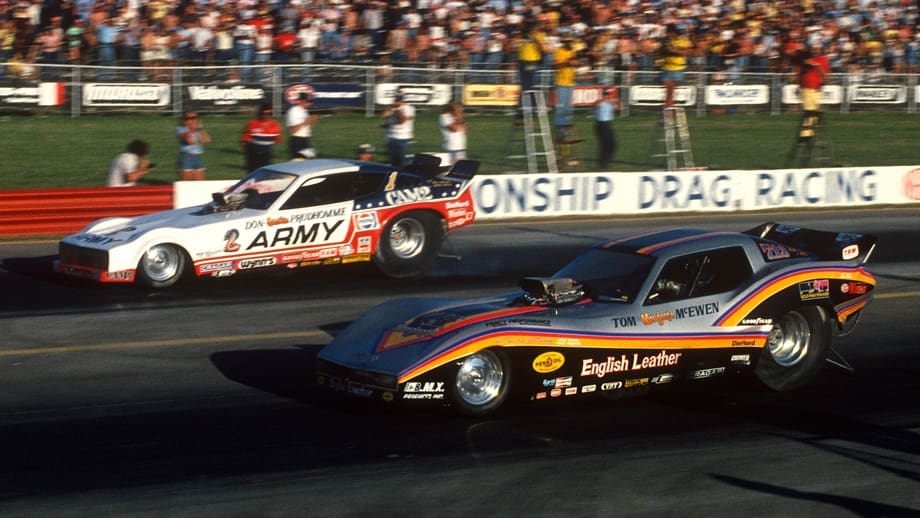
The mythology surrounding their rivalry reached its peak at the 1978 U.S. Nationals, a race framed by personal tragedy after McEwen lost his son, Jamie, to leukemia just weeks earlier. Over time, the story softened, suggesting emotion might have influenced the outcome.
Prudhomme has never allowed that version to stand. “Oh, yeah. Yeah, absolutely. No, no, no, no,” he said. “We come up to run… I’m there to blow his ass off.”
The truth of that race lies in execution, or more accurately, a lapse in it that Prudhomme still owns. “We were running good, better than him,” he said. “But to be honest… we got a little lazy… didn’t service the clutch. It blew the tires off me.”
There was no charity, no easing up, and no rewriting of intent after the fact. There was only the understanding that sometimes the outcome carries meaning beyond the mistake.
“It was meant to be. It was his race,” Prudhomme said. “I couldn’t be happier. It really made our relationship.”
Even with time adding perspective, Prudhomme never lost the edge that defined him, and he admits that edge often fueled the intensity between them. “Back in the early days, it was more my fault than anything else because I was really a hard-nosed racer,” he said. “If we were having a race… I got nothing in the tank and I’m there to blow his ass off.”
McEwen saw the same environment through a different lens, one that prioritized opportunity and understood the value of presentation alongside performance. “And he’s there to make money or to put on a show,” Prudhomme said.
That contrast became the foundation of something the sport had never seen before, a partnership that balanced raw competition with promotion and brought new eyes to Funny Car. It’s why their impact still resonates, because it wasn’t built on sameness, it was built on difference.
Together, they forced the sport to evolve, showing that drag racing could be both brutally competitive and commercially viable at the same time. That balance changed everything that followed.
What many didn’t fully understand was the imbalance in McEwen’s personal life, where generosity often outweighed self-preservation and impulse often overruled caution. Prudhomme saw it up close, not as an observer but as someone who experienced it repeatedly through years when the lines between racing, business, and life were rarely clear.
“He would come over to my shop… and open up his trunk… and take out a brand new pair of tennis shoes that he bought for you,” Prudhomme said. “I’m not s****** you.”
It wasn’t occasional. It wasn’t calculated. It was instinct, the same instinct that made him a force at the track and a presence everywhere else.
McEwen lived wide open, a natural showman who understood people as well as he understood promotion, someone who could walk into a room and leave with a deal, a story, and an audience. Prudhomme saw that side clearly, the way McEwen worked a crowd, connected with fans, and moved through life with a confidence that bordered on reckless but somehow always landed on its feet.
That personality made him impossible to ignore and, at times, impossible to keep up with, because he wasn’t operating on the same rhythm as everyone else. He wasn’t built to slow down, and he never really tried to.

McEwen’s later years reflected that same independence, a man who never really slowed down or adjusted to doing things any differently. Even away from the racetrack, he remained wired on instinct, living moment to moment in a way that left those close to him both admiring and concerned.
For Prudhomme, the end didn’t come with warning or buildup, just the kind of call that stops everything cold.
“Bibbins called me… said, ‘Mongoose died.’ Get the f*** out,” Prudhomme said.
There was no time to process, only time to react.
“I got in my car and went over there… went upstairs and he was in bed,” he said. “I looked at him, I kissed him on the forehead.”
The image stayed with him, not as a racer recalling a rival, but as someone who had lost a part of his own history, a connection that couldn’t be replaced or replicated. In that moment, everything else fell away, leaving only the truth about who McEwen was at his core.
“He would take care of other people before he would take care of himself,” Prudhomme said. “That’s how Mongoose was.”
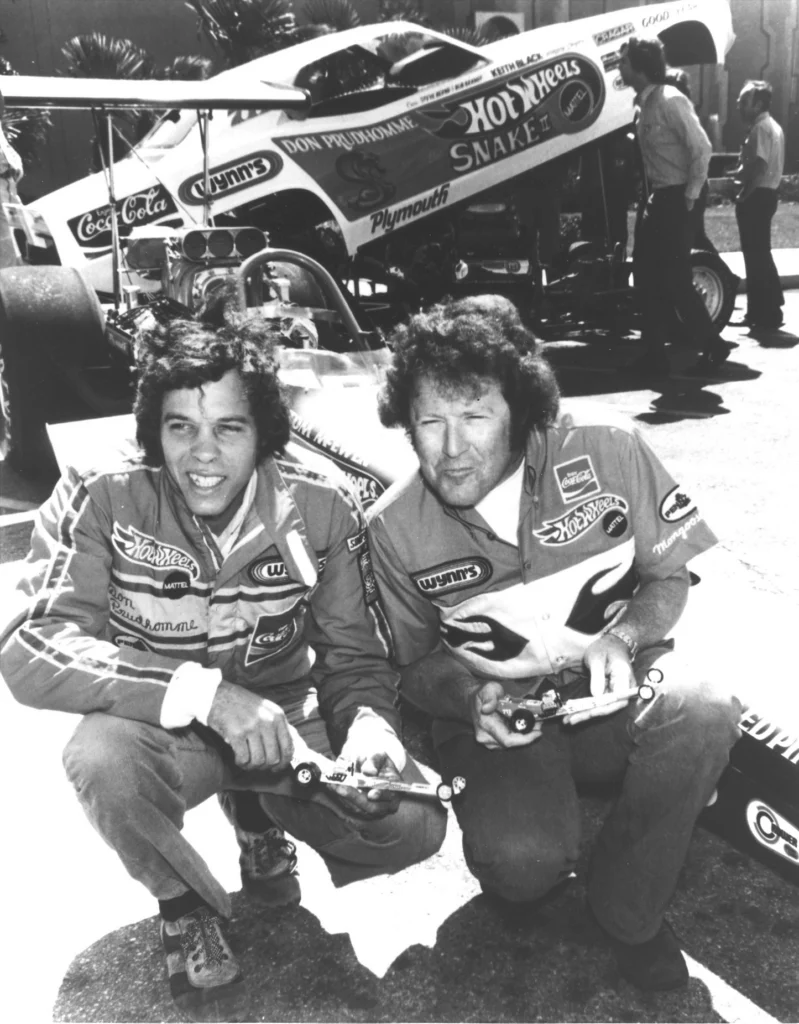
Time didn’t erase the edges of their relationship, but it clarified what mattered, allowing Prudhomme to see it differently than he did when competition defined every interaction. “I think so,” he said when asked if their bond grew stronger later in life. “Yeah, it was.”
They argued, separated, and reconnected, following a pattern that mirrored family more than rivalry, built on a shared past that couldn’t be replaced and a connection that never fully went away. “We’d argue like cats and dogs but when it came time to stick up for one another… we were ready to fight for each other,” Prudhomme said.
In the end, what remains isn’t just the wins, the losses, or the moments that filled grandstands, but a relationship that defined an era and set a standard that hasn’t been matched. “Those were great days,” Prudhomme said. “Those were unbelievable days.”
He let it sit, then said what mattered most.
“He was the best.”
























REYES ON TOUR: INVASION OF THE CHEVROLET VEGA — PART 1