
Mountain Motor Pro Stock isn’t supposed to work like this anymore.

The class is deeper than it’s been in years. The competition is tougher. The costs continue to rise. Conventional wisdom says the teams with the biggest budgets should eventually separate themselves from everyone else. Three weeks ago at the IHRA Spring Nationals, Matt Giangrande reminded everyone that drag racing doesn’t always follow conventional wisdom.

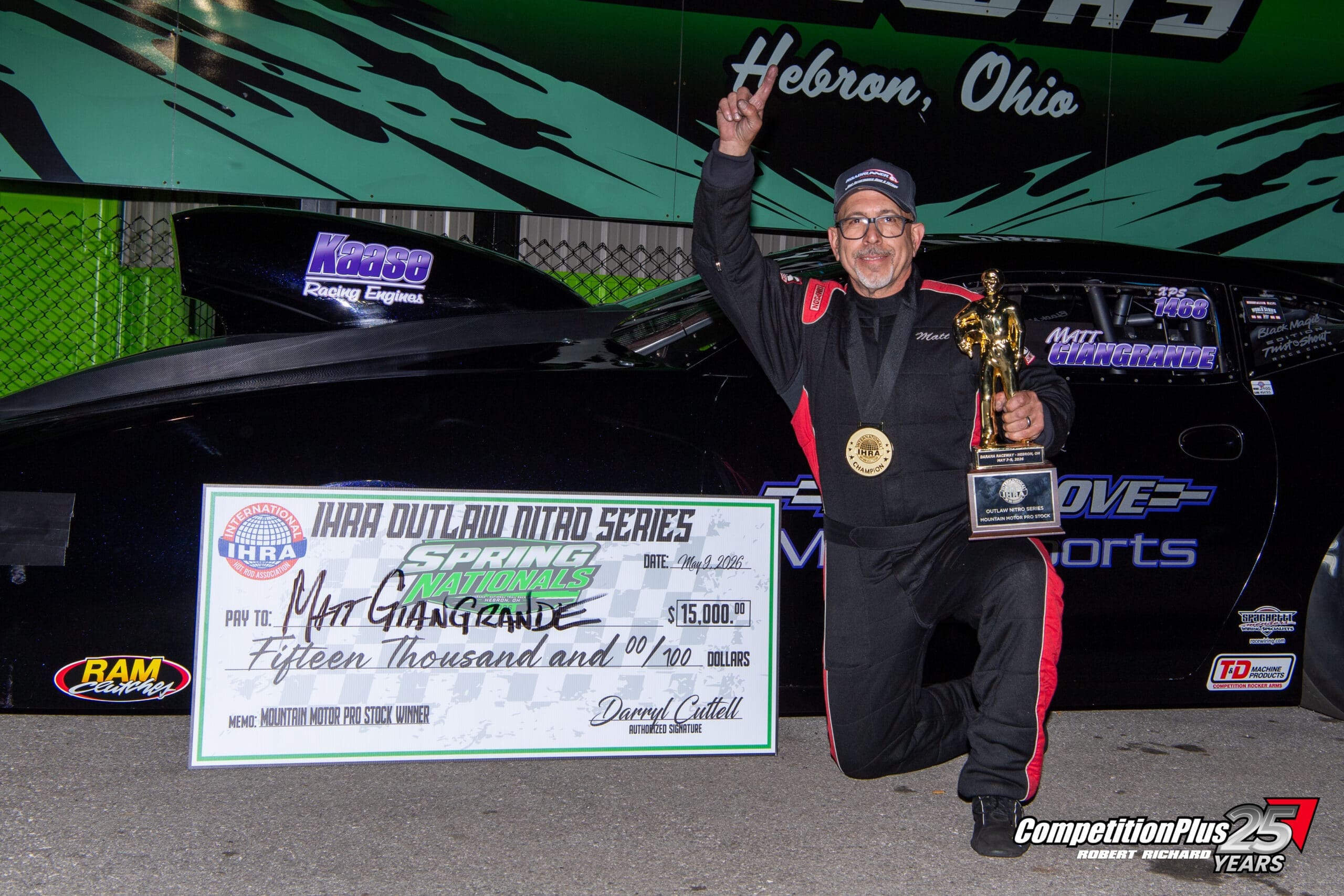
Giangrande defeated Jerry Tucker in the final round to earn his first IHRA Mountain Motor Pro Stock victory, becoming the 77th different winner in the category since 1977. Tucker was quicker, running a 4.043-second pass to Giangrande’s 4.078, but Giangrande’s .010 reaction time at the starting line proved to be the difference.

The final round lasted four seconds. The journey to get there took 45 years.

“I can’t tell you how bad we wanted to win one of these,” Giangrande said after the victory. “Enoch’s been trying a long time. Boy, this one’s for him. My team worked so hard.”

Giangrande reached the final round by defeating Brad Waddle, Dwayne Rice and Alan Drinkwater. The path wasn’t easy, but neither has been much of anything during a racing career built on finding ways to compete against racers with more resources. For those who know Giangrande, the victory wasn’t simply another race result. It was validation for a racer who has spent decades doing things differently because he never had much choice.

“Yeah, I would say that’s a very accurate statement,” Giangrande said when asked if his operation fits the underdog label. “I feel like we can very well be the ultimate underdog. I feel like that’s the way my entire racing career has been.”

He’s not a newcomer enjoying a breakthrough moment. He’s a racer who has spent nearly half a century figuring out how to compete against teams with larger budgets and bigger operations.

“I’ve been doing this for 45 years and I feel like I’ve always been a little bit of an underdog because I’ve never had the monetary means, the budget that maybe some of the other teams that I’ve always raced against has had,” he said. “So I’ve always had to figure out another way to go about my racing.”

That usually meant becoming his own solution. Whether it was engines, transmissions, rear-end work or suspension, Giangrande learned long ago that if something needed attention, there was a good chance he would be the one handling it.

“Usually that meant doing as much as you possibly could yourself, whether it was engines, transmissions, rear ends, suspension, all of the things that you usually have certain resources allocated to,” Giangrande said. “I really take pride in knowing a lot about the race car that we race.”
The easy answer in drag racing is money. More money buys parts. More money buys testing. More money provides options when things break or plans go sideways. Giangrande understands all of that. He also knows it isn’t the whole story. While many racers point to budgets as the deciding factor, Giangrande still believes there is room for determination to make up some of the difference.

“I feel like we’ve been a win waiting to happen for a while,” Giangrande said. “And that might be a little cocky, especially when you are the underdog.”

Then he explained why he wasn’t afraid to say it.

“Hard work and determination really means something,” Giangrande said. “And sometimes a lot of people forget that. Sometimes if you don’t have… The answer isn’t always money. Sometimes it’s just hard work and determination and just grit, and I feel like that was it all coming together finally.”

The win may have been credited to Giangrande, but his first thoughts after crossing the finish line weren’t about himself. They were about the people waiting at the starting line.

“Well, it was obviously very, very exciting,” Giangrande said. “And Bobby, the first thing that came to my mind when I crossed the finish line and saw the win light come on was what was going on back at the starting line for my team, because while I get to be in the car and enjoy that four seconds of excitement, that’s something they don’t get to feel. They get to watch it, and it’s a different feeling.”

Giangrande has experienced racing from both perspectives.

“Honestly, that’s what makes it worthwhile,” he said. “I certainly enjoy it. It’s not something I do or take lightly. I take racing very seriously, even though it’s very much a hobby, but it’s my lifestyle. It’s who I am.”

He knew exactly who was back there waiting.

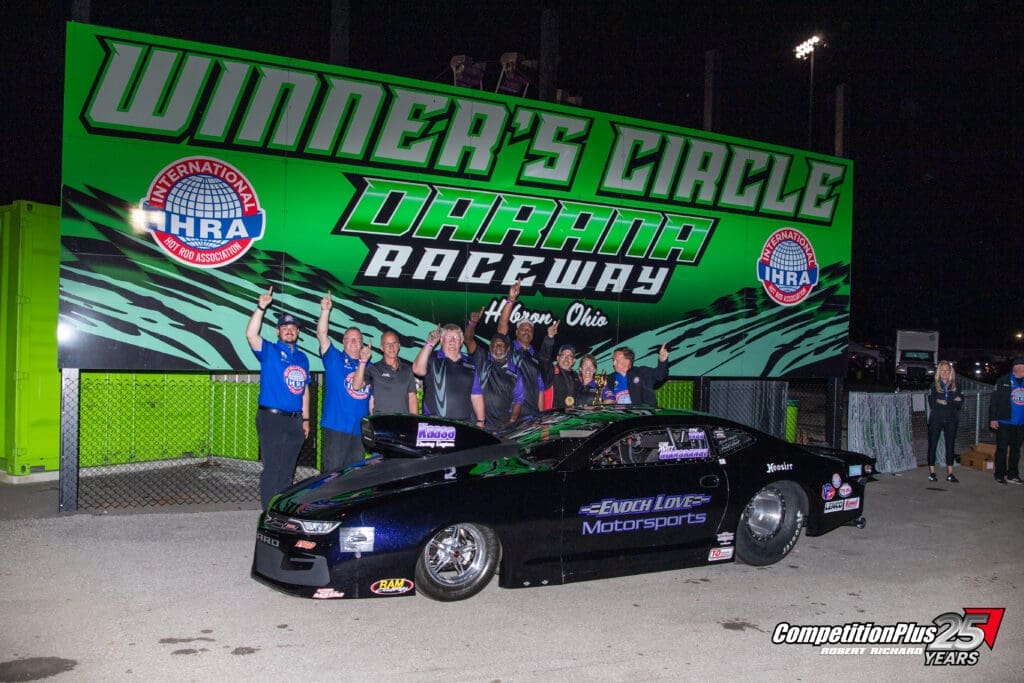
“To know that I had Jennifer and Pat and Tim and Joe and Link and even some other competitors back there watching us in the final, getting excited, jumping up and down, that was really what I was thinking about,” Giangrande said. “Just wanting to be part of that.”
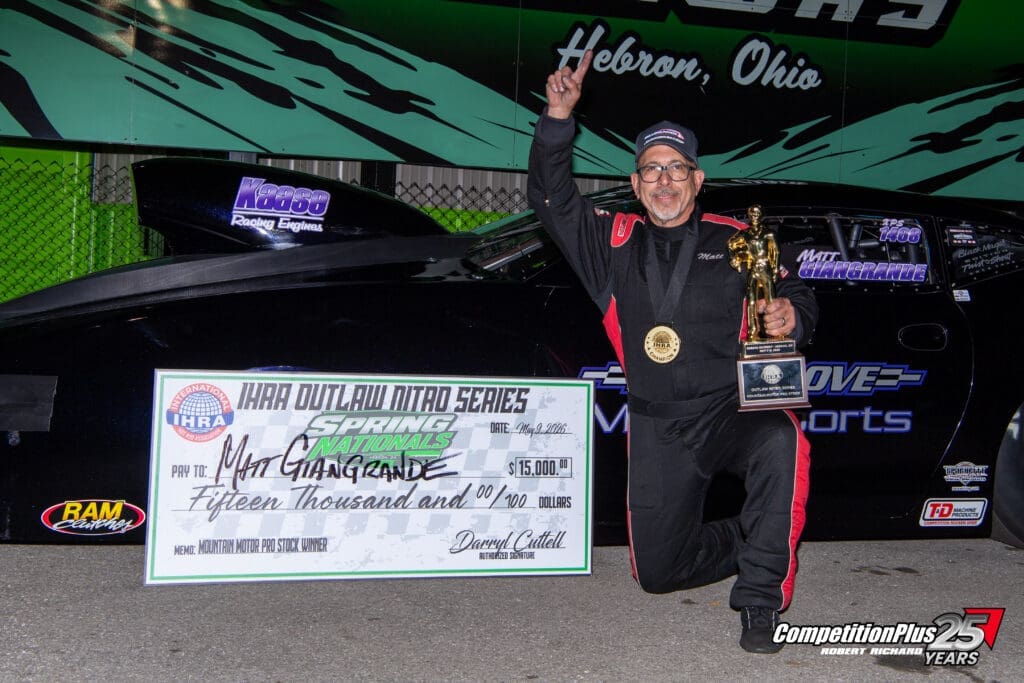
The victory also belonged to Enoch Love. For years, Love has invested in racers, race cars and a category he believes deserves a larger spotlight. At 82 years old, he finally got the IHRA victory he had been chasing. Ironically, he almost missed seeing it happen.

When Giangrande called him from the return road after the final round, Love had no idea the team had won. Technical issues interrupted his SPEED SPORT stream, and after unsuccessfully trying to reconnect, he walked away from the broadcast and started folding laundry.

“He said, ‘Matt, I didn’t even see it,'” Giangrande recalled. “He said, ‘I started to watch it. My phone went out. I tried to get re-hooked back up, but I couldn’t do it. I decided I was going to go downstairs and fold some laundry.'”

Several hours later, the phone started ringing.

“He said, ‘Suddenly, my phone started to blow up a couple of hours later, congratulating me,'” Giangrande said. “And he said, ‘Congratulating me for what? Folding laundry?'”

The story drew laughs throughout the pits. The people closest to the team understood there was much more behind the moment than a missed livestream. This is the same organization that endured one of its darkest moments with the loss of Bert Jackson at Rockingham. It is a memory that remains with everyone involved.

“Absolutely,” Giangrande said. “That’s something that is all in the back of our minds that Enoch and a couple of other people that are still there with him still have to endure.”

Giangrande was there that night and understands why the victory carried a deeper meaning.

“I was there that unfortunate evening at Rockingham, and it’ll be a day that a lot of us never forget,” he said. “To know that Enoch could somehow come out on the other side of that and be victorious in so many different ways, getting a trophy maybe is not even the ultimate victory.”

Jackson’s memory remains part of the team’s identity.

“I knew Bert. I was friendly with Bert. He was a great guy,” Giangrande said. “So to know that we can carry on Enoch Love Motorsports and have Bert along for the ride in some capacity is satisfying as well.”

EDITOR’S NOTE – Article continues after sidebar

SIDEBAR – STILL SHIFTING THE OLD WAY: GIANGRANDE STICKS WITH LENCO
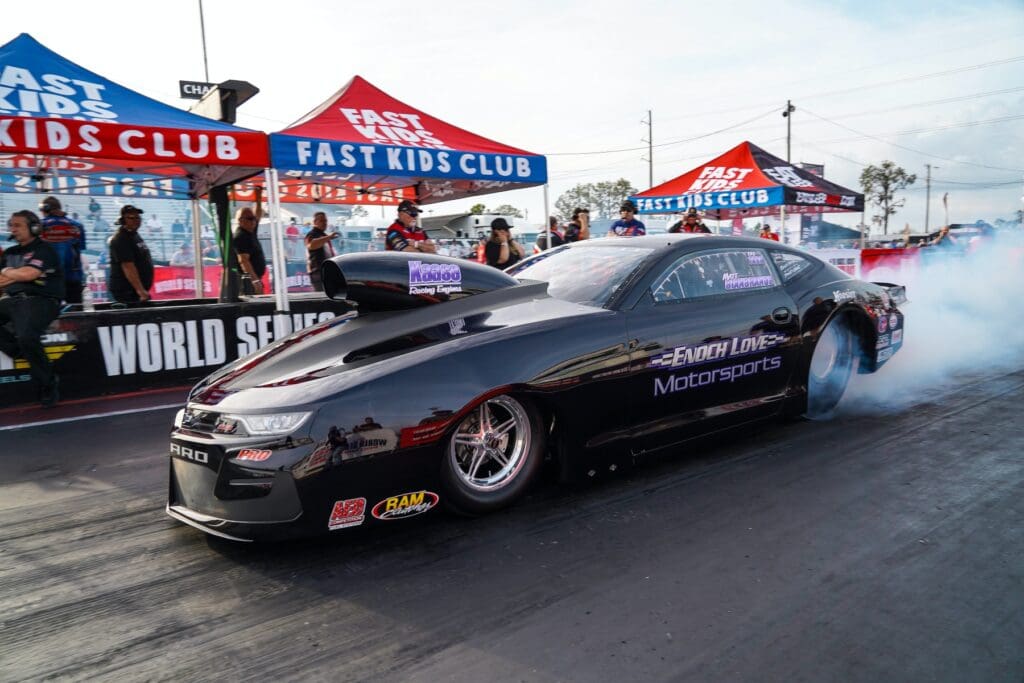
In an era where electronics handle more of the workload than ever before, Matt Giangrande still prefers doing some things himself. That includes shifting his Mountain Motor Pro Stock car. While many racers have moved to automated systems, Giangrande remains committed to the Lenco transmission and the hands-on approach that has defined much of his racing career.

“Yeah, we are still of the old guard,” Giangrande said. “I guess the old saying, ‘It’s hard to teach an old dog new tricks,’ is, I guess, applicable here.”

Giangrande continues to use a VertiGate-style shifter, requiring him to manually push and pull each gear change during a run.

“So we have a long style shifter. So it’s a VertiGate type shifter,” Giangrande explained. “So I still got to push and pull every single gear. No buttons for me. I tried that one time, wasn’t a fan of it.”

The veteran racer credits Lenco Racing Transmissions for helping keep the combination competitive and reliable.

“We still use the Lenco transmission,” Giangrande said. “Scott out there, Ashley at Lenco’s been super helpful in getting us parts and pieces to keep our Lenco in service. So Lenco has been a great supporter, as well.”

That doesn’t mean changes are off the table forever. Giangrande understands the demands of staying competitive in a class that continues to evolve, and he’s willing to adapt if necessary.

“Still of the old guard doesn’t mean we might not do something in the future,” he said. “We’ll just have to see what keeps us at, what we feel to be, at the front of the pack.”

For now, however, the old-school approach remains good enough.

“We might see the need to make a switch, but right now Lenco serves us fine and we’re going to stay with it,” Giangrande said.

Like most racers, Giangrande appreciated the winner’s purse and like most racers, he also knew exactly where it was going.

“The winnings always help,” Giangrande said. “The trophies are what lasts.”

The money, he admitted, was practically spent before the celebration ended. That’s especially true in a class he believes has become one of the toughest in drag racing.

“That race was three weeks ago, and I could assure you that those winnings are already spent because we just can’t rest on our laurels,” Giangrande said. “We have to keep figuring out how to try and stay on top. If there’s one thing we’ve learned about our class is that it has now become maybe what it was decades ago, one of the hardest, if not the hardest class to qualify for, much less win a round of racing, and then the race,” he said.

The veteran racer sees a direct connection between that competitiveness and the renewed momentum surrounding IHRA’s Mountain Motor Pro Stock program. He credits Darryl Cuttell and the IHRA leadership team for helping provide stability, larger purses and venues worthy of the category.

“I’m glad to see us go back to where we were born, where we came from, IHRA,” Giangrande said. “And I can’t thank Darryl Cuttell and the IHRA team enough for giving us the platform that we’ve got.”

Giangrande believes the category is healthier than it has been in years. New racers are entering the class, longtime competitors continue supporting it and the level of competition continues to rise.

“We’ve managed to stay afloat as a group,” Giangrande said. “It shows you just how steadfast our group is.”

What stood out most to him after the final round wasn’t the trophy presentation or the payday. It was what happened when the race was over.

Competitors who had spent the entire weekend trying to beat him made their way to the winner’s circle to shake hands and celebrate with his team.

“Everybody was so complimentary,” Giangrande said. “We’re competitors at heart. We hate each other for four seconds at a time when we line up there, but once the win light comes on and the race is over, we all go back to being friends.”

For one afternoon, the rivalries were set aside. The racers who know how difficult this class can be understood exactly what Giangrande and his team had accomplished.

“I don’t think there was one person that didn’t come out, shake our hands, congratulate us, and honestly seem genuinely happy for us,” Giangrande said. “And that’s a great feeling to know that you’ve got this little internal racing family that, like I said, we hate each other for four seconds at a time, but all the other time, we’re willing to help each other, no matter what it takes.”


Share the Insights?

Click here to share the article.

ad space x ad space

ad space x ad space

Competition Plus Team

Since our inception, we have been passionately dedicated to delivering the most accurate, timely, and compelling content in the world of drag racing. Our readers depend on us for the latest news, in-depth features, expert analysis, and exclusive interviews that connect you to the sport’s pulse.

Sign up for our newsletters and email list.

This field is for validation purposes and should be left unchanged.
Name

MATT GIANGRANDE’S WIN PROVES THERE’S STILL ROOM FOR GRIT IN MOUNTAIN MOTOR PRO STOCK

Mountain Motor Pro Stock isn’t supposed to work like this anymore.

The class is deeper than it’s been in years. The competition is tougher. The costs continue to rise. Conventional wisdom says the teams with the biggest budgets should eventually separate themselves from everyone else. Three weeks ago at the IHRA Spring Nationals, Matt Giangrande reminded everyone that drag racing doesn’t always follow conventional wisdom.

Giangrande defeated Jerry Tucker in the final round to earn his first IHRA Mountain Motor Pro Stock victory, becoming the 77th different winner in the category since 1977. Tucker was quicker, running a 4.043-second pass to Giangrande’s 4.078, but Giangrande’s .010 reaction time at the starting line proved to be the difference.

The final round lasted four seconds. The journey to get there took 45 years.

“I can’t tell you how bad we wanted to win one of these,” Giangrande said after the victory. “Enoch’s been trying a long time. Boy, this one’s for him. My team worked so hard.”

Giangrande reached the final round by defeating Brad Waddle, Dwayne Rice and Alan Drinkwater. The path wasn’t easy, but neither has been much of anything during a racing career built on finding ways to compete against racers with more resources. For those who know Giangrande, the victory wasn’t simply another race result. It was validation for a racer who has spent decades doing things differently because he never had much choice.

“Yeah, I would say that’s a very accurate statement,” Giangrande said when asked if his operation fits the underdog label. “I feel like we can very well be the ultimate underdog. I feel like that’s the way my entire racing career has been.”

He’s not a newcomer enjoying a breakthrough moment. He’s a racer who has spent nearly half a century figuring out how to compete against teams with larger budgets and bigger operations.

“I’ve been doing this for 45 years and I feel like I’ve always been a little bit of an underdog because I’ve never had the monetary means, the budget that maybe some of the other teams that I’ve always raced against has had,” he said. “So I’ve always had to figure out another way to go about my racing.”

That usually meant becoming his own solution. Whether it was engines, transmissions, rear-end work or suspension, Giangrande learned long ago that if something needed attention, there was a good chance he would be the one handling it.

“Usually that meant doing as much as you possibly could yourself, whether it was engines, transmissions, rear ends, suspension, all of the things that you usually have certain resources allocated to,” Giangrande said. “I really take pride in knowing a lot about the race car that we race.”

The easy answer in drag racing is money. More money buys parts. More money buys testing. More money provides options when things break or plans go sideways. Giangrande understands all of that. He also knows it isn’t the whole story. While many racers point to budgets as the deciding factor, Giangrande still believes there is room for determination to make up some of the difference.

“I feel like we’ve been a win waiting to happen for a while,” Giangrande said. “And that might be a little cocky, especially when you are the underdog.”

Then he explained why he wasn’t afraid to say it.

“Hard work and determination really means something,” Giangrande said. “And sometimes a lot of people forget that. Sometimes if you don’t have… The answer isn’t always money. Sometimes it’s just hard work and determination and just grit, and I feel like that was it all coming together finally.”

The win may have been credited to Giangrande, but his first thoughts after crossing the finish line weren’t about himself. They were about the people waiting at the starting line.

“Well, it was obviously very, very exciting,” Giangrande said. “And Bobby, the first thing that came to my mind when I crossed the finish line and saw the win light come on was what was going on back at the starting line for my team, because while I get to be in the car and enjoy that four seconds of excitement, that’s something they don’t get to feel. They get to watch it, and it’s a different feeling.”

Giangrande has experienced racing from both perspectives.

“Honestly, that’s what makes it worthwhile,” he said. “I certainly enjoy it. It’s not something I do or take lightly. I take racing very seriously, even though it’s very much a hobby, but it’s my lifestyle. It’s who I am.”

He knew exactly who was back there waiting.

“To know that I had Jennifer and Pat and Tim and Joe and Link and even some other competitors back there watching us in the final, getting excited, jumping up and down, that was really what I was thinking about,” Giangrande said. “Just wanting to be part of that.”

The victory also belonged to Enoch Love. For years, Love has invested in racers, race cars and a category he believes deserves a larger spotlight. At 82 years old, he finally got the IHRA victory he had been chasing. Ironically, he almost missed seeing it happen.

When Giangrande called him from the return road after the final round, Love had no idea the team had won. Technical issues interrupted his SPEED SPORT stream, and after unsuccessfully trying to reconnect, he walked away from the broadcast and started folding laundry.

“He said, ‘Matt, I didn’t even see it,'” Giangrande recalled. “He said, ‘I started to watch it. My phone went out. I tried to get re-hooked back up, but I couldn’t do it. I decided I was going to go downstairs and fold some laundry.'”

Several hours later, the phone started ringing.

“He said, ‘Suddenly, my phone started to blow up a couple of hours later, congratulating me,'” Giangrande said. “And he said, ‘Congratulating me for what? Folding laundry?'”

The story drew laughs throughout the pits. The people closest to the team understood there was much more behind the moment than a missed livestream. This is the same organization that endured one of its darkest moments with the loss of Bert Jackson at Rockingham. It is a memory that remains with everyone involved.

“Absolutely,” Giangrande said. “That’s something that is all in the back of our minds that Enoch and a couple of other people that are still there with him still have to endure.”

Giangrande was there that night and understands why the victory carried a deeper meaning.

“I was there that unfortunate evening at Rockingham, and it’ll be a day that a lot of us never forget,” he said. “To know that Enoch could somehow come out on the other side of that and be victorious in so many different ways, getting a trophy maybe is not even the ultimate victory.”

Jackson’s memory remains part of the team’s identity.

“I knew Bert. I was friendly with Bert. He was a great guy,” Giangrande said. “So to know that we can carry on Enoch Love Motorsports and have Bert along for the ride in some capacity is satisfying as well.”

EDITOR’S NOTE – Article continues after sidebar

SIDEBAR – STILL SHIFTING THE OLD WAY: GIANGRANDE STICKS WITH LENCO

In an era where electronics handle more of the workload than ever before, Matt Giangrande still prefers doing some things himself. That includes shifting his Mountain Motor Pro Stock car. While many racers have moved to automated systems, Giangrande remains committed to the Lenco transmission and the hands-on approach that has defined much of his racing career.

“Yeah, we are still of the old guard,” Giangrande said. “I guess the old saying, ‘It’s hard to teach an old dog new tricks,’ is, I guess, applicable here.”

Giangrande continues to use a VertiGate-style shifter, requiring him to manually push and pull each gear change during a run.

“So we have a long style shifter. So it’s a VertiGate type shifter,” Giangrande explained. “So I still got to push and pull every single gear. No buttons for me. I tried that one time, wasn’t a fan of it.”

The veteran racer credits Lenco Racing Transmissions for helping keep the combination competitive and reliable.

“We still use the Lenco transmission,” Giangrande said. “Scott out there, Ashley at Lenco’s been super helpful in getting us parts and pieces to keep our Lenco in service. So Lenco has been a great supporter, as well.”

That doesn’t mean changes are off the table forever. Giangrande understands the demands of staying competitive in a class that continues to evolve, and he’s willing to adapt if necessary.

“Still of the old guard doesn’t mean we might not do something in the future,” he said. “We’ll just have to see what keeps us at, what we feel to be, at the front of the pack.”

For now, however, the old-school approach remains good enough.

“We might see the need to make a switch, but right now Lenco serves us fine and we’re going to stay with it,” Giangrande said.

Like most racers, Giangrande appreciated the winner’s purse and like most racers, he also knew exactly where it was going.

“The winnings always help,” Giangrande said. “The trophies are what lasts.”

The money, he admitted, was practically spent before the celebration ended. That’s especially true in a class he believes has become one of the toughest in drag racing.

“That race was three weeks ago, and I could assure you that those winnings are already spent because we just can’t rest on our laurels,” Giangrande said. “We have to keep figuring out how to try and stay on top. If there’s one thing we’ve learned about our class is that it has now become maybe what it was decades ago, one of the hardest, if not the hardest class to qualify for, much less win a round of racing, and then the race,” he said.

The veteran racer sees a direct connection between that competitiveness and the renewed momentum surrounding IHRA’s Mountain Motor Pro Stock program. He credits Darryl Cuttell and the IHRA leadership team for helping provide stability, larger purses and venues worthy of the category.

“I’m glad to see us go back to where we were born, where we came from, IHRA,” Giangrande said. “And I can’t thank Darryl Cuttell and the IHRA team enough for giving us the platform that we’ve got.”

Giangrande believes the category is healthier than it has been in years. New racers are entering the class, longtime competitors continue supporting it and the level of competition continues to rise.

“We’ve managed to stay afloat as a group,” Giangrande said. “It shows you just how steadfast our group is.”

What stood out most to him after the final round wasn’t the trophy presentation or the payday. It was what happened when the race was over.

Competitors who had spent the entire weekend trying to beat him made their way to the winner’s circle to shake hands and celebrate with his team.

“Everybody was so complimentary,” Giangrande said. “We’re competitors at heart. We hate each other for four seconds at a time when we line up there, but once the win light comes on and the race is over, we all go back to being friends.”

For one afternoon, the rivalries were set aside. The racers who know how difficult this class can be understood exactly what Giangrande and his team had accomplished.

“I don’t think there was one person that didn’t come out, shake our hands, congratulate us, and honestly seem genuinely happy for us,” Giangrande said. “And that’s a great feeling to know that you’ve got this little internal racing family that, like I said, we hate each other for four seconds at a time, but all the other time, we’re willing to help each other, no matter what it takes.”

Picture of John Doe

John Doe

Lorem ipsum dolor sit amet consectetur adipiscing elit dolor

More Posts

Send Us A Message

Picture of Bobby Bennett
Bobby Bennett
Thank you for joining us on this journey. Your support and trust inspire us every day to deliver the best in drag racing journalism. We are excited about the future and look forward to continuing to serve you with the same dedication and passion that has defined CompetitionPlus.com from the very beginning.

Don’t miss these other exciting stories!

Explore more action packed posts on Competition Plus, where we dive into the latest in Drag Racing News. Discover a range of topics, from race coverage to in-depth interviews, to keep you informed and entertained.