

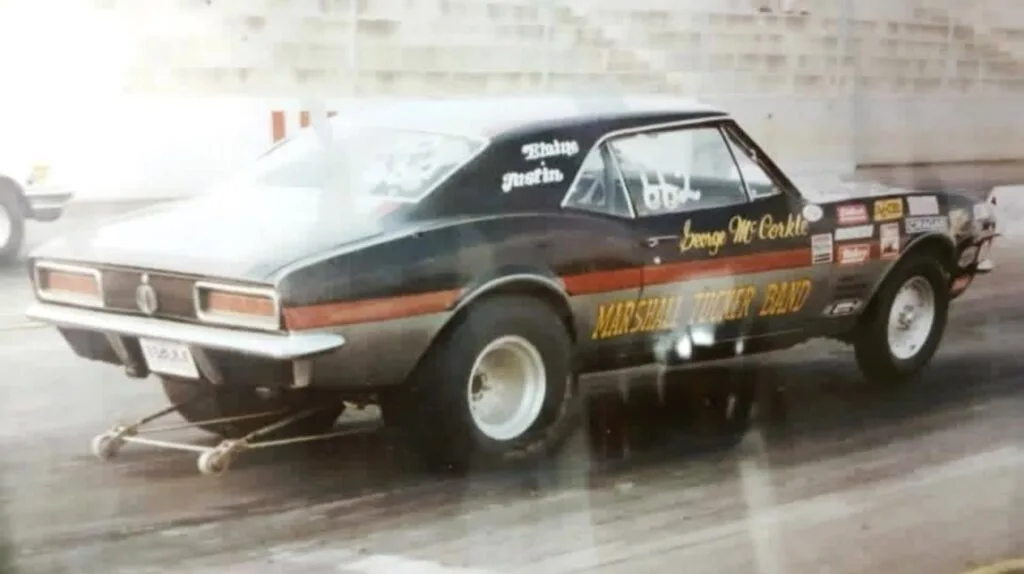

They didn’t want to be noticed, heralded, or gawked over. Drag racing was their escape from having had their fill of all three.
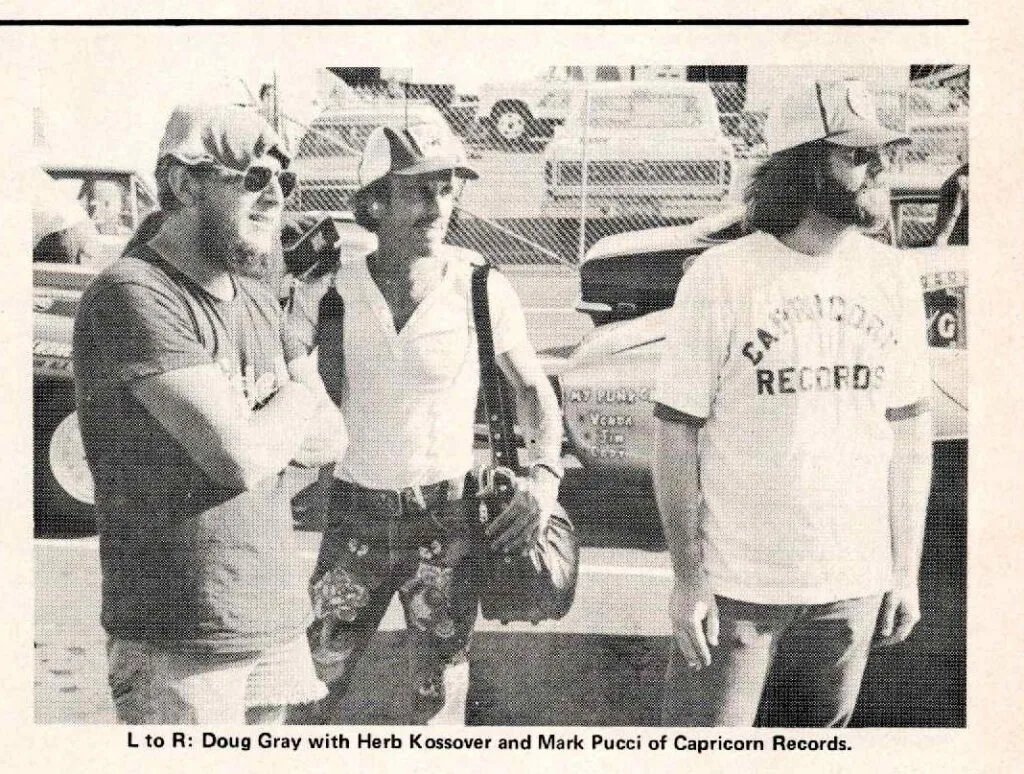
George McCorkle and Doug Gray, two members of the revered Marshall Tucker Band, had a passion for fast cars, and it didn’t hurt that their hometown of Spartanburg, South Carolina, would eventually lay claim to being the drag racing capital of the world. They enlisted a couple of hometown boys, Gene Fulton and Harold Bradey, to help them scratch their high-performance itch.
“Well, hell, they’re just local boys back then,” Fulton said. “All the boys on that side of town knew them. I didn’t know them. And I was just working for local people, they’re just like anybody else.”
CompetitionPlus.com reached out multiple times to the Marshall Tucker Band’s management to talk drag racing, but none of our requests were answered. No big deal; we just went to those who helped them along the way and found an article that answered every question we had.
McCorkle, in an interview published in the August/September 1977 issue of Drag Review, explained why he preferred the company of drag racers when he wasn’t performing on stage.
“I think race fans walk in there and they are interested in the competitiveness of the car,” McCorkle said. “They’re interested in your attitude toward racing. All they want to do is touch you at a rock and roll concert. Nobody as ever hassled me at a motel before at a race. That’s dynamite.”
“You can’t say that about a concert,” Gray added.
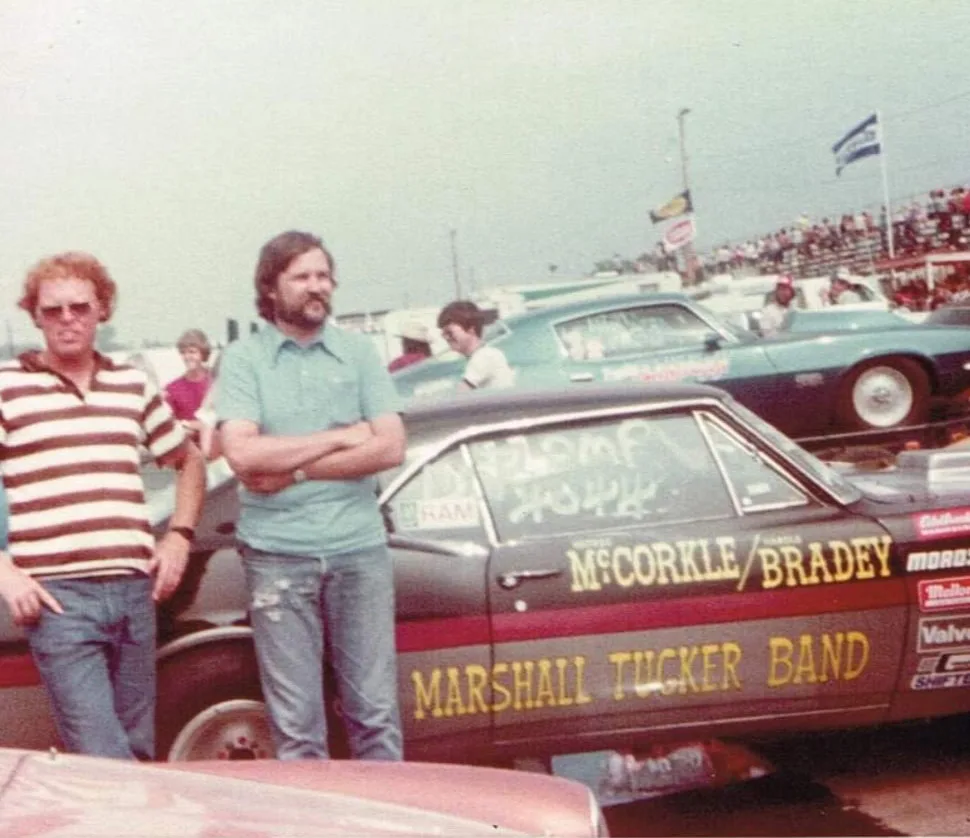
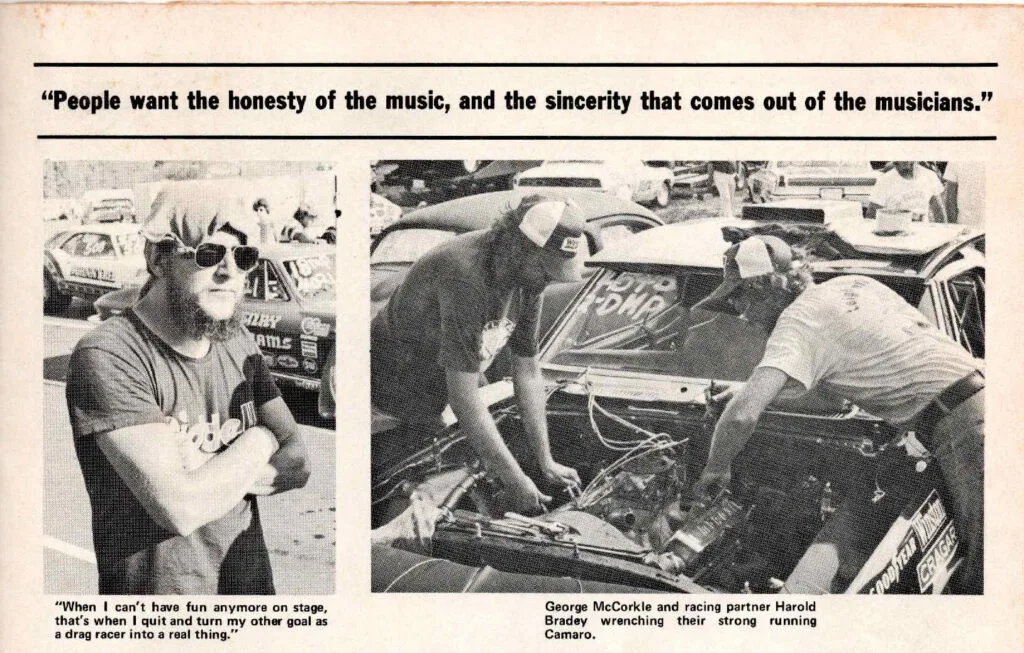
Bradey, an accomplished sportsman drag racer, became McCorkle’s driver and racing partner, and also helped Gray maintain his race car when needed.
McCorkle and Gray were in Johnson City, Tennessee, for a concert one weekend when the drag racers were competing in nearby Bristol. Neither musician had a race car with him, but both found themselves sitting outside their motel watching the racers work on theirs.
“We were sitting on the curb watching them and they said, ‘What are you doing out here with all this grease flying around?’” McCorkle recalled. “We said we loved it. We even offered to help them. That weekend helped me to decide to build the type car I built.”
The musicians returned the favor that weekend by extending an invitation to the racers. As McCorkle recalled, “We got every driver at the motel in backstage for the concert.”
Not every encounter involving the Marshall Tucker boys and a motel during a race weekend went that smoothly. Doug Gray probably wasn’t one of a motel owner’s favorite guests one weekend at Rockingham, North Carolina.
Gray had missed enough gears to damage the sliders in his transmission and, with some assistance, removed it from his race car. He decided his motel room would serve as his transmission shop for the evening.
“But he didn’t have a plug to back the transmission — he didn’t know any better,” Fulton recalled. “He left a greasy trail all the way down the parking lot, in the door, all the way down the hall, and right straight in his room. It wasn’t like they couldn’t find out who it was. That motel owner come raising hell.”
Gray’s introduction to high-performance driving came under considerably different circumstances. His 1957 Chevrolet, powered by a 283-cubic-inch engine bored to 301, was particularly well suited for his line of work outside of school.
“I use to run moonshine and they were closing in on me,” Gray told Drag Review. “Daddy worked at the mill and would get off around seven in the morning. I was in the tenth or eleventh grade.”
Gray was transporting moonshine from just across the North Carolina state line and delivering it in Greenville, South Carolina. His father unwittingly tipped him off one morning about revenue agents being up the road, and Gray had a car full of moonshine he hadn’t delivered the previous day.
“Then, I started thinking I wasn’t going to get out of that situation,” Gray recalled. “After thinking about it for a while, I went down to this vacant lot that was down there and emptied everything I had and broke it all. Then, I drove down to the end of the road, and sure enough they pulled me over and didn’t find a damn thing. They let me go, and that’s when I quit.”
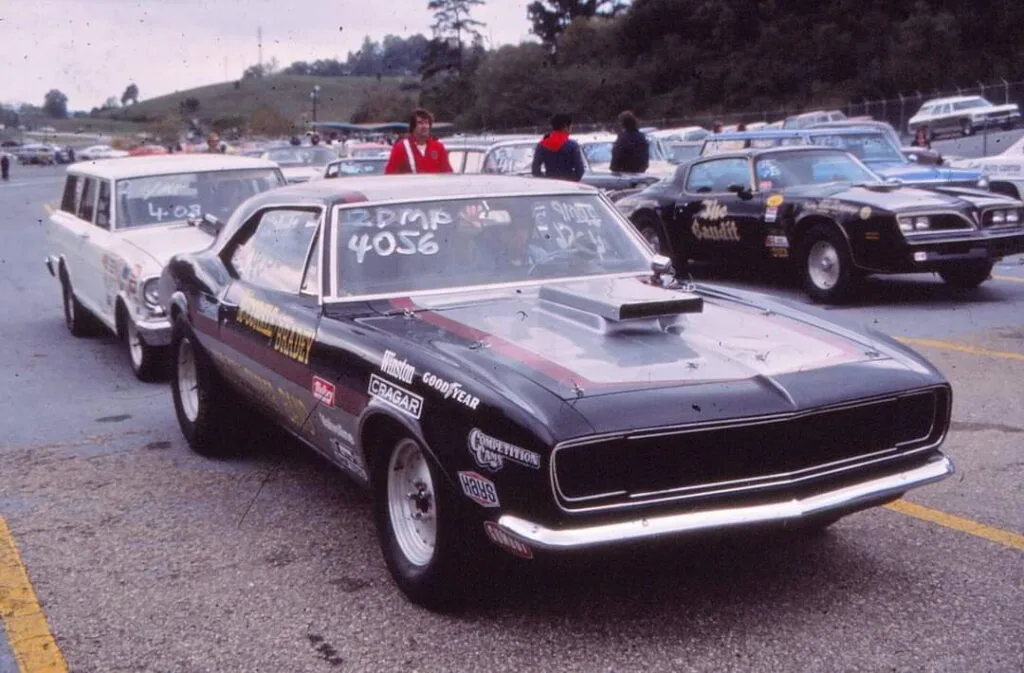
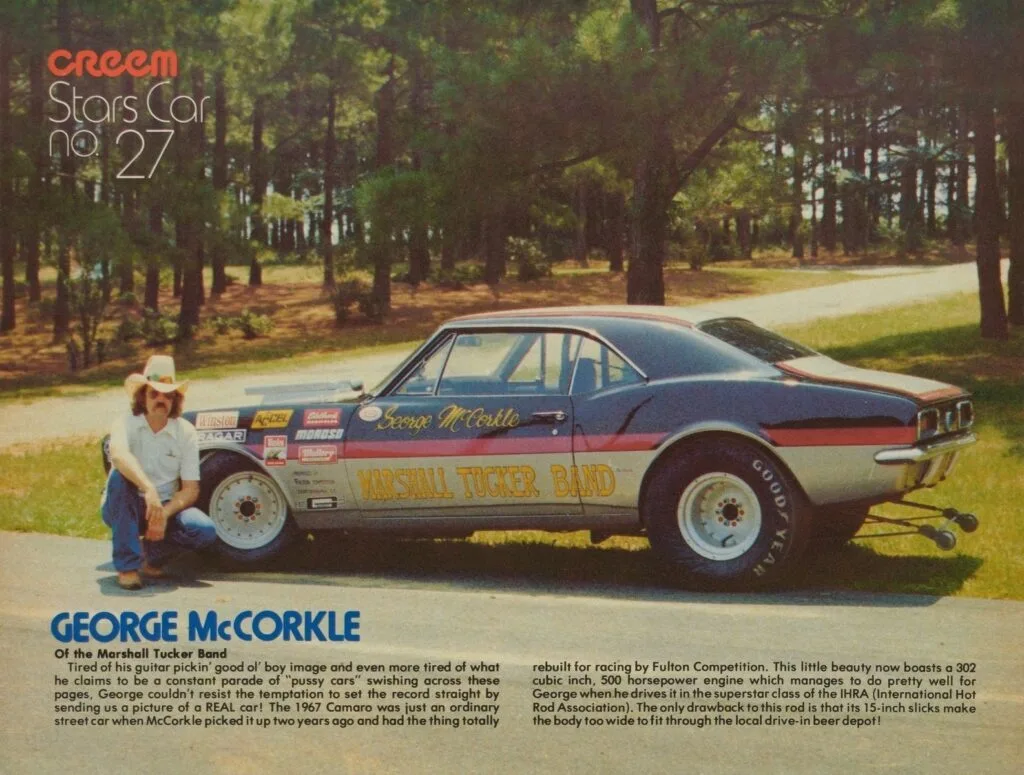
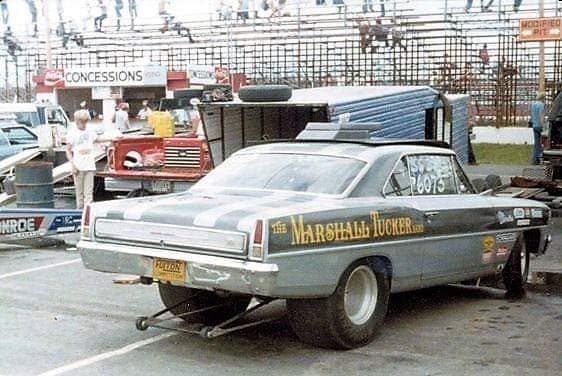
Fulton, who won five IHRA Modified championships from 1973-82, built Gray’s Nova from the ground up. He finished the mechanical work on McCorkle’s Camaro after McCorkle and Don Rogers constructed the frame and had installed the sheet metal under Fulton’s supervision. Rogers also had ties to the Marshall Tucker Band’s involvement in dirt-track racing through its sponsorship of driver Doug Osteen.
Fulton and fellow Spartanburg racer Tommy Hall, who worked alongside the engine builder for decades, had talked McCorkle out of building a 1962 Chevrolet in favor of the Camaro. McCorkle acquired the Camaro body from Gray, trading him the ’62 Chevrolet.
“After it was finished, he took me out and scared me to death in it,” McCorkle recalled. “When I reached the point I wasn’t scared of it, I started driving it.”
Gray received much the same introduction to his Nova, courtesy of Fulton.
“When Gene gunned my car, throwing me into the back, my feet went into the air and my eyes were laying out under the front wheels,” Gray said.
“He and Tommy Hall get their kicks scaring rock and roll musicians,” McCorkle added.
Fulton’s attempts to teach the musicians how to drive their race cars provided Bradey with a few memories, including one he believed happened at Commerce, Georgia. McCorkle apparently managed to engage reverse and third gear simultaneously while attempting a burnout.
“He just burns the clutch out of it,” Bradey recalled. “He thought it was smooth.”
McCorkle also gave Fulton a few anxious moments at Shelby (NC) Drag Strip. Both musicians had Fulton-built small-block Chevrolet engines capable of turning 9,000 rpm, equipped with adapters to accommodate spin-on Ford oil filters.
One of those filters came off McCorkle’s engine while he was on the starting line, and apparently, McCorkle was unaware of it.
“And when the tree turned on, he dropped the clutch and he went straight to the other end,” Fulton said. “It was an eighth-mile then and it blowing every bit of the oil straight on the ground from the oil pump. It looked like a funny car doing a burnout.”
Fulton and the others ran down the return road trying to get McCorkle’s attention before finally getting him to shut off the engine in the pits. When Fulton pulled the engine apart the following week, he was shocked to discover the bearings had survived.
McCorkle eventually approached Bradey about driving his Camaro, a conversation Bradey believed took place at Shelby Drag Strip. Bradey already had a race car of his own, but McCorkle’s equipment was better.
“I said, ‘Okay, we’ll talk,’” Bradey recalled. “And so the next week we got together and talked, and I said, ‘Why not?’ It’s better stuff than I had.”
Bradey’s ability to maintain a competitive race car enabled McCorkle to campaign the Camaro while maintaining a music career that, according to the Drag Review interview, had required spending as many as 320 days a year on the road. McCorkle had driven the Camaro himself for a year before entering into the partnership.
“Harold can fix anything that a car breaks,” McCorkle said. “If something major breaks on it, he always consults Gene because Gene did build the car. He’s never had a problem fixing anything that’s broken between rounds.”

Bradey even acquired a bit of celebrity status of his own while driving McCorkle’s Camaro, although it was a case of mistaken identity. Some fans apparently didn’t know the band had taken its name from a blind piano tuner in Spartanburg.
“Yeah, I get hassled some, since the band’s name is on the side of the car and I’m driving it,” Bradey told Drag Review. “Sometimes they ask me if I’m Marshall Tucker.”
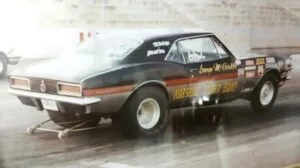
The Camaro initially competed in Super Stock with a cross-ram intake featuring two four-barrel carburetors. They eventually switched to IHRA’s Formula 2 Modified Production, the predecessor to Econo Modified.
“We got the one carburetor on it, and I didn’t really like running Super Stock. I didn’t like it,” Bradey said. “So I told George, I said, ‘We need to switch over to D/Modified.’ So, they had a one four-barrel D/Modified Production class, and we just fell over and hit. We were fairly competitive in it.”
McCorkle told Drag Review they had taken a D/Modified class record previously held by Cates and Walker. He wasn’t particularly fond of the practice of lowering class records excessively when a car could be competitive in a faster classification. He eventually became hip to the class-racing jargon and method of doing business.
“I can’t see blowing the bottom out of a record just to hurt somebody else,” McCorkle said. “I wish everybody felt that way.”
Just how serious were the Marshall Tucker boys about drag racing? McCorkle and Bradey had entertained the possibility of making a leap to Pro Stock.
Gray figured if the two musicians ever had the time to devote themselves to drag racing, they’d pool their resources and race professionally.
McCorkle insisted he had no intention of spending money on a Pro Stocker just to fill out the field: “You can bet it would run up front or we would sell it and find one that would,” McCorkle said.
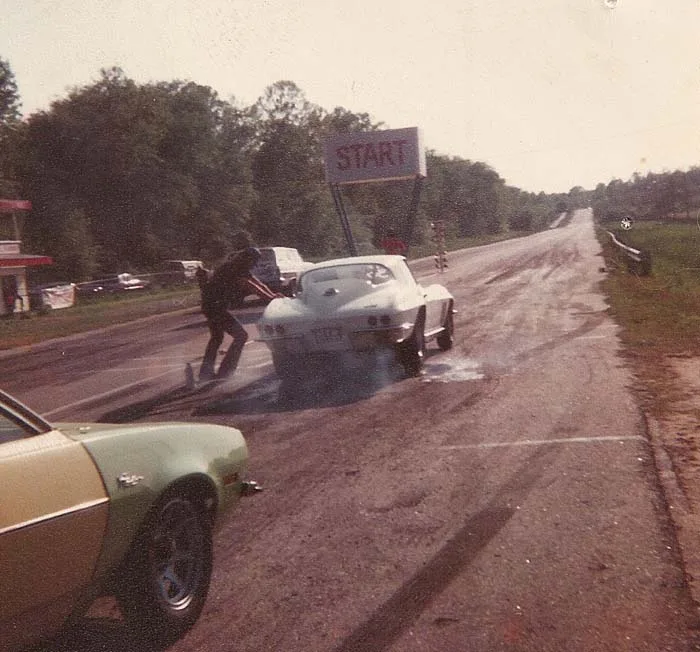
The McCorkle-Bradey partnership eventually produced a 1967 Corvette when Bradey bought a roadster to convert into a race car.
McCorkle just happened to have a 327-powered, three-speed Corvette coupe sitting around, and the two combined their resources, with Bradey and Doug Hardin, a colorful local chassis builder, handling the construction.
Building a Corvette that could run both IHRA Super Stock and Modified required some compromises. Bradey found out at Spartanburg Dragway that one of those compromises could have put him on his roof.
“Right as you hit third gear, there was a dip, and we didn’t have that spring right,” Bradey said. “I don’t know. The way we had it mounted, something was wrong. That thing, I almost turned the car over second race we went to, and so we scratched our head there and fooled with it, and George got spooked of it. He wasn’t driving it. He just didn’t want no part of it, I guess.”
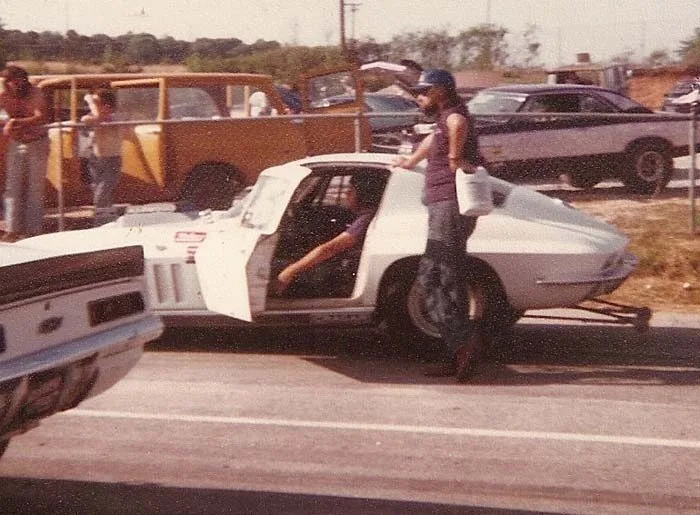
Bradey bought out McCorkle’s interest, removed the troublesome suspension and converted the Corvette into a dedicated Modified entry. McCorkle later acquired a red Chevy II that Bradey had once owned as a street car.
For all the gold records McCorkle and Gray accumulated — in its career, the band has sold 20 million albums — neither had a problem spending a weekend at the drag strip enjoying a measure of anonymity. Bradey remembered them being every bit as interested in what the other racers were doing as they were in their own cars.
“I mean, if they knew who they were, they didn’t get mobbed or anything,” Bradey recalled. “They were just there wanting to be … they wanted to be with the racers. They wanted to be one of the guys.”
Fulton never saw much difference between working on a race car for a couple of musicians with gold records hanging on their walls and working on one for anybody else in Spartanburg. Nearly five decades later, his assessment of the two hadn’t changed.
“They were just good ol’ average guys,” Fulton said. “They went with us to the races back then at IHRA, and it was just like they was one of the group. It wasn’t like no f***ing rock star.”












WHAT I AM THANKFUL FOR WITH ELON WERNER