
Southern California had the beaches, the hot rods and the reputation as drag racing’s birthplace. But nearly 1,500 miles to the east, another group of racers was making a convincing argument that the future of professional drag racing didn’t belong exclusively to California.
Dallas, Texas, had its own collection of nitro-burning royalty, and they weren’t particularly interested in taking a back seat to anybody.
Raymond Beadle, Kenny Bernstein, Billy Meyer and Richard Tharp were four faces on the Dallas nitro scene’s Mount Rushmore. They won championships, built businesses, pushed the boundaries of promotion and occasionally gave the people running the sport more trouble than they knew what to do with.
Beadle was the ringleader, Bernstein the businessman, Meyer the ambitious young racer and Tharp the fellow whose party animal reputation could make the others appear downright respectable.
They were polished when sponsors and television cameras were watching. Once the cameras were turned off, however, there was another side to the operation, and it wasn’t necessarily suitable for the corporate boardroom.
Former NHRA public relations representative Dave Densmore saw both versions.
“They raced hard, but they also partied hard,” Densmore said. “And it was just a great time to be involved in drag race in those days because really it’s because of the personalities.”
Bernstein remembers a time when drag racing was accessible enough for a couple of mechanically inclined young men to put together a team without needing a corporate financial statement.
“California, of course, had it going then for most of it, but it drifted over to us,” Bernstein said. “There was just a bunch of guys there that were hot rodders, and that just started the whole thing, and it just kept rolling and rolling and rolling in those days.”
Texas wasn’t short of places to race or people willing to participate.
Densmore recalled the Texas Pro Fuel Circuit attracting 20 or 30 Top Fuel dragsters for eight-car shows paying $1,000 to win. Competitors came from Dallas, Fort Worth, Houston and San Antonio, with the circuit extending into Oklahoma and Louisiana.
The garages along Reeder Road in Dallas became gathering places where racers shared parts, ideas, stories and occasionally their next questionable adventure.
The competitive environment produced considerably more than the four best-known personalities. Gene Snow, Mike Burkhart, Kelly Chadwick, the Carroll brothers and numerous others contributed to a regional nitro culture capable of challenging the country’s established racing centers.
Bernstein and Beadle had known each other long before either became a household name in drag racing. They attended school together in Lubbock, Texas, although Bernstein said their friendship developed primarily after they became racers.
The Dallas area also had something else going for it: the willingness to build facilities as ambitious as the racers themselves.
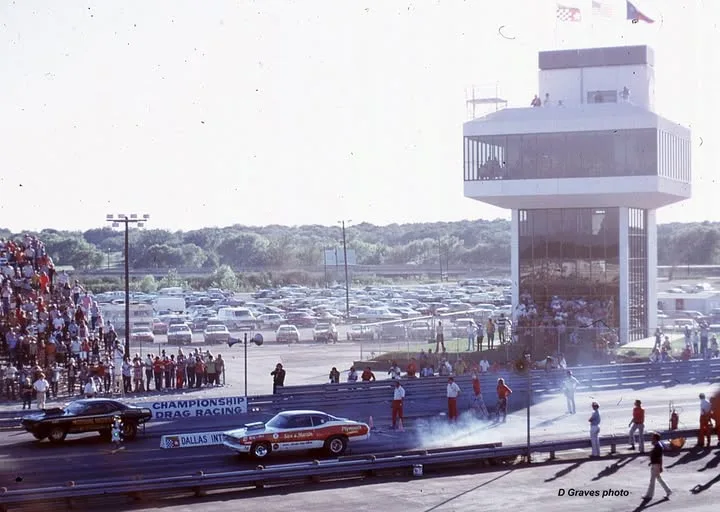
Dallas International Motor Speedway opened in Lewisville on June 13, 1969, with the NHRA Springnationals. The facility featured a 5,000-foot dragstrip, paved pit areas, permanent restrooms and a towering control structure that represented a considerable departure from the modest dragstrips of the period.
It was among the earliest examples of a purpose-built drag racing supertrack, arriving during the same era as California’s Orange County International Raceway.
The Lewisville facility hosted the NHRA Springnationals from 1969 through 1971 and the World Finals in 1969 and 1970. Its opening Springnationals produced the first all-six-second, 32-car Top Fuel field, although the debut was marred by the death of Funny Car racer Gerry Schwartz in a collision with Pat Foster.
The track was impressive but its finances were another story.
Weather disruptions, substantial operating costs and unsuccessful efforts to expand into other forms of motorsports created financial problems. Ownership changed, the track switched from NHRA to IHRA sanctioning, and the operation eventually collapsed into bankruptcy in 1973.
The facility closed after only four years, leaving behind a monument to how quickly a grand motorsports vision could become an expensive failure.
Former NHRA Vice President of Race Operations Steve Gibbs remembered Dallas International as one of the sport’s finest facilities.
“Dallas International was a big deal when it opened up,” Gibbs said. “You’ve probably seen pictures of it, but it had a great tower down there, great layout.”
Gibbs also recalled that NHRA founder Wally Parks wanted to purchase the property, but the sanctioning body’s leadership declined to become a racetrack owner.
NHRA never bought Dallas International, and the track disappeared.
Its failure didn’t end North Texas’ ambitions. In 1986, Meyer opened Texas Motorplex in Ennis, bringing another revolutionary drag racing facility to the Dallas area, this time with an all-concrete quarter-mile racing surface.
If the facilities reflected the region’s ambition, the racers reflected its attitude.
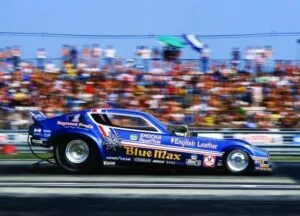
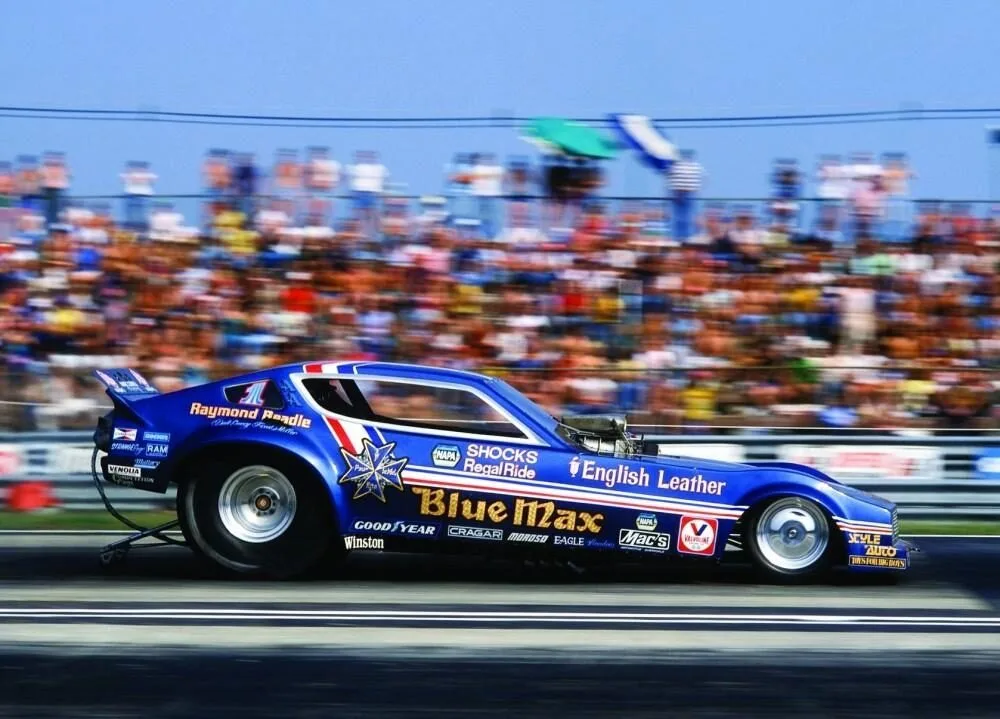
Beadle’s Blue Max became one of Funny Car racing’s most recognizable operations, blending championship performance with merchandising and promotion. The Blue Max name became a commercial property as much as a racing identity.
Gibbs credited Beadle with helping establish the merchandise business that later became a major revenue source for professional drag racing teams.
“Raymond Beadle, he kind of set the tone as far as the Blue Max thing, as far as marketing,” Gibbs said. “He was the first guy that really revolutionized the T-shirt deal.”
Beadle won three consecutive NHRA Funny Car championships from 1979 through 1981, ending Don Prudhomme’s four-year championship streak. He also collected three IHRA Funny Car titles and later achieved success in NASCAR as a team owner.
Bernstein eventually surpassed nearly everybody in the group in NHRA championship totals, winning four consecutive Funny Car titles from 1985 through 1988 and two Top Fuel championships, in 1996 and 2001.
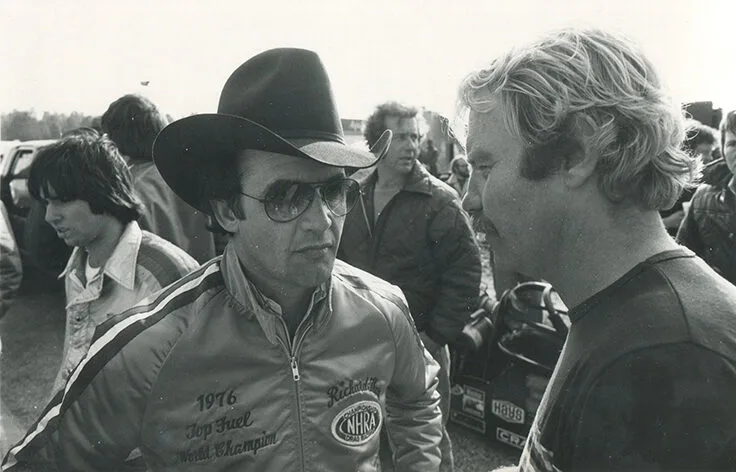
Tharp had already captured the 1976 NHRA Top Fuel championship, while Meyer won the 1980 IHRA Winston Funny Car title. Meyer never captured an NHRA season championship despite becoming one of the category’s most formidable competitors.
Their accomplishments were substantial enough to fill separate books. Their personalities probably could have filled a few more, although some chapters might have required legal review.

Densmore described Bernstein and Beadle as successful men who approached business from opposite directions.
“Bernstein’s idea of how you conducted business and Raymond’s idea of how you conducted business were at the opposite extremes,” Densmore said. “But they both got to the finish line and they both were very successful.”
Nothing illustrated their complicated relationship better than the 1981 NHRA Winternationals at Pomona.
Beadle had won his semifinal when the roof blew off his Blue Max Funny Car body. Without a usable replacement, his opportunity to race Meyer for the event championship appeared finished.
Bernstein offered an unlikely solution.
His team allowed the roof to be cut from its own Funny Car body and grafted onto Beadle’s damaged machine. The emergency operation became known as the Texas Chainsaw Massacre.
Beadle made the final, although Meyer won the race.
It was a remarkable display of cooperation between competitors who were otherwise perfectly comfortable trying to beat one another into the ground.
Densmore recalled that the relationship between Bernstein and Beadle included a grudging respect that could override their competitive differences.
“So they had a grudging respect for each other, I think would be how you would characterize that for sure,” Densmore said.
Meyer, meanwhile, had reason to question why one competitor was helping another get back into the race.
The incident was pure Dallas nitro racing. Friendship had its privileges, even when those privileges involved taking a saw to somebody else’s Funny Car.
There were occasions when the group’s influence extended beyond repairing race cars.
In May 1981, a Funny Car boycott targeted the NHRA Cajun Nationals. Beadle was identified by Bernstein as a central figure in the effort, which demonstrated the leverage leading professional racers could exert over a national event.

The boycott was particularly effective because it wasn’t limited to established stars staying home. According to an interview account supplied for this story, prospective replacements also faced warnings about consequences if they participated.
The source characterized the warnings as threats, although the specific claims about physical retaliation remain unverified.
Bernstein acknowledged Beadle’s leadership when asked about the boycott.
“He was the ringleader, there’s no question about it,” Bernstein said. “His workplace where he had all his cars and everything at the garage there, it was a big facility for us in those days. That was a gathering spot for everybody.”
The episode exposed a complicated relationship between NHRA and the racers whose participation helped make its events successful.
These weren’t competitors who waited quietly for somebody else to decide their future. When they believed their interests were threatened, they had enough influence to make the sanctioning body pay attention.
NHRA Division 4 Director Dale Ham had the unenviable responsibility of dealing with many of those personalities before they became nationally recognized stars.
Ham was respected throughout the region, but he wasn’t the kind of official who automatically backed away from confrontation.
Densmore remembered a particularly memorable dispute involving Meyer at Amarillo.
The event had been interrupted by rain, and a disagreement developed over lane choice when racing resumed. Meyer went to the tower to argue his position with Ham.
According to Densmore, the discussion became physical.
Meyer eventually returned to the pits with a torn shirt and blood on his face.
Densmore asked what had happened.
“He said, ‘We don’t get lane choice,’” Densmore recalled.

The episode eventually became part of drag racing folklore. At a subsequent Division 4 banquet, Dave Settles presented Ham with boxing gloves and a side of beef, a reference to the popular Rocky movies.
Densmore, who began his career as a newspaper reporter in Amarillo, remembered Ham as considerably more than a tough official.
“Dale Ham, he taught me everything I know about drag racing,” Densmore said. “I knew nothing about motor sports at all until I started covering motor sports for the Amarillo Paper and he kind of took me under his wing and taught me all about it and taught me to love it.”
Meyer eventually became one of drag racing’s most accomplished businessmen, but some of his earlier adventures weren’t exactly the sort of material one would include in a corporate presentation.
One involved Meyer being tackled by Secret Service agents while completely naked. It wasn’t a punch line somebody invented years later, either, at least according to Densmore, who confirmed the episode without offering the circumstances that led to it.
“Well, yeah. It’s kind of amazing. You could write a book on Billy’s escapades alone,” Densmore said. “Well, you could really write a book on all these guys, but people wouldn’t believe some of the stories if they heard them. So what’s the use, you know?”
Richard Tharp represented another side of the Dallas racing culture.
He had driven Funny Cars before moving into Top Fuel, where his accomplishments included the 1976 NHRA world championship. His reputation for enjoying life away from the racetrack was nearly as well established as his driving ability.
His famous personal declaration, “A Star I Are, A Saint I Ain’t,” wasn’t exactly the sort of statement designed to reassure a nervous sponsor.
One persistent tale had Tharp sleeping in his dragster, although the details have become considerably less certain with the passing years. It was one of those stories nobody seemed particularly quick to deny, perhaps because it fit the personality of a man whose personal motto was practically a warning label.
With Tharp, the line between racing legend and outrageous rumor could get awfully thin.
Gibbs remembered Tharp as someone capable of doing things other people might only consider.
“Tharp especially, he’s a guy that would do everything you would think about but wouldn’t do, or he would do it and get by with it,” Gibbs said.
Gibbs had plenty of opportunities to observe the group’s behavior as an NHRA official, but he also admitted that the relationship wasn’t always strictly business.
“We partied with those guys,” Gibbs said. “They were as crazy as they were, but I had some good times with them. Some real good times.”
One of his favorite memories involved a rain-delayed Cajun Nationals that eventually resumed on a Wednesday.
With time to kill in New Orleans, Gibbs rented rooms overlooking Bourbon Street, where the gathering turned into an all-night celebration involving racers and track operators.
It wasn’t exactly the sanitized corporate environment that professional drag racing would eventually embrace. It was a time when the officials and competitors occasionally socialized together, argued together and returned to the racetrack to settle matters with nitromethane.
The Dallas group helped drag racing move from its match-racing roots toward a more commercially sophisticated professional sport.
Bernstein understood corporate sponsorship and business development.
Beadle recognized the value of branding and merchandise; Meyer eventually built a major racetrack; and Tharp proved a larger-than-life personality could be a valuable attraction in its own right.

None of those contributions should obscure the fact that they were formidable racers first.
The championships established their credibility, while the stories surrounding them made the personalities endure long after their competitive careers ended.
Densmore watched much of it unfold, first as a reporter and later as a public relations representative who worked with several of the sport’s biggest names.
He remembered the friendships as fondly as the racing, despite having witnessed enough trouble to fill an entire career.
“I was very fortunate,” Densmore said. “I came along in drag racing when there wasn’t any drag racing PR. And so we kind of winged it and created it, you know?”
He worked with racers whose careers helped establish drag racing as a professional business, although keeping up with their off-track adventures could be another job entirely.
“I had a great life and the big thing is those guys are still my friends, which means more to me than just about anything,” Densmore said.
Southern California deserves its place in drag racing history and nobody needs to rewrite that part of the record. But Dallas had its own nitro royalty, and what started with a bunch of Texas kids who loved hot rods eventually became something none of them could have imagined.
Bernstein remembers when the whole thing was considerably less complicated.
“We all just kind of grew up at the same time and just loved cars,” Bernstein said. “I mean, we all had some kind of a hot rod of some kind.”