

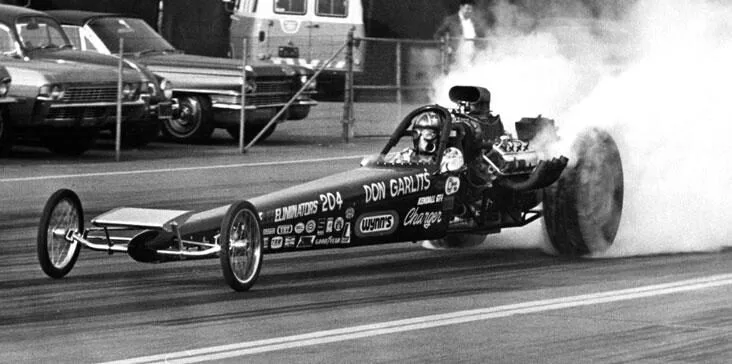


Drag racing history has a way of making Don Garlits’ greatest innovation sound almost too convenient.
A transmission exploded beneath him at Lions Drag Strip in March 1970, he lost part of his right foot, dreamed up a rear-engine Top Fuel dragster while recovering in a Long Beach, Calif., hospital, and returned to win the 1971 NHRA Winternationals.
The story is chock full of tragedy, inspiration and triumph. It makes for a wonderful story, except there’s a sizable piece of Garlits’ journey that seldom gets told.
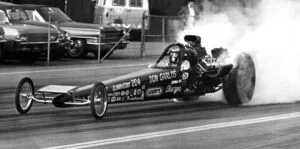
Before the rear-engine Swamp Rat XIV changed Top Fuel racing, Garlits climbed back into the very dragster that nearly killed him. His foot was still bandaged, the car had been pieced back together from wreckage, and “Big Daddy” had some unfinished business.
“These damn slingshot dragsters have got to go,” Garlits recalled thinking after the explosion. “See, there was rear-engine cars [at the time], they just wouldn’t do nothing.”
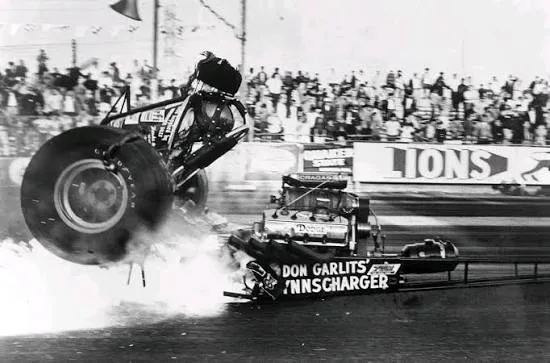
On March 8, 1970, Garlits was racing Richard Tharp in the Top Fuel final of the AHRA Grand American at Lions when his experimental Garlitsdrive two-speed transmission disintegrated. The explosion tore Swamp Rat XIII into two sections.
The transmission’s internal sprag is said to have rolled over the drum, allowing the rotating assembly to reach an estimated 20,000 to 30,000 rpm before disintegrating. Garlits lost part of his right foot, fractured his left foot in five places and spent approximately six weeks in a Long Beach hospital.
Garlits had briefly lost consciousness inside the wreckage and didn’t learn until later that he had been knocked out.
“The first thing I remember, Mickey Thompson leaned into the car and he said, ‘You’re going to be all right, pal,’” Garlits recalled. “That was the first thing that they said.
“And then Thompson saw the foot, and he tucked it up under his arm … so I couldn’t see it,” Garlits continued. “And they lifted me out of the car and carried me to the ambulance, which wasn’t too far away.”
The ride to the hospital provided Garlits with another unpleasant memory. He squeezed his leg hard enough to restrict the blood flow, hoping to control the pain and bleeding.
“The pain hit me in the ambulance,” Garlits said. “It was so grotesque.
“The pain was just, it was unbelievable,” Garlits continued, “because it wasn’t a nice clean cut, it was a real raggedy cut. In fact, the piece was still attached to my foot. When they put me in the ambulance, it was one of those slant backs and the foot wasn’t in there all the way.”
“When they shut the door, it clipped that piece and it cut it off the rest of the way and it fell on the ground,” he added. “They opened the ambulance door, picked it up and threw it back in my lap.”
Don Prudhomme, who witnessed the explosion from the staging lanes, later joined Tom McEwen in visiting Garlits in the hospital. Garlits was already contemplating a rear-engine dragster, although he was well aware of the shortcomings of previous attempts.
“Ollie Morris had the little White L way back in the ’50s with a flat end in it,” Garlits said. “It was a nice little car — won some races — ut the minute you put the big powerful motor in it and decided to run with the guys, you were in trouble. In fact, Pat Foster had been hurt real bad in one, a Woody [Gilmore] car, several weeks or months before I came out to Lions, at Lions.”
In the meantime, Garlits had found a buyer for the wreckage of Swamp Rat XIII in his crew chief, T.C. Lemons. The transaction was one Garlits could still document decades later.
“I have the canceled check,” Garlits said. “He gave me $4,000 for all the wreckage, the motor and everything.”
Lemons and Connie Swingle put the dragster back together and went out on tour. When the two were scheduled to race at the AHRA event in Bristol, Tenn., Garlits told his wife he was getting stir-crazy sitting around the house and wanted to watch them race.
“I got there and Swingle was having trouble,” Garlits said. “He’d made three qualifying attempts and smoked the tires on every run, and he wasn’t in the show.”
Lemons and Swingle were arguing over the chassis, specifically whether the repairs had made the rear of the car too stiff. Garlits decided to find out for himself.
“And I said, ‘Swingle, give me your hat and your suit,’” Garlits recalled. “I stepped over there on the tailgate.
“When I pulled the right foot through the shoe, it was still bandaged up and still leaking. And Tharp was sitting there on the tailgate with me, and he nearly passed out because he doesn’t like the sight of blood.
“And he says, ‘Gar, what are you going to do?’” Garlits recalled. “I said, ‘I’m going to put this car in the show.’ And he says, ‘I wouldn’t do that if I were you. I says, ‘I’ve got to know if the car’s any good.’”
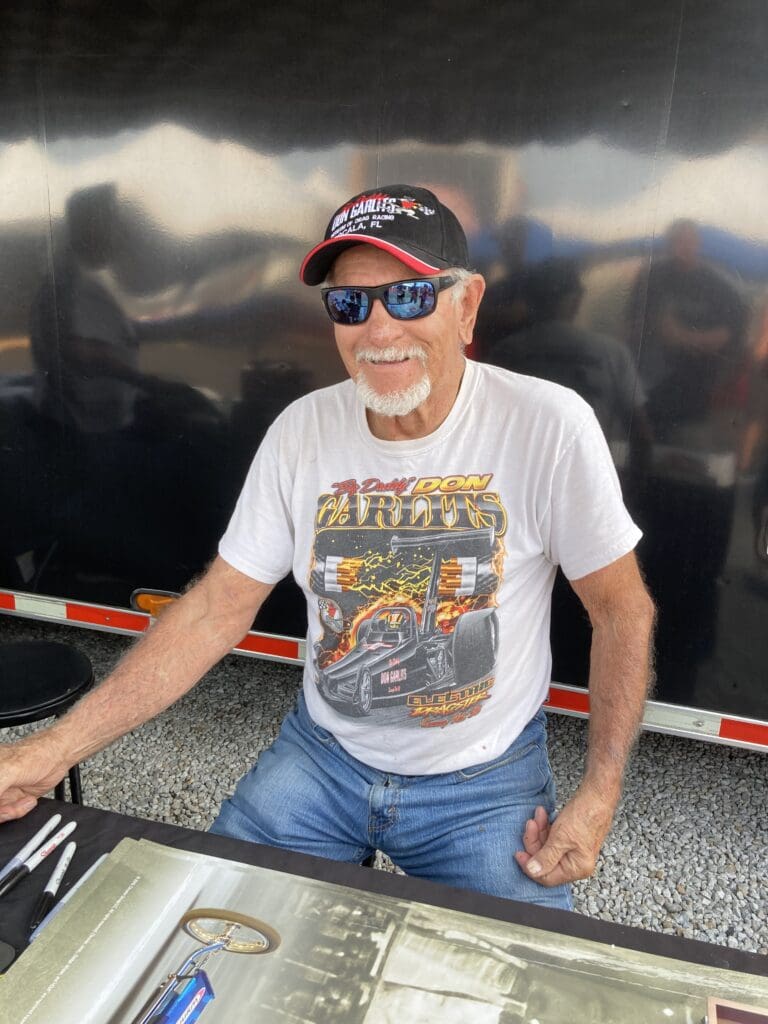
Wearing Swingle’s helmet, Garlits made one qualifying attempt without those watching initially realizing who was driving. According to Garlits, he established low elapsed time, top speed and qualified No. 1.
“There was a trick there about stepping down and letting off on the clutch,” Garlits explained. “And then I said, ‘It’s all yours now, Swingle. There’s nothing wrong with the car.’”
Swingle smoked the tires in the first round, but Garlits had inadvertently created a problem for himself. Word of his qualifying run reached the track operators who had booked him for match races.
“The [drag] strips had heard that I made the run and they didn’t want somebody else filling in for me,” Garlits said. “So they said, ‘You’ve got to make the runs if we’re going to fulfill the contracts.’”
Garlits went to work driving his former dragster for Lemons, collecting 40% of the gross. He recalled finishing the season without blowing an engine while also winning his match races.
His last serious Top Fuel outing in Swamp Rat XIII came against Prudhomme at Fremont, Calif. The two had raced the previous night in South San Francisco, where Garlits blew the supercharger.
“The drive broke in it, and we had a spare blower, but we didn’t have a manifold,” Garlits said. “And we borrowed the Snake’s manifold to make the runs on Sunday.
“Had to take the car apart and give it back to him before we left California.”

Lemons eventually sold the dragster to Art Malone, who enlisted Bob Taft to race it. They took the car to Indianapolis for the 1971 NHRA U.S. Nationals, where they failed to qualify, while Garlits competed with his rear-engine dragster.
Swamp Rat XIII eventually wound up in the hands of racers who installed a small-block Chevrolet. Garlits spotted the car at Bradenton, Fla., and bought the chassis back for $300.
He restored it to its appearance on the day of the Lions explosion and made it operational for a cacklefest at Union Grove, Wis. The Harley-Davidson Museum in Milwaukee subsequently displayed the dragster for six months.
“But it runs now, but it doesn’t have a clutch inside the can,” Garlits said. “There’s no way you can … But it’s got one of my transmissions. Quite a deal.”
Garlits, benefitting from help by Swingle and Lemons, had worked through the handling problems of Swamp Rat XIV before winning the 1971 NHRA Winternationals and the Bakersfield March Meet. By the end of 1972, the front-engine dragster had largely disappeared from Top Fuel.
“I had to slow the steering down,” Garlits explained. “It was about 6:1. That’s too fast. We slowed it down to 10, and we could drive the car then.
“And then of course the wing made another difference, because the driver’s down front so you don’t have that driver in the back pushing the wheels down. So you needed the wing to push it down.
“Once we put the wing on it, that was the end of the slingshots.”













WHAT I AM THANKFUL FOR WITH ELON WERNER