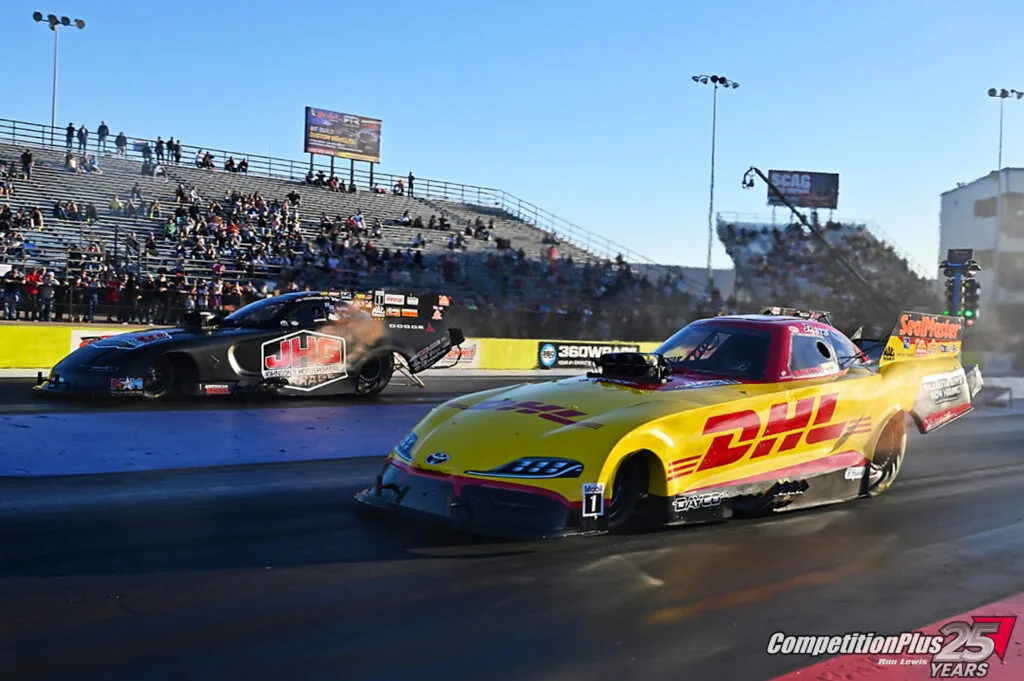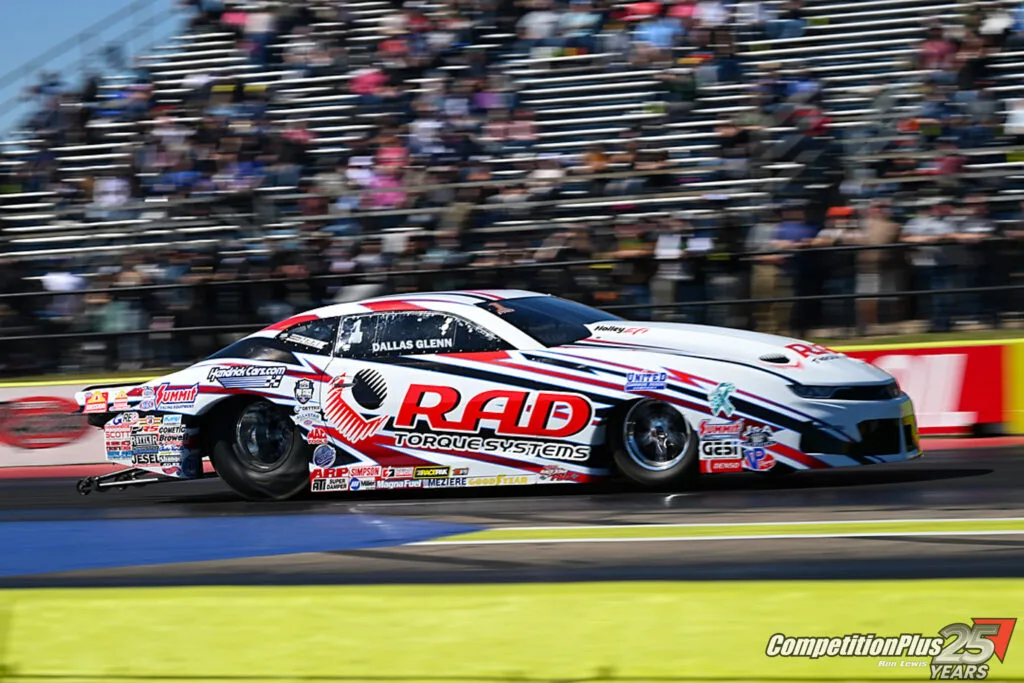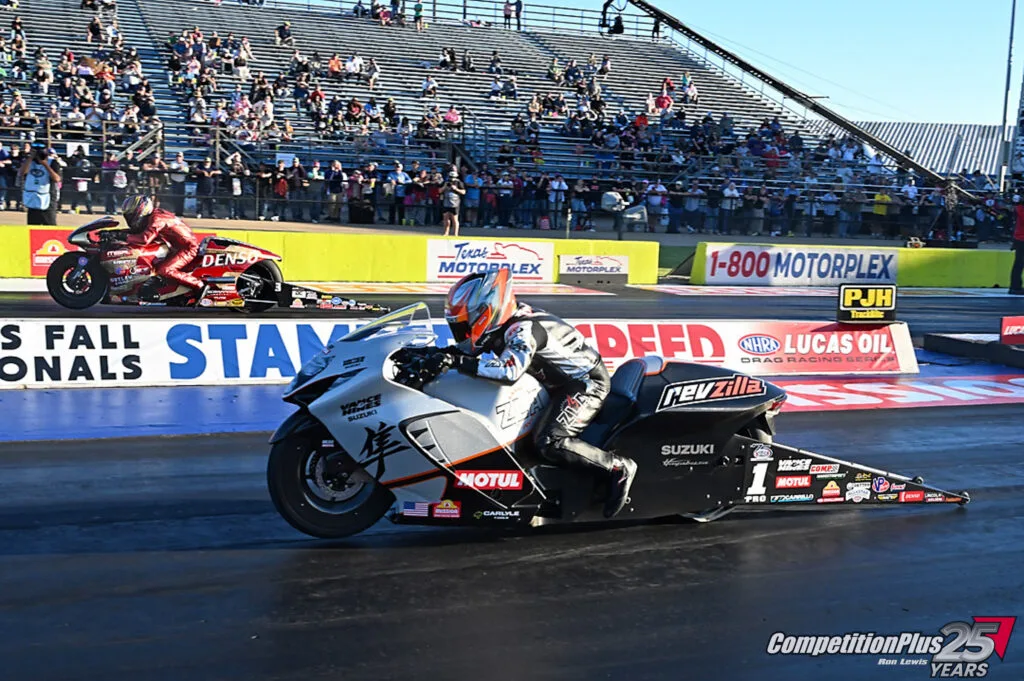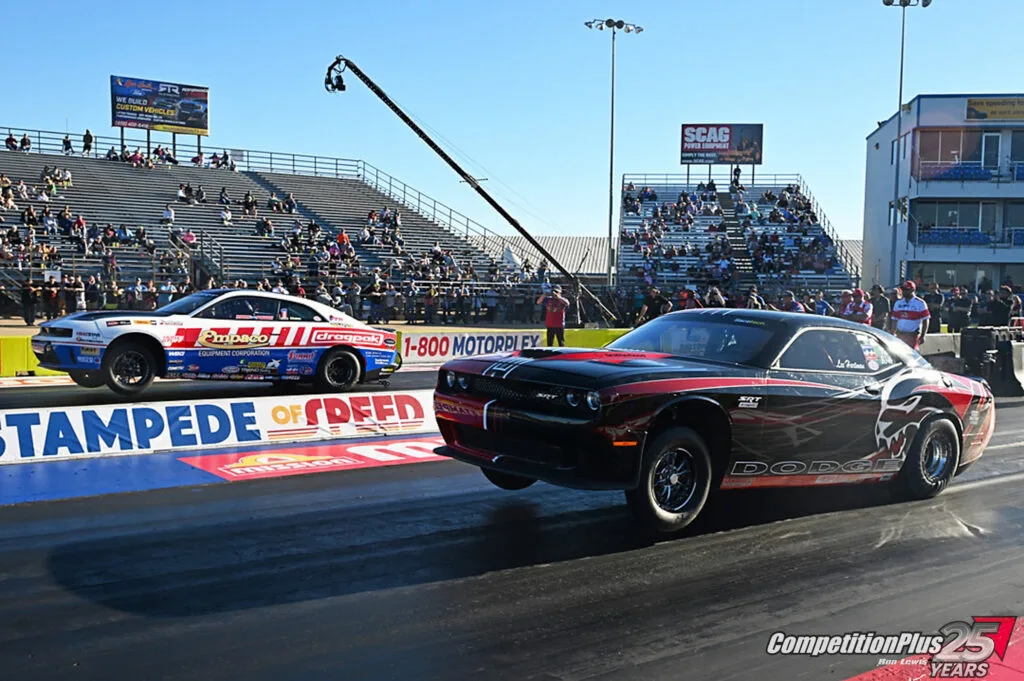


Doing a tribute Funny Car involves considerably more than pulling up an old photograph, copying the graphics and sending the file to a wrap company.
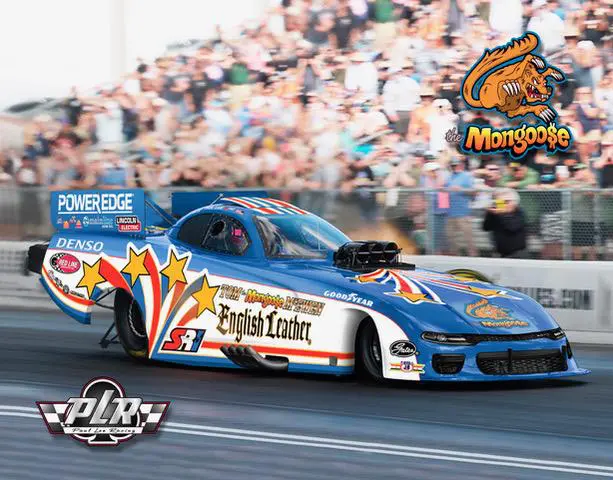
Steve Cole knows because he spent roughly a year chasing the pieces required to put Paul Lee’s tribute to Tom “The Mongoose” McEwen on the starting line at the NHRA U.S. Nationals in Indianapolis.
There was permission to secure, although honoring Lee’s longtime friend McEwen wasn’t the difficult part. There were trademarked logos from companies whose ownership had changed, current sponsors that still needed representation and a 1976 design that had to fit a modern Dodge Funny Car body.
Then came finding the man who created the original artwork.
Kenny Youngblood, one of drag racing’s most influential artists, designed McEwen’s starburst scheme when paint, brushes and imagination were the tools of the trade. Nearly 50 years later, Cole wanted Youngblood involved again rather than having somebody imitate his work from photographs.
After that came crew uniforms, starting-line shirts, T-shirts, photographs, supporting artwork and even die-cast plans.
For Cole, the project became less about recreating an old race car than figuring out how to make 1976 and 2026 occupy the same piece of fiberglass without either one looking out of place.
“This has a lot of deep meaning for both of us,” said Cole, who was introduced to Lee through McEwen. “When you look at that paint scheme, the first thing that screams to you is you got to find the guy who did it.”
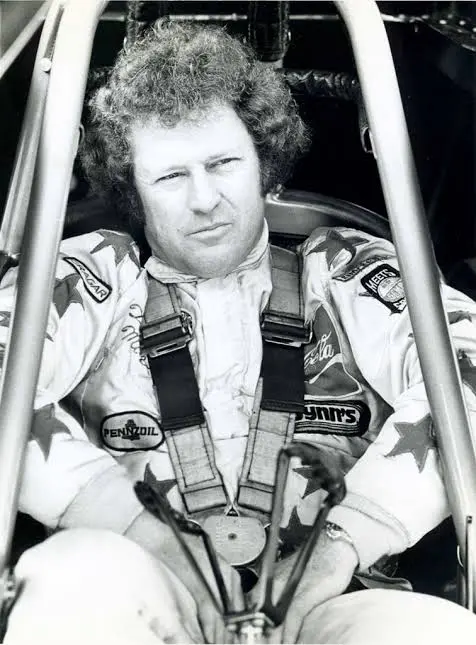
It wasn’t hard to find Youngblood as he is still heavilly involved in drag racing.
“Well, luckily Kenny Youngblood is still around,” Cole said. “And obviously Kenny and Paul have a relationship. It goes back to Paul’s first Top Alcohol Funny Car design.”
For every problem Cole solved, there seemed to be six more waiting for him.
A legitimate tribute needed enough of McEwen’s original sponsor identity that somebody who remembered the car wouldn’t need an explanation. Lee, however, has sponsors paying to be on his Funny Car today, creating the delicate job of honoring yesterday without ignoring the people paying the bills in 2026.
“So then you look at it and go, okay, well, let’s look at the sponsors on the car because Paul Lee Racing has sponsors and some can compete and some you may have to go get to keep the relevance of the livery on the car the same,” Cole said. “So fans go, ‘I know that car. That car’s 50 years ago raced in ’76.’”
McEwen’s longtime association with English Leather presented the most important piece of the increasingly complex puzzle. The aftershave brand occupied prominent real estate on McEwen’s original Funny Car, and Cole knew immediately that leaving it off would ruin the re-creation. Finding somebody who could authorize use of a decades-old version of the company’s logo became another matter entirely.
“I had to track down for about a year English Leather and find the right person that controls the marks,” Cole explained. :And that brand has been moved around quite a bit. But I did find a group out of New York City that had that.”
That search ultimately became a year of conversations and negotiations. The objective wasn’t just getting another company to write a sponsorship check; Cole needed legal permission to put the vintage English Leather identity back where drag racing fans remembered seeing it.
“We were able to negotiate at least the opportunity to put some money in to sponsor it, but really it was more about getting them to allow us to use the old vintage English Leather on the race car,” Cole said. “We were able to do that. So that took a year of back and forth and we were going to maybe run it next year or last year, but now we decide to run it this year for obvious reasons.”
Those reasons lined up almost too neatly.
The United States is celebrating its 250th anniversary, NHRA is celebrating its 75th season, and 2026 marks 60 years since Funny Car became an official NHRA eliminator. McEwen’s Youngblood-designed Funny Car also reaches its 50th anniversary.
Put all of those numbers against the backdrop of the U.S. Nationals, and waiting another year didn’t make much sense.
“Yeah. It’s a lot of moving parts. It is. And you’re trying to race the season,” Cole said. “But with 250th anniversary of our country, 60th anniversary of Funny Car, 50th of when Mongoose ran the car, and 75th of age. You’re right, Bobby, it’s a good time to do something commemorative at the biggest race of the year.”
Getting English Leather aboard didn’t finish the complete sponsor puzzle.
The U.S. Navy had been another recognizable part of McEwen’s racing history, and Cole explored bringing that element into the project. The layers of approval required to make it happen proved too much for the timetable.
“With that being said, that’s probably the hardest thing. Navy, I was working with Navy on there,” Cole said. “I know that was a big Mongoose sponsor. There’s just too many layers to go through.”
Instead of dropping an unrelated modern logo into the space and calling the job finished, Cole looked for something that could visually serve the original theme.
That’s where Greg Fornelli and SRI Performance provided the answer.
“That was one that couldn’t quite come to fruition. But my buddy, Greg Fornelli owns SRI Performance, and SRI, and he’s a big supporter of the team,” Cole said. “So he stepped up and said, ‘Look, let’s make a custom red, white and blue retro SRI logo, and we’ll put it where the Navy was.’ So I had to do that. There was a lot of moving parts.”
That challenge of getting the green light from English Leather and the challenges of the U.S. Navy with SRI willing to step up illustrated the difference between copying an old Funny Car and interpreting one.
Cole wasn’t trying to fool anybody into believing McEwen’s original machine had somehow been rolled out of storage. He was trying to preserve enough of its visual language that a fan who saw the car race in 1976 would recognize it before reading Lee’s name on the window.
Youngblood became the connection between those two eras and his fingerprints are all over the period Lee is honoring.
Youngblood worked with Funny Car royalty including Jim “Jungle Jim” Liberman, Don “The Snake” Prudhomme, Ed “The Ace” McCulloch and McEwen. His relationship with McEwen stretched through several cars and included an understanding that the Mongoose usually knew exactly what he wanted.
“I’ve been blessed to be old enough to have worked with the superstars of Funny Cars in the ’70s, Jungle Jim, Snake, Mongoose, the Ace, Black Magic… So many of them,” Youngblood said. “And I loved working with Tom McEwen.”
Youngblood recalled one of his earliest assignments with McEwen involving the famous Hot Wheels dragsters. He had an idea for changing the name placement and believed his version would improve the appearance.
McEwen wasn’t interested.
“I ran it by Tom, and he goes, ‘No, just paint it the way I told you to do it.’ And it really kind of bugged me because when you have a better idea, and as an artist, you want it to look the best possible,” Youngblood said. “So, on the way home, I was really aggravating over it, and then it came to me, and I had a realization. I thought, I really liked this guy, Tom McEwen, and I said, ‘He’s obviously set in his ways. He ain’t going to change, so I give, I’ll just do what he wants.’”
Doing what McEwen wanted worked wonders.
“And so, forever after, I had a great relationship with him because I wouldn’t… Sometimes he would come over and I’d be at the drawing board, and he’d be standing over my shoulder telling me what to do, and I would just do it,” Youngblood said. “I’d jokingly tell people, he’d say, ‘Oh yeah, Kenny, you design all these Funny Cars.’ I go, ‘Well, actually Tom McEwen does.’”
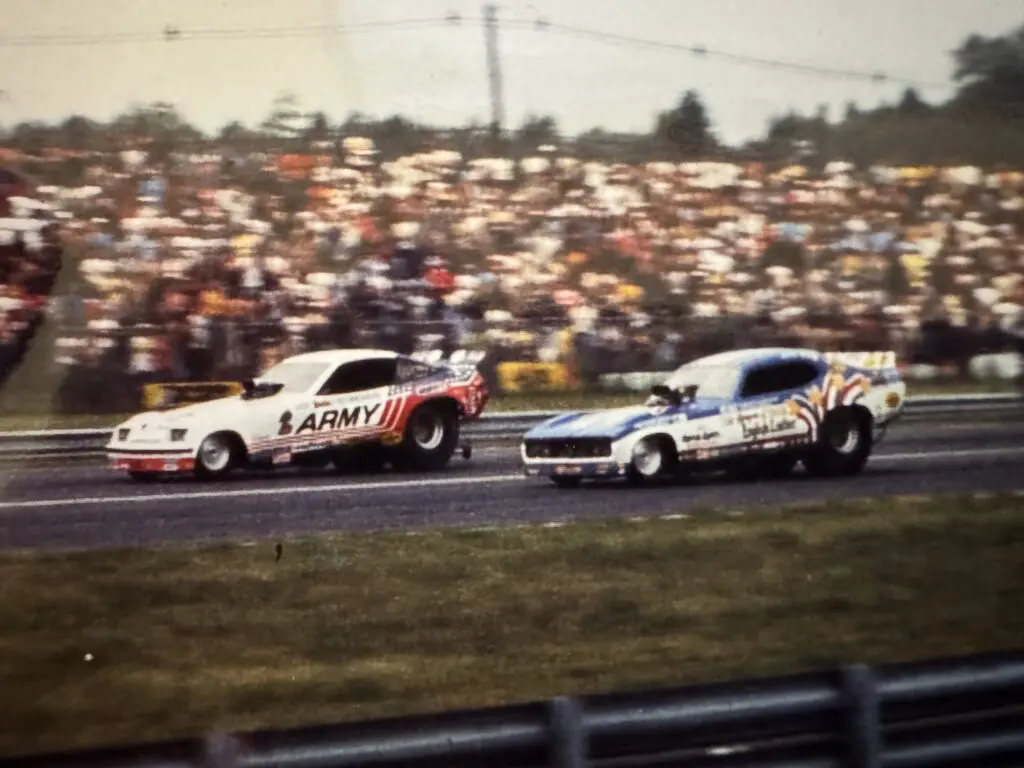
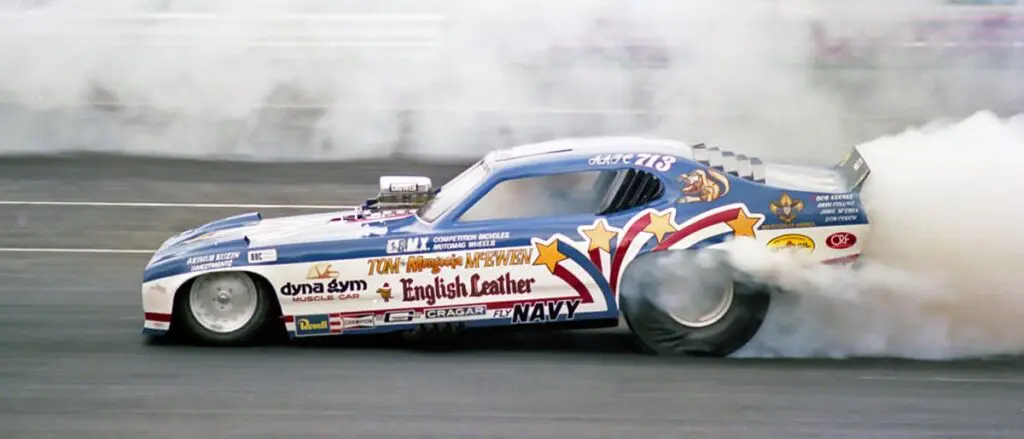
The starburst car, as many called it in 1976, was a different kind of design.
Youngblood started with a blank piece of paper. There was no computer program to manipulate the body shape, no digital template and certainly no vinyl wrap waiting to hide a mistake.
“Then I did this particular design with the starburst on it, which I’ll sit there with a blank piece of paper… And this is before computers,” Youngblood said. “And so, there was no wraps or anything. And so, you had to come up with a design, with a line, I would call it, what’s the shape that’s going to be on this car?”
The answer emerged while Youngblood was doodling.
“I was just doodling, and the starburst thing came out, which is really kind of, my tastes are pretty conservative,” Youngblood said. “And it was really pretty out there for me. But I thought, man, that looks pretty wild. I colored it in, and showed it to Tom, and he liked it. So, that’s what we went with.”
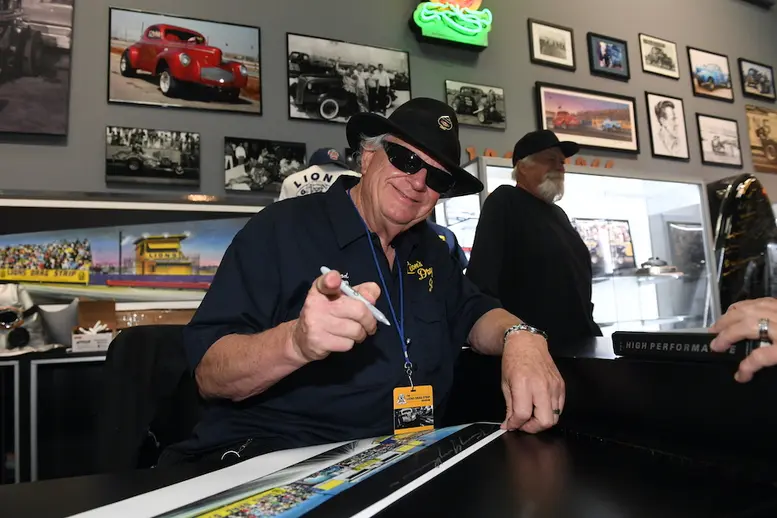
Five decades later, Youngblood faced a problem his younger self never had. Lee’s Dodge Funny Car isn’t shaped like McEwen’s 1976 machine.
The proportions are different, sponsor requirements have changed and what once existed as hand-painted artwork now had to become a digital wrap. Youngblood doesn’t consider himself a digital artist, and he wasn’t interested in handing his work to somebody who could operate software but couldn’t understand the artwork.
“I have a saying that just because you can buy a Mac and learn Photoshop doesn’t make you an artist,” Youngblood said. “You have to have the eye for it.”
Eventually, Youngblood found somebody who did.
He connected with digital artist Greg “Garland” Flowers, who could translate Youngblood’s ideas into the modern production process without losing what made the original work.
“I called Garland, I said, ‘Could you help me put this wrap together?’ And he said, ‘Yeah.’ So, I sent him pictures of the car, and he started building it out,” Youngblood said. “However, because I was involved, I had the opportunity to tune it up, to make some little tweaks here and there, add some pinstriping where I needed it, and some different things to make it really look nice.”

Youngblood wasn’t being asked to reproduce a museum piece. He was adapting his own work to a Funny Car separated from the original by a half-century of aerodynamic development.
Cole then had to carry that authenticity beyond the body.
Crew apparel became its own research project. Cole enlisted help in finding old photographs so the team’s starting-line appearance could resemble what surrounded McEwen’s car in the era, without pretending everything was exactly as it had been.
“Then from there, you start going into all the support artwork and starting line shirts to what the crew wore back in the day,” Cole said. “I had Richard Shute and Gary Nastase trying to dig up old photos for me to try to recreate what they had, or at least try to honor them as best we could. There’s a lot of moving parts, and it’s only me.”
Cole may have delivered the best explanation for why these projects rarely happen overnight..
“We have a winner here,” Cole continued. “And to pull this off might have been the biggest win of them all.“