
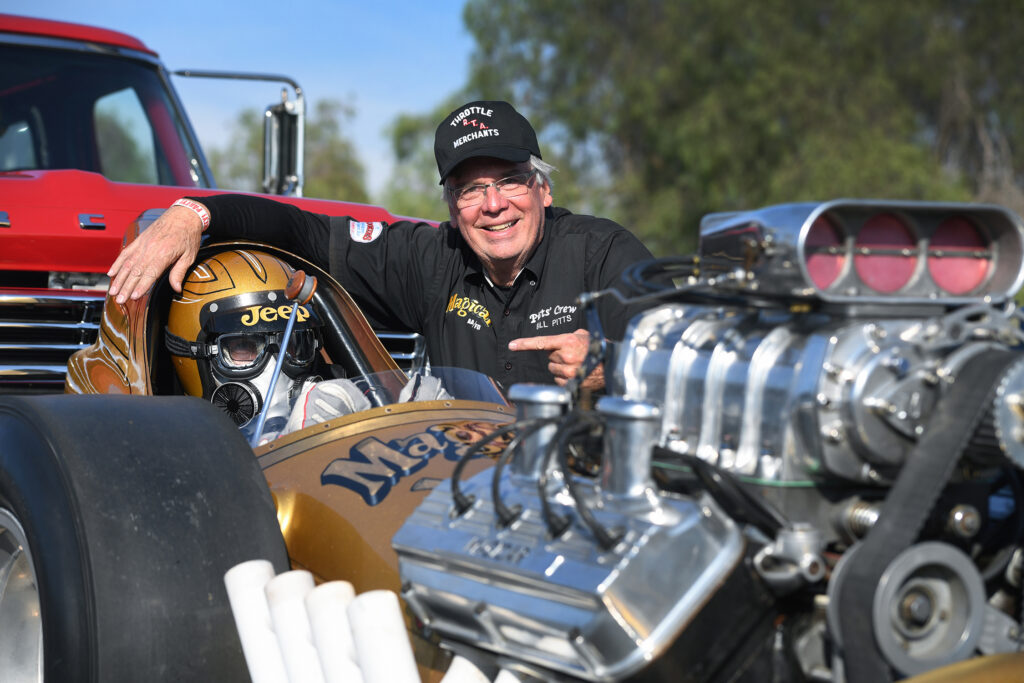
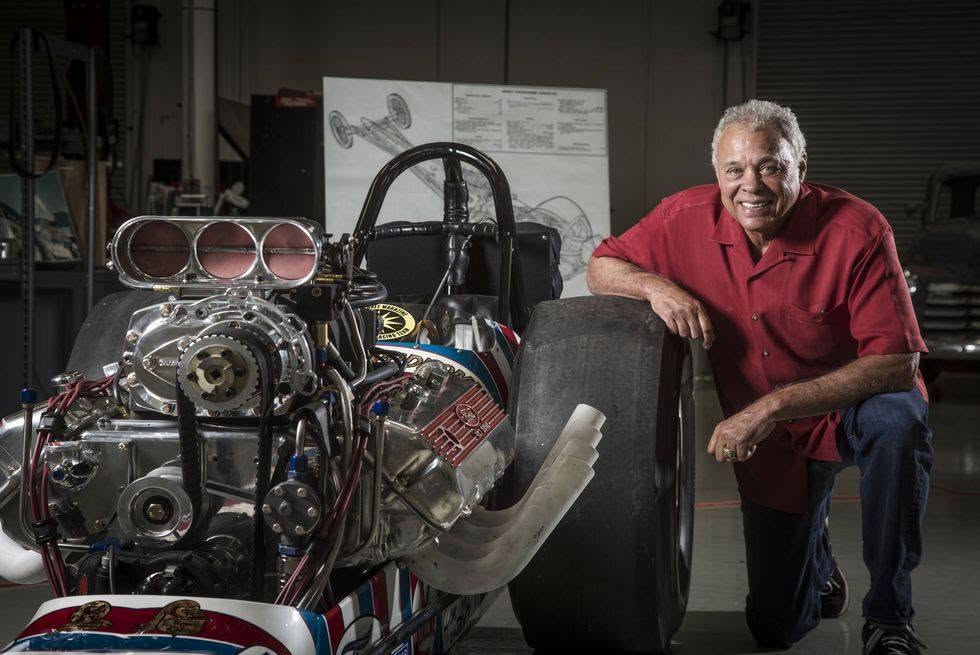
The Cacklefest portion of the Good Vibrations California Hot Rod Reunion featuring the Nitro Revival will have one person in the middle of nitro-burning, living it up and smiling ear-to-ear, and even though he’s famous amongst those burning nitromethane, the average Bakersfield attendee has no clue who he is, but they should if they love vintage cars.
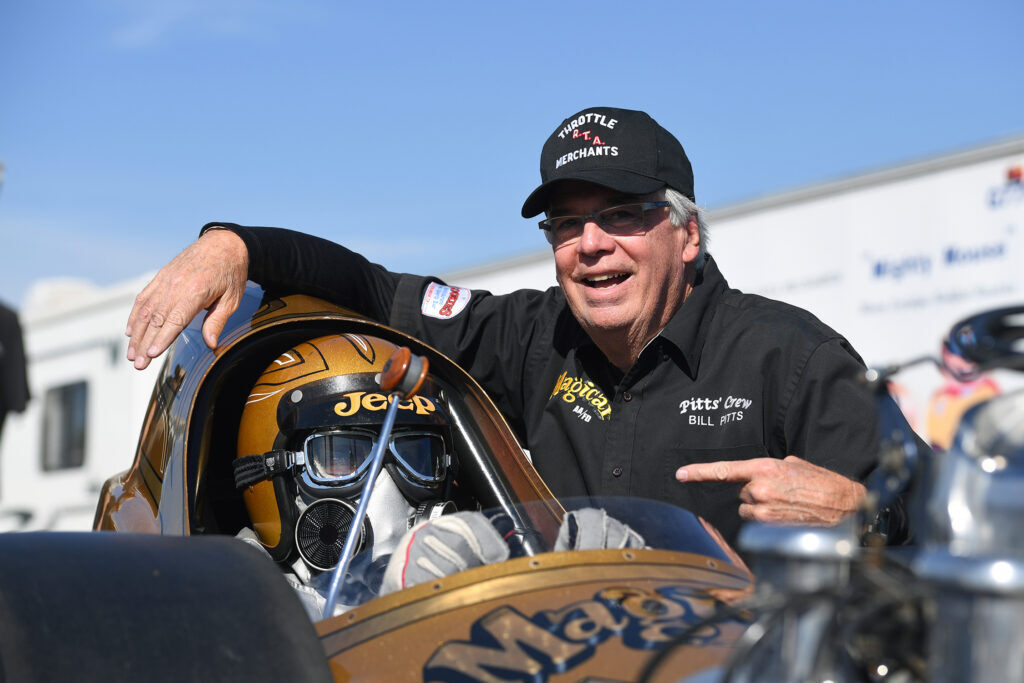
If Don Garlits gets to be called Big Daddy for helping revolutionize the Top Fuel dragster, Bill Pitts ought to have some kind of parental rights to the cackle car.
After all, the retired San Diego firefighter helped get the whole business of firing up old nitro-burning dragsters in front of appreciative crowds off the ground. And he did it because, somewhere along the way, drag racing had quit giving him what he wanted.
Pitts didn’t have a problem with the modern Top Fuel dragster. He just preferred the old ones, back when the driver sat behind the rear tires, the engine sat out front and a push truck was part of the starting procedure.
He missed the 1960s, and not because he wanted to be young again. He missed the race cars.
By the late 1980s, Pitts had developed a routine with his fellow San Diego firefighters. They would charter a bus, head to Pomona for the NHRA Winternationals or Winston Finals and spend the day watching the quickest and fastest dragsters in the world.
Pitts enjoyed the outings, but something was wrong with the picture.
“Well, you know what it does is there was something that was missing,” Pitts said. “When I would go to the races in the mid to latter part of the 1980s, I would go to the current NHRA races, the Winston Finals and the Winter Nationals down at Pomona, but there was something that was missing and I couldn’t figure out what it was.”
The answer eventually came to him. He wanted the old slingshots back, the front-engine dragsters that had made such an impression on him during the 1960s.
There was only one problem. Nobody was bringing those cars to the races anymore, at least not in the numbers Pitts remembered. So he decided to find one himself.
Pitts estimates that around 1988 or 1989, he asked Ray Burrs, a fellow firefighter who worked at the department’s repair facility, to keep his eyes open for an old front-engine dragster. Pitts wasn’t particular about what he would do with it, although he knew he didn’t want to race.
Burrs eventually found something in Santee, California, sitting inside an old trailer parked beside a house.
What he found wasn’t just some forgotten piece of racing equipment. It was Don “The Snake” Prudhomme’s Shelby Super Snake dragster, a car Pitts identified as the first to break into the six-second range at an NHRA event, so he bought it.
At the time, he suspected the car had a history, but he didn’t know exactly what he had purchased. One evening at the fire station, he decided to do some investigating.
He pulled out his old drag racing magazines and started looking for photographs that might help identify the car. When he finally found one, he had to look twice.
“What I did was I took some of my old drag racing magazines to my fire station one evening and I started looking through my old magazines because I was hoping to find something that would lead me to what this car was that I had just purchased,” Pitts said. “And sure enough, I stumbled on a picture and it was the Shelby Super Snake and I just said, ‘What?'”
While his fellow firefighters were asleep, Pitts was pacing the station.
“It was at nighttime,” Pitts said. “I was at the fire station and I started walking on the apparatus floor between the fire trucks at 10 o’clock at night and everybody else was in bed and I was sweating. I couldn’t believe that I had a Super Snake.”
Now, most people who stumble onto a historically significant Don Prudhomme dragster would probably figure they’d hit the jackpot. They might restore it, put it on display or spend the next several years telling everybody about the treasure they found in somebody’s trailer but Pitts had another idea.
He traded it away and he did do knowing what it was when he made the deal.
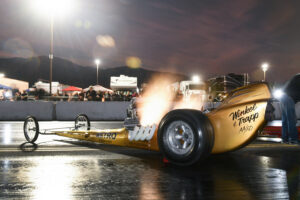
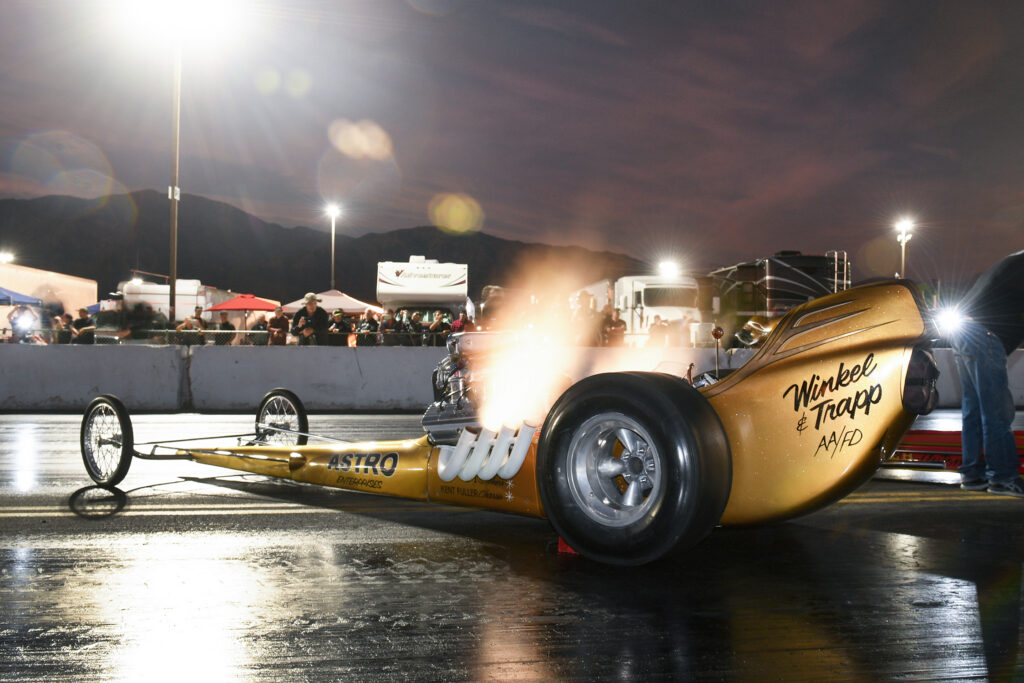
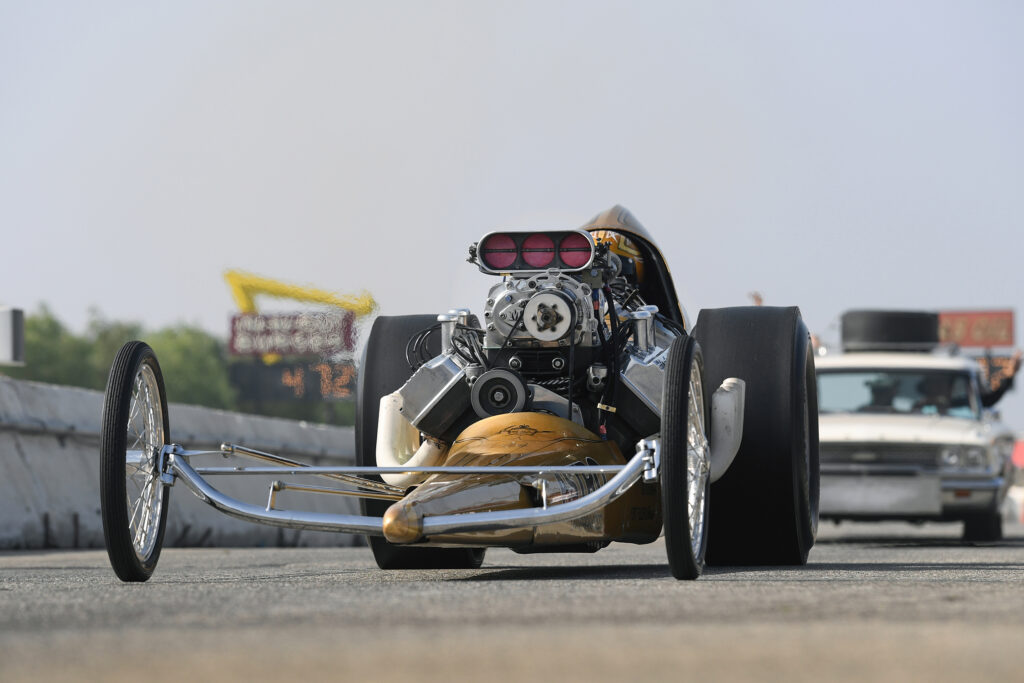
The car Pitts wanted was the Winkel-Trapp-Fuller Magicar, a front-engine dragster he’d actually watched race during the 1960s. The Magicar had appeared at Bakersfield, and Pitts couldn’t get the thing out of his head.
John Barrett of Oklahoma owned the Magicar and wanted something he could race. Pitts had a Super Snake that Barrett believed could be returned to competition with some modifications.
One man wanted to race and the other wanted to make noise, so they traded.
Pitts knew exactly what he was giving up when he traded the Shelby Super Snake. But the Winkel-Trapp-Fuller Magicar was the dragster he remembered watching race in the 1960s, and no amount of historical significance was going to change his mind.
“Yeah, I know. Yeah, I know. I know, but it’s whatever passion you have for the sport, whatever it is that is truly a passion for you, that’s what you have to pursue,” Pitts said. “And that’s what I had to pursue. I had to get a car that I’d seen back in the day run, actually run, and so I did.”
Pitts wasn’t trying to make a shrewd investment. He wanted a car that took him back to a particular time in drag racing, and the Magicar was it.
Besides, he had no intention of taking either dragster down the quarter-mile.
“Hey, I’ll take the Magicar any day because I don’t want to race,” Pitts said. “I don’t want to do that. I just want to get a car, start it up, make flames, shut it off and tell stories about the old days and we would have fun doing that.”
As it turned out, there were plenty of people who liked that idea.
Pitts eventually brought the Magicar to Famoso Raceway in Bakersfield, where the old dragster was pushed out in front of the spectators. They fired it using a conventional blower starter, brought the engine up a few times and shut it down.
It was just an old dragster doing what old dragsters used to do, minus the trip down the racetrack and the crowd went nuts.
Steve Gibbs, who helped establish the Good Vibrations California Hot Rod Reunion featuring the Nitro Revival, saw something in the reaction. If one old front-engine dragster could generate that kind of response, what would happen if they brought out several of them and started them the old-fashioned way?
“Well, Steve Gibbs was the one who thought, ‘You know, maybe we should hook these cars up and push them,'” Pitts said. “I mean, what we did was we brought my car out. My car was, I’ll call it the first car to be pushed out in front of the crowd, and we used a regular blower starter on the front of it to start it up and rev it up a couple times and shut it down and see what the crowd’s reaction was.”
Gibbs took the idea and ran with it. He worked with Pitts and other owners to get their cars ready for traditional push starts, bringing back a procedure that had largely disappeared from professional drag racing.
“So it was that first step that gave Steve Gibbs the idea that, ‘Man, this is a really good idea. We should bring these cars back,'” Pitts said. “So he went about the process of contacting us and having us work to couple up the car to where they could be push-started to life.”
What followed became the Cacklefest, a gathering of historic nitro-burning dragsters that eventually grew into one of the California Hot Rod Reunion’s signature attractions.

Pitts hadn’t set out to create a spectacle. He just wanted to hear the Magicar run, and it turned out a whole lot of other people wanted to hear it, too.
There’s another part of the story that should make anyone who cringed at Pitts trading away the Super Snake feel a little better.
The Prudhomme dragster eventually found its way back to Prudhomme.
According to Pitts, The Snake took the car to his shop in Carlsbad, California, restored it to its original appearance and even performed a burnout in it. The car later went into a museum collection, although Pitts wasn’t certain which museum had it.
So the Super Snake got its happy ending, and Pitts got the Magicar. Considering what came afterward, it’s hard to argue he made the wrong deal.
The Magicar remains part of his life, even as the men who grew up watching those front-engine dragsters become fewer in number. Pitts retired from the San Diego Fire Department in 2009 after 35 years, but he hasn’t retired from making nitro noise.
His wife supports the hobby, and Pitts continues to do the work required to keep the car ready for appearances. Before this year’s California Hot Rod Reunion, he was measuring the Magicar’s push bar so Cindy Gibbs could coordinate with the person responsible for pushing it at Bakersfield.
The details might seem small to somebody who has never watched an old slingshot come to life. To Pitts, they’re part of getting the car back in front of the people who appreciate it.
“We’re not spring chickens,” Pitts said. “That’s guys that went to the races and saw it and fell in love with it. There’s some of us that are dying off and it’s hard to put a value on it all, but all I know is it’s been something that keeps us going.”
Pitts understands that the generation that watched those cars race is getting older. He also knows there are people who never saw a front-engine Top Fuel dragster make a competitive pass but have discovered what all the fuss was about through the Cacklefest.
He never needed the Magicar to win another race. Getting it running and hearing the crowd respond was plenty.
And after all these years, the former firefighter who traded away a legendary Prudhomme dragster is still looking forward to lighting another fire.
“It’s something that moves us forward,” Pitts said. “And I’m so looking forward to getting to Bakersfield this year.”