

Never has a perceived insult led to so many good things.
Jason Galvin had been out of high school for maybe a month when his uncle, iconic 1970s crewman Pat Galvin, called with what probably wasn’t intended as a glowing assessment of his nephew’s strongest qualities.
“Hey, I was thinking, I was driving to work this morning listening to Dan Patrick and Colin Cowherd,” Pat told him. “And they’re all on the radio talking about sports and whatnot. And I thought to myself, ‘Jason knows more about sports than anybody I know. And he also doesn’t know when to shut up.’ You ever thought about making that a career?”
Being part of the Galvin family apparently requires a thick skin. Jason managed to get past the insult long enough to think about it.
No, he hadn’t considered making a living talking about sports. But it’d be darn cool, right?
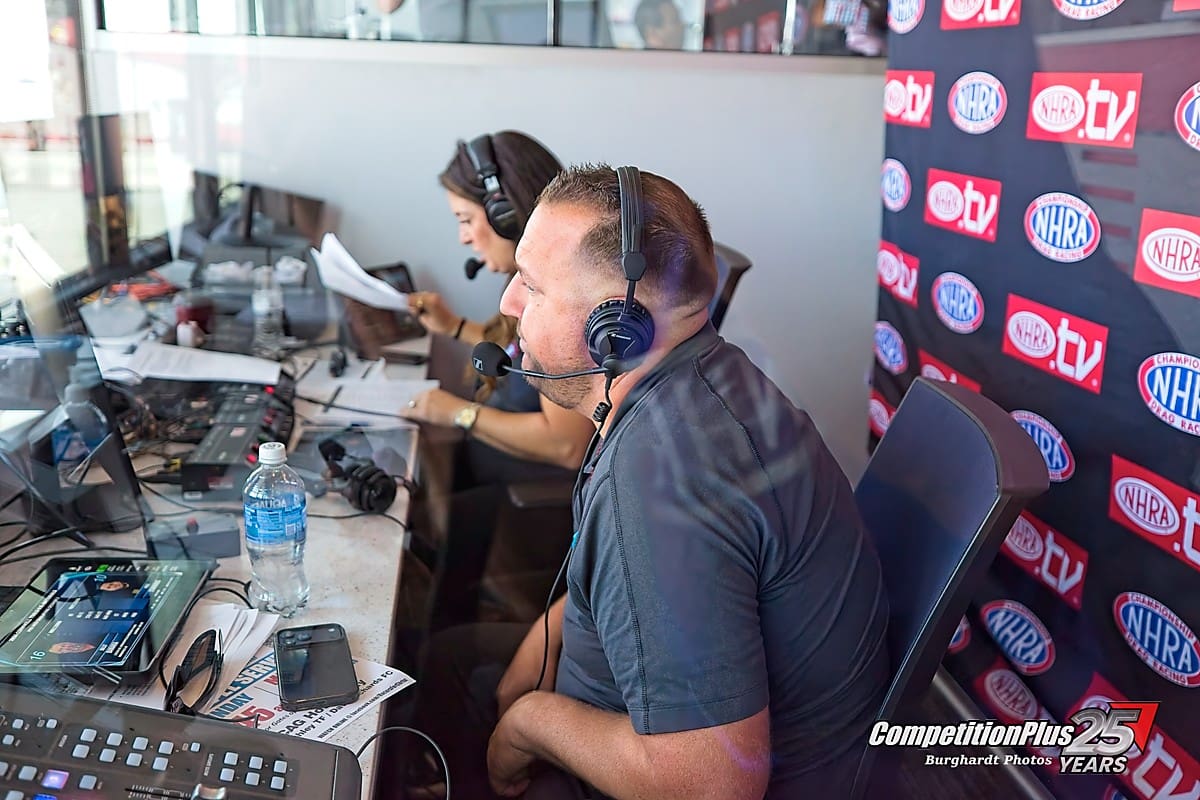
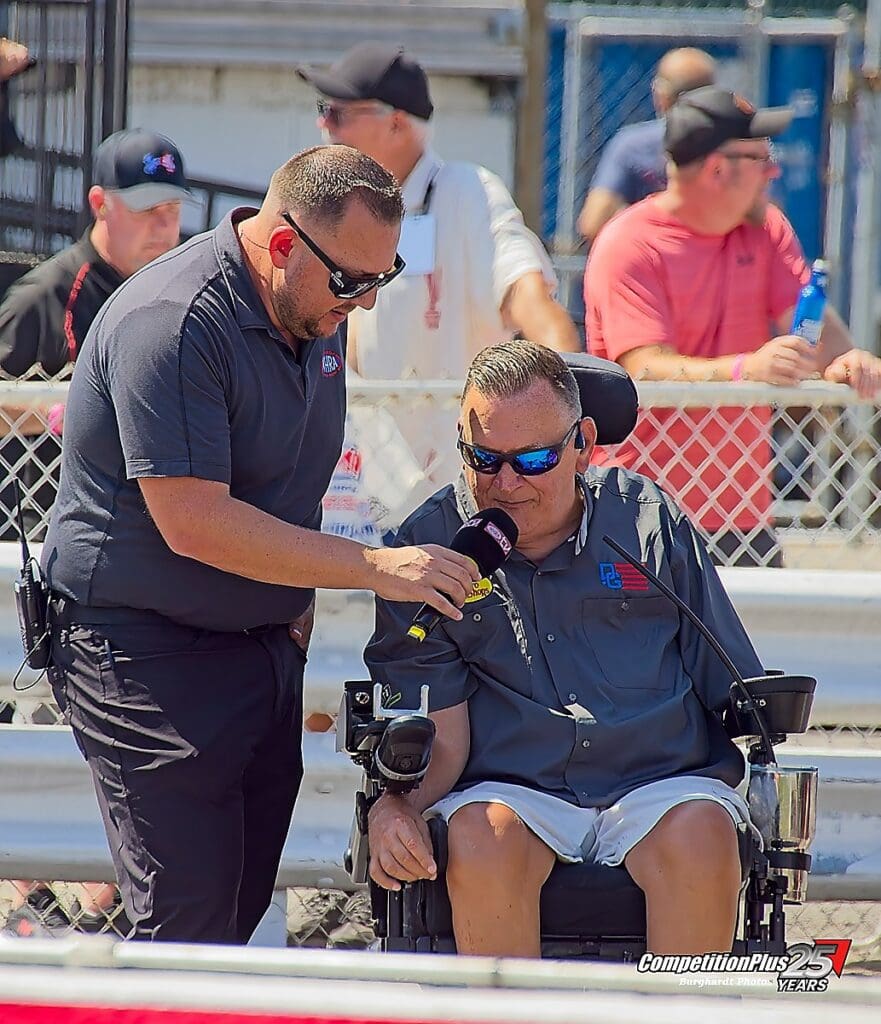
Roughly two decades later, Galvin is one of the voices calling NHRA Top Fuel and Funny Car on Sunday. Getting from Pat’s wisecrack to an NHRA microphone required considerably more than possessing the gift of gab.
Turns out talking wasn’t Galvin’s problem. Knowing what the hell he was talking about was.
Galvin grew up around drag racing, which makes that last part even better. His father, Mike, tinkered with race cars, while Pat took the family connection much deeper and turned drag racing into a full-time career.
Galvin went to Pomona as a kid, knew the names, knew the cars and once entertained the same dream plenty of kids sitting along the fence had: Top Fuel driver. When that didn’t happen, he still wanted through the gate somehow.
“I knew at a pretty early age that I loved this sport and it helps to be involved in a sport or to be around a sport, I guess, that has meant so much to your family,” Galvin said. “And when it’s all that you hear about and read about and see in everybody’s house, it makes you really want to be part of it.”
Pat eventually pointed him toward a microphone, although neither of them could have known where it would lead. Galvin planned to study marketing and business when his uncle suggested there might be money in Jason’s inability to shut up.
Within about a month of graduating, Galvin landed an internship at KHTS radio in Santa Clarita, California. Before drag racing came calling, he accumulated a résumé that suggested he didn’t need it.
Galvin called Pac-12 football and other major college sports, covered Milwaukee Brewers spring training for the Milwaukee Journal Sentinel and broke a national story that landed on the front page of USA Today. He also worked NBA Finals, Stanley Cup Finals, Major League Baseball All-Star Games and major boxing events.
“Pinch me, little kid stuff,” Galvin added.
For all of that, the sport he’d grown up around wasn’t part of the paying gig. When drag racing finally did put a microphone in his hand, Galvin found out pretty quickly that growing up around it wasn’t enough.
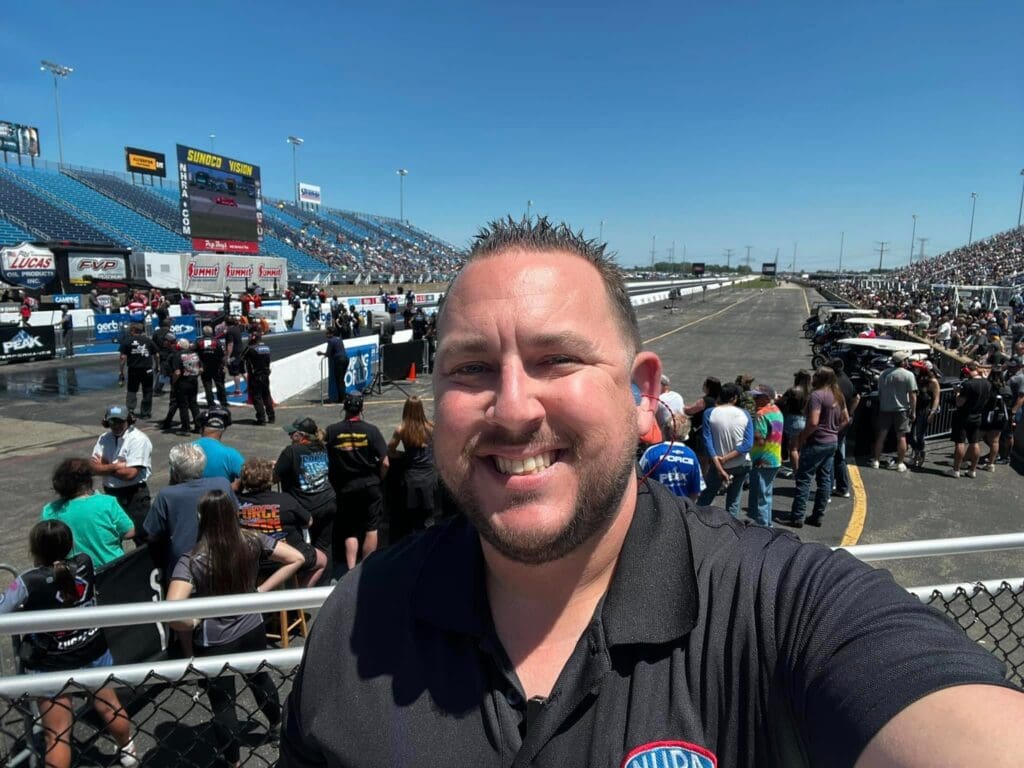
His first racetrack announcing opportunity came at Irwindale Speedway in 2008. Galvin was 19 and already working radio when friends recommended him as a fill-in for an ill track announcer.
During a Legends race, longtime announcer Larry Naston unknowingly offered his assessment over a live microphone: “This kid’s pretty good.”
Then Galvin tried announcing drag racing.
“I sucked at it. I was not good,” Galvin admitted. “I didn’t know anything about it.”
He knew Top Fuel and Funny Car and could name the stars from Pro Stock and Pro Stock Motorcycle. Then somebody rolled a bracket car into the water box, and all that time around drag racing didn’t help nearly as much as Galvin probably figured it would.
“I actually got fired when the track got a new GM. I got fired from the drag race announcing job,” Galvin said. “I just wasn’t good at it. Rightfully so. I deserved to be fired. I stunk at it.”
Getting fired for being a lousy drag racing announcer isn’t the conventional route to announcing nitro on Sunday but Galvin apparently didn’t get that memo.
He finished college at Arizona State and built a television career, eventually becoming an Emmy Award-winning news anchor. He also continued calling auto racing, including NASCAR Cup and IndyCar events at Phoenix International Raceway. The television career looked considerably better from the outside than it felt from Galvin’s chair. By 2018, he wanted out.
The Route 91 Harvest festival shooting in Las Vegas made the decision painfully clear. Galvin knew a racing family whose daughter had been killed, leaving him to make a telephone call no reporter wants to make.
“I had to call a friend at 3:00 in the morning and ask him if it was true that his daughter died while he was driving to Las Vegas to claim her body,” Galvin said.
He threw his work phone across the newsroom and broke it. There wasn’t much left to debate after that.
Blake Bowser and Mark Dawson later brought Galvin onto streaming coverage of the 2018 March Meet, where he worked with Mike Dunn. Galvin told Dunn what he wanted to do next. It was the NHRA.
Dunn offered advice. Bob Frey later did the same, and Galvin kept hanging around the races looking for his crack in the door.
Brian Lohnes finally provided one at the 2018 NHRA World Finals. He pulled Galvin aside during J.R. Todd’s championship celebration, told him some news was coming and instructed him to call when it became public.
Lohnes soon was announced in his new NHRA television role. Galvin made the call and learned Lohnes had arranged an audition for him at the 2019 Winternationals.
Galvin arrived Thursday with years of broadcasting experience, major sporting events on his résumé and, by his own admission, probably a little too much strut.
Then Alan Reinhart handed him Super Comp.
Galvin called the time trials “qualifying” because that’s what he thought the computer told him they were. All those NBA Finals, Stanley Cup Finals and college football games weren’t much help now.
“I mean, I couldn’t have flunked this anymore if I wanted to,” Galvin confirmed.
Rain pushed the event into Monday, and Galvin came back even though nobody was paying him. Reinhart was needed for television, Mike English was handling other duties and somebody needed to call the alcohol finals.
Galvin was there. More importantly, he knew enough about the alcohol cars not to make a mess of it.

Reinhart gave him some advice afterward that wasn’t particularly complicated. He needed to learn Sportsman racing.
Galvin worked divisional races and got more national-event opportunities, but he knew he still wasn’t where he needed to be. Then COVID stopped racing and gave him plenty of time to think about why.
The answer eventually put him somewhere few announcers go looking for broadcasting lessons. It put him inside a race car.
“I need to get into drag racing,” Galvin said. “I will be a better drag racing announcer if I can drag race. I need to learn it.”
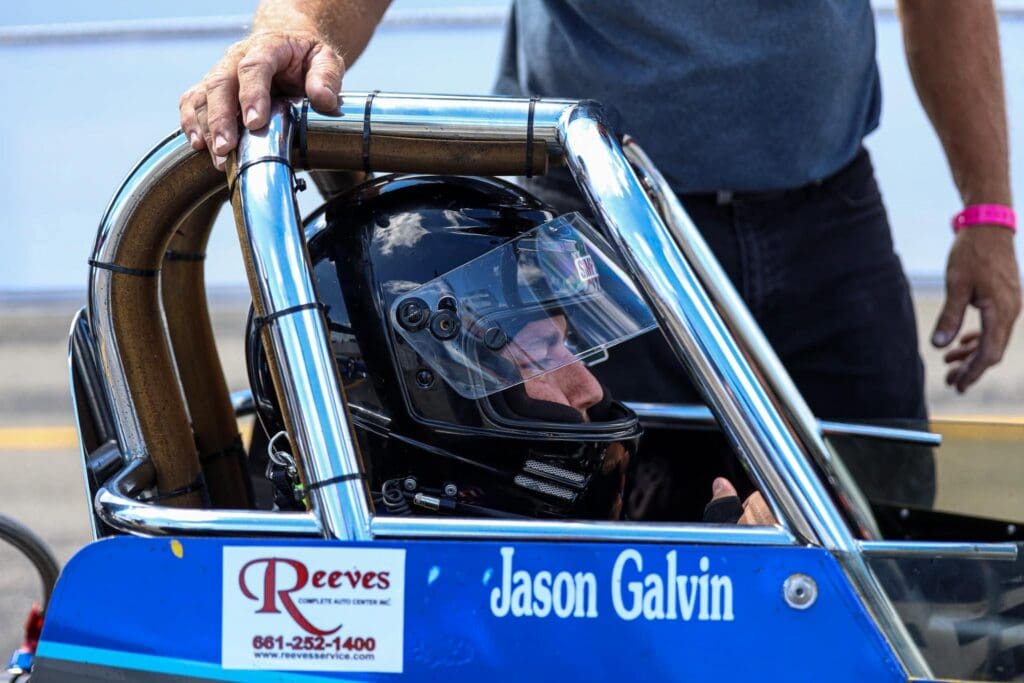
Galvin cold-called Tom Bayer, and three months later he was licensing in Bayer’s Super Comp dragster. A couple of weeks later, he entered one of Bayer’s 8.90 races at Famoso and won.
He kept racing, tried bracket competition, raced at a national event and learned to see the starting line from somewhere other than behind glass in an announcing booth. Bayer taught him to think like a driver.
The new status changed the announcer.
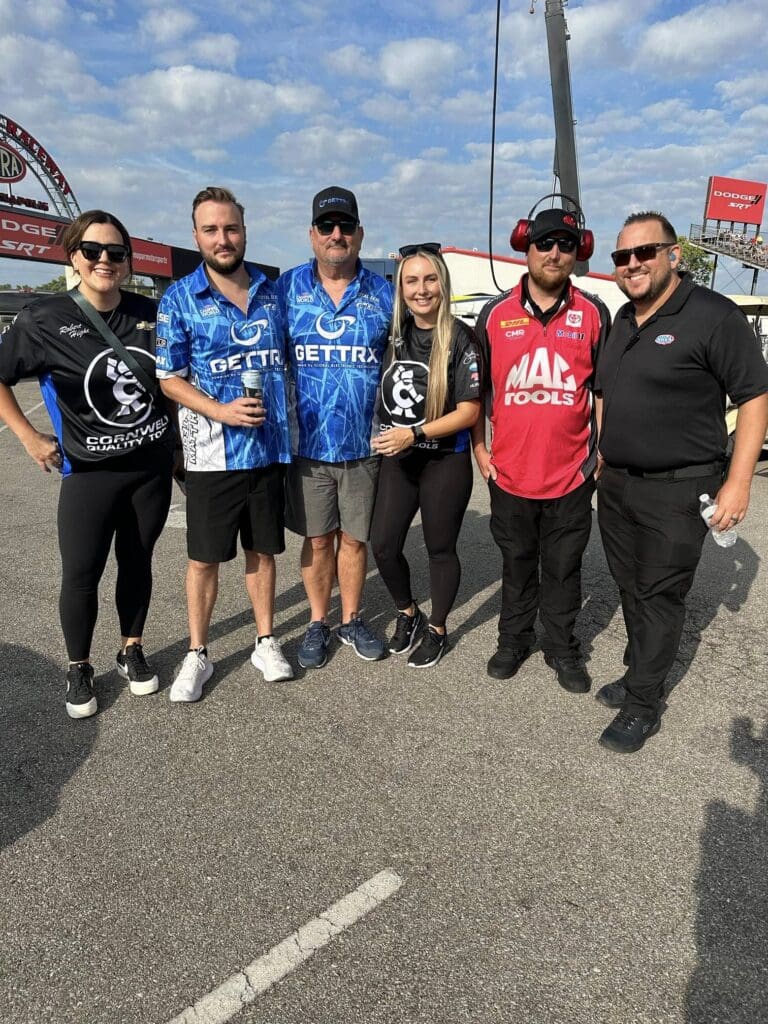
When Galvin returned to the NHRA tower, Reinhart heard it. He worked through Super Comp, Super Gas and Super Stock before Reinhart came back to the tower and asked him for a minute. Then Reinhart shut the door and checked the microphones.
Considering Galvin’s history with drag racing announcing evaluations, the closed door wasn’t especially comforting.
“What have you been doing for the last year and a half?” Reinhart asked.
Galvin explained the divisional races and heritage events before mentioning the Super Comp driving. Reinhart already knew something was different; he just didn’t know why.
“The announcer who rolled in here today is not the announcer who rolled into here a couple years ago,” Galvin recalled Reinhart telling him. “The guy who walked in here today, you can be part of this team and I’m willing to help you because you put the work in to get better.”
It had taken getting fired, failing an NHRA audition and finally climbing into a race car, but Galvin had become good enough for the job he’d wanted all along.

Looking back Galvin doesn’t dare clean up the résumé when he tells it. What seemed like a cat with nine lives was dangerously close to running out of chances.
“I had six opportunities and I flunked every test,” Galvin said. “Every test that I took to be an NHRA announcer full-time, I got an F on and life happened to work out. However you want to call it, fate, luck, you create your own opportunities, you’re ready for the moment, whatever it was.
“Cat’s got nine lives. I was on my ninth life,” Galvin said. “I really was. I was not good enough and I probably didn’t take it serious enough.”
Eventually, he did. The kid who once sat at Pomona listening to Bob Frey and Alan Reinhart now has somebody else sitting in those grandstands listening to him.
“I sat in the stands once and listened to Bob Frey and Alan Reinhart and thought, man, it’d be cool to be one of them,” Galvin said. “And if somebody sits in the stands and says, ‘I’d like to be Joe Castello or Brian Lohnes or Jason Galvin one day,’ then man, I did my job and that’s what matters to me. I don’t need to leave some grand scale legacy. I just want to know that this sport is healthy into the future.
“And for me, that would be enough, is to know that I contributed to the growth of this sport, hopefully. And that whenever my career is done, whether that’s Monday after this race or 25 years or 50 years from now, that I left it in a little bit better place than where I found it.”


















REYES ON TOUR: INVASION OF THE CHEVROLET VEGA — PART 1