

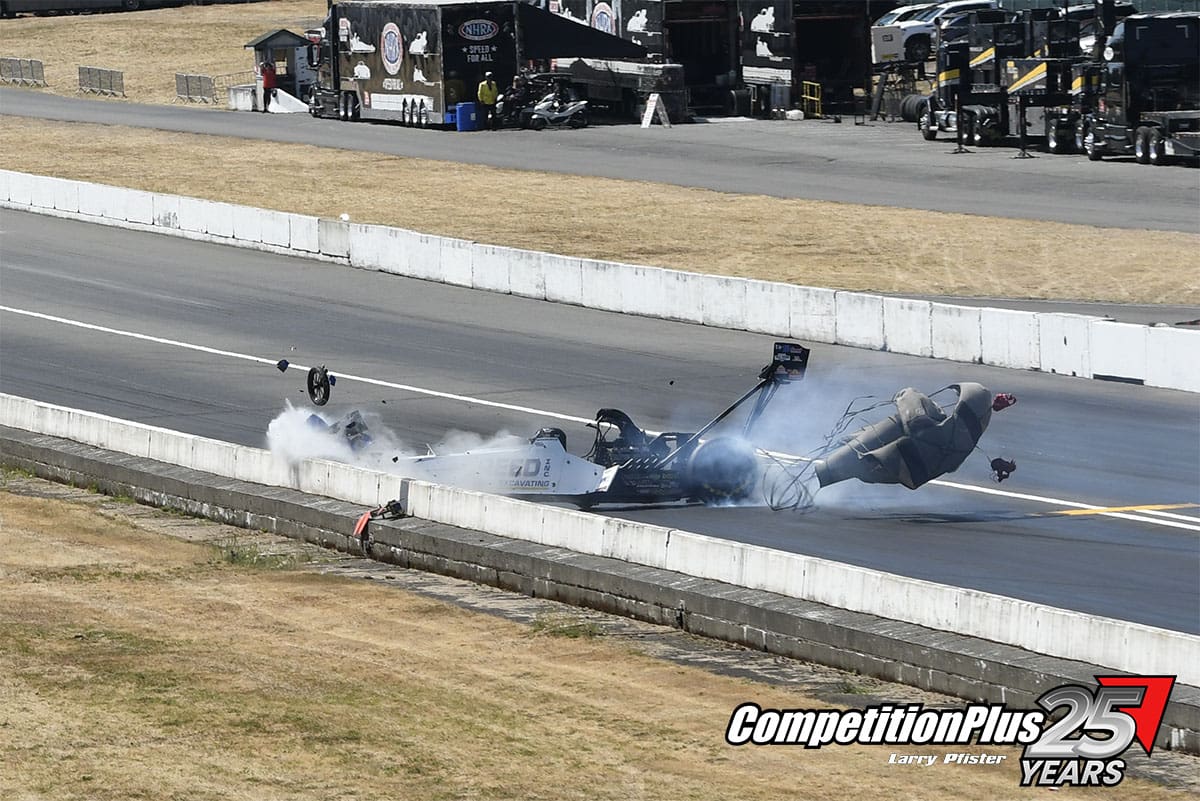

It has been a year since Shawn Reed suffered fractured ribs and serious hand injuries that cost his left index finger during the NHRA Northwest Nationals outside of Seattle. That incident occurred during Saturday qualifying due to a rear tire failure at 290 mph. A woman spectator near the top end of the track was airlifted to the hospital with a potential head injury that thankfully was not as severe as initially thought.
In that one year, Reed crew chief Rob Wendland has taken measures to mitigate personal and collateral damage should such an accident recur. But all that Reed and Wendland have from tire manufacturer Goodyear so far is the assertion that “there was no smoking gun,” meaning it determined no discernable cause for the tire failure.
Goodyear representatives met following Reed’s wreck, Wendland said. “After they got all the pieces back, they collected 99.9 percent of all the pieces, so they said, ‘Put it all back together,’ and gave us a presentation right here on the counter, and said that there was absolutely nothing that they could find for the reason for that failure to happen. There was nothing that was punctured. There was nothing that was, material-wise, [wrong] with the tire that they could figure that happened.”
So, does Wendland accept that explanation?
“Well,” he said, “I don’t know if there was a construction issue with the tire. I do know this: After looking at all the information that we had and there were no pieces on the track at that point that they found the punctures, Goodyear said themselves there was no puncture marks on it. You saw where it came off and hit the wing and had a piece of the wing in the tire or whatever from hitting it, right? From hitting the wing – that’s what took out the car, when the tire let loose and hit the wing. And the super slo-mo that was provided to us from TRD at the time and [PRO representative] Chad Head, you could go frame by frame and look at it and it looks like the actual tire is coming apart. I don’t know if [it was] delamination, but it lost its normal form.
“And then actually Goodyear said that there was no smoking gun. ‘There was no smoking gun’ was the exact words,” Wendland said.
“And that was a brand-new tire. On top of everything else, that was a brand-new tire. I think possibly something happened to the tire. Any of the crew chiefs that look at it, the data, all that kind of stuff, nothing came out of the motor. The motor was still fine. We ran that motor. And so nothing happened to the motor. Nothing came out of the motor. Matter of fact, that short block was in for [Jordan] Vandergriff when he drove the car and ran it” at Brainerd, he said. “Another thing they did … They came up to me five minutes after the crash, and I’m down there watching them take Shawn out and everything. And they said to me, ‘It looks like something punctured that tire.’ I’m like, ‘How can you tell something punctured that tire five minutes after[ward]?’”
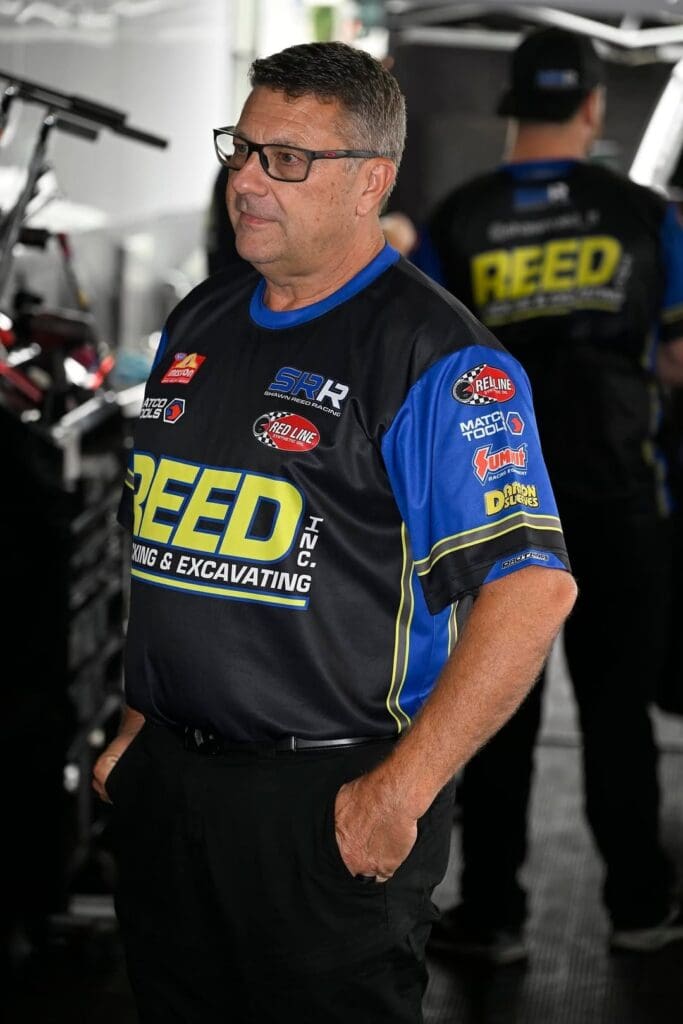
Although he still has no definitive answers about the cause of the tire failure, he recognized Goodyear’s long-time and deep investment in the sport. He said, “A couple things are going on in this sport that are good and bad. The great thing is that Goodyear makes a tire that we can race on. I don’t think there’s any other manufacturer out there that wants to do that. It’s a lot of liability, right? And with that, there was an injury in the crowd. Wasn’t from the rear tire, although it was from the tire coming apart and the car crashing. A front wheel came off the car and hit the lady. I think she’s supposed to be out here this weekend.”
Wendland said he spearheaded his own quest to solve the problem or at least minimize the impact of such an event in the absence of a sustained effort from the NHRA Technical Department. “We try to make these cars as ‘unballistic’ as we can,” he said.
“What we’ve done, we’ve been proactive about it. And I find this really hard for NHRA not to jump on board, but I’ve made some tethers. The whole control arm came off when it hit the wall,” Wendland said. “There’s only two points of attachment for the front spindle and wheel. There’s only two attachment points, the upper and lower control arm. And they’re both single-point attachments. It needs to be three. That would help things. As we know, a plane is described by three points, and that would help hold that. I did it at one time, I remember. I think it was around 40-some percent stronger to hold that assembly onto the car. So what we did to help, we ran a cable through the spindle and wrapped it around the frame rails. So if it was to break, the cable would actually slow the process of it leaving the car. And hopefully the cable would take away some of that energy of the tire and the A-arm flying away from the car. Both our cars are like that. And it’s very, very, very, very cost effective to do. It’s like maybe $50 worth of parts.
“It’s something that’s proactive that NHRA hasn’t mandated, but I felt that if any car was in that kind of position again where the front end is going something to slow that down or keep it from leaving the car [this would work],” he said.
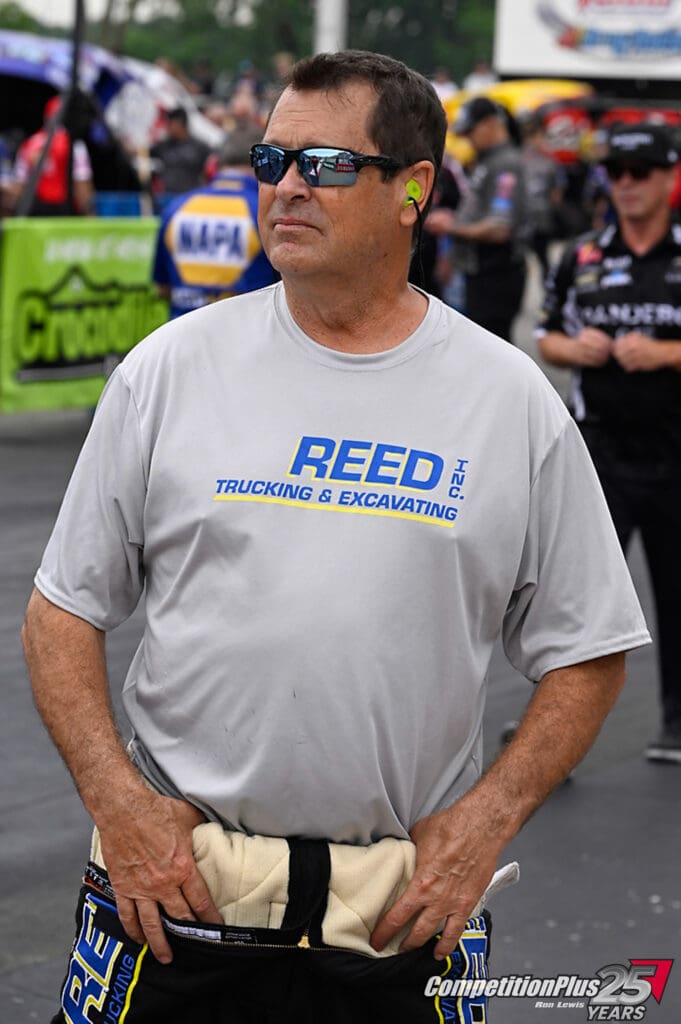
Wendland talked last with NHRA’s Tech Department approximately six months ago. He showed them exactly what he did to Reed’s car. Officials looked at it and agreed to “talk about maybe mandating some tethers on there. They had some drawings and stuff like that, and then boom, it’s gone,” he said. “The subject has been dropped. Now, are they still exploring it behind the scenes? Maybe. They damn sure haven’t told me.
“I feel like you got to be proactive, but in the moment when cars aren’t seeing a safety issue, then we’re more relaxed on being proactive about doing some of that,” he said.
Has Goodyear ever explained what happened with the tire here last year in qualifying?
Reed made a storybook comeback, winning an IHRA race near Columbus, Ohio, that was designed to be simply a test run to see how he would adapt to the steering wheel and car following the amputation of his left index finger. Then the next week at Pennsylvania’s Maple Grove Raceway, the former boat racer earned his first NHRA Top Fuel trophy with a victory in the Countdown opener.
“What that man has been through … with his recovery and running a business at the same time and keeping all of our guys employed … that tells you a lot about his character,” Wendland said.
Whatever the reason for the accident last July, the ordeal still evokes an emotional response from Reed. After reeling off a 3.837-mph elapsed time at a session-fastest 325.14 mph on the 1,000-foot course that put him second in the order to Shawn Langdon in that first time down his hometown dragstrip since 2025, Reed was emotional.
The native of Puyallup, Wash., who owns Tacoma-based Reed Trucking and Excavating, said, “I haven’t thought about this place until about a week ago. All my friends are here. My employees are here. It’s pretty dang weird, to tell you the truth. It’s been pretty emotional for me. But we’re here. The team’s here. We’ll go home in one piece, I promise you.”

















NHRA’S COUNTDOWN PROBLEM DIDN’T START WITH SHAWN REED, BUT HIS CASE EXPOSED IT