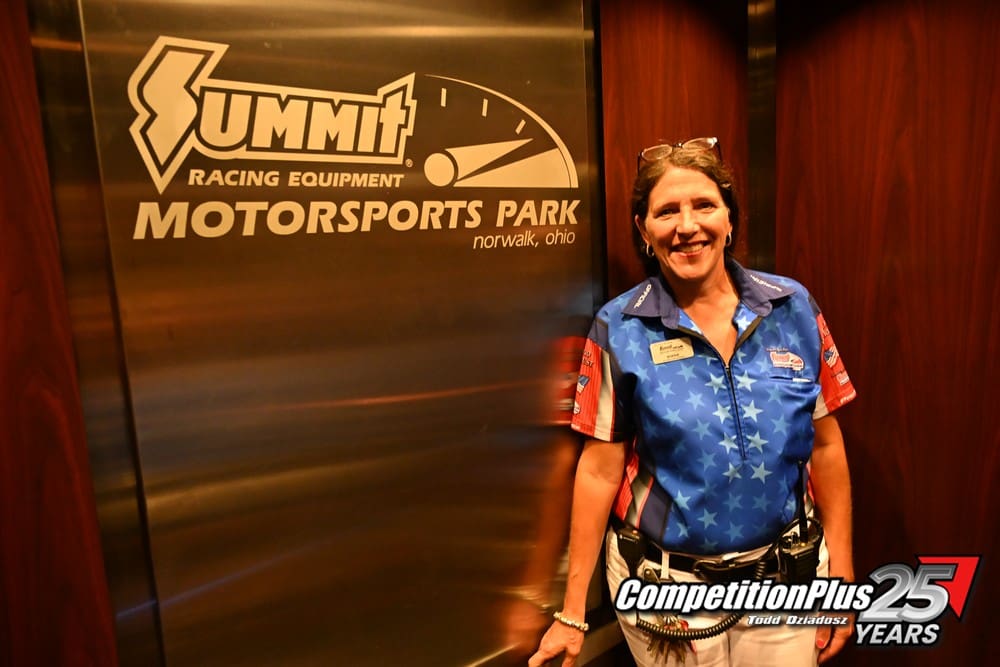
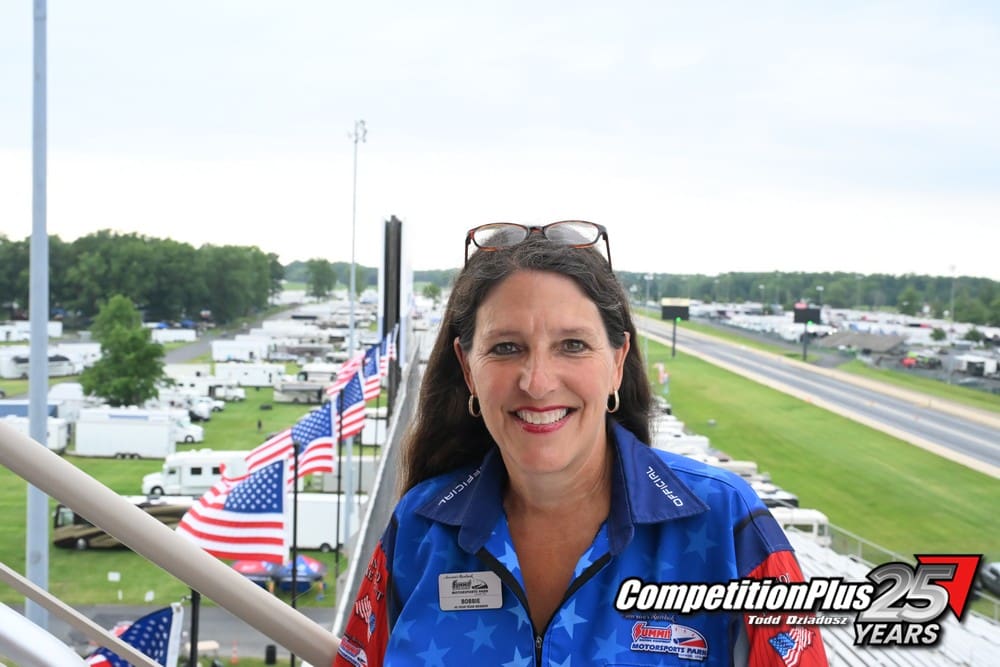

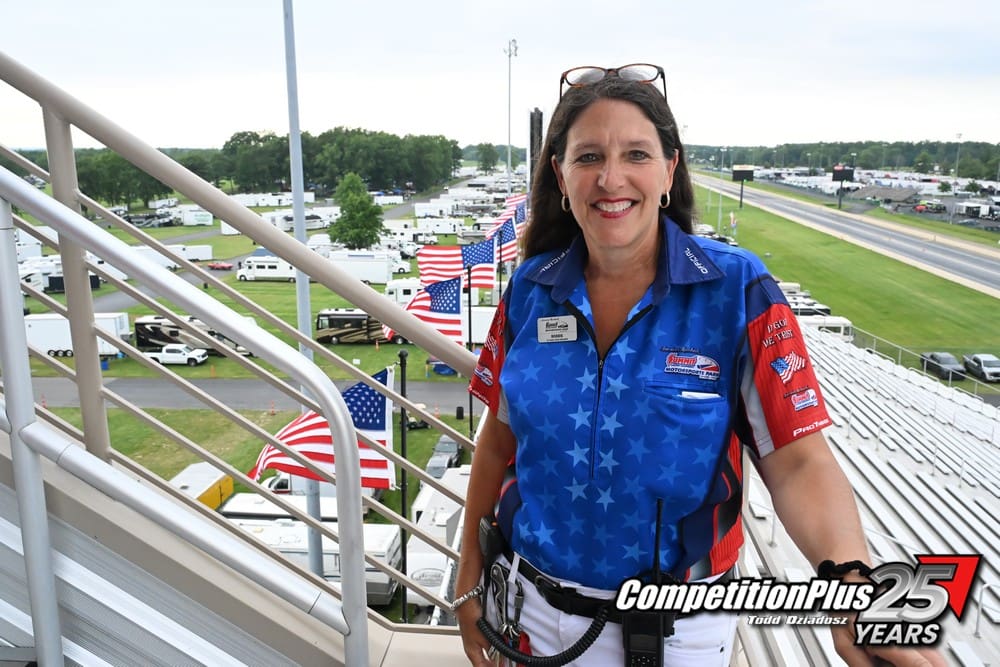
Spend five minutes with Bobbie Bader and something starts to feel familiar. It isn’t just the smile or the unmistakable resemblance to her late father, Bill Bader Sr.; it’s the way she sizes up a situation, finds a solution and somehow makes every person standing in front of her feel like they’re the most important person at the racetrack.
Those who knew Bill Bader Sr. recognize the resemblance immediately. It isn’t the smile that gives it away nearly as much as the way she treats people, because that’s how her father built Summit Motorsports Park into one of drag racing’s most respected destinations.
His daughter never set out to become a copy of her father. Instead, she grew up watching him until those lessons became second nature.
“Do what you say and say what you do,” Bader said. “So if you tell somebody you’re going to do it, by God, you better do it. That’s probably, that and you are only as good as you are flexible. He always said you have to be able to change on a dime and do this and do that. And there’s a lot of people in this world that are not flexible.
“I mean, you can script it out the best you can, but if you can’t be flexible and it throws your whole world off, that’s not good. And I think I’m both of those. If I tell you I’m going to do something I do and I think I’m as flexible as they come.”
Those two principles remain visible every time the gates open at Norwalk Raceway Park. While her brother, track owner Bill Bader Jr., oversees the business and operations, Bobbie has become the face many racers, sponsors and fans associate with the facility.
She doesn’t prep race surfaces or determine race-day schedules. Her responsibility begins long before the first pair leaves the starting line and often ends long after the final engine falls silent.
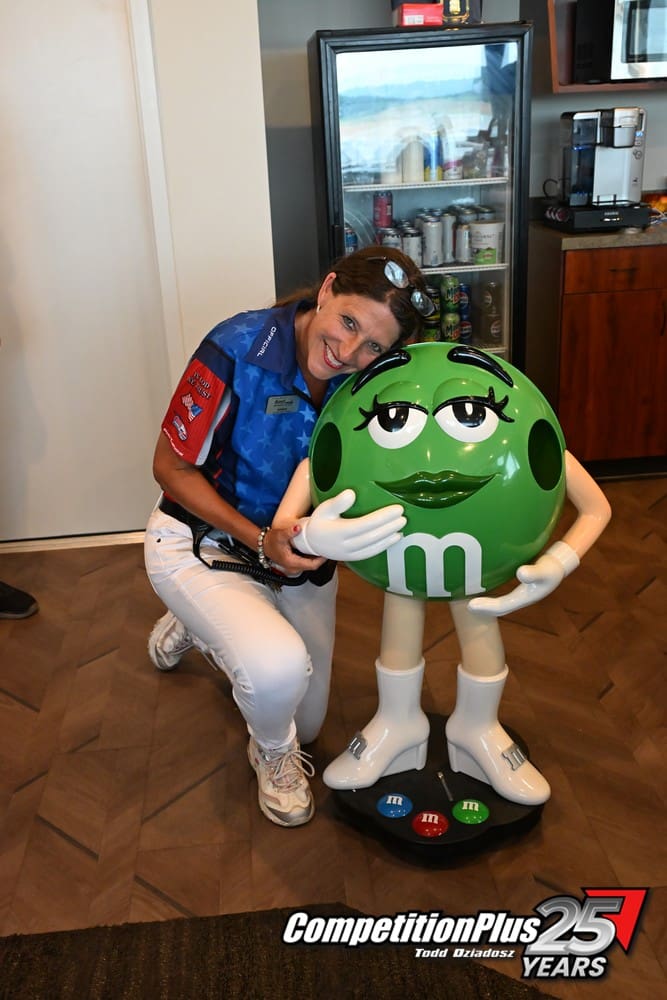
The facility’s iconic Night Under Fire event, scheduled for this weekend, may be remembered for jet cars, nitro, fireworks and overflowing grandstands. But in this instance, Bader is usually focused on something entirely different. She’s making certain a sponsor receives the return on investment they expected, ensuring hospitality guests feel appreciated, solving customer concerns before they become problems and creating an experience people want to repeat.
That role wasn’t assigned to her as it grew naturally from a personality her father recognized years before she did.
“I think probably the hardest thing is balancing taking care of my sponsors and taking care of the track,” Bader said.
She admits there are times when those priorities collide.
“I over-accommodate. I give everybody more than what they expect,” she said. “I’m trying to please my sponsors and keep my sponsors happy so they keep coming back.”
Her brother doesn’t disagree. Instead, the siblings have developed a working relationship that mirrors their personalities. They clearly know their roles and their prospective lanes to remain within.
“I feel I’m valuable, as the bridge between the racetrack and racers,” Bader said. “My brother’s more of a numbers guy and I’m more of a people person. So I was kind of that bridge, that gap.”
Bill Jr. has openly acknowledged that difference.
“He stood up there and said that at my dad’s funeral, that I got dad’s personality and all of his traits,” Bader said. “I love people, and I love coming out on race day talking to people and bringing them stuff. Bill, he’d be just as happy sitting in his office and doing the numbers. So I’m not a numbers person.”
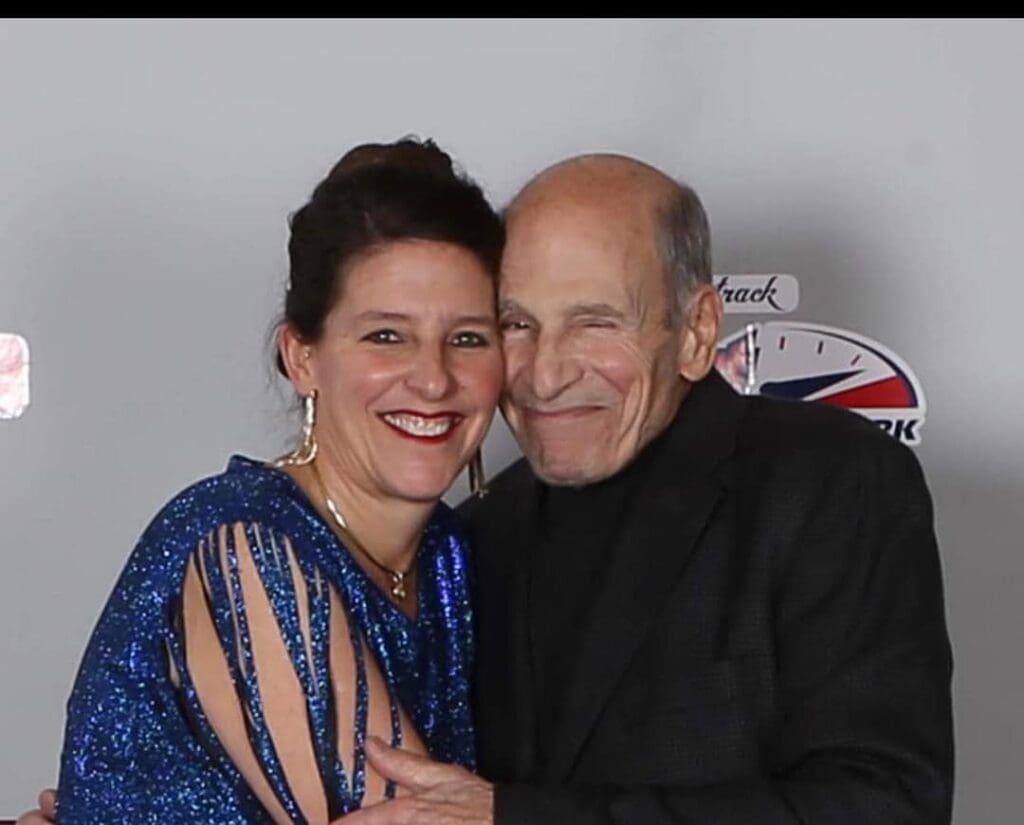
That contrast has become one of the family’s greatest strengths instead of a source of conflict.
“We always got along great,” Bader said. “We never had a problem.”
She credits that harmony to understanding where authority ultimately rested.
“I realized that he was the boss,” she said. “And if he said, ‘Paint those walls purple,’ whether I liked it or not, I was painting those walls purple.”
Long before she became one of the most recognizable ambassadors in drag racing, Bader was another kid doing whatever job needed to be done.
She started working at the track when she was only 9 years old, picking up trash, pulling time slips, working the ET shack and helping wherever adults pointed. Like every Bader child, she learned quickly that breathing generally qualified someone to work.
“If you were breathing, you went to work,” Bader said. “It’s not like these kids nowadays where they call in sick because they have cramps or they call in sick because they have a cold. I mean, growing up, if you were breathing, you went to work.”

That work ethic never left.
“I never miss work,” she said. “I just had a complete hysterectomy surgery June 4th, and I took one week off, and then I came back and worked at Cavalcade and worked the nationals, and I wasn’t even supposed to be back to work for six weeks.”
Her father also refused to let his children move directly into the family business. Instead, he insisted they experience the working world first.
“Dad never let us come straight to the track,” Bader said. “He made us go get a job in the world, and then come back to the racetrack. Which was probably the best thing because you got to see what else is out there, and not just coming straight to work in a family business.”
She worked at Donnelly’s, Midwest Industries, McDonald’s and even sold premium vacuum cleaners before returning full time nearly three decades ago.
“I finally said, ‘okay, I don’t have anything to prove. I can go back to the track,” she said.
One childhood lesson, however, still makes her shake her head. The boys in the family were encouraged to attend college. The girls were expected to marry and build their lives another way.
“We never got the option to go to college,” Bader said. “It was the guys went to college and the girls got married and had somebody take care of them, which is kind of very shallow thinking if you think about it.”
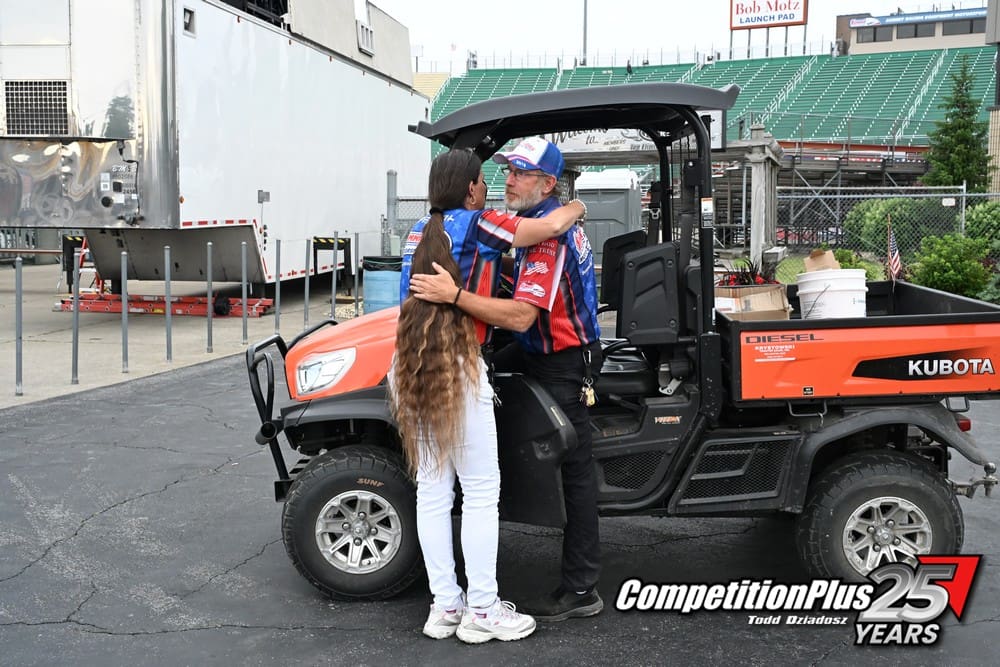
She doesn’t say it with bitterness as much as perspective. Life unfolded differently than anyone expected, and she has spent more years standing on her own than depending on someone else.
One conversation during her teenage years confirmed something Bill Bader Sr. already knew about his daughter. It also involved the biggest name in drag racing.
While working hospitality during an event, a young Bobbie caught the attention of John Force. He liked what he saw enough to offer her a job in California.
“John offered me a job, and I was thrilled,” Bader recalled. “I ran over and told Dad at the end of the night, and he was not impressed.”
Force had no idea the young woman he wanted to hire was Bill Bader Sr.’s daughter.
“He wanted me to go to California and wanted me to work for him,” she said. “Dad said, ‘Force, she’s my daughter. She’s hands off. She’s off limits.'”
The phone never rang Monday, just as Force had promised. For a teenager who thought one of the sport’s biggest stars had seen something special in her, the silence hurt.
“I was so upset because John told me, ‘I will give you a call Monday, and we will talk about a job,'” Bader said. “When I didn’t hear from John, I thought my world was crushed.”

Her father wouldn’t let the story end that way.
“So my dad called John and said, ‘You told her you would call her. You owe her a phone call,'” she recalled. “John called me and said, ‘I’m sorry, I can’t hire you. I didn’t know you were Bill’s daughter.'”
Years later, she understood exactly why her father protected her. At the time, she only saw a dream disappearing. Time changed her perspective. What once felt like a missed opportunity eventually became proof of how strongly her father believed she belonged at Summit Motorsports Park.
That confidence never disappeared.
“My dad believed in me more than anybody in my entire life ever has or ever will,” Bader said. “He was my biggest fan.”
Whenever she questioned herself, her father supplied the answer before she finished asking.
“If I wanted to do something, he’d say, ‘Figure it out.’ And he said, ‘I know you will.’ He called me Bobber.”
Those words became more than encouragement. They became the foundation for the confidence she carries today.
“I think that’s part of where I get my drive and my determination because I grew up thinking I can do anything,” she said. “I’d raise my son to never say you can’t. You can do anything that you want if you want to do it. And that came from my dad.”
The relationship extended well beyond business. When her parents divorced, Bobbie made certain the distance never affected her relationship with her father.
“If I wanted to see my dad, I had to come to the track,” she said. “I used to bring my dates out in my prom dress and in their tuxedos to go to prom just to get a picture with my dad before we went to a dance.”
Those moments are ones she will always cherish.
“I tried every way in the world to make sure that my dad was a part of my life,” she said. “I wasn’t going to let that relationship fade away.”
Then came the day no child wants to face. When Bill Bader Sr. passed away, the place he loved suddenly became the place that reminded everyone what had been lost.
“It was very hard,” Bader said. “It was very hard that first day coming back after he passed away.”
Eventually, her grief gave way to a bigger purpose.
“After a while, it started to be like I could find comfort in being here because my dad worked so hard to build this and to make it what it is today,” she said. “I love people telling me stories about my dad. That helped more than what anybody knows.”
Her father’s greatest lesson wasn’t about promoting races. It always returned to the same baseline which was about treating people as they were important.
“My dad always preached to us that your customer is king,” Bader said. “Without them being your customer, they would be somebody else’s customer.”

She has carried that philosophy into every sponsor meeting, every hospitality suite and every conversation with a fan who simply wants someone to listen.
“I always try to treat people the way that my dad would’ve,” she said. “If I can help somebody or give them an experience, or do something special for them, I try to do that.”
Customer service has become an overused phrase in business. At Norwalk Raceway Park, it remains a daily expectation.
“I compare everybody to our standards,” Bader admitted. “Customer service is off the charts here, and it’s not like that in the world.”
She still believes in the promise generations of race fans came to know as the Bader Guarantee.
“If they’re not happy for any reason, we’ll give them their money back,” she said. “I absolutely believe that.”
Ironically, the woman responsible for making sure thousands enjoy Night Under Fire rarely experiences it the way the average fan does.
Her office is wherever people need her.
Whether escorting sponsors to the starting line, coordinating hospitality or solving problems before they become complaints, she’s usually standing in the middle of the action instead of watching from the grandstands.
“I see, hear, smell…” Bader said. “I take sponsors out on the starting line. I’m standing between the nitro cars.”
She wouldn’t trade that view for any amount of money.
“I love the fireworks. I love how patriotic we are,” she said. “I get to witness all of that up front. I’ll take sponsors out in the center of the track that would never get to experience that any other way.”
Perhaps no one ever explained the Bader children better than Bill Bader Sr. himself. He had a favorite story that perfectly captured the personalities of each of his three children.
“My dad would say if there’s a wall with a million dollars on the other side of it, Bobber is going to hit that wall and hit that wall until she breaks that wall down getting to the other side,” Bader said. “He said Kelly’s just going to give up and do something else, while Bill’s going to fly an airplane over it and go over it rather than go through it.”