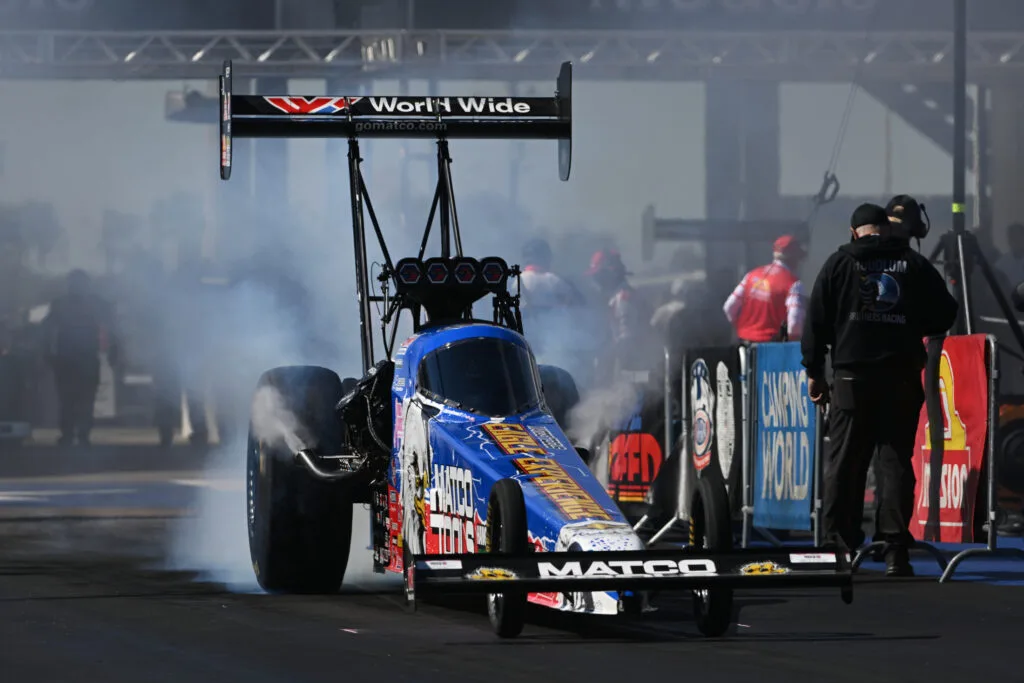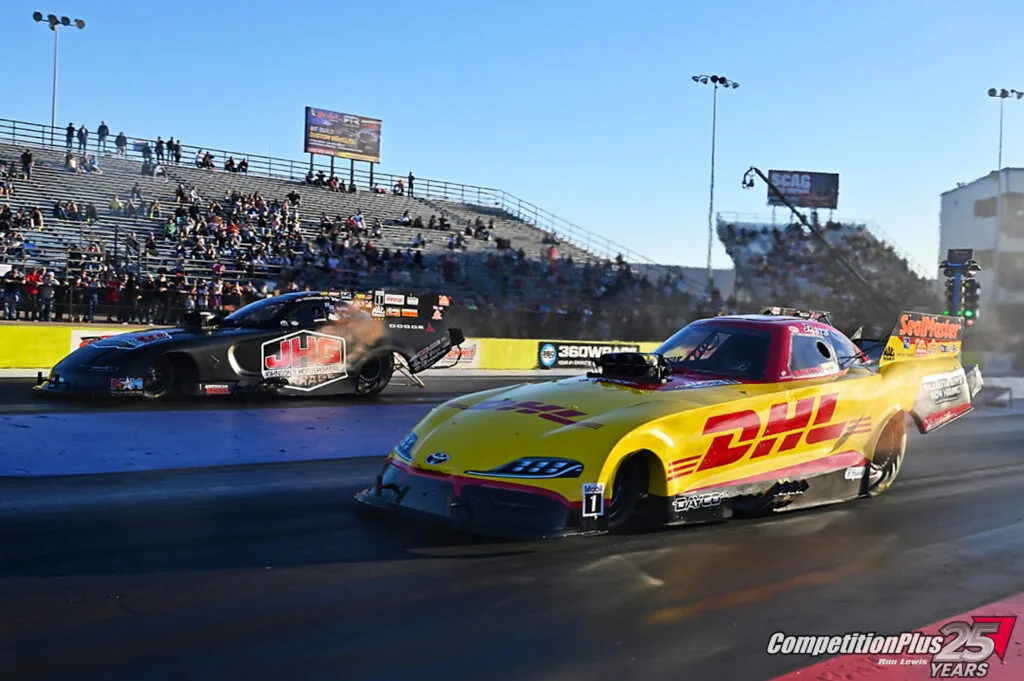
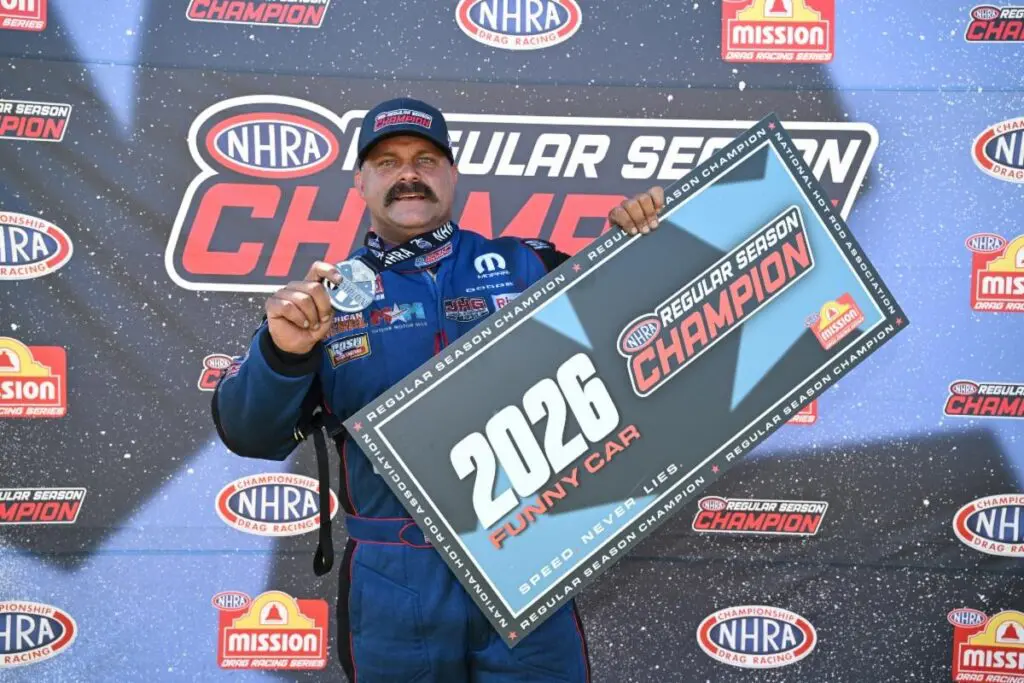


There was a time when Matt Hagan came to U.S. 131 Motorsports Park with considerably smaller concerns than championships, Countdown points and whether his Funny Car could run in the 3.80s.
Mostly, Hagan was trying not to set himself on fire.
Martin, Michigan, belonged to another lifetime for Hagan, back before the NHRA championships, before Don Schumacher Racing and before anyone looked at him as one of the established names in nitro racing. In 2008, he was still trying to figure out what in the world he had gotten himself into.
“I was just trying to learn to drive the car. It was ’08, you know what I mean?” Hagan said. “Golly, dude, that was cutting my teeth in a funny car. And I was so worried about what the car was going to do to me, much less what the racetrack had for me. I was still probably in here breathing, and fogging my visor up, and everything else, just trying to learn to drive one of these things and making sure I’m not setting myself on fire by pulling the pumps on and everything else.”
That pretty well describes Hagan’s early Funny Car education. There was no polished championship contender yet. There was a young driver learning nitro racing the way nitro racing has traditionally taught its hardest lessons: quickly, violently and occasionally with flames involved.
“The least I was worried about was what the racetrack had for me,” Hagan admitted. “I was worried about what the car had for me. But, how far we’ve come, and what a learning curve it’s been, and how the opportunities were from there to now, it’s like, oh, my gosh. You know what I mean? I would’ve never dreamed of being where I’m at today.”
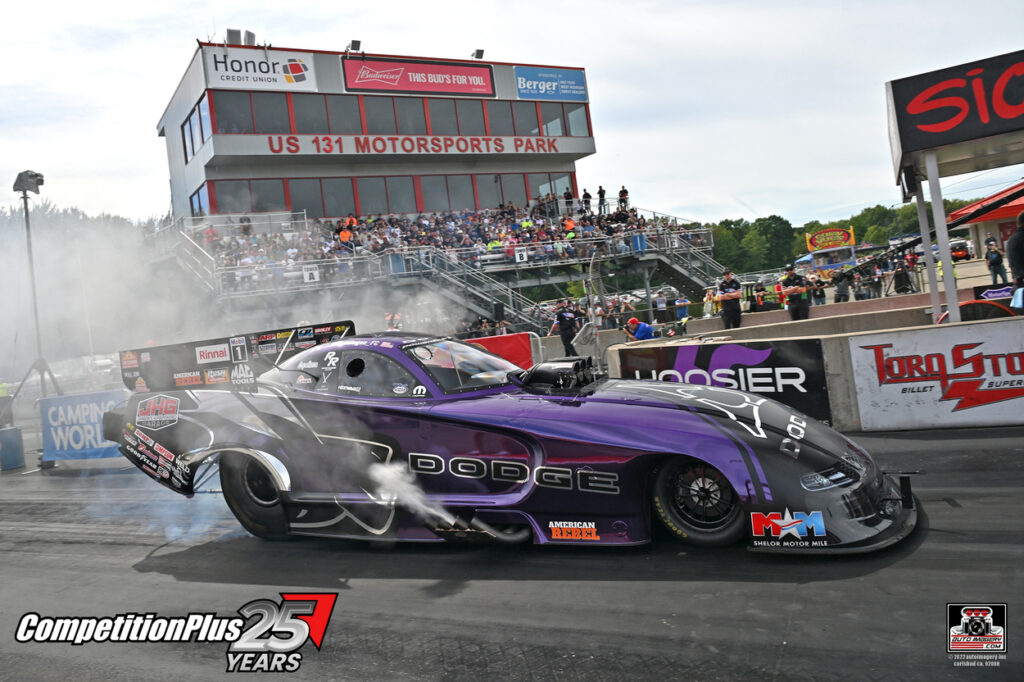
Hagan’s memories of U.S. 131 Motorsports Park are good ones, even if the race car sometimes did its best to make the experience otherwise.
What he remembers now is a racetrack that generally gave racers two good lanes and a surface capable of taking whatever a nitro team could throw at it.
“The facility was always great even back in those IHRA days,” Hagan said. “We always ran really well here and it was pretty good parity, the track, as far as left and right lane, was pretty equal. I don’t remember anything being crazy that stood out, where it was like a one lane racetrack.”
Of course, there’s the funny part.
Hagan can recognize all of that now. Back then, he probably wouldn’t have known the difference.
Left lane, right lane, good lane, bad lane, it was all secondary when the bigger concern was sitting directly in front of him. Hagan wasn’t studying the nuances of the racing surface in 2008; he was trying to figure out how to drive a nitro Funny Car that seemed perfectly willing to teach every lesson the hard way.
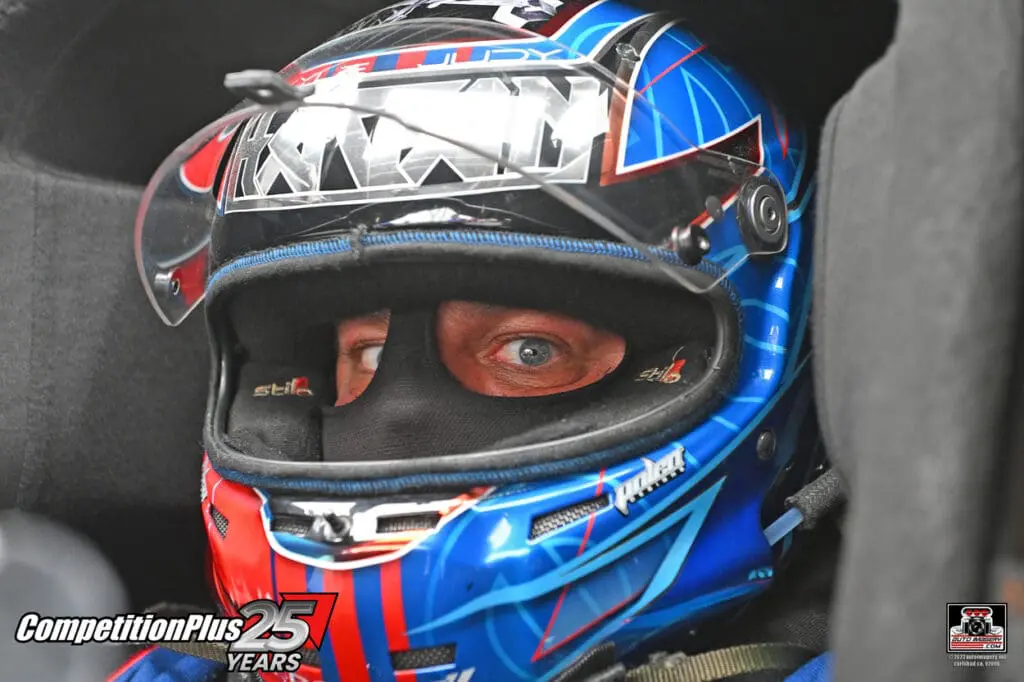
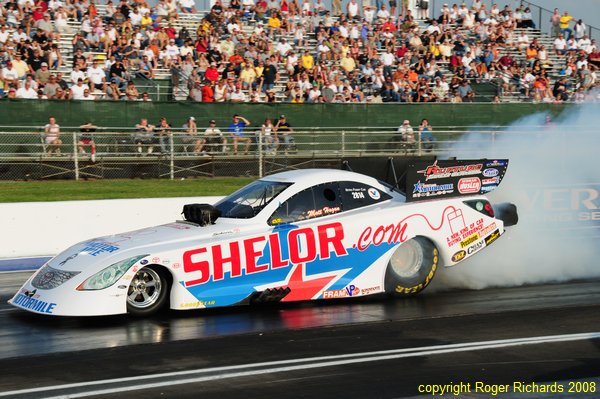
Hagan won three IHRA national events during the 2008 season and finished third in the championship. The part that still sticks with him is how he lost it: oildown penalties.
Hagan’s translation of an oildown penalty is considerably less detailed.
“I was on fire about every other run, man,” Hagan said. “And I think when you talk to Alex, my car chief, he kind of looks back and he remembers, he was like, dude, those IHRA days, he’s like, you earned your stripes. He’s like, that thing was on fire. It was blowing up on me. I remember we blew the freaking steering arm off of it. We took the heads off of it and the crank fell on the bottom of it. And it’s just like, you’re going like, what in the hell are we doing?
“I won more races in IHRA than anybody, but I lost the championship on oildowns. And Terry Haddock ended up winning the championship. And I think everybody else only won one race. We won three or four races, or something like that. And I was like, man, we’re doing this. But, dude, I was on fire every other run.”
There is the sanitized version of learning how to drive a nitro Funny Car and then there is Hagan’s version. His was apparently measured in burned parts, broken pieces and how often somebody had to clean up behind him.
“So, I lost it, as far as oildown points,” Hagan said. “But, when I say oildown points, it means that you’re on fire points. You know what I mean? So, it was definitely … I earned my stripes really early on with it and it got better and better. That’s why we’re still here.”
The funny part is Hagan wasn’t necessarily chasing some grand career plan when all of this started. He was racing, learning and trying to survive the experience with enough pieces left to come back and do it again.
“Just thought I was coming out here having fun and it turned into a career,” Hagan said. “And it’s just like, holy s***. Here we are. It’s like, wow. But, not that it didn’t set out to be that way, but I was just at the right place at the right time for a lot of those situations, and have had a lot of great sponsors around me.”
Those early cars didn’t exactly whisper encouragement.
“But, when you look back to just trying to cut my teeth in a nitro car, man, every run I was like, oh, my God, what have I got myself into?” Hagan said. “You’re warming it up every time thinking, ‘This is stupid.’ And it’s jumping off the ground on the jack stands and cackling back and forth.”
There was another problem. His father, who was paying the bills, was watching.
“But, you’re in that situation. And back then my pops were showing up at every event and I was just like, I can’t be a puss in front of him. I got to hit the gas,” Hagan said. “So, it’s kind of one of those things where it was fun, man. It’s still fun.”
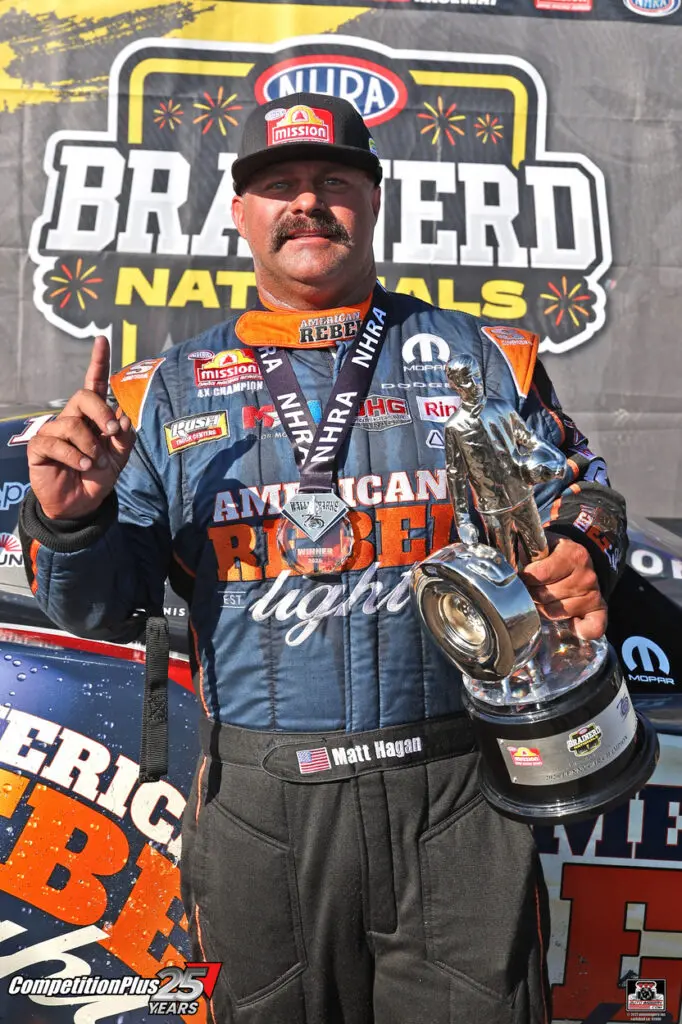
That might explain Hagan better than anything contained in a championship biography.
Nearly two decades later, Hagan returned to Michigan able to laugh at the kid who once fogged up his visor worrying about everything that could go wrong. The education eventually worked.
“I’ve been here all week with the headquarters, with Dodge, and warming up, and got to blip the throttle for the first time out there at the headquarters,” Hagan said. “And every weekend we show up, there’s something cool that’s going on. So, looking back at how far we’ve come and how much we’ve accomplished, but it takes those times back then to just go like, wow. We really didn’t know what the hell we were doing, at all.”
Hagan can afford to laugh about it now. He also has enough experience to recognize there remains a thin boundary between courage and doing something spectacularly questionable.
“Well, common sense, you know what I mean? And I’ve shown that I don’t have very much of it here with driving a nitro funny car, but at least with these things, when you click them off, they turn off most of the time,” Hagan said. “Most of the time, that ain’t all the time. But, with a bull, it ain’t no on-off switch. You know what I’m saying? So, at least here, we got that going for us. There’s at least an off switch with this thing.”
Somewhere between those 2008 trips to Martin and everything that followed, the Funny Car stopped being something Hagan feared and became something he understood.
And through all the fires, broken parts, championships and years that separated the Hagan who first came to Martin from the one who returned in 2026, something surprisingly survived intact.
“I think that’s what’s so cool about this sport is the fun has never gone away – 20 years later,” Hagan said. “Even though we’re really trying to run down our fifth championship here and really put ourself in that category with just John Force, it’s still been a pile of fun.”