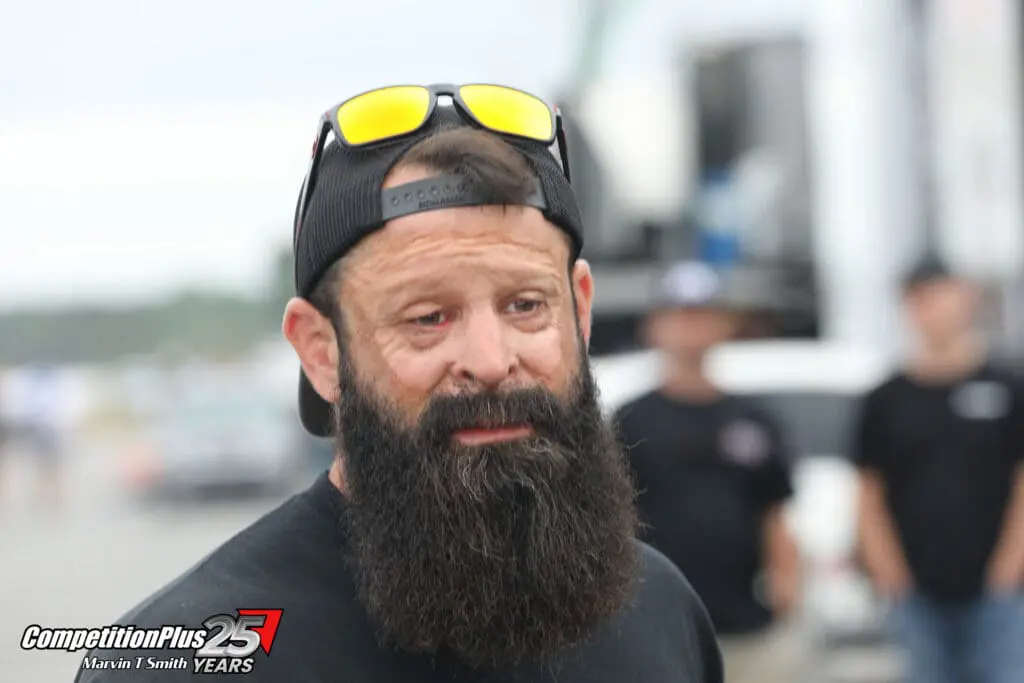


Lyle Barnett can be skimming channels on an off weekend, and if he happens across the 1993 Western classic Tombstone, there is a good chance the remote control has found its resting place. How much of the movie remains almost doesn’t matter.
The film told the story of Wyatt Earp, Doc Holliday and a collection of gunfighters whose reputations were often settled by who could draw first. Barnett spent Saturday at Bristol Dragway in a modern version where the weapons had superchargers, the duels lasted 660 feet and hesitation could get a racer sent home.
There was no Johnny Ringo waiting across the street. There were Ned Dunphy, Jason Harris, Fletcher Cox, Ty Tutterow and enough quick-reacting Pro Boost racers to make the O.K. Corral look considerably less dangerous.
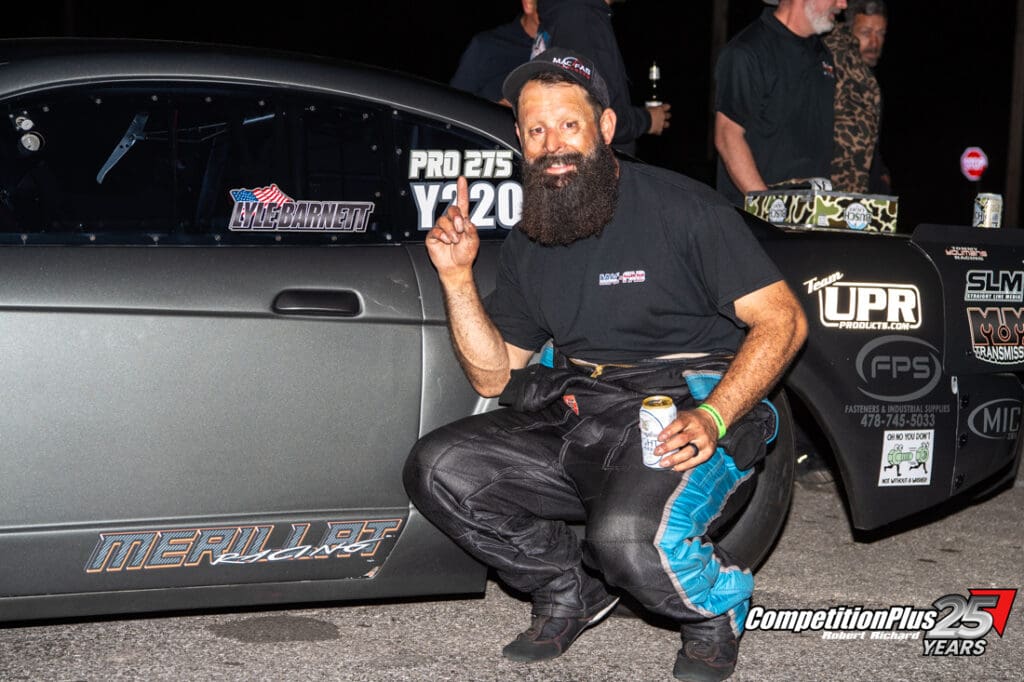
By the time Dunphy beat Barnett in the final round of the PDRA Thunder Valley Throwdown, Barnett had seen enough to know exactly what he had witnessed.
Somehow he struggled to find the right word to describe his experience.
“Dude, the PDRA has turned into a fricking… What do you call those things when you’re in the Wild West when you used to stand there and pull from the hip and whoever could quick fire the standoff… What do you call that?” Barnett said.
A gunfight.
“Yeah. Honestly, in my opinion, that is what the PDRA has turned into. I think it’s arguably the most competitive Pro Mod drag racing in existence. I’ve been a huge voice for the NHRA, and it is still one of the toughest places to win. NHRA Pro Mod is one of the toughest, but not a second place, unequal for sure is PDRA Pro Boost right now. It is fricking unbelievable how good the racing is and how on you have to be as a driver. Everybody. Now Ned, I’ll give it to Ned Dunphy, that dude drove an absolute star of a race. I mean, put on a clinic.”
Dunphy’s clinic ended with a .013 reaction time in the final and a 3.632-second pass at 207.08 mph. Barnett ran quicker with a 3.627 at 208.42, but his .029 reaction time surrendered enough at the starting line for Dunphy to reach the stripe first.
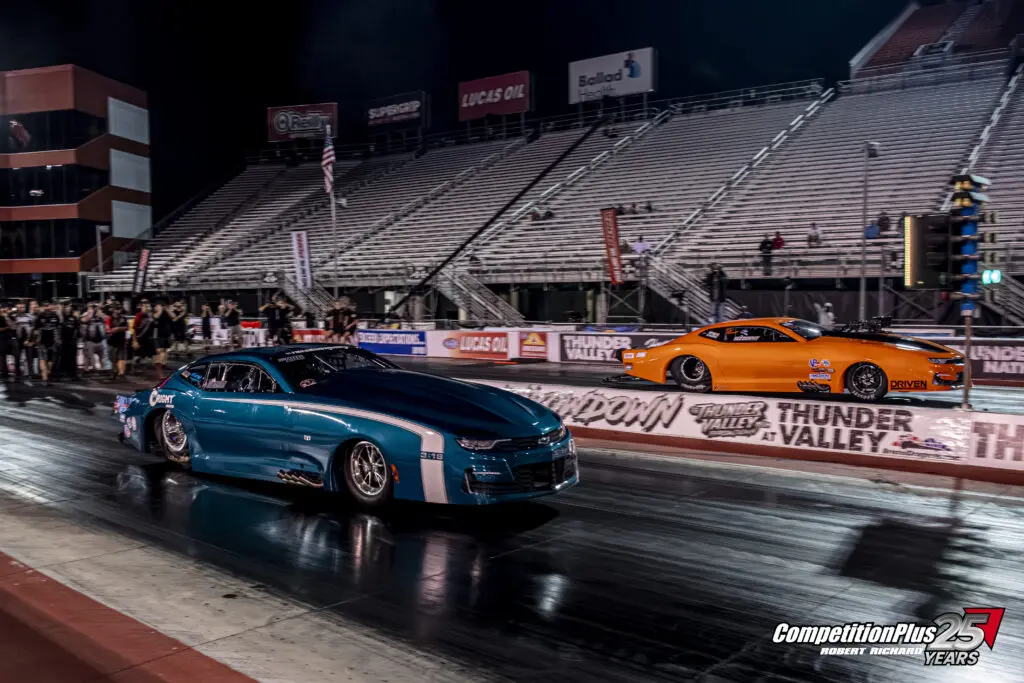
That was the kind of margin separating success from second place all afternoon. Barnett said a spark plug problem also dropped a cylinder during much of the final, but he wasn’t interested in using mechanical trouble to absolve himself.
“But I rolled enough in the box before the final that had I not rolled that in, I would’ve won. And we had a spark plug malfunction, one hole. It put one hole out at 0.8, and I was down a hole, really. I ran on seven, seven and a half because it actually came back towards the end of the run. But I lost number eight for the majority of the run. And had it stayed lit, I would’ve won. And everything has to be perfect. You have to absolutely kill it every time you go to the start line. It’s unbelievable.”
Barnett had spent most of the day doing exactly that.
He opened eliminations against Randy Weatherford with a .004 reaction time, close enough to the red-light side that Barnett admitted he considered it almost too good. Weatherford went red, and Barnett moved on knowing the starting line was going to become increasingly unforgiving.
“Yeah, sometimes it be like that. Out here, dude, that’s what it takes. Me and Lee spent a lot of time talking about the tuning on the delay box and that thing, and that was a lot closer than I though, but when I went to the wood there, the car rolled, I don’t know, probably two or three inches. And when you’re as close to the tree as I tend to be most of the time, that can get you too close. I consider anything better than .005 a bad job at red light. Nobody means to do that. I don’t care what they tell you on this thing.”
Barnett’s prediction that he would need to remain better than .020 proved remarkably accurate. By the second round, Cox’s .016 was the slowest winning reaction time among the racers who ultimately advanced to the semifinals.
Dunphy was perfect with a .000 light against Paul Gargan. The number that mattered to Barnett was the .000 itself, another warning that nobody in the class was waiting around for the other lane.
Barnett was .001 in his own second-round victory. Harris was also buried near the front edge of the starting-line window, while Cox’s .016 looked pedestrian only because of the company it was keeping.
“Yep. That’s what I was talking about. Ned was trip zip. I was .001. Jason was .007 and Fletcher was .016 to be the slowest. It’s stupid. I mean, it’s just absolutely insane.”
That is where the Western comparison stopped being decoration.
Pro Boost racing at Bristol wasn’t only about having enough horsepower to run in the 3.60s. The driver had to take almost everything the Christmas Tree would give him without stepping across the line into a red light, then hope the race car delivered exactly what the crew had asked of it.
Barnett understands that mentality because he came from small-tire grudge racing, where giving away the starting line can make the rest of the run academic.
“When you come from the small tire grudge style scene back home, you got to take everything you can get. And sometimes you got to go up there. And Randy’s a friend of mine. I love Steve Petty. All those guys over there are good friends of mine. But when we put them in the water box, ain’t nobody on the property I dislike more. So, got to go up there and cut their head off and make them earn it if they’re going to get it.”
That aggression carried Barnett to the final, but Dunphy eventually beat him at the part of the race Barnett takes most personally.
When Barnett reached the shutdown area and saw his 3.62 on the scoreboard beside Dunphy’s 3.63, he already knew how the math had worked. Only one word properly summed up his feelings.
“Disgust.”
Barnett keeps an unusually precise mental inventory of those losses. He said Bristol became only the fifth time in eliminations during his career that an opponent had beaten him on a holeshot.
“Because I can see the scoreboards. And I immediately look up and see I went .62. And I look over and see he went .63, and I knew. Because I know in eliminations, I’ve been beat on a holeshot five times in my entire career. I know who it was, and I know every racetrack it was at. I can tell you right this second.
“I lost to Ron Rhodes on a holeshot in a Leaf Spring… South Georgia. I lost to Matt Bell on a holeshot in Limited Drag Radial in Memphis. I lost to J.R. Gray on a holeshot at the Gatornationals in my rookie season. I lost to Nick LaCerenza on a holeshot in Alabama this year in Pro 275. And I just lost to Ned Dunphy in the final round at Bristol on a holeshot.”

The loss bothered Barnett because reaction time has long been one of the pieces of his driving he expects to control. A .029 light would be respectable in plenty of categories, but Bristol had already established that respectable wasn’t going to collect the trophy.
“I know them all. And every one of them make me as disgusted… Because, Brett, I’m known for that. I’m known to be a good leaver. A large percentage of the time I leave first no matter what, whether I’m the faster or slower car. Most of the time I’m first to leave the starting line. And in a time like that when it matters… And granted, we had a parts malfunction. They still gave me a car that was faster than my opponent, and I was late.”
Barnett wasn’t alone in watching a quicker race car lose from behind at Bristol. Marcus Butner defeated Tommy Franklin on a holeshot in the Pro Nitrous final, giving the PDRA two premier Pro Mod-style eliminator finals decided by what happened before the cars had traveled a foot.
“I wish, I had some conversations today, that we could explain to the fan out there how awesome that is, how good the racing… That’s some of the best racing I’ve ever seen, collectively. I mean, you look at Pro Street, Super Street, Pro Nitrous, Pro 632, Pro Boost. Across the board, it was badass. Both Pro Mod final rounds were won on a holeshot, both of them. Marcus Butner over Tommy Franklin and Ned over me. It’s just crazy, man. It’s fricking insane how good the racing is.”
Barnett left Bristol without the 660 Man, but also without any temptation to soften his opinion of the competition. If anything, losing the final reinforced it.
He has raced NHRA Pro Mod, small-tire cars, grudge combinations and enough different machinery this season to approach 300 runs in 16 cars. What he saw in Bristol’s Pro Boost field still got his attention.
The next person who views PDRA Pro Boost as a convenient place to get acquainted with Pro Mod racing may want to hear Barnett’s warning first.
“Saying you’re going to go to NHRA racing or whatever, and you’re going to come to PDRA and get your feet wet, come on. You’ll drown. Come on.”