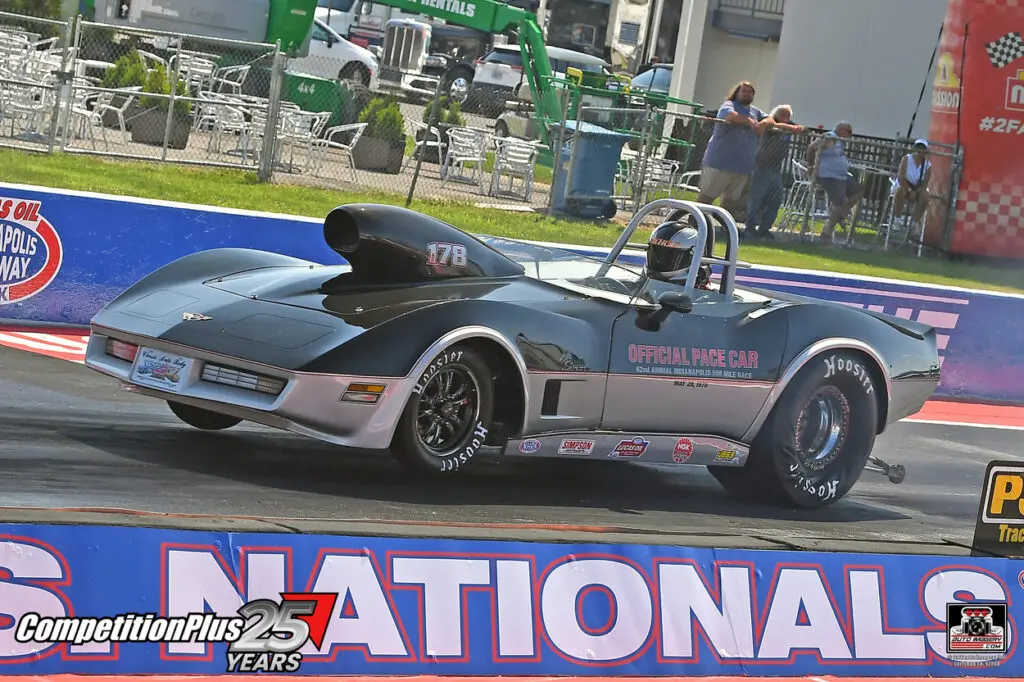
There’s one thing about Earl Nichols’ Super Gas roadster. His machine looks fast while sitting still, and old pace cars seem to have that effect.

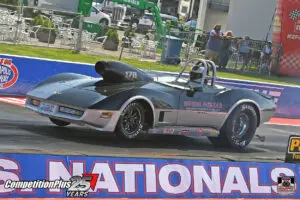
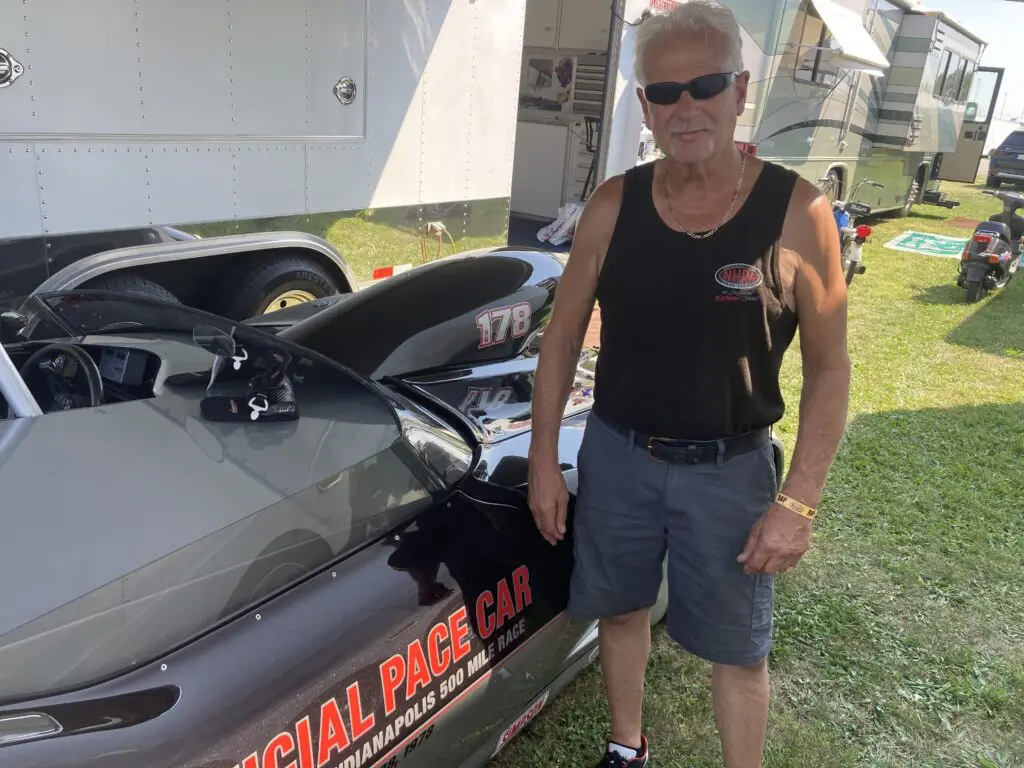
Nichols’ 1978 Corvette roadster, adorned in Indianapolis 500 Pace Car graphics, is one of those cars that grabs attention in the largely similar Super Gas division. There’s only one problem with the assumption most people make when they see it.

It was never a pace car.

“It’s a real race car, that whole body comes off,” Nichols said. “It’s all tubular chassis, but it is the exact configuration of a real car.”

Nichols, who lives in Fair Hill, Maryland, acquired the Corvette from friend Dave Graytag, a Wilmington, Delaware, Chevrolet dealer who once raced NHRA nitro coupes. Graytag drove the then-roofed Corvette to street rod shows with a supercharged engine before Nichols traded a paint job and some money for it.

Nichols eventually transformed the car as roadsters became more practical for Super-class racing, where visibility at the finish line can be critical. Tom Goldman of Auto Race Specialties handled the tinwork and roll cage, while Classic Auto Body in Wilmington worked on the body.
The result is something Nichols believes stands alone among Corvettes of the 1978-82 body style.

“There’s a lot of Corvette Roadsters, but this is the only one I’ve ever seen that is of this style,” Nichols said.

earl nichols 01

The Corvette still incorporates legitimate production pieces, including a Corvette rear body panel, hood and bumpers, wrapped around its race chassis. Nichols even retained working doors. Its Indianapolis Pace Car appearance came later.

Nichols previously raced the Corvette in pearl white with candy-colored flames, including an appearance at the U.S. Nationals 50th anniversary 25 years ago. He made it to Monday eliminations before losing to Ray Conley in the opening round.

After years racing it with the roof, Nichols decided visibility won out over originality and converted it into a roadster. Following a crash at Englishtown during the track’s final season, he rebuilt the front end and eventually repainted the car.

The pace-car treatment was almost an experiment. The reaction convinced him to keep it.

“When everybody in the lanes was coming over, looking at it and a lot of people have stopped, it’s been a pretty neat experience that everybody just seemed to be thrilled with it,” Nichols said. “So that’s cool. There’s a lot of beautiful cars here, so that makes a difference if the other racers think it looks nice too.”

Not everyone gets the joke.

“More than one,” Nichols said when asked how many people have questioned cutting up an original pace car. “I’ve had older gentlemen screaming at me at Maple Grove in the staging lanes, ‘Why would you cut a pace car up?’ But they never made a convertible pace car.

“So if they really knew what they were talking about, they would know that wasn’t true.”

EarlNichols Wedesday USNationals 26 01

Share the Insights?

Click here to share the article.

ad space x ad space

ad space x ad space

Competition Plus Team

Since our inception, we have been passionately dedicated to delivering the most accurate, timely, and compelling content in the world of drag racing. Our readers depend on us for the latest news, in-depth features, expert analysis, and exclusive interviews that connect you to the sport’s pulse.

Sign up for our newsletters and email list.

This field is for validation purposes and should be left unchanged.
Name

NICHOLS’ SUPER GAS CORVETTE LOOKS LIKE AN INDY PACE CAR — BUT DON’T CALL IT ONE

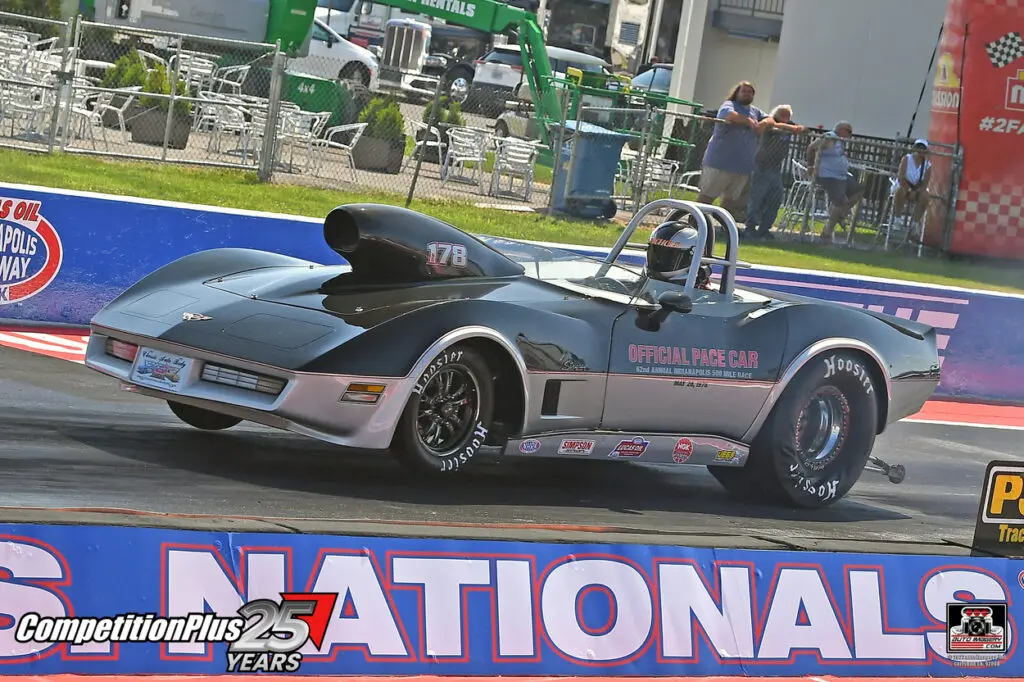
There’s one thing about Earl Nichols’ Super Gas roadster. His machine looks fast while sitting still, and old pace cars seem to have that effect.

Nichols’ 1978 Corvette roadster, adorned in Indianapolis 500 Pace Car graphics, is one of those cars that grabs attention in the largely similar Super Gas division. There’s only one problem with the assumption most people make when they see it.

It was never a pace car.

“It’s a real race car, that whole body comes off,” Nichols said. “It’s all tubular chassis, but it is the exact configuration of a real car.”

Nichols, who lives in Fair Hill, Maryland, acquired the Corvette from friend Dave Graytag, a Wilmington, Delaware, Chevrolet dealer who once raced NHRA nitro coupes. Graytag drove the then-roofed Corvette to street rod shows with a supercharged engine before Nichols traded a paint job and some money for it.

Nichols eventually transformed the car as roadsters became more practical for Super-class racing, where visibility at the finish line can be critical. Tom Goldman of Auto Race Specialties handled the tinwork and roll cage, while Classic Auto Body in Wilmington worked on the body.
The result is something Nichols believes stands alone among Corvettes of the 1978-82 body style.

“There’s a lot of Corvette Roadsters, but this is the only one I’ve ever seen that is of this style,” Nichols said.
earl nichols 01

The Corvette still incorporates legitimate production pieces, including a Corvette rear body panel, hood and bumpers, wrapped around its race chassis. Nichols even retained working doors. Its Indianapolis Pace Car appearance came later.

Nichols previously raced the Corvette in pearl white with candy-colored flames, including an appearance at the U.S. Nationals 50th anniversary 25 years ago. He made it to Monday eliminations before losing to Ray Conley in the opening round.

After years racing it with the roof, Nichols decided visibility won out over originality and converted it into a roadster. Following a crash at Englishtown during the track’s final season, he rebuilt the front end and eventually repainted the car.

The pace-car treatment was almost an experiment. The reaction convinced him to keep it.

“When everybody in the lanes was coming over, looking at it and a lot of people have stopped, it’s been a pretty neat experience that everybody just seemed to be thrilled with it,” Nichols said. “So that’s cool. There’s a lot of beautiful cars here, so that makes a difference if the other racers think it looks nice too.”

Not everyone gets the joke.

“More than one,” Nichols said when asked how many people have questioned cutting up an original pace car. “I’ve had older gentlemen screaming at me at Maple Grove in the staging lanes, ‘Why would you cut a pace car up?’ But they never made a convertible pace car.

“So if they really knew what they were talking about, they would know that wasn’t true.”

EarlNichols Wedesday USNationals 26 01
Picture of John Doe

John Doe

Lorem ipsum dolor sit amet consectetur adipiscing elit dolor

More Posts

Send Us A Message

Picture of Bobby Bennett
Bobby Bennett
Thank you for joining us on this journey. Your support and trust inspire us every day to deliver the best in drag racing journalism. We are excited about the future and look forward to continuing to serve you with the same dedication and passion that has defined CompetitionPlus.com from the very beginning.

Don’t miss these other exciting stories!

Explore more action packed posts on Competition Plus, where we dive into the latest in Drag Racing News. Discover a range of topics, from race coverage to in-depth interviews, to keep you informed and entertained.